

A warehouse manager spots a brown stain over the same aisle after every hard southerly. The roof sheets get blamed first. On commercial roofs, the repeat offender is often a poorly detailed junction around a penetration, parapet, curb, box gutter, or wall abutment. That is where roof flashing either keeps the building dry or lets water into the structure.
In NSW commercial and industrial work, flashing is part of the roof waterproofing system, not a cosmetic finish. If it is wrong, water can reach insulation, ceilings, switchboards, stock, plant, and tenant fit-outs long before the leak shows up inside. The cost is rarely limited to a small patch repair. Owners end up paying for downtime, damaged materials, access equipment, safety controls, and another round of call-outs to chase the same defect.
Commercial roofs also carry risks that generic residential advice does not cover. Long metal runs expand and contract. Coastal and industrial sites accelerate corrosion. Warehouses, factories, retail centres, and strata complexes have more penetrations, more rooftop traffic, and more interfaces between trades. On older NSW sites, you can also be dealing with fragile substrates or asbestos-containing materials, which changes how inspection, access, and replacement work must be handled.
If you are tracing a recurring ingress point, start with a proper roof leak detection process for commercial buildings. Lasting results usually depend on whether the flashing has been designed, fabricated, and installed to suit the roof system, the building movement, and the compliance requirements on that site.
I have seen plenty of roofs where the main sheets were still serviceable, but failed flashing details turned a manageable maintenance item into a capital works problem. Done properly, flashing protects the roof asset, reduces avoidable maintenance, and helps owners avoid the bigger costs that come with water entry in occupied commercial buildings.
Table of Contents
- Why Roof Flashing Is Your First Defence Against Water Damage
- Understanding Roof Flashing Types and Their Applications
- Choosing the Right Flashing Materials for Commercial Roofs
- A Professional Roof Flashing Installation Process
- Navigating Compliance and Safety in Commercial Installations
- Inspection Maintenance and Common Failure Modes
- Selecting a Qualified Commercial Roofing Contractor
Why Roof Flashing Is Your First Defence Against Water Damage
A commercial roof rarely fails in the middle of a sheet. It fails where water is asked to change direction, slow down, pass around a penetration or discharge into another component. Flashing controls those moments. When it's designed and installed well, water sheds cleanly and the roof system behaves the way it should. When it's wrong, even a newer roof can leak.
That matters more on commercial and industrial sites because the damage spreads beyond the roof build-up. Water can reach pallet racking, tenant fit-outs, switchboards, suspended ceilings, insulation and internal wall systems. In strata and multi-tenancy properties, one failed flashing detail can trigger disputes about maintenance responsibility, make-good works and access.
Small Metal Pieces, Big Asset Protection
Owners sometimes see flashing as a finishing item because it doesn't have the visual scale of roof sheeting or cladding. On site, that thinking causes trouble. A cheap cap, a rushed penetration detail or a badly lapped apron can undermine an otherwise solid roof package.
Practical rule: If a roof junction looks improvised, it usually performs that way.
On larger NSW sites, this becomes a total cost of ownership issue. Every reactive repair means access equipment, safety controls, labour, disruption to occupants and often some degree of internal reinstatement. It's almost always cheaper to build flashing properly the first time than to keep chasing leaks around the same weak point.
Commercial Conditions in NSW Expose Bad Details Fast
Industrial and commercial roofs don't get an easy run. Sheet movement, UV exposure, wind-driven rain, coastal salt, rooftop service trades and debris loading all test the weakest junctions first. Flashing sits right in that line of fire.
What works is simple in principle. Match the detail to the roof profile, the pitch, the penetration and the exposure of the building. Allow for movement. Make sure water can drain. Keep the installation compliant. What doesn't work is relying on excessive sealant, forcing a standard flashing onto a non-standard condition, or patching over corrosion without addressing the cause.
Understanding Roof Flashing Types and Their Applications
A warehouse roof can look sound at handover and still leak at the first decent storm because the flashing package was treated as an afterthought. On commercial and industrial sites, leaks rarely start in the middle of a roof sheet. They start at parapets, penetrations, valleys, curb upstands and terminations where water meets a change in direction.
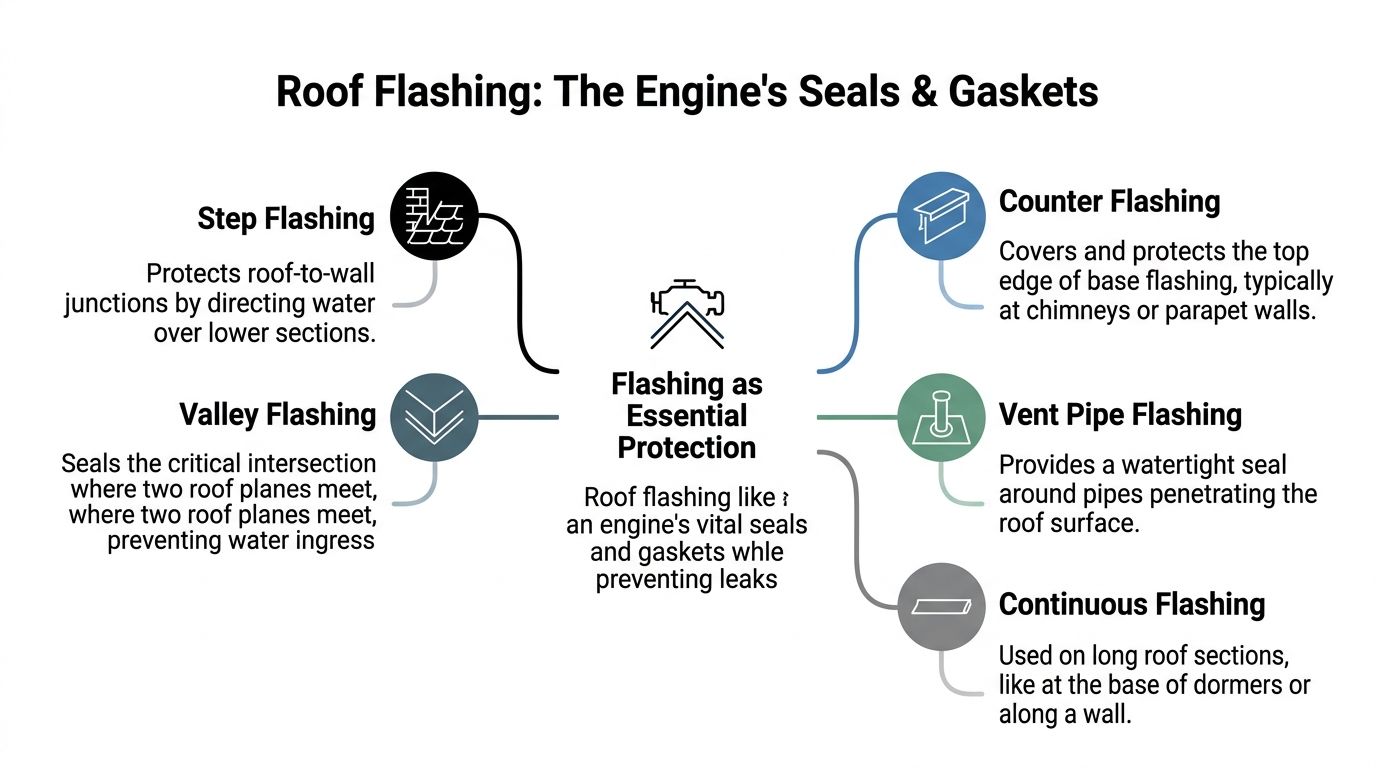
Flashing works like the seals and gaskets in a machine. The main roof system carries the span and takes the weather load, but the junctions decide whether the building stays dry. If those junctions are wrong, water tracks behind cladding, into insulation, around services and down into occupied areas.
Commercial roofs in NSW add another layer of complexity. Large roof areas collect and move more water. Service density is higher. Plant curbs, box gutters, firewall junctions, movement joints and compliance requirements all affect the detail. On older industrial sites, asbestos roof replacement or asbestos-adjacent work can also limit how flashings are removed, fixed and sequenced, which changes both cost and methodology.
Where Each Flashing Type Does Its Job
Some flashing types are visible from the ground. Others sit behind cladding or inside transitions and only get noticed after a failure.
- Step flashing is used where a sloping roof meets a wall. It sheds water back onto the roof covering in stages and suits conditions where a single long piece would be more vulnerable to movement and poor fit-up.
- Counter flashing covers and protects the top edge of base flashing at walls, parapets and masonry interfaces. In practice, this detail often decides whether water stays on the face of the wall or gets behind the system.
- Valley flashing handles concentrated flow where two roof planes meet. On commercial buildings, valley details also need to cope with debris, overflow pressure and maintenance traffic.
- Apron flashing is fitted at the downslope side of penetrations and vertical surfaces such as skylights, equipment curbs and upstands. Its job is straightforward. Discharge water cleanly back onto the roof surface without trapping it.
- Back tray or saddle flashing sits on the upslope side of a penetration or structure. It splits the water path and stops ponding against the back of the obstruction, which is a common leak point around larger rooftop plant.
- Ridge and barge flashings finish ridgelines and roof edges. On exposed sites, the profile, fixing pattern and closure details matter because wind-driven rain will test any gap.
- Drip edge flashing controls runoff at the perimeter and prevents capillary action from dragging water back into fascia lines, wall cavities or under the roof edge.
- Pipe and vent flashing seals around penetrations. On metal roofs, these details must suit the sheet profile and allow for thermal movement. A tight-looking install that fights movement often cracks, lifts or leaks early.
The right detail depends on water volume, roof profile, movement, access needs and what trades will be back on that roof later. A distribution centre with repeated service penetrations needs a different flashing strategy from a small office roof, even if both use metal sheeting.
That point matters in NSW commercial work because the failure cost is rarely limited to a simple patch. A bad penetration detail can mean wet insulation, damaged stock, plant shutdowns, tenancy disruption and arguments about whether the issue sits with roofing, mechanical or hydraulic works.
Owners comparing roof systems should also understand how the base metal affects flashing selection and maintenance. This guide to Zincalume and Colorbond differences for commercial roofing is a useful starting point, especially when matching new flashings to an existing roof.
On industrial roofs, shortcuts show up first around penetrations, parapets and boxed gutter interfaces. The roof can look tidy from the ground and still fail at every high-risk junction.
Good flashing design assigns each profile one job and details it properly for that condition. Problems start when one generic folded piece is forced to handle discharge, weatherproofing, movement and finish all at once.
Choosing the Right Flashing Materials for Commercial Roofs
Material selection isn't about picking whatever looks tidy in a quote. On commercial roofs, the flashing material has to suit the roof system, the environment and the building's maintenance strategy. If those three don't line up, the install might look acceptable on handover and still become a recurring problem.
Material Choice Changes the Maintenance Story
The wrong flashing material usually fails in predictable ways. It corrodes too early in coastal air. It reacts badly with adjacent metals. It distorts on long runs. It becomes difficult to maintain because replacement pieces never quite match the profile or finish of the original roof.
For NSW commercial projects, common choices include Colorbond, Zincalume, copper and zinc. Each has a place. The best choice depends on exposure, design intent, expected lifespan and whether you're matching an existing roof or building a new envelope around premium cladding.
If you're weighing standard metal roofing options, this breakdown of Zincalume vs Colorbond helps frame the conversation. For flashing, the same principle applies. Compatibility matters as much as upfront cost.
Commercial Flashing Material Comparison
| Material | Typical Lifespan | Relative Cost | Corrosion Resistance | Best For |
|---|---|---|---|---|
| Colorbond | Varies by environment and maintenance | Moderate | Strong when matched to the site conditions | Commercial roofs where colour match, profile compatibility and a consistent system matter |
| Zincalume | Varies by environment and maintenance | Lower to moderate | Good in many settings, but site exposure still matters | Industrial buildings where practicality and compatibility with existing metal roofing are priorities |
| Copper | Long service life when detailed properly | High | Excellent, with a natural patina over time | Premium architectural work, heritage contexts and visible high-end detailing |
| Zinc | Long service life when specified correctly | High | Strong, especially in the right design conditions | Architectural façades, premium parapets and projects where appearance and longevity both matter |
A few trade-offs matter more than owners expect:
- Coastal exposure: Salt changes the conversation. A material that performs well inland may not be the smartest option near the coast.
- Adjacent metals: Mixed-metal details need care. If materials aren't compatible, the junction can become the failure point.
- Profile fit: Flashing has to sit correctly on the actual roof profile, not just the nominal product family.
- Replacement planning: On active commercial sites, future maintenance access matters. Some bespoke details look sharp but are harder and costlier to repair later.
The best flashing material isn't the fanciest one. It's the one that suits the roof, the exposure and the way the building will actually be maintained.
For owners, the practical move is to ask why a material has been specified, what it's being paired with, and how it will perform on that site over time. If the answer is only about price, the specification probably isn't complete.
A Professional Roof Flashing Installation Process
A warehouse roof rarely fails all at once. More often, water starts at a poorly flashed penetration, tracks into insulation, stains ceilings, trips electrical faults, and shuts down part of the building before anyone finds the entry point. On a commercial site in NSW, that is not a minor defect. It is a maintenance cost, an operational risk, and in some buildings, a compliance problem.
Set-Out and Fabrication Matter More Than Most Owners Realise
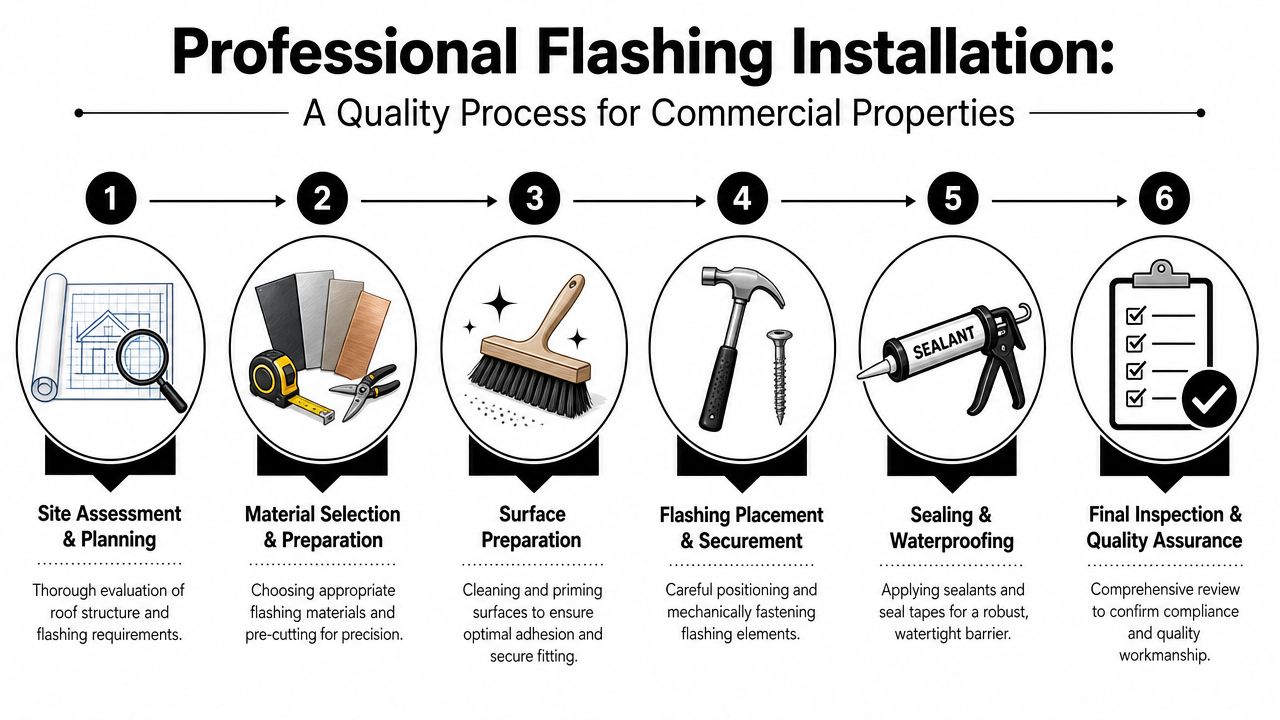
Good flashing work is decided before the first fixing goes in. On commercial and industrial roofs, drawings only tell part of the story. Steel lines can be out, penetrations can be shifted by other trades, and older roofs often have distortion, corrosion, or previous patch repairs that change the detail on site.
That is why experienced roofers measure the actual opening, the roof profile, the fall, and the surrounding sheet condition before fabrication. A flashing made to suit the roof will sit properly, drain properly, and need less sealant to compensate for bad fit. That matters even more on large buildings, where one bad detail can be repeated across dozens of penetrations.
Preparation is where patch jobs usually show themselves. Old mastics, failed flashings, loose fasteners, rust scale, and damaged sheet edges need to be removed or repaired first. If the substrate is unsound, the new flashing is being installed over a defect, not over a roof.
On older NSW industrial sites, asbestos adds another layer of risk. If the roof or adjacent wall components contain asbestos, the flashing scope has to be planned around licensed handling requirements, access controls, and safe work sequencing. Owners who skip that planning usually pay for it later in delays, variation claims, or contaminated work areas.
Fixing, Laps and Sealants Must Match the Roof System
Flashing details have to suit the roof system they are being installed into. Pipe penetrations in metal roofing, for example, need the correct profile match, a proper dry-pan arrangement, and sealants that will not attack the surrounding metal. Schnap's guide to pipe flashing for Australian metal roofs outlines the standard approach for these penetrations, including EPDM rubber bases, malleable aluminium support, appropriate fixing methods, and the use of neutral-cure silicone instead of acid-cure products.
That last point is missed far too often. Acid-cure silicone can start a corrosion problem that stays hidden until the flashing fails. The roof may look sealed on handover and still be deteriorating underneath.
Long runs need movement allowance as well. Commercial roofs expand, contract, and move under thermal load. If the flashing is locked up too tightly, it will stress at laps, deform at fixings, or split at corners. On distribution centres, factories, and plant buildings with long sheet lengths and high heat load, movement detailing is part of durability, not a finishing touch.
Quality Checks That Separate Proper Work from Patch Jobs
A properly installed flashing should manage water by shape and overlap first. Sealant supports the detail. It does not replace it.
Owners and facility managers can check a few practical indicators without getting into trade jargon:
Accurate fit to the roof profile
The flashing should sit flat, follow the sheeting correctly, and avoid forced bends or gaps at ribs and pans.Orderly fixings
Fasteners should be consistent in type, spacing, and placement. Random screw patterns usually mean the installer was correcting poor set-out.Clean laps and discharge points
Water needs a clear path off the detail. If laps face the wrong way or terminate into debris traps, leaks usually follow.Movement allowance where the run demands it
Long lengths should show that thermal movement has been considered in the design and installation.Proper integration with services
Mechanical, hydraulic, and electrical penetrations should be flashed as part of the roof system, not sealed as an afterthought.
I pay close attention to post-installation penetrations on industrial buildings. HVAC contractors, plumbers, and electricians often come in after the roofing package is finished. If their penetrations are cut in and sealed without proper flashing, the owner inherits a weak point that fails early and costs more to rectify once plant, ceilings, and internal finishes are in place.
The cheapest flashing job is rarely the lowest-cost result over the life of the building. Good installation reduces leak callouts, protects insulation and structure, and avoids disruption to tenants, stock, and operations. On commercial property, that is where the greatest value resides.
Navigating Compliance and Safety in Commercial Installations
On commercial sites in NSW, flashing work sits inside a larger compliance picture. Owners often focus on whether the leak stops, but the legal and risk side matters just as much. If the work isn't compliant, the building owner can end up paying twice. Once for the original job and again for rectification.
NCC Compliance Is Not Optional
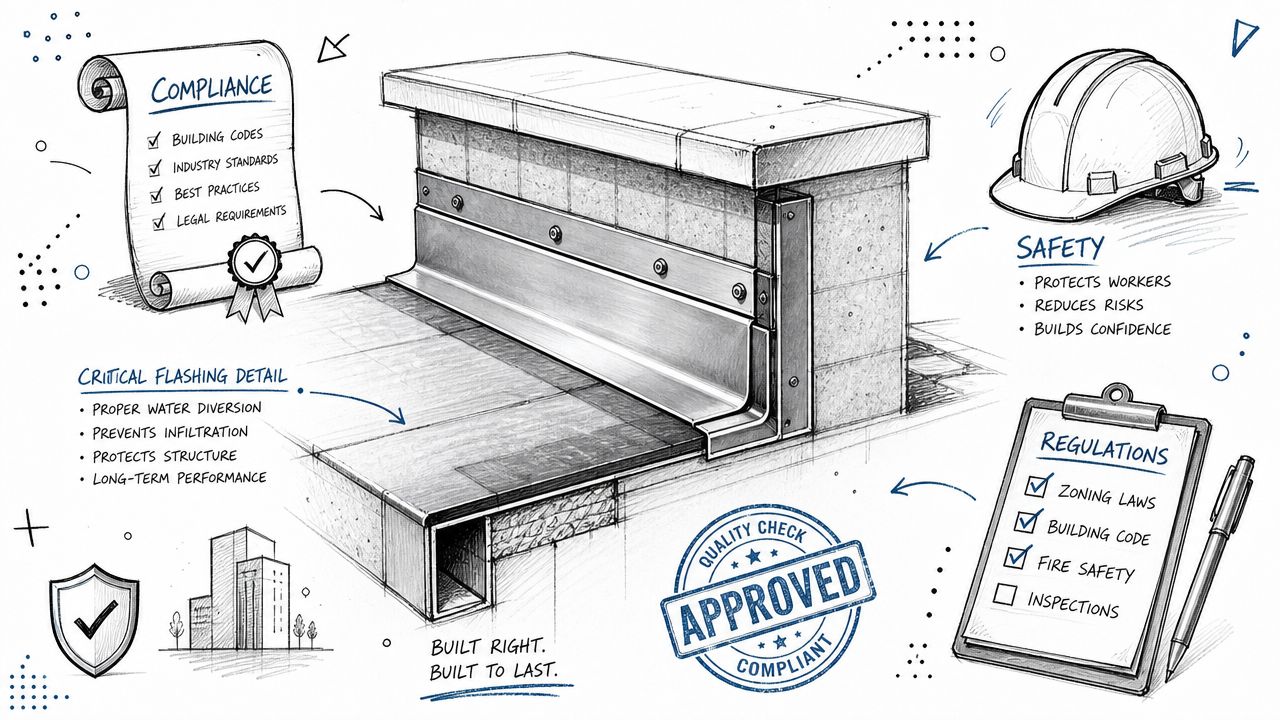
The National Construction Code mandates roof flashing under Clause 3.3.5.8. For compliant installation, flashing must extend 150mm on each side of an opening, turn up 150mm in the cavity, and joints must overlap by at least 75mm, according to this summary of NCC flashing requirements for Australian buildings.
Those aren't decorative details. They're minimum compliance markers intended to stop water ingress. On larger buildings, one non-compliant opening detail can affect internal wall systems, insulation, ceilings and finishes well beyond the immediate area.
The same NCC summary notes that failure to meet these requirements is a common cause of defects identified by bodies such as the QBCC. That lines up with what roofers see in the field. A lot of “mystery leaks” are non-compliant flashing details that should never have passed the first time.
Asbestos and High-Risk Roofs Need a Different Level of Control
Commercial and industrial roofing in NSW often involves older structures where asbestos is part of the existing roof assembly. In those cases, flashing replacement isn't just a metalwork job. It becomes a controlled removal and replacement exercise with strict safety obligations.
That changes the workflow completely:
- Access planning has to prevent unnecessary disturbance of the existing roof.
- Containment and handling procedures need to match the risk profile of the material being removed.
- Waste disposal must be managed correctly and documented.
- Sequencing with replacement works matters because exposed areas can't be left vulnerable to weather.
Working at heights is another major factor. Flashing is often installed right where the risk increases, at edges, penetrations, brittle roof sections and around plant. Professional crews manage edge protection, access systems, exclusion zones and trade coordination so the work is safe as well as watertight.
Compliance isn't paperwork after the fact. It starts with how the work is planned, accessed, installed and signed off.
For owners and strata managers, that's the difference between hiring someone to “patch the leak” and appointing a contractor who can manage legal exposure, occupant safety and durable performance at the same time.
Inspection Maintenance and Common Failure Modes
A commercial roof can look fine from the ground while water is already tracking behind a failed apron flashing, wetting insulation, staining ceilings, and shutting down part of a tenancy. By the time the leak shows inside, the flashing failure is rarely the only cost.
On commercial and industrial sites, flashing wears out faster than owners expect because it sits at the busiest points of the roof. Plant platforms, access hatches, service penetrations, gutters, parapets, and sheet terminations all see movement, foot traffic, and concentrated water flow. In NSW, that matters for more than weatherproofing. Once water gets into a roof build-up, owners can face damaged stock, disrupted operations, mould complaints, and arguments over whether the original work met code and manufacturer requirements.
What Fails First
The first failure is often small. The consequences are not.
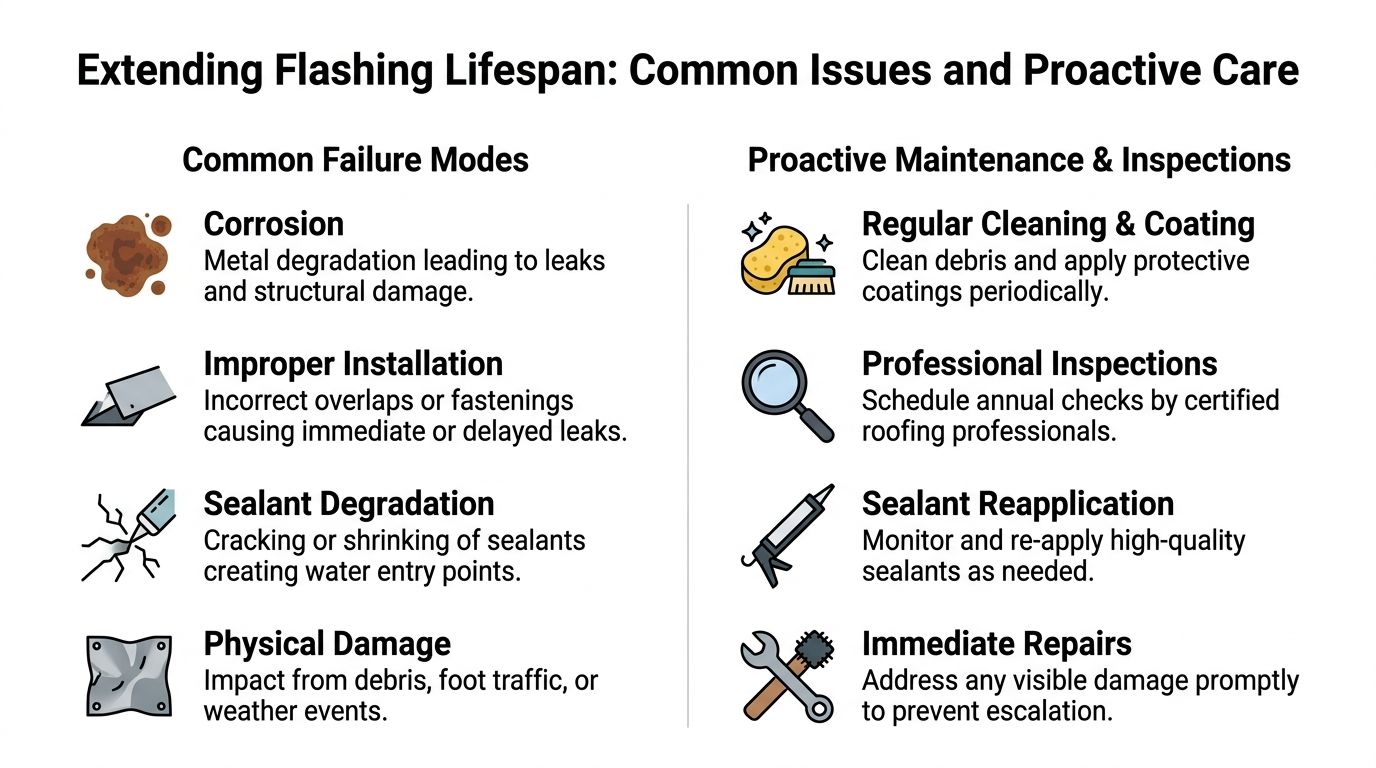
- Corrosion at cut edges, laps, and fixings usually starts where protective coatings were damaged during installation, where incompatible metals were paired, or where debris keeps the area wet.
- Sealant failure shows up as shrinkage, splitting, loss of adhesion, or hardening from UV exposure. It is common on details that rely on sealant to do the job of correctly formed metal.
- Movement cracks and loose fixings develop around penetrations, parapets, and long flashing runs where thermal expansion was ignored.
- Mechanical damage comes from HVAC crews, electricians, solar contractors, and maintenance staff lifting edges, denting pans, or refitting plant without restoring the waterproof detail.
- Poor original detailing appears as back-falls, open laps, short upstands, ponding against vertical faces, and patch repairs layered over failed substrate.
Surface patching has its place, but only in the right condition and usually as a short-term control. If the flashing is undersized, badly lapped, unsupported, or fixed through the wrong zone, another bead of sealant just buys a little time.
A Practical Inspection Routine
For most commercial roofs, flashing should be checked on a planned schedule and again after major weather events or any trade activity on the roof. High-risk sites need closer attention. That includes warehouses with frequent plant servicing, older factories, coastal buildings, and properties with brittle or aging roof sheets.
A useful inspection routine covers the areas that fail in service, not just the sections visible from the access point:
- Perimeters and parapets for lifted edges, failed cappings, loose cleats, and water tracking at terminations.
- Penetrations and equipment curbs for split seals, movement gaps, loose counterflashings, and signs of previous patching.
- Valleys, box gutters, and sump areas for debris build-up, corrosion, ponding, and overflow staining.
- Sheet laps and transitions where roof pitch changes or different materials meet.
- Post-trade checks after any mechanical, electrical, hydraulic, or communications work.
On larger sites, photos and condition notes matter. They create a maintenance record, help separate storm damage from contractor damage, and make it easier to justify targeted repairs before failure spreads. Owners comparing service providers should look for a contractor with documented inspection procedures and commercial roof experience. This guide to choosing a commercial roofer for inspections and ongoing maintenance is a useful starting point.
Failure Modes That Cost the Most
The expensive failures are rarely the obvious ones. A lifted edge flashing is easy to spot. Slow water entry behind a parapet, curb, or gutter apron can soak insulation and corrode concealed fasteners for months before anyone notices.
That is where total cost of ownership comes in. A scheduled flashing repair is controlled work. Internal water damage is not. Once moisture gets past the external detail, the bill can spread into ceiling replacements, electrical rectification, damaged inventory, tenant claims, and production downtime. On older NSW industrial buildings, the cost and complexity rise again if the roof system includes asbestos-containing materials and any remedial work has to be planned around safe disturbance controls.
Flashing maintenance is cheap compared with wet insulation, damaged interiors, and an emergency callout during trading hours.
The practical goal is simple. Find the small defects early, repair the actual cause, and keep the roof compliant and serviceable for the long term.
Selecting a Qualified Commercial Roofing Contractor
Flashing work looks simple until you see the cost of getting it wrong. On commercial roofs, you're not hiring someone to bend metal. You're hiring a contractor to protect a building asset, manage compliance risk and deliver details that will survive movement, weather and maintenance traffic.
Questions Worth Asking Before You Sign
A capable commercial roofer should be able to answer direct questions without ducking into vague sales language.
Licensing and insurance
Ask for current details and make sure the scope covers commercial roofing work, not just basic residential repairs.Relevant project experience
Warehouses, factories, strata complexes and healthcare sites all have different access, compliance and sequencing issues.Asbestos capability
If the building is older, confirm the contractor can lawfully and safely manage asbestos-related roofing work where required.Who does the work
In-house crews give you clearer accountability than a chain of unknown subcontractors.Warranties and scope clarity
Ask what is covered on materials and labour, and what assumptions the quote is making about existing roof condition.
For owners comparing firms, this guide on finding a commercial roofer near you is a practical starting point. The best appointment usually goes to the contractor who understands compliance, explains the detail clearly and doesn't pretend every leak can be solved with a quick bead of sealant.
Commercial roofs don't forgive poor junction work. If you need experienced help with roof flashing installation, leak repairs, asbestos roof replacement or full commercial roofing works across NSW, Commercial Roofers provides licensed, insured, in-house expertise with a strong focus on safety, compliance and long-term performance.