

You've got a wet ceiling tile, a tenant calling reception and stock sitting directly below the drip. The obvious move is to climb up, find the damp patch and smear sealant over it. On a commercial roof, that's often how the leak returns after the next storm, usually in a different room.
A commercial roof leak is an investigation first and a repair second. The ceiling stain is evidence, not a diagnosis. Water can travel along roof sheets, insulation, framing, flashings and services before it appears indoors, while the roof itself may contain fragile asbestos cement, live electrical hazards, failed drainage or concealed membrane damage.
This guide sets out how to repair roof leak problems in commercial buildings without turning a small defect into a safety incident, an uninsured loss or a recurring maintenance complaint. The practical sequence is simple: make the area safe, trace the water path, control the immediate damage, select a compatible repair and leave a record another contractor or insurer can rely on.
Table of Contents
- Why Commercial Roof Leaks Need a Different Mindset
- Diagnose the Leak Before You Touch Anything
- Match the Repair Method to the Roof System
- Asbestos, Safety and Access on Older Roofs
- Temporary Containment That Actually Holds
- Patch Metal, Tile and Membrane Roofs the Right Way
- Document the Repair for Insurers and Auditors
Why Commercial Roof Leaks Need a Different Mindset
A domestic homeowner may be able to watch a small drip, place a bucket underneath and arrange a repair when conditions improve. A warehouse, factory, retail centre or strata building has more at stake. Water can reach switchboards, lighting, machinery, stored goods, insulation and occupied tenancy areas before anyone confirms where it entered.
The visible stain also misleads people. A ceiling mark might sit below a valley, box gutter, roof penetration or sheet lap several metres away. Sealing directly above the stain can hide the symptom while water continues moving through the roof system. The next rain then produces another drip, and the maintenance record incorrectly describes the issue as a failed patch rather than an unconfirmed source.
The cost of treating symptoms
Recurring water entry creates a chain of practical problems:
- Stock and equipment exposure: Cardboard packaging, stored materials, electrical plant and finished goods can suffer damage before the leak becomes obvious.
- Electrical risk: Water near lighting, power outlets, distribution equipment or machinery requires immediate isolation and controlled access.
- Tenant and strata disputes: A recurring stain often leads to arguments about whether the roof, plumbing, air-conditioning plant or a neighbouring lot caused the damage.
- Insurance evidence problems: An insurer may need to understand when the damage occurred, what was done immediately and whether the owner maintained the building.
- Wasted repair spend: Generic silicone or a coating-only patch can make later investigation harder without addressing movement, corrosion, blocked drainage or failed flashing.
Australian household data illustrates why targeted maintenance matters. In 2019–20, 10.3% of Australian households reported roof repair or maintenance during the previous 12 months, while 89% considered their dwelling free of major structural problems, according to the Australian Bureau of Statistics housing conditions data. The commercial lesson is similar, although the consequences of delay are often greater. Fix a local defect while the surrounding roof system remains serviceable, rather than allowing moisture to reach adjoining materials.
Practical rule: Treat the ceiling stain as the starting point of the investigation, never as proof of the entry point.
Three repair decisions
Once the source and risk are understood, the repair usually falls into one of three categories:
- Same-day local repair: A confirmed loose fixing, small puncture or accessible flashing defect can sometimes be repaired immediately with compatible materials.
- Documented temporary control: Active rain, unsafe access, suspected asbestos or uncertain moisture paths may require internal protection and temporary external control before permanent work.
- Section repair or replacement: Widespread corrosion, saturated insulation, repeated failed patches, structural movement or a damaged roof section demands a broader scope.
That decision should follow evidence, not urgency alone.
Diagnose the Leak Before You Touch Anything
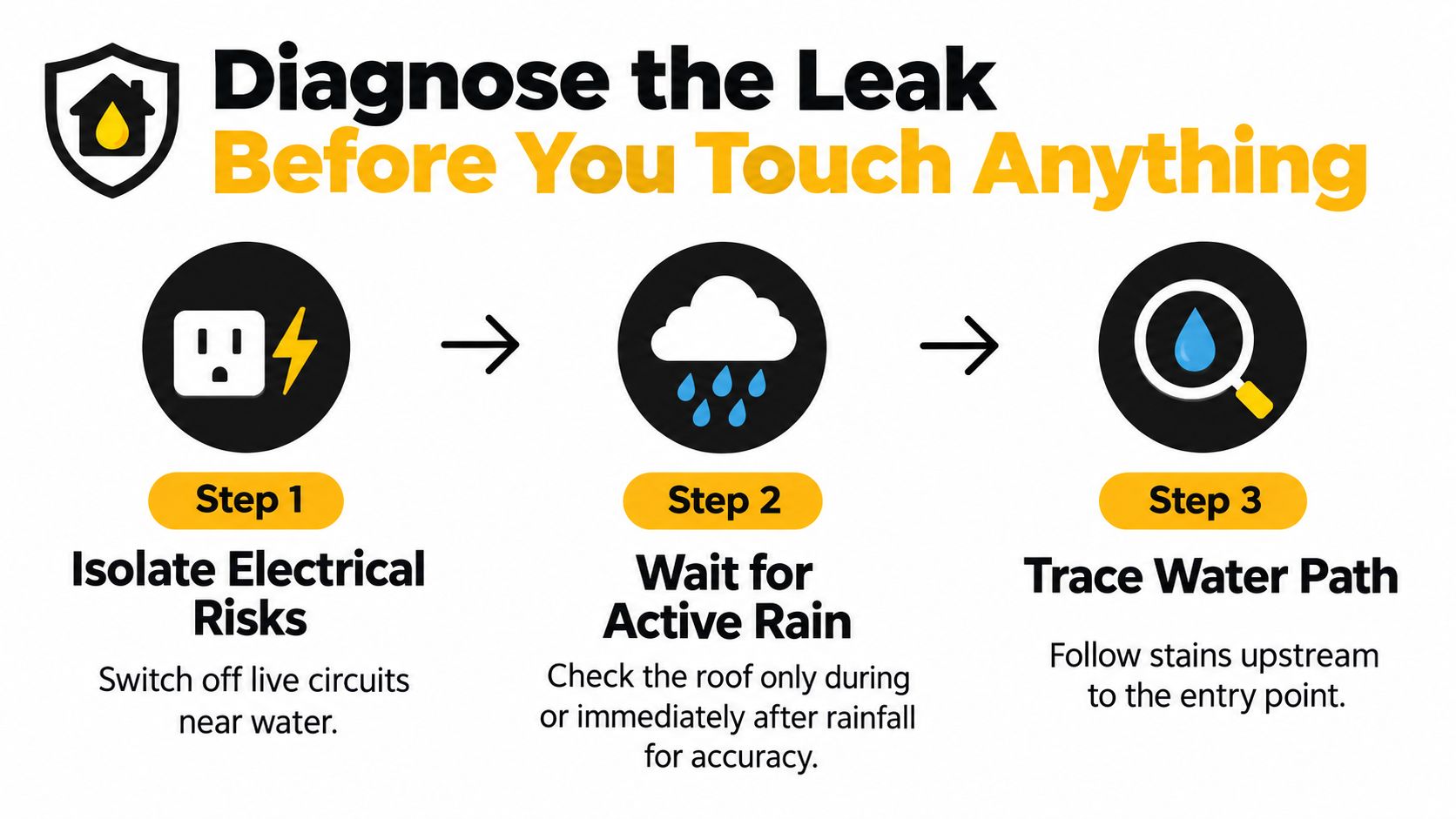
Start inside the building, but don't assume the interior drip marks the roof defect. Protect people and isolate electrical risks around wet lighting, power points, switchboards and equipment before anyone investigates above the ceiling. If water is entering an occupied area, restrict access and move stock or plant out of the affected zone.
Safe Work Australia classifies roof work as high-risk construction work where there's potential for a fall of more than two metres, asbestos disturbance, structural demolition or work near energised electrical services, as explained in its roof work safety information. Diagnostic access therefore needs its own plan. A ladder is not a substitute for edge protection, suitable access equipment or a roof-condition assessment.
Use rain as a diagnostic tool
The most useful inspection often takes place during or immediately after rainfall. Look for the wettest area, then trace moisture upslope and against the fall of the roof. Check whether water is travelling along a purlin, insulation blanket, sheet rib, flashing or service penetration before it reaches the internal drip point.
A controlled hose test can help in dry weather, but it needs discipline. Work in small zones, starting lower on the roof and moving methodically upslope. Keep one person inside watching the known entry area and allow time between tests, otherwise water from one zone can be mistaken for water from another.
Inspect the complete route, not just the nearest sheet:
- Penetrations: Examine skylights, vents, pipe boots, air-conditioning supports and mechanical plant.
- Laps and fixings: Look for lifted laps, failed washers, loose fasteners, corrosion and punctures.
- Flashings: Check whether flashings intercept and direct water, or whether gaps allow water behind the system.
- Drainage: Clear the visual line of box gutters, valleys, sumps, outlets and downpipes, but don't step on fragile or suspect materials.
- Adjacent bays: Inspect roof areas beside the apparent defect because water can enter away from the internal mark.
Before applying sealant, capture the weather, interior location, roof zone, photographs, visible defects and any temporary measures already taken. A commercial roof leak detection process should produce a traceable cause, not just a photograph of a wet ceiling.
Match the Repair Method to the Roof System
A repair compound only works when it suits the roof surface, the movement expected at the defect and the way water drains across the system. The product that sticks to a metal lap may not adhere to a membrane, and a coating that looks watertight on a dry afternoon may crack, peel or trap corrosion after exposure.
In Greater Sydney, the systems encountered most often include profiled metal roofing, concrete or terracotta tiles, and flexible membranes. Each needs a different diagnostic emphasis.
| Roof type | Most common leak points | Compatible repair approach |
|---|---|---|
| Metal roofing, including Colorbond and standing seam | Laps, fixings, penetrations, flashings, corrosion and blocked drainage | Clean and prepare the surface, replace compatible fixings, use purpose-made flashings and a sealant approved for the roof materials |
| Concrete or terracotta tile | Broken or displaced tiles, valleys, ridge details, sarking and deteriorated pointing | Replace damaged tiles, inspect the underlay and valley system, then renew bedding or pointing where appropriate |
| TPO, EPDM or modified bitumen membrane | Open seams, punctures, failed upstands, plant penetrations, ponding and movement | Prepare the membrane, use the correct primer or adhesive, weld or bond a compatible patch and test the repaired area |
Metal roofs reward preparation
A generic silicone bead over a dirty metal lap is a classic short-lived repair. Remove loose contamination and failed sealant, check whether the sheets have moved, replace loose fixings with compatible fasteners and washers, and seal the lap using a product suited to the roof coating and expected movement.
Flashings need more than a visible bead along the top edge. The Queensland Building and Construction Commission guidance on roof flashings explains that a complete flashing system must intercept, collect and discharge water into the stormwater system. A commercial roof waterproofing approach should therefore consider the flashing geometry and drainage path, not just the appearance of the patch.
Tile and membrane systems need different judgement
Replacing a broken tile may stop the immediate entry, but a deteriorated valley tray, damaged sarking or failed pointing can continue feeding water below the replacement. Membrane repairs depend on clean preparation, compatible primers, correct seam treatment and a patch that extends beyond the damaged area. An installer must also check whether ponding, substrate movement or failed detailing caused the puncture.
The best repair method is the one that restores the roof system's water path. A product chosen because it's convenient is not the same as a repair chosen because it's compatible.
Asbestos, Safety and Access on Older Roofs
An older commercial roof can turn a routine leak call into an asbestos-management event. Roofing sheets, cladding, gutters and associated components may contain asbestos, particularly in buildings constructed before modern asbestos controls. You can't identify asbestos reliably by appearance alone, and drilling, cutting, breaking or pressure-cleaning a suspect sheet can release hazardous fibres.
Before any roof work, the person controlling the workplace should check the asbestos register and management plan. If the register is missing, incomplete or doesn't cover the roof area, stop and arrange an assessment. Isolate the affected zone below and above where practicable, prevent workers and tenants from approaching damaged material, and separate emergency water control from permanent repair.
Compare the safe and unsafe response
| Situation | Appropriate response | What not to do |
|---|---|---|
| Suspected intact asbestos cement sheet | Check the register and obtain competent assessment before disturbing it | Drill through it to install a fixing |
| Cracked or damaged suspect sheet | Isolate the area and arrange controlled asbestos advice | Walk across it or sweep fragments |
| Active internal leak with uncertain roof condition | Protect stock and equipment, document the damage and plan compliant access | Send an untrained worker onto the roof |
| Planned removal or disturbance | Use trained workers, the required safe work method and applicable licensed controls | Treat asbestos work as ordinary patching |
SafeWork NSW classifies work that repairs, removes or disturbs an asbestos roof as asbestos-related work. Its NSW code of practice for work on roofs requires a safe work method statement and trained workers, and notification to SafeWork NSW at least five days before non-friable removal exceeding 10 square metres or any friable removal begins.

Access controls matter even without asbestos
Fragile sheets, wet surfaces, roof edges, skylights, penetrations and nearby electrical services all change the job. A compliant access plan may involve edge protection, a suitable platform, exclusion zones, electrical isolation and a safe work method. If the roof flexes, deflects or shows widespread corrosion, don't test it by walking further.
A contractor specialising in asbestos roof repair in NSW should be able to explain the register review, assessment, removal controls, disposal process and replacement scope before work starts. The cheapest patch is irrelevant if it exposes workers or contaminates an occupied site.
Temporary Containment That Actually Holds
Permanent repair may not be possible during active rain, unsafe access or an unresolved asbestos assessment. The immediate job is to keep water away from people, stock, electrical equipment and building contents without damaging the roof further.
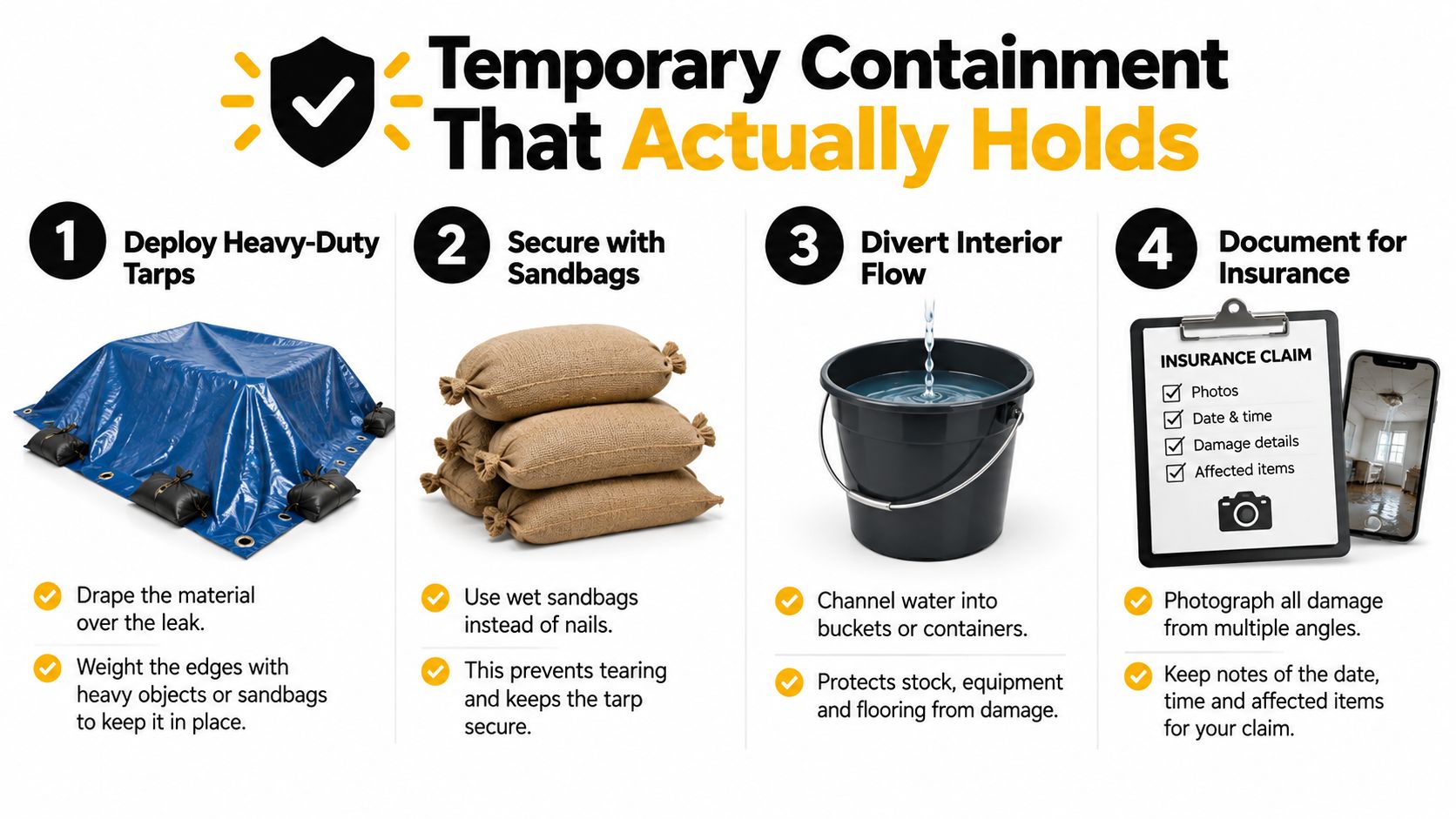
Inside, move goods away from the drip and use buckets or containers that won't overflow unnoticed. Where water is spreading across a ceiling, use polythene sheeting to channel the flow into a controlled container, but keep the plastic away from electrical fittings and don't create a trip hazard. Record where the water is going, not just where it first appeared.
Externally, a heavy-duty tarp can cover the suspected roof zone when it can be deployed without exposing workers to an unsafe surface. Extend it beyond the entry area and keep the edges secure with sandbags positioned to avoid concentrated loading or sharp contact with sheets. Don't nail through the tarp or roof, and don't drag weights across fragile materials.
Build an evidence trail on day one
Australia's rainfall conditions make fast containment important. The Bureau of Meteorology reported that Australia's 2025–26 financial-year rainfall was 27% above the 1961–1990 average, ranking as the 10th-wettest year on record, while extreme short-duration rainfall can increase by 7–28% for each 1°C of warming, according to the Bushfire and Natural Hazards CRC resilience analysis.
Photograph the ceiling stain, active flow, affected contents, roof area, tarp placement and any visible defect. Note the date, time, weather, room, roof zone, people involved and whether electrical isolation occurred. Label the images so a contractor or insurer can connect the interior damage with the external investigation.
A temporary patch must remain visibly temporary in the maintenance file. Record what it protects, what it doesn't prove and when a permanent inspection is required. That prevents a tarp or sealant bead from being mistaken for a completed repair.
Patch Metal, Tile and Membrane Roofs the Right Way
A patch fails when the contractor repairs the opening but leaves the mechanism that created it. Movement, blocked drainage, corrosion, failed fixings and poor flashing geometry will defeat a new layer of sealant. The repair needs to remove or correct the defective component wherever the roof system allows it.

Metal roofing
For a metal sheet, start by confirming the defect. Clean the lap or puncture area according to the coating and sealant requirements, remove failed material and check the sheet edges for corrosion. Replace loose or deteriorated fixings with fasteners and washers compatible with the roof system, then seal a sound lap compressively with a compatible sealant rather than brushing a coating over the top.
Purpose-made, machine-folded flashings usually provide a better water path than a thick bead applied over a gap. The flashing should direct water into the drainage system and allow for the movement expected at the junction. If corrosion has reduced the sheet or flashing, cut-and-patch work may only postpone section replacement.
Tile roofing
A cracked or displaced concrete or terracotta tile should be replaced with a compatible tile, not merely coated. Check the tiles around it, then inspect the sarking, valley tray, ridge and hip details if water continues below the replacement. Re-pointing may restore a sound detail, but it won't compensate for a failed underlay or valley system.
Membrane roofing
Membrane work depends on the exact product and installation method. Prepare the surface, use the specified primer or adhesive, and install a compatible patch with properly treated edges and seams. EPDM, TPO and modified bitumen aren't interchangeable, so a patch material chosen from a general hardware shelf can create adhesion or chemical-compatibility problems.
The test of a repair is not whether it looks sealed. It's whether water follows the intended path after the repair has been tested.
After curing or welding, water-test the repaired zone where safe and record the result. If the leak persists, reopen the investigation rather than adding another layer over the first failed patch.
Document the Repair for Insurers and Auditors
A commercial roof repair file should allow someone who wasn't present to answer five questions: what happened, where did water enter, what risk was controlled, what work was completed and what remains unresolved. Without that record, the next contractor starts from the ceiling stain again.
Take photographs before moving contents where possible, then photograph the protected area, the suspected roof defect and each repair stage. Use consistent viewpoints and include enough surrounding detail to identify the roof bay, penetration, gutter or tenancy. Close-up images show the defect, while wider images show its position in relation to the building.
Record the cause, not just the activity
A work order saying “sealed leak” is weak evidence. Use plain descriptions such as “water traced upslope to failed flashing at the mechanical penetration” only when the investigation supports that conclusion. If the source remains uncertain, say so.
The written record should include:
- Incident details: Date, time, weather, affected room, roof area and the person who reported the leak.
- Immediate controls: Electrical isolation, exclusion zones, stock relocation, internal water diversion and temporary roof protection.
- Inspection findings: Roof type, suspected entry point, adjacent defects, drainage condition and any signs of structural or asbestos risk.
- Materials and method: Product names where known, compatible fixings, flashing details, membrane preparation, patch dimensions and water-testing results.
- Limitations: Areas not accessed, suspected concealed damage, temporary measures, asbestos assessment pending and weather restrictions.
- Commercial records: Contractor details, scope, photographs, invoices, safe work documents, permits and warranty terms.
Don't describe an emergency tarp or interior bucket as a permanent repair. Separate the event into temporary water control, diagnostic inspection and permanent rectification. That distinction helps the insurer assess the sequence and gives the next roofer a clean starting point.
Know when to stop
A facility manager should stop work and call a qualified commercial roofer when any of these conditions apply:
- Suspected asbestos: A sheet, gutter or flashing may contain asbestos, or the register is unavailable.
- Unsafe height access: The task requires roof access above two metres without suitable edge protection or controlled access.
- Structural concern: The roof deflects, the support system appears damaged or sheets feel unstable.
- Widespread corrosion: The defect affects more than an isolated repair area, or fixings no longer hold sound material.
- Recurring failure: The leak returns after a properly documented repair or repeated sealant application.
- Hidden moisture: Insulation, ceiling materials, timber or internal linings are saturated.
- Electrical exposure: Water is entering near live services, switchboards, lighting or machinery.
- Unclear cause: Hose testing, rainfall observation and roof inspection haven't established a defensible entry path.
A commercial roofing contractor brings more than a tube of sealant. The useful deliverable may include a marked roof plan, ingress-path photographs, moisture investigation, thermal mapping where appropriate, access controls, asbestos coordination, repair specifications and manufacturer-compatible warranty information. The right scope also states what wasn't inspected and what future monitoring is required.
Facility manager checklist
Before closing the work order, confirm that:
- The affected area is safe for occupants and workers.
- Electrical and access hazards were assessed.
- The asbestos register was checked where relevant.
- The internal damage and external roof area were photographed.
- The water path and suspected cause were recorded.
- Temporary controls were identified separately from permanent repairs.
- Materials and repair methods were documented.
- The repaired area was tested when safe.
- Warranty terms and exclusions were supplied.
- Follow-up work was assigned a responsible person.
Common questions after a leak
Should I seal the visible stain from inside?
No. Interior sealing may conceal the symptom while water continues entering above. Protect the room, isolate hazards and investigate the roof path.
Can a maintenance worker walk onto the roof to inspect it?
Only after access, fall, surface, asbestos and electrical risks have been assessed and controlled. A wet or fragile roof isn't a routine walking surface.
When is a patch enough?
A patch can suit a confirmed, localised defect in sound surrounding material. It isn't a reliable solution for failed drainage, widespread corrosion, movement, saturated insulation or an unknown ingress path.
What should I give the roofer?
Provide the incident timeline, weather details, marked interior location, photographs, roof plans if available, asbestos-register information, previous repair records and any insurer instructions. This reduces duplicated investigation and helps the contractor price the actual problem.
Commercial Roofers offers commercial and industrial leak inspections, ingress-path diagnosis, compliant localised repairs, flashing and gutter work, metal sheet replacement, membrane repairs and broader roof replacement across Greater Sydney and NSW. If your facility has recurring leaks, suspected asbestos, unsafe access or an insurer evidence requirement, visit Commercial Roofers to arrange a documented assessment and repair scope.