
A leaking commercial roof doesn't automatically need replacing. In NSW, restoration is often the more responsible decision when the roof structure remains sound, while full replacement becomes the better investment when damage has spread through the roof system or compliance requirements have changed. The difficult part is separating a roof that looks tired from one that has become a liability.
That distinction matters more on warehouses, factories, retail centres and strata buildings than it does on a house. A low initial quote can become expensive if it leaves wet insulation, unsafe access, asbestos or recurring leaks unresolved. Conversely, a full strip-out can waste capital when cleaning, repairs and a protective coating would have restored a viable roof.
Table of Contents
- Understanding the Commercial Roof Decision
- Defining Restoration and Replacement Workflows
- Comparing Costs and Service Life
- The Hidden Costs of Delayed Action
- Making the Right Choice for Your Asset
- Navigating Compliance and Safety Requirements
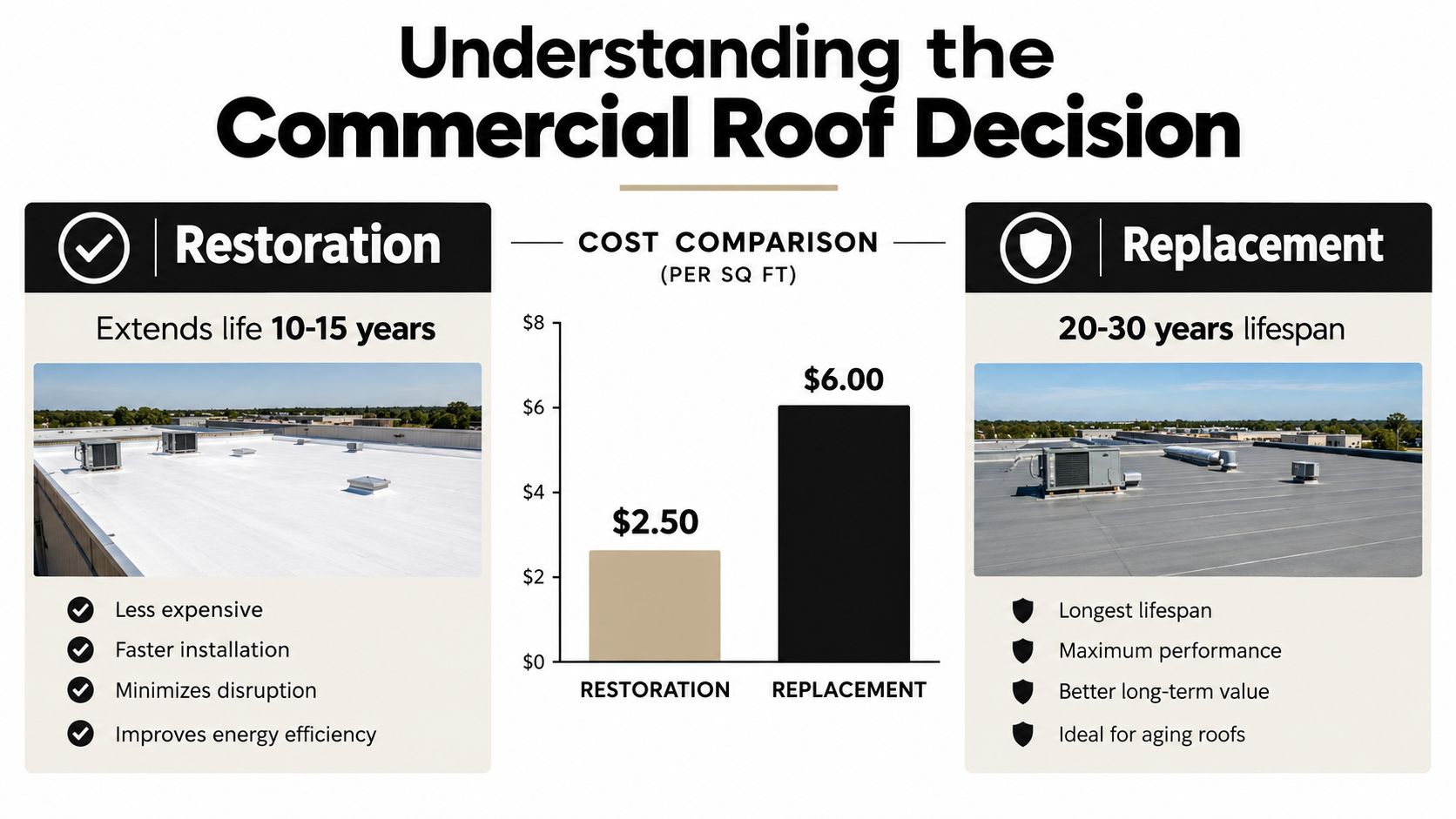
Understanding the Commercial Roof Decision
A commercial roof decision is an asset decision, not just a maintenance decision. The question isn't, “How much will the contractor charge?” It's, “What condition is the roof assembly in, what obligations does the building carry, and which option gives the property a dependable operating life?”
Restoration and replacement solve different problems. Restoration preserves a viable roof by repairing defects, preparing the surface and applying a protective system. Replacement removes the existing system and gives the owner the opportunity to address the deck, insulation, drainage, flashings and materials as one coordinated project.
A Sydney warehouse with faded metal sheets, isolated corrosion and failed fasteners may be a sensible restoration candidate. A strata building with repeated leaks, damaged substrate and an older roof containing asbestos is a different proposition. Applying another coating in the second situation may make the roof look better while leaving the most serious risks untouched.
| Decision factor | Roof restoration | Full roof replacement |
|---|---|---|
| Existing structure | Must remain fundamentally sound | Can address failed or unsuitable substrate |
| Typical work | Clean, repair, seal and coat | Strip out, inspect, rebuild and install |
| Capital profile | Lower initial commitment | Larger capital project |
| Operational effect | Usually less invasive | More staging, waste and disruption |
| Best fit | Localised wear and repairable defects | Widespread failure, compliance change or end-of-life condition |
| Main risk | Paying repeatedly for a roof that should be replaced | Spending heavily before proving replacement is necessary |
The decision changes with the building
A business owner may prioritise keeping stock, machinery and staff protected during trading hours. A strata manager also has to consider owners' levies, common-property responsibilities, resident communication and the risk of repeating the same work after another leak. A facility manager may need to coordinate permits, access controls, isolation zones, emergency response plans and contractor reporting.
That operational context should appear in the scope of works. A restoration that can be staged around deliveries may be preferable to a replacement that affects loading areas, plant access or tenant operations. But minimising disruption isn't a reason to preserve an unsafe roof. It's one factor in a decision that must also account for substrate condition, moisture, access and compliance.
Practical rule: If the proposal only discusses the visible roof surface and says nothing about substrate, drainage, access or hazardous materials, it isn't a lifecycle assessment.
Owners also need a reliable record of inspections, defects, photographs and completed works. For larger sites, a facility management employee app can help teams assign inspections, record defects and keep maintenance communication visible across managers, contractors and site personnel. It won't determine whether a roof should be restored, but it can reduce the information gaps that lead to reactive decisions.
Defining Restoration and Replacement Workflows
Restoration is a renewal of an existing roof system. It starts with inspection and preparation, not with a bucket of coating. The contractor needs to identify leaks, corrosion, failed fasteners, open seams, damaged flashings, penetrations, drainage problems and areas where the existing surface won't accept the proposed system.
The practical workflow normally includes surface cleaning, removal of loose material, localised repairs, treatment of corrosion, reinforcement of vulnerable details and application of compatible primers, membranes or protective coatings. On a metal roof, that may involve replacing fasteners, sealing laps and addressing rust before repainting. On a tiled roof, the work may involve replacing broken tiles, repairing pointing and renewing the protective finish. The exact specification must suit the substrate.
A useful explanation of the sequence is provided in this guide to the roof restoration process. The important distinction is that restoration only works when the roof beneath the system can continue to perform.
Replacement starts below the surface
Replacement is more intrusive because it removes the existing roof assembly, usually exposing the deck, purlins or supporting structure for inspection. The project may then include replacement of damaged sheeting, insulation, membranes, flashings, gutters, box gutters, penetrations and drainage details.
That broader scope is the reason replacement can solve problems that restoration cannot. If moisture has travelled through insulation or the deck has deteriorated, a surface coating won't remove the affected material. If the existing roof contains hazardous material or no longer supports the required thermal, drainage or operational outcome, replacement gives the owner a chance to change the system rather than preserve it.
The substrate sets the boundary
Restoration suits sound structure, limited moisture impact and defects that can be isolated and repaired. It doesn't suit a roof where the contractor can't establish what lies beneath the surface, where failures are widespread, or where previous patching has created an unreliable assembly.
Replacement is more defensible when the roof has recurring leaks across multiple areas, structural movement, widespread corrosion, extensive deterioration or materials that create a compliance problem. Age matters, but it shouldn't be used alone. A younger roof with major damage may need replacement, while an older roof with a sound structure and isolated wear may still be viable for restoration.
The contractor's inspection should therefore distinguish between cosmetic wear, serviceable defects and system failure. Ask for marked-up roof plans, photographs, moisture findings where relevant, details of proposed repairs and an explanation of what the chosen option will not fix. A credible scope makes the limits clear.
Comparing Costs and Service Life
Restoration usually wins the initial cost comparison, but that doesn't automatically make it the cheaper lifecycle choice. An NSW cost guide places roof restoration at about A$4,000 to A$11,000, while full replacement commonly ranges from A$10,000 to A$40,000 or more, depending on dwelling size and storeys. The figures are residential benchmarks rather than a commercial quotation, but they illustrate the capital gap that has made restoration a standard intermediate option in Australia. NSW roof cost guidance provides the underlying comparison.
For commercial owners, the quote needs to show more than the starting price. Compare the scope, expected service life, access arrangements, preparation, waste handling, warranty conditions, maintenance requirements and the consequences of leaving failed components in place.
| Metric | Roof restoration | Full replacement |
|---|---|---|
| Initial capital | Generally lower when the roof is viable | Higher because removal, disposal and reconstruction are included |
| Structural correction | Limited to accessible and repairable defects | Allows inspection and renewal of the broader roof assembly |
| Disruption | Usually lower, with less tear-off and staging | Greater noise, debris, access control and weather exposure during works |
| Service-life effect | Can add roughly 10 to 15 years when the structure is sound | Resets the roof system, subject to material, installation and maintenance |
| Material decision | Preserves the existing system | Allows a change to modern metal profiles, insulation and drainage |
| Financial risk | False economy if repeated repairs continue | Premature capital expenditure if restoration was still practical |
The 10 to 15 year service-life extension for a structurally sound roof is identified in Australian market guidance, alongside restoration as the lower-cost response to surface wear and isolated defects. Australian restoration and replacement cost guidance similarly positions restoration as materially cheaper than replacement, while identifying recurring leaks, structural movement and broader age-related failure as reasons to consider replacement.
Material age changes the calculation
Roof material provides useful context, but it isn't a substitute for inspection. Australian guidance commonly places Colorbond steel at 40 to 70 years, concrete tiles at 40 to 50 years, terracotta tiles at 50 to 100 years and asphalt shingles at 15 to 30 years. This Australian roof lifespan guide explains why material age should be assessed alongside condition and maintenance history.
A Colorbond roof within its expected material life, with isolated corrosion and sound support, may justify restoration. A roof with widespread deterioration near or beyond its expected life is harder to defend as a coating project, particularly if leaks are recurring or access costs are rising.
You should also separate service-life extension from new-system life. Restoration buys time and protects an existing asset. Replacement creates a new assembly, but its value depends on correct detailing, drainage, ventilation, insulation and maintenance. For owners assessing metal roofing, this guide to how long a Colorbond roof lasts is useful background, but the final decision still needs site-specific evidence.
The Hidden Costs of Delayed Action
Restoration is often described as the budget-friendly option. That description is fair only when the roof qualifies and the owner treats the work as a complete system renewal rather than another round of patching.
The hidden cost appears when a contractor repairs the same leak repeatedly, leaves failed drainage unresolved or applies a coating over defects that were never properly prepared. Each intervention may look modest on its own. Together, they can consume maintenance budgets while the underlying roof moves closer to failure.
Downtime is part of the roof cost
A warehouse leak can affect stock, racking, electrical equipment and dispatch schedules. A retail leak can damage ceilings, displays and customer areas. In a strata property, repeated water ingress creates complaints, access coordination and uncertainty over who carries responsibility for each repair.
Those consequences rarely appear in a roofing quote. They still belong in the decision. Include temporary protection, internal repairs, tenant disruption, stock movement, after-hours work, site security and the management time required to coordinate another emergency response.
Access can also change the economics. A roof that was easy to reach during a planned project may become expensive when every small repair requires specialised equipment, traffic management or work around operating plant. A staged restoration may remain sensible, but only if the contractor identifies a clear endpoint rather than promising indefinite patching.
Maintenance can become false economy
The tipping point isn't a universal invoice amount. It arrives when the roof no longer delivers dependable performance between interventions, or when the next restoration would still leave major compliance, drainage or substrate questions unresolved.
Ask the contractor to show:
- Repeat defects: Which leaks, flashings, fasteners or drainage points have already been repaired?
- Unresolved exposure: What areas remain vulnerable after the proposed restoration?
- Access burden: Will future maintenance require the same difficult access arrangements?
- Operational impact: How will another failure affect tenants, stock, machinery or opening hours?
- Replacement readiness: What parts of the roof would still need renewal if restoration fails?
A low quote is not a saving if it preserves the reason you keep calling the roofer.
The commercial roofing guidance for Sunshine Coast properties reflects the broader Australian distinction: restoration suits a sound but worn roof, while replacement becomes appropriate when structural issues or extensive damage make surface treatment unreliable. Sydney conditions and site constraints differ, so owners should use that distinction as a decision principle, not as a substitute for a local assessment.
The following video can help non-roofing stakeholders visualise the difference between preserving a roof and rebuilding it.
Making the Right Choice for Your Asset
Start with evidence, then compare the options against the building's operating needs. Don't ask a contractor to recommend restoration or replacement from ground level photographs alone. A useful assessment should examine the roof surface, details, drainage, accessible substrate, previous repairs, leak history and the materials that may be disturbed.
Use a condition-first test
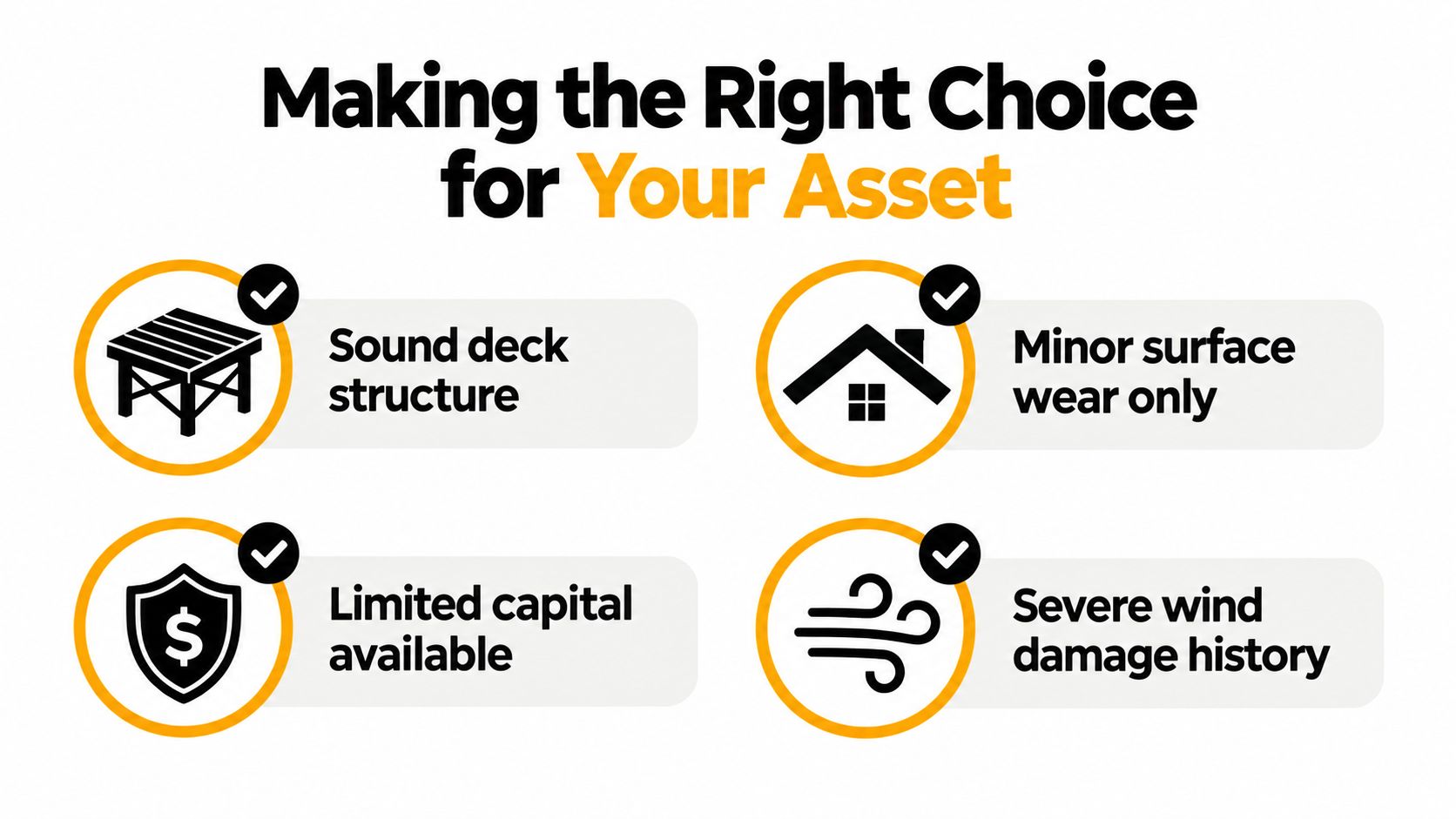
Restore when the evidence supports preservation. That usually means the roof structure is sound, defects are localised, water ingress can be traced and repaired, and the existing surface can accept the proposed restoration system. Minor corrosion, faded coatings, failed fasteners and isolated leaks don't automatically justify a strip-out.
Replace when the roof has become a system problem. Widespread leaks, structural movement, extensive corrosion, damaged substrate, persistent drainage failure or an unsafe roof condition should move the discussion beyond another surface treatment. The same applies where replacement is needed to address asbestos, insulation, ventilation or other building requirements together.
A roof under about 20 years old with localised damage is often considered a repair or restoration candidate, while roofs over 25 to 30 years old with multiple problems are more likely to warrant replacement, according to Australian roofing guidance. This guide to common issues in older homes provides that age and condition framework. Commercial buildings may have different materials and exposure histories, so treat those thresholds as prompts for investigation.
Put the proposal under pressure
Request two scopes where the condition is uncertain. The restoration scope should identify preparation, repairs, coating compatibility, drainage treatment, exclusions and maintenance obligations. The replacement scope should identify strip-out depth, waste classification, substrate repairs, insulation, flashings, gutters, staging and weather protection.
Then ask three direct questions:
- What evidence proves restoration will work? Look for photographs, testing, defect mapping and a clear explanation of substrate condition.
- What will remain unresolved? A contractor should state whether the proposal leaves old insulation, inaccessible areas, drainage limitations or hazardous materials in place.
- What triggers replacement later? If the answer is “another inspection”, the asset plan isn't specific enough.
Finally, assess the contractor as carefully as the system. Check licensing, insurance, safety planning, references for comparable commercial sites, warranty terms, supervision and who will perform the work. The cheapest quote often omits the preparation or access controls that determine whether the roof performs.
Navigating Compliance and Safety Requirements
Compliance can turn a maintenance project into a capital project before the roof shows catastrophic failure. Older commercial and industrial buildings may contain asbestos roofing or associated materials. If those materials are disturbed, the owner needs a properly planned approach to identification, removal, containment, transport and disposal. A coating may avoid disturbance in some circumstances, but it doesn't make an asbestos risk disappear or justify treating an uncertain material as ordinary roofing waste.
Replacement can therefore be triggered by more than leaks. An owner may need to remove a hazardous roof, improve thermal performance, renew insulation, correct drainage, improve ventilation or bring the roof system into a more maintainable configuration. Australian commercial roofing guidance identifies asbestos removal, insulation, drainage and ventilation as part of the decision set, not optional extras. Commercial roof repair guidance outlines that broader relationship between roof renewal and building upgrades.
WHS planning starts before the first sheet is removed
Roof work exposes workers and building occupants to risks from height, fragile surfaces, falling objects, weather, live services, plant movement and changing access conditions. A commercial project needs coordinated controls, not a generic statement that workers will “take care”.
The plan should set out access routes, exclusion zones, edge protection, roof condition, material handling, emergency response, weather controls and communication with tenants or site staff. Work at height also needs active supervision, suitable equipment and a rescue method that fits the actual site. For a practical overview of the planning issues, KODOBI's height safety guidance is a useful resource for owners and facility managers.
Use replacement to solve several problems at once
A full replacement may allow the owner to coordinate asbestos removal, new insulation, modern metal profiles, improved box gutters and safer maintenance access in one project. That can create better long-term value than restoring the visible surface while retaining obsolete or difficult components.
Restoration still has a place where the roof is structurally sound and the compliance position is clear. For tiled assets, this tile roof restoration guide provides relevant context on preserving an existing roof rather than replacing it by default. The correct choice depends on whether restoration addresses the actual risk, not whether it produces the smaller first invoice.
Before approving works, require a written scope that identifies hazardous-material assumptions, WHS controls, access arrangements, waste handling, drainage, insulation, warranties and post-work documentation. That record protects the asset manager as well as the building. It also gives future contractors the history they need to avoid repeating the same investigation.
Commercial Roofers offers Sydney and NSW commercial owners inspections, roof restoration, asbestos roof removal and replacement, industrial roof renewal, metal roofing, tiling, drainage and detailed project reporting. Visit Commercial Roofers to request an assessment that compares restoration and replacement against your roof's condition, compliance requirements and operating constraints.