
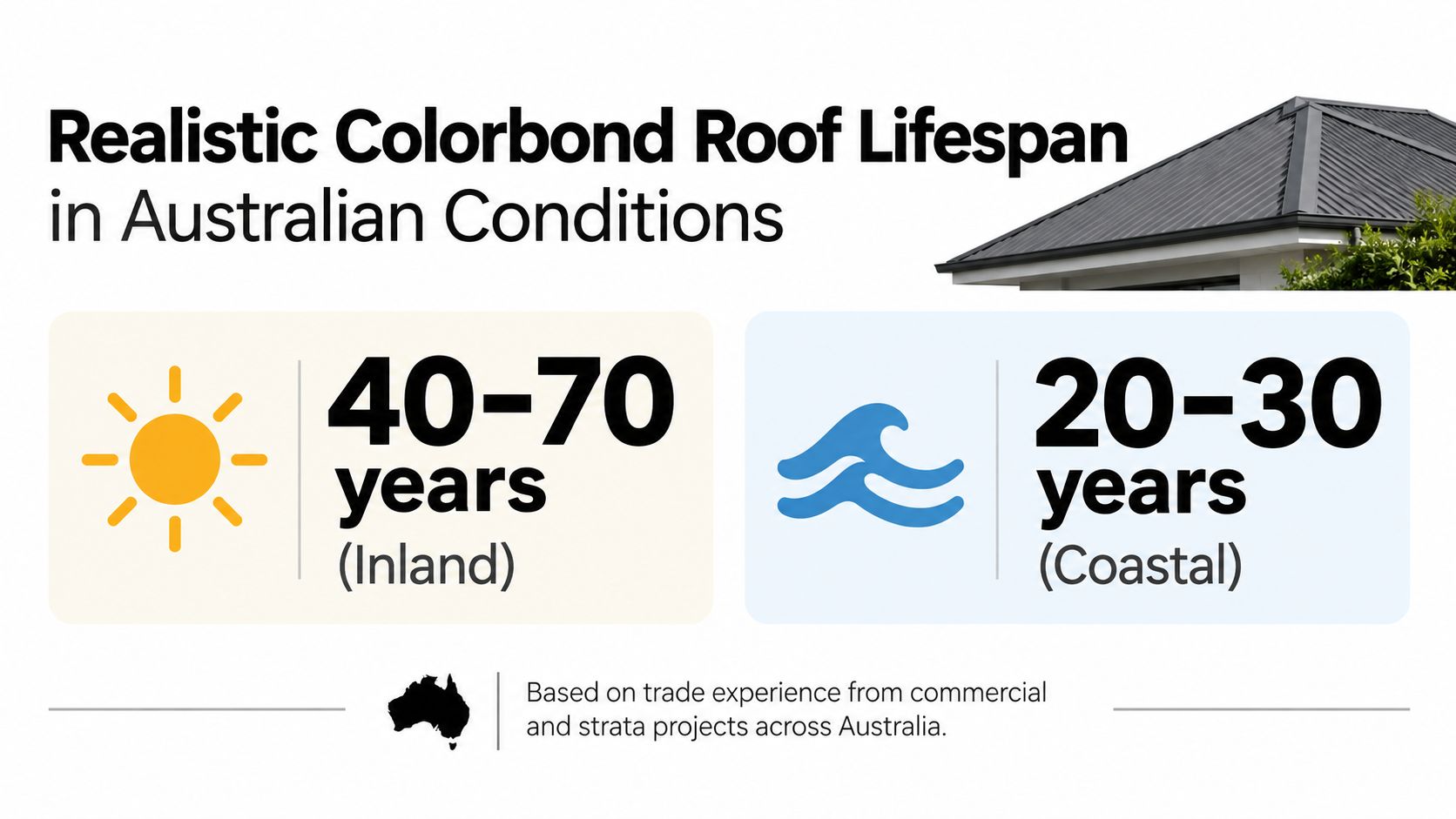
A Colorbond roof generally lasts 40 to 70 years in normal Australian conditions, but that can fall to 20 to 30 years within 1 km of the coast. The practical answer depends less on the product name than on the steel specification, paint finish, exposure, installation quality and maintenance.
That range surprises many commercial owners because a roof often starts looking tired well before the steel substrate has reached the end of its useful life. The painted finish may fade, chalk or need renewal while the underlying steel remains serviceable. Treating those as the same failure point leads to unnecessary replacement on some buildings and delayed action on others.
On Sydney industrial, warehouse and strata projects, the postcode gives only a rough guide. A roof beside an exposed headland, a roof under tree cover and a roof in a relatively sheltered western suburb can age very differently. Salt, airborne dust, industrial fallout, trapped leaf litter, standing water and poor detailing all change the result.
Table of Contents
- Realistic Colorbond Roof Lifespan in Australian Conditions
- Key Factors That Decide Where in the Lifespan Range Your Roof Lands
- What the BlueScope Colorbond Warranty Actually Covers
- Inspection and Maintenance Schedule for Commercial Roofs
- Early Warning Signs Your Colorbond Roof Is Ageing Out
- Lifecycle Costs and How Colorbond Compares to Other Materials
- Replacement Planning and When Restoration Is the Smarter Move
Realistic Colorbond Roof Lifespan in Australian Conditions
Professionally installed and maintained COLORBOND® steel generally falls within a 40 to 70 year lifespan range in Australian conditions. Within 1 km of the coast, salt exposure can reduce service life to around 20 to 30 years. The comparison appears in Australian roofing guidance on roof types and service life.
That range describes the roof asset, not necessarily a paint finish that still looks new. The steel substrate may remain structurally serviceable for decades after the coating has faded or chalked. An Australian roofing source separates a practical steel life of 50 to 70 years from a painted finish that may need attention after roughly 15 to 25 years, depending on grade, colour, orientation and environment. For background on the coating process, see Vivid Skylights powder coating. The distinction is also discussed in this explanation of Colorbond roofing and finish performance.
Inland and coastal roofs age differently
An inland warehouse with reliable drainage and limited contamination may approach the upper end of the broad range. A coastal strata building receives salt-laden air, especially across exposed elevations, roof edges, laps and cut ends. Industrial fallout can settle on the coating and stay wet, increasing the load on the finish and vulnerable details.
Microclimate often matters more than the suburb label. Ocean exposure, prevailing wind, tree cover, rooftop plant and drainage design can make one elevation age faster than another.
Commercial owners and strata managers control much of the outcome. They can specify a coating and profile suited to the site, require sound flashing and fixing details, maintain drainage, wash contamination away and keep inspection records. Those decisions affect both the steel substrate and the period before the painted finish needs work.
Practical rule: Use the advertised lifespan as a planning range, not a promise. Exposure and maintenance history determine where the roof sits within it.
Key Factors That Decide Where in the Lifespan Range Your Roof Lands
The highest-impact decisions happen before the sheets arrive on site. A thicker, better-suited system installed correctly in a harsh environment still needs maintenance, but it gives the roof a stronger starting position than a light specification with poor drainage and incompatible accessories.
Specification has to match exposure
Steel grade and thickness influence how the roof handles corrosion, spanning and physical wear. Commercial specifications may compare substrate options such as AZ150 and AZ200, along with sheet thicknesses such as 0.42 and 0.65 BMT. Those labels shouldn't be selected in isolation. The designer needs to consider span, foot traffic, wind loading, penetrations and the site's corrosion exposure.
The paint system also matters. Standard COLORBOND®, Matt and higher-resistance options serve different design and environmental requirements. Marine sites may require a more suitable equivalent for severe exposure rather than a standard finish chosen solely for appearance. A fresh coat of paint can't correct a substrate or coating class that was wrong for the location.
Profile and fixing details affect water entry
A concealed-clip system reduces exposed penetrations, but it isn't automatically the right choice for every warehouse or strata roof. Pierce-fixed profiles can perform well when the washer, fastener, spacing and installation technique suit the sheet and support structure. Poorly driven screws, distorted washers and incorrect spacing create leak paths long before the steel has corroded through.
Flashing design deserves the same attention as the roof sheet. Valleys, parapets, penetrations, skylights and transitions need positive drainage and compatible materials. Dissimilar metals, trapped moisture and rough cut edges can create localised corrosion even where the broad roof field still looks sound.
Rank the controllable influences
| Factor | Impact on lifespan | Notes |
|---|---|---|
| Environmental exposure | Very high | Salt spray, industrial fallout, dust and persistent wetting can shorten service life. |
| Installation and detailing | Very high | Flashings, laps, penetrations, fasteners and drainage determine where water remains. |
| Maintenance cadence | High | Cleaning and prompt repairs prevent local defects becoming widespread corrosion. |
| Coating and substrate specification | High | The system must match exposure, use and structural requirements. |
| Profile and fixing method | Medium to high | The right profile performs well, but poor fixing practice undermines it. |
| Colour and orientation | Medium | Solar exposure and orientation can make finish deterioration uneven. |
The most useful quote comparison therefore isn't just “Colorbond roof replacement”. Ask each contractor to identify the substrate, coating class, profile, fixing pattern, flashings and rainwater compatibility. Those details explain service-life differences far better than a generic material description.
What the BlueScope Colorbond Warranty Actually Covers
A warranty isn't the same as a guaranteed roof life. For Australian COLORBOND® roofing, BlueScope warranty information indicates coverage of up to 36 years against corrosion to perforation, with paint-system coverage of up to 20 years, provided the product, site and installation meet the warranty terms. The underlying warranty benchmark is discussed in this Australian Colorbond roof lifespan guide.
Those two periods cover different failures. Perforation corrosion means corrosion has progressed through the steel, not that the colour has faded or the surface has lost its original appearance. Paint coverage concerns the specified finish and its warranty conditions. A roof can therefore need cleaning, touch-up work, recoating or fastener maintenance while still having a usable steel substrate.
Read the conditions before relying on the number
The referenced Australian warranty information specifies conditions including a roof pitch of at least 5 degrees, a fully lined roof and a location more than 5 km from salt water. Those requirements are material for Sydney and other NSW markets, where coastal exposure can move a project into a different risk category.
A warranty may also depend on compatible flashings and fasteners, correct installation, suitable drainage and proper maintenance. Ponding water, blocked gutters, contamination and unaddressed damage can create circumstances outside the cover. The exact product, location and warranty document must be checked before a specification is approved.
Manufacturer cover is not workmanship cover
BlueScope's product warranty addresses the manufactured steel and finish under its terms. It doesn't replace the installer's responsibility for workmanship, defective flashing details, incorrect screw placement or poor site practice. Commercial owners should request both documents, then keep them with the roof drawings and completion records.
A warranty is useful evidence of intended performance. It isn't permission to postpone inspections.
Keep the product description, batch or delivery records where available, installer details, completion date, photographs of flashings and penetration details, and maintenance reports. If a claim becomes necessary, a clear record helps establish what was installed, where it was installed and how the roof was maintained.
Inspection and Maintenance Schedule for Commercial Roofs
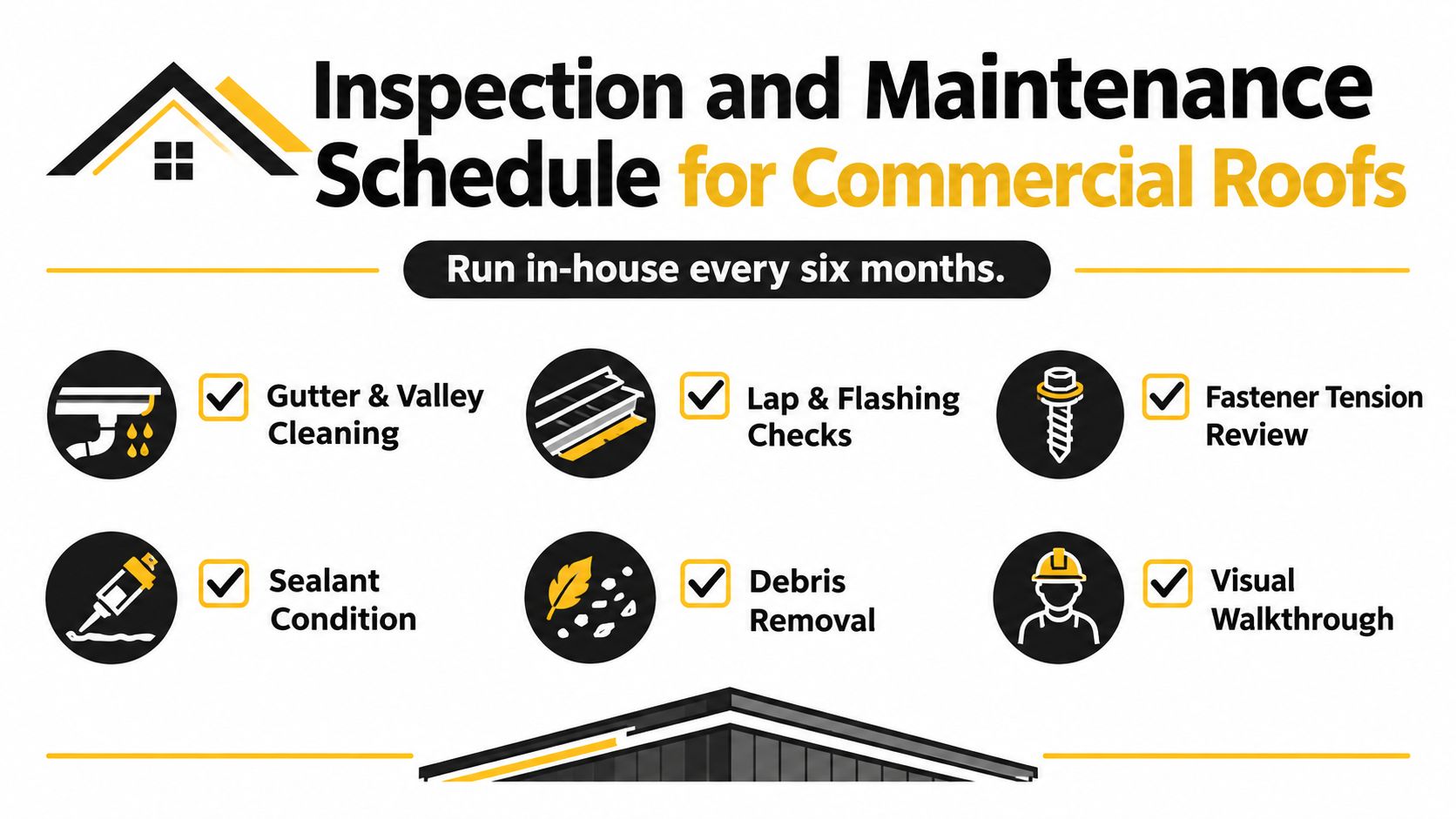
A commercial Colorbond roof benefits from a six-monthly inspection cycle, ideally after autumn and spring. BlueScope-linked maintenance guidance recommends that frequency, with more frequent checks where trees, dust or coastal contamination increase the load on gutters and the coating. The Colorbond maintenance guide explains why debris and dirt can keep surfaces wet and promote localised breakdown.
What the facility team can check
A trained facility team can record visible conditions from safe access points and established walkways. Staff shouldn't improvise roof access or walk on fragile sheets, skylights or areas without suitable fall protection.
Use the inspection to look for:
- Gutters and valleys: Remove leaf litter, silt and other debris that holds moisture and restricts drainage.
- Laps and flashings: Check for lifted edges, open joints, failed sealant and signs of water tracking.
- Fasteners: Look for backing-out screws, damaged washers and rust around fixing heads.
- Coating condition: Note chalking, fading, scratches, blistering or flaking around penetrations and edges.
- Rooftop equipment: Check condensate discharge, cable supports and plant bases for persistent wetting.
- Internal evidence: Compare roof observations with ceiling stains, damp insulation and musty areas below.
The team should photograph each defect, mark its location on a roof plan and record whether it is urgent, scheduled or being monitored. That creates a practical maintenance record rather than a vague note that “the roof was checked”.
What needs a licensed roofer
A licensed contractor should handle sealant renewal, flashing replacement, fastener replacement, coating repairs and any work requiring roof access. Pressure washing and chemical wash-down must suit the coating and drainage system. In coastal or industrial catchments, scheduled external washing removes salt, dust and organic deposits before they remain wet against the finish.
For a broader maintenance checklist and contractor workflow, use this guide to commercial roofing and maintenance. Keep invoices, product information, photographs, reports, weather observations and completed repair notes in the building's compliance file.
Early Warning Signs Your Colorbond Roof Is Ageing Out
A roof rarely jumps from “fine” to “replacement required” overnight. Facility managers usually see a sequence. The first signs concern the finish, then exposed edges and fixings, followed by water entry and substrate corrosion.
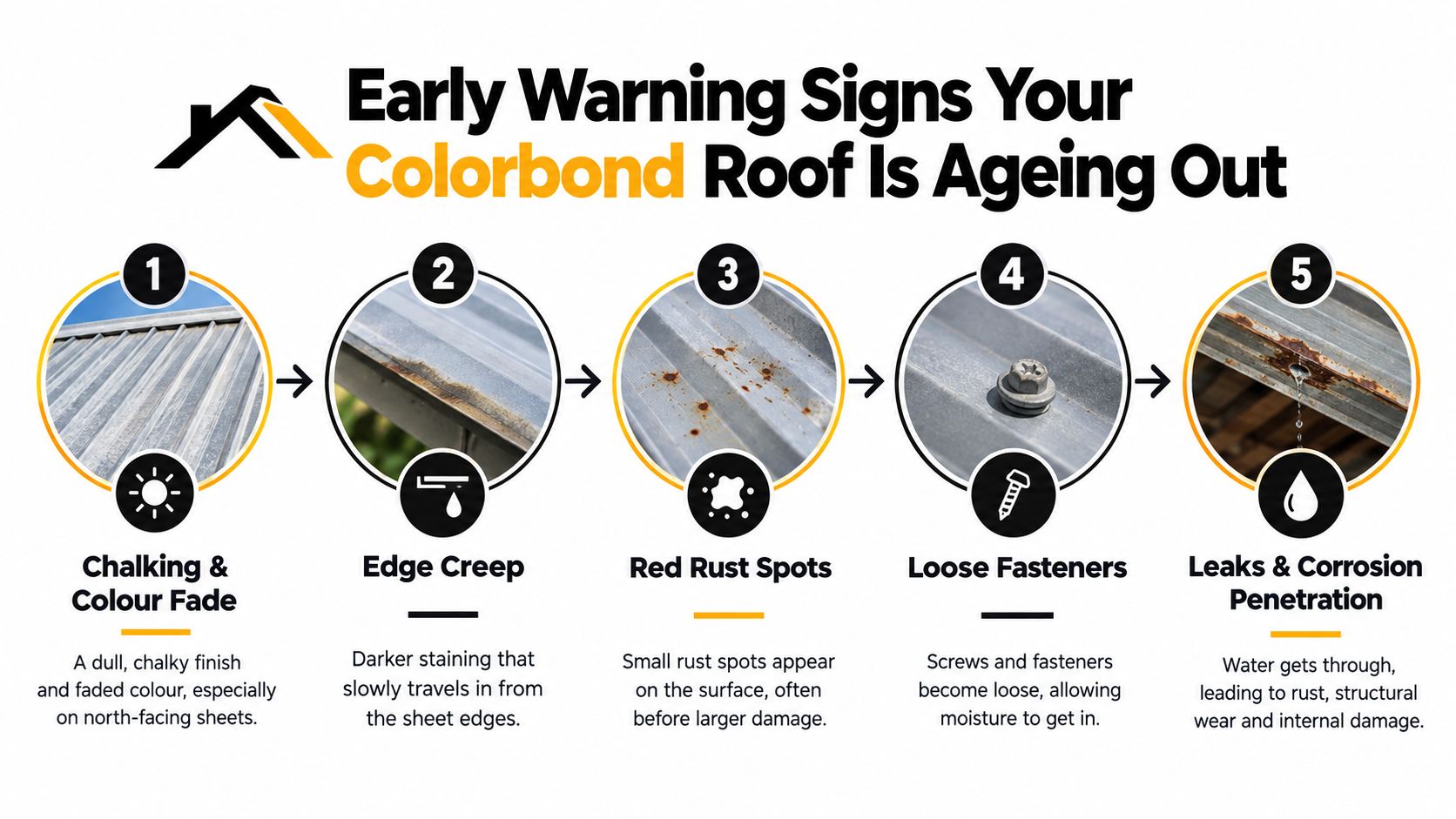
Chalking and colour fade often appear first on exposed or north-facing sheets. A change in appearance doesn't automatically mean the steel is failing. It does indicate that the coating needs assessment, particularly if the surface has become powdery, rough or uneven.
Edge creep deserves quicker attention. Corrosion can begin at cut edges, laps, penetrations and damaged areas where moisture remains trapped. Small rust marks around fastener heads may be repairable, but they shouldn't be painted over without finding out whether water is entering below the washer or whether the fastener itself is no longer sound.
The progression from finish damage to leaks
Loose or backing-out screws can follow years of thermal movement, installation problems or deteriorated washers. Once a fixing no longer clamps the sheet properly, wind-driven rain can enter the lap or penetration. A contractor needs to distinguish a simple fastener replacement from wider movement or support failure.
Inside the building, look for ceiling staining near skylights, damp insulation, musty odours and daylight at laps. A leak may appear away from the actual defect because water travels along a rib, purlin or insulation layer before it becomes visible.
Don't confuse a cosmetic defect with a harmless defect. Chalking may only call for coating work, while rust at a lap can signal a concealed moisture problem.
This short video gives managers another visual reference for recognising roof deterioration:
When the steel remains sound and defects are localised, cleaning, compatible touch-up work, new fasteners or flashing repairs can preserve the roof. When rust has reached broad sheet areas, laps are perforating, sheets have deformed or water is affecting insulation and internal finishes, replacement planning should begin. If repainting or coating renewal is being considered, this overview of metal roof painting by Painters North Shore helps clarify why surface preparation matters.
Lifecycle Costs and How Colorbond Compares to Other Materials
Commercial committees often ask for a single lifecycle cost figure, but a credible comparison needs the actual project quantities, access conditions, structural work and material specification. Without those details, precise dollar amounts or annual totals would be misleading. The useful comparison is therefore qualitative, using the same questions for each roof type.
Compare the cost lines, not just the tender price
| Cost line | Colorbond | Concrete tile | Asphalt shingle | Standing seam |
|---|---|---|---|---|
| Initial installation | Usually straightforward where the structure and drainage suit metal sheeting | Can require heavier supporting structure and careful handling | Depends strongly on substrate and commercial suitability | Often higher-detail installation with specialist labour |
| Routine maintenance | Gutters, laps, fasteners, flashings and coating checks | Cracked or displaced tiles, ridge and bedding work, moss or organic growth | Shingle condition, seals, edges and substrate moisture | Clips, seams, flashings, penetrations and coating condition |
| Restoration option | Often practical when the substrate remains sound | Repairs may be spread across many individual tiles and ridge details | Restoration depends on shingle and deck condition | Specialist seam and coating assessment required |
| Replacement trigger | Widespread perforation, deformation or structural support failure | Broad cracking, movement, failed ridge work or substrate problems | Widespread deterioration or wet substrate | Failed seams, concealed corrosion or incompatible details |
| End-of-life work | Remove sheets, flashings, fixings and affected accessories | More handling and structural considerations | Remove roofing layers and assess the deck | Specialist dismantling and replacement planning |
Colorbond's main lifecycle advantage is often predictable access to individual sheet, flashing and fixing repairs. Its low weight can also help retrofit planning where an existing structure was not designed for a heavier roof covering. That benefit still needs an engineer's confirmation, especially on older buildings.
Concrete tile can provide long service in suitable conditions, but cracked tiles, shifted units, ridge deterioration and organic growth create recurring maintenance tasks. Coastal exposure affects every material differently. Salt and moisture can attack metal edges and fixings, while porous or cut tile areas can also deteriorate. No material escapes the need for correct detailing and inspection.
For a metal roof comparison, review Zincalume and Colorbond differences. The question isn't which product has the longest brochure life. It is which system fits the building's structure, exposure, use, access constraints and maintenance capacity.
Restoration versus full replacement
A restoration package may include cleaning, corrosion treatment, compatible priming, a new coating system, replacement fasteners and flashing repairs. It makes economic sense only when inspections confirm that the substrate, supports and drainage remain reliable. A coating applied over active corrosion or dirty steel hides the defect for a short time and makes later diagnosis harder.
Standing seam systems can reduce exposed fixings and offer strong architectural control, but their installation details and repair methods differ from common pierce-fixed profiles. Asphalt shingle systems may suit some applications, yet commercial owners should assess local climate, fire requirements, maintenance access and availability of experienced installers before comparing them with steel.
Replacement Planning and When Restoration Is the Smarter Move
Restoration works when the roof is tired, not when the roof is structurally failing. The decision should start with a close inspection of the sheets, laps, fasteners, flashings, supports and internal moisture evidence, followed by separate quotes for restoration and replacement.
The supplied restoration framework uses a practical threshold: where chalking and edge corrosion affect less than 15% of sheets and fixings remain sound, a suitable restoration package may buy 12 to 18 years for under 35% of replacement cost. Those figures come from the project brief and should be treated as a decision benchmark, not a warranty. If deterioration affects more than 25% of sheets, replacement is the stronger starting assumption, while the middle range needs a detailed assessment.
Choose restoration when the structure still deserves protection
A restoration scope can include:
- Surface preparation: Remove dirt, salt, organic deposits and loose coating before corrosion treatment.
- Sheet assessment: Separate cosmetic chalking from rust at laps, cut edges and penetrations.
- Fixing renewal: Replace failed screws and washers rather than coating over them.
- Flashing repairs: Correct water paths, open joints and incompatible transitions.
- Approved coating work: Apply a compatible system to properly prepared steel, not as a cosmetic cover-up.
Full replacement becomes more appropriate where rust is widespread at laps, sheets have deformed, supporting battens have failed or the roof has spent decades in a severe marine environment. Active leaks over food-grade, healthcare or sensitive tenancy areas also raise the consequences of relying on patch repairs.
Match the decision to the asset plan
Strata managers should align the roof decision with meeting approvals, reserve planning, access arrangements and disruption to occupants. A warehouse owner should consider stock protection, roof-mounted plant and the risk of interrupting operations. Developers and builders need to verify the specification, warranties and handover records before accepting a new roof.
Obtain two replacement quotes and one restoration quote with matching scopes. Confirm whether older sections contain asbestos before any disturbance. For membrane-based restoration work, plan around reliable dry weather and require the contractor to state preparation, products, curing requirements and exclusions. A detailed metal roof restoration guide can help owners compare scopes rather than choosing by headline price.
Commercial Roofers offers commercial Colorbond inspections, cleaning, repairs, restoration and replacement across Sydney and NSW, with reporting that separates finish deterioration from substrate and detailing problems. Visit Commercial Roofers to arrange an assessment and receive a clear comparison between targeted restoration and full replacement for your building.