
You're probably looking at a tiled roof that still looks serviceable from the ground, but the leaks, slipped ridge lines, or stained ceilings keep coming back after every patch. That's the point where tiled roof restoration stops being a cosmetic discussion and becomes a commercial asset decision, especially on NSW sites where access, downtime, weather exposure, and compliance all affect the final bill. For business owners, strata managers, and facility teams, the key question is whether the roof can be returned to a stable serviceable condition without drifting into repeated repairs that never fix the underlying problem.
Table of Contents
- Understanding Restoration Versus Replacement
- Conducting Pre-restoration Inspection
- Cleaning and Tile Replacement Techniques
- Re-bedding Repointing Flashing and Sealing
- Compliance and Safety Requirements
- Timeline Cost and Contractor Selection
- Avoiding Pitfalls Warranties Maintenance and Case Studies
Understanding Restoration Versus Replacement
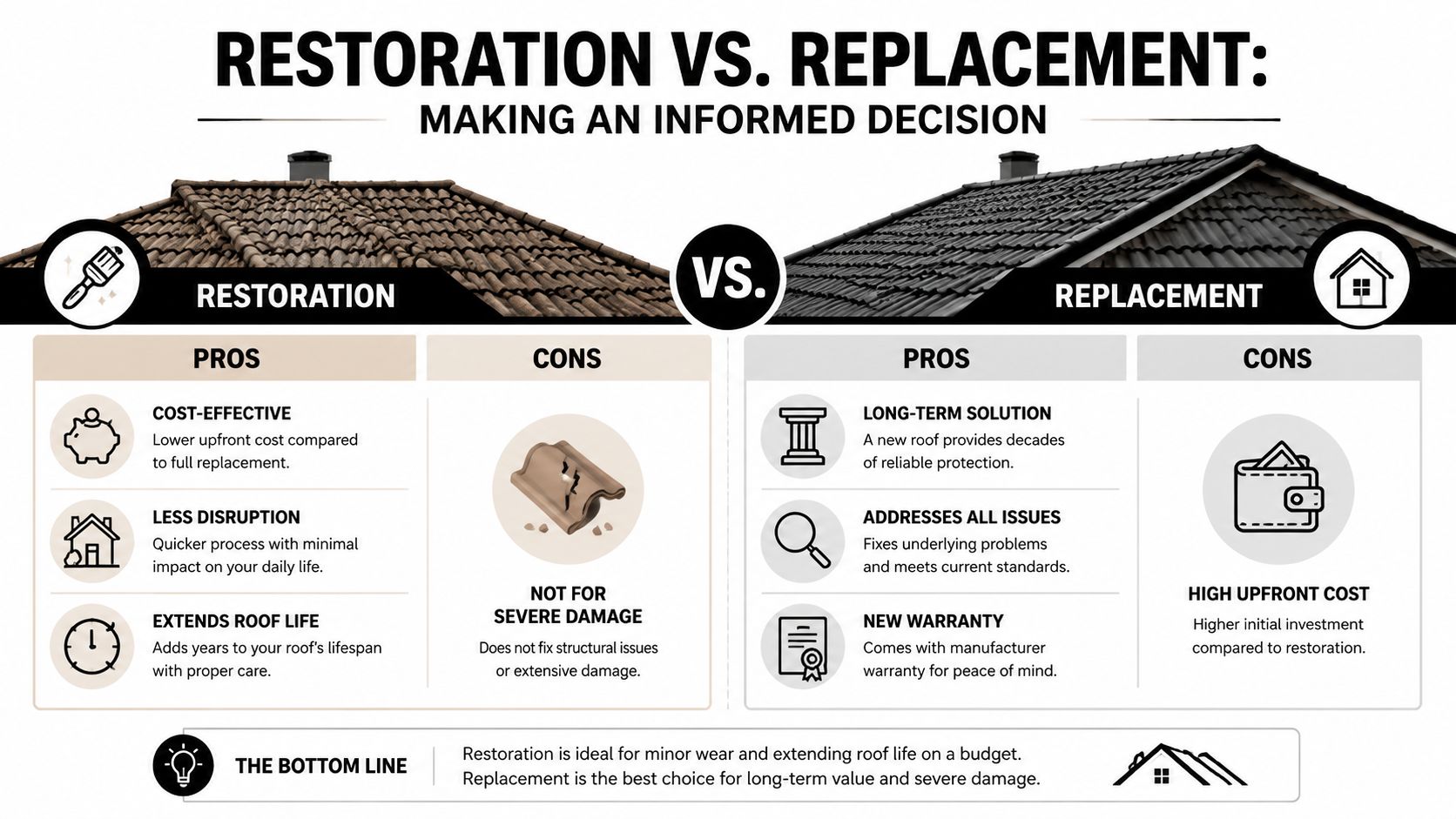
A commercial manager usually reaches this decision after the roof has already started to drain budget through call-outs, access hire, and disrupted operations. Tiled roof restoration can still make strong financial sense when the tile field is broadly serviceable, but it stops being the right answer once deterioration has moved into the underlay, widespread fixings, or repeated leak zones that keep appearing after work is done. The quote has to be tested against the roof's remaining life, the likely cost of another mobilisation, and the risk of keeping a leak-prone asset in service.
Practical rule: if the roof can complete the full sequence of cleaning, tile replacement, rebedding, sealing, and coating without recurring substrate defects during inspection, restoration is still in play.
Use defect patterns, not just roof age
Age matters, but defect pattern matters more. Australian guidance treats restoration as a lifecycle event rather than an annual repair, and one Queensland industry source says tile roofs generally should be restored every 15–20 years (Innovate Roofing). That timing helps identify roofs that may still justify renewal, but the inspection findings still decide the job.
The commercial test is straightforward. If leaks are isolated, tiles are mostly intact, and ridge bedding has failed without widespread substrate damage, restoration usually gives better value. If the roof has repeated leak history, hidden underlay failure, or enough breakage that the repair scope keeps expanding, replacement protects the asset more reliably than patch-and-coat work.
Build the decision around business disruption
Restoration usually causes less disruption than a full reroof. That matters on operating sites where access, noise, and weather windows affect tenants or production. Australian consumer-style guidance notes that restoration commonly involves cleaning, repairing, repointing, and recoating, while replacement is a much broader intervention (OZ Roof). That difference is why restoration can suit warehouses, strata buildings, and retail sites when the roof structure is still sound.
Use that lens in tender documents. Ask bidders to state whether the substrate is serviceable, whether ridge work and tile replacement are enough to stabilise the roof, and what findings would push the job beyond restoration economics. For commercial assets, the question is not whether the roof looks tired, it is whether targeted work will hold under NSW weather exposure and ongoing site use. If tile defects are localised, commercial roof tile replacement guidance can support a restoration scope without committing to a full reroof.
Conducting Pre-restoration Inspection
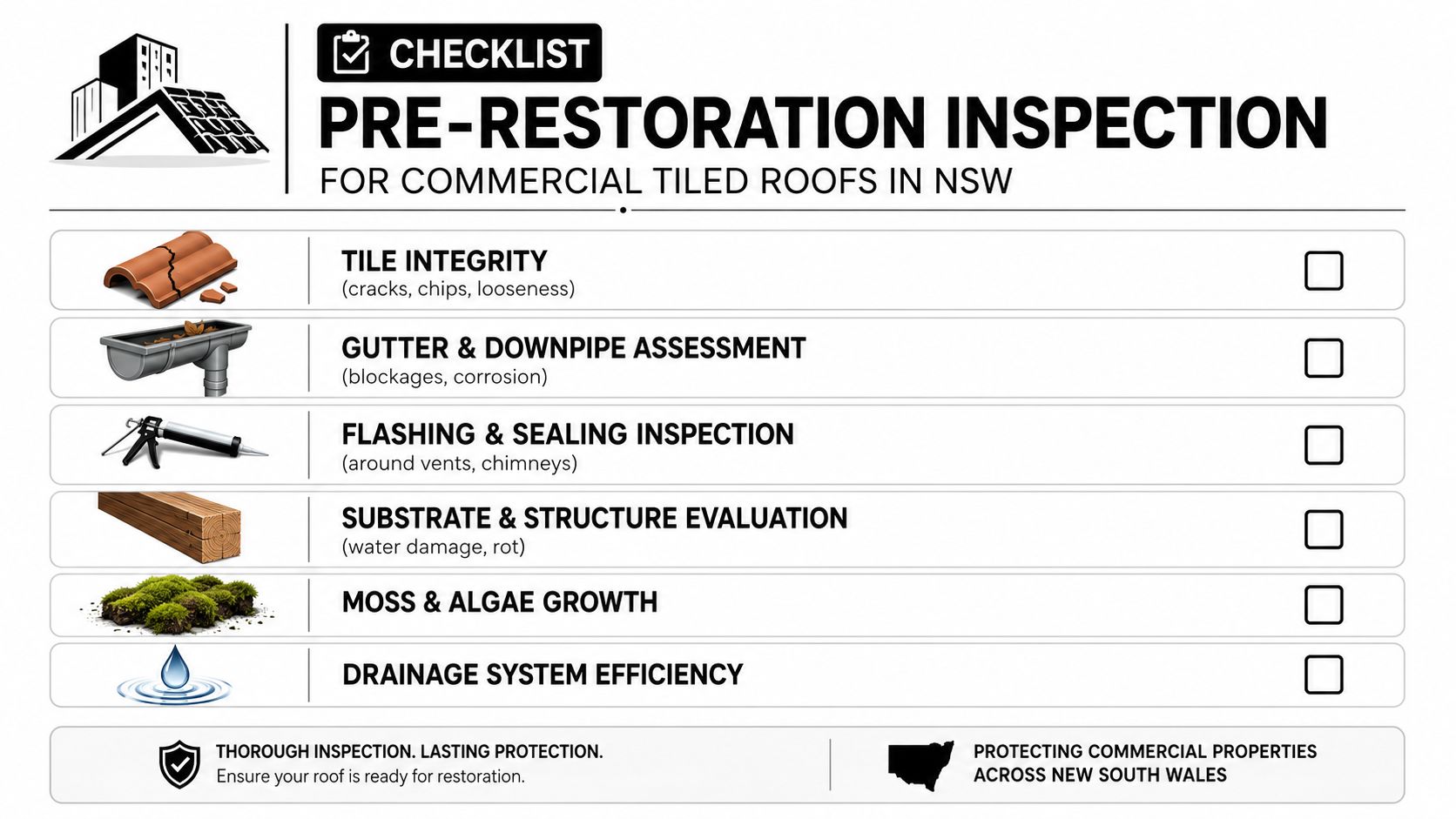
A commercial tiled roof should be inspected before anyone commits to restoration. The job starts with separating surface wear from deeper defects, because a roof that looks tired from the yard may still be serviceable, while a roof that appears only moderately aged can hide underlay failure, loose bedding, or movement at the ridges. Restoration on these roofs normally involves cleaning, replacing damaged tiles, repairing flashing and guttering, then rebedding and repointing ridge caps before coating, so the inspection has to confirm each layer is worth keeping in service.
For NSW commercial and industrial sites, the primary concern is lifecycle cost. If the roof can carry targeted repair and restoration work without opening up larger substrate problems, the asset usually gets more value from that path than from premature replacement. If the inspection finds recurring leaks, widespread tile failure, or signs that the roof structure is already beyond local repair, the scope needs to be questioned early. For tile-specific repair planning, Commercial Roofers' tile roofing repair guidance is a useful reference point.
Start with the tile field and the drainage path
Begin with cracked, chipped, loose, and displaced tiles, then follow the roof's water path. On commercial roofs, one damaged tile rarely sits alone. It often sits beside blocked gutters, tired flashings, ponding at valleys, or movement around penetrations, and that combination is what pushes a restoration from straightforward maintenance into a more complicated repair scope.
Drainage deserves close inspection. Gutters, downpipes, and valley lines that hold debris can indicate that the roof needs drainage repairs alongside the restoration, not after it. In NSW weather, heavy rainfall exposes weak detailing quickly, so the inspection needs to show whether the roof will shed water reliably once it is cleaned and recoated.
Check the hidden items before the tender closes
Ridge caps, flashing laps, and the underside of the tile field often carry the largest scope risks. Safe access, visual checks under caps, moisture tracing where needed, and close inspection of valley junctions help show what the surface alone will not reveal. If there are signs of rot, failed underlay, or movement around capped edges, the restoration quote needs a harder review before it is accepted.
Inspection notes should also explain the difference between minor repair and a wider rectification scope. That matters for owners and facility managers because it affects tender pricing, warranty discussions, and the timing of future capital work. A roof that can be stabilised with targeted restoration should be documented that way, and a roof that is already carrying hidden defects should be flagged before the contractor starts work.
The cheapest scope is often the one that finds the problem early enough to price it honestly.
Keep the records specific. On a commercial roof, the inspection file should be clear enough to support the scope, justify the repairs chosen, and explain why some defects were fixed now while others were left for later.
Cleaning and Tile Replacement Techniques
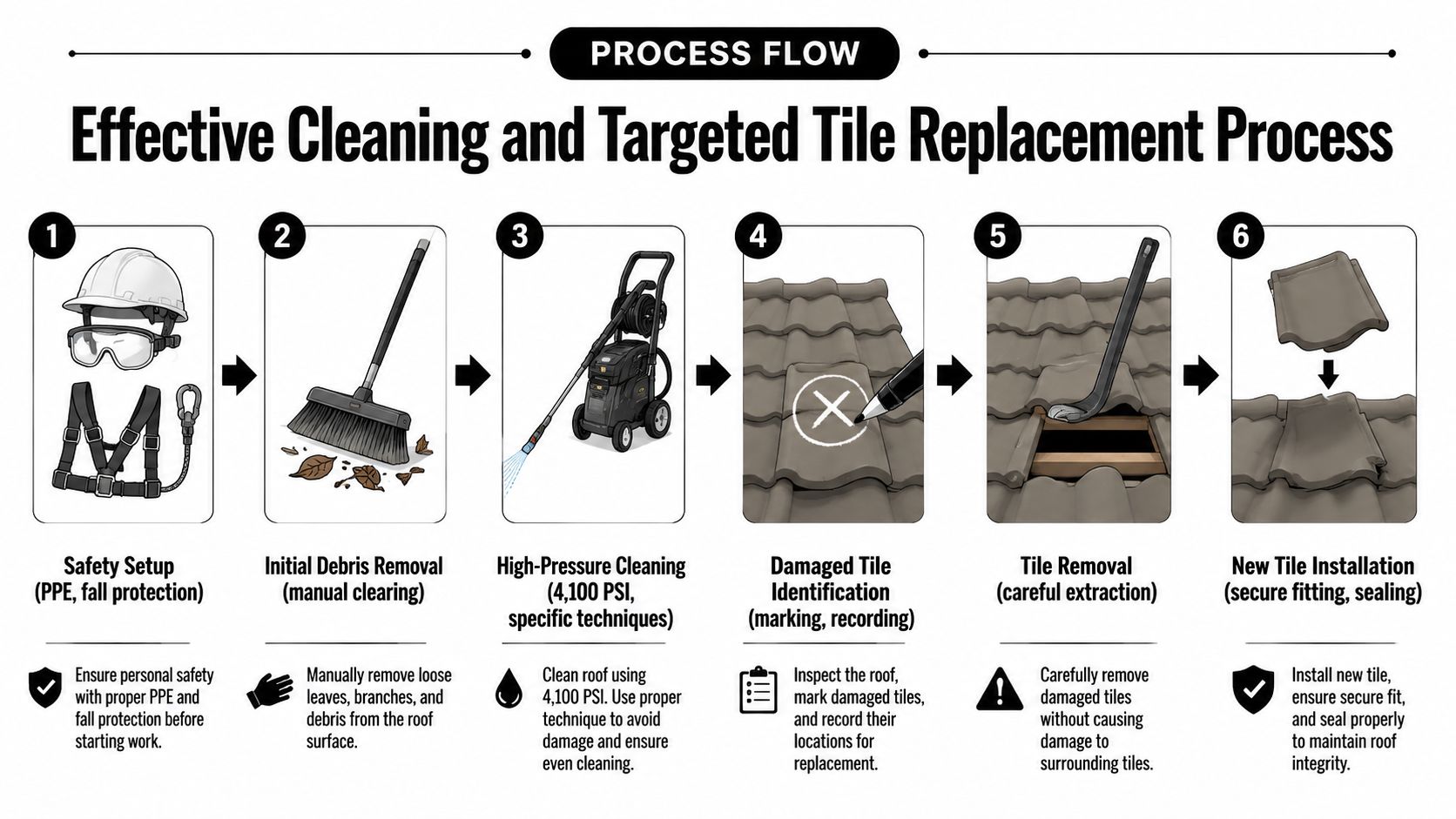
The cleaning stage often decides whether a restoration adds real service life or just improves the look for a short period. If preparation is poor, the roof may shed coating, hold moisture, or start leaking around tiles that were disturbed during the work. A sound commercial sequence is full inspection, safe access, high-pressure cleaning, replacement of cracked tiles, ridge-cap rebedding, repointing, priming or sealing, and finish coats. That order matters because each step prepares the surface for the next one, and leaving one out weakens the whole system.
Safety setup and surface preparation
Start with access control, PPE, edge protection, and containment. On a commercial roof, the job is not only about the tile field. It is also about protecting workers, tenants, vehicles, walls, and drainage points from overspray and falling debris. A rushed setup can turn a straightforward restoration into a safety incident and a cleanup problem.
Before washing starts, clear loose debris by hand and mark tiles that need replacement. That discipline saves time later because crews do not have to return to the same area after the cleaning exposes hidden cracks. It also reduces the chance of walking on unsupported sections twice.
Pressure cleaning and tile matching
One Australian technical note recommends around 4,100 PSI cleaning pressure for restoration work, followed by a full re-bed of caps and valley tiles in a 3:1 sand/cement mix and then flexible pointing plus multiple coating layers. The exact machine setup still has to suit the tile profile and the roof condition, because too much pressure can damage fragile surfaces or drive water into weak points. The aim is to remove dirt, moss, and loose coating without creating new defects.
Cleaning pressure and tile condition need to be judged together, not separately. Older clay tiles, weathered concrete tiles, and areas near ridges or penetrations often need a lighter hand than open, sound fields. If the crew is unsure, a test patch gives a better reading than guessing across the whole roof.
Matching replacement tiles matters just as much as washing them clean. Tile profile, colour weathering, and glaze variation all affect the finished result, especially on street-facing industrial and commercial buildings where patchwork repairs are easy to see. A proper crew removes damaged tiles carefully, checks the underlay beneath them, and secures the new tiles with the correct fixing pattern rather than forcing a near-match that can move under load.
For owners comparing repair scopes and lifecycle costs, commercial tile roof repair options and methods should be reviewed alongside the restoration plan. That helps separate cosmetic patching from repairs that reliably hold up through NSW wind and rain cycles.
Drying matters more than speed
Do not rush from cleaning to coating. If the roof still holds moisture in laps, caps, or under replacement tiles, the coating system can fail early and the ridge lines can stay unstable. Drying time is part of the workmanship, not an inconvenience.
On commercial roofs, the cost of waiting is usually lower than the cost of recoating a damp surface. Moisture left in hidden pockets can trap contamination, weaken adhesion, and shorten the service life of the whole restoration.
Re-bedding Repointing Flashing and Sealing
A tiled roof can look serviceable from the ground and still fail at the ridge. On commercial and industrial sites in NSW, the primary consideration is whether the roof can keep resisting wind, heat, and storm movement for another service cycle, or whether the mortar and junction detailing have already reached the point where patching only delays a larger repair. Re-bedding and repointing sit at the centre of that call. They restore the ridge system's grip, but only if the work is matched to the roof's age, exposure, and maintenance history.
Ridge caps and mortar work
Ridge caps need a sound bed, even joints, and mortar that suits the roof system. Trade guidance often specifies a 4:1 brickies loam-to-cement mix for re-bedding, while other technical specifications use a 3:1 sand/cement mix for rebedding ridge caps and valley tiles, then flexible pointing and coating layers. The practical lesson is simple. The crew should follow the specification that matches the roof condition and the chosen system, because mixing methods or leaving bedding uneven can create movement that later opens cracks in the pointing.
On larger roofs, the trade-off is speed versus stability. A fast mortar job can get crews off the roof sooner, but it usually shortens the life of the ridge work if the caps are not bedded onto clean, stable surfaces. Set the caps firmly, keep the lines straight, and protect exposed edges while the mortar cures. Where site conditions require it, temporary edge protection and harnesses are part of the job, not an add-on. That is especially relevant on long commercial runs, where access points, parapets, and service equipment can make the work awkward.
Flashings, junctions, and water paths
Flashings often decide whether a restoration holds through the next storm season. The tiled field may still be intact while penetrations, parapet junctions, valleys, gutters, and changes of plane start letting water in. That risk is higher on mixed-age buildings, where earlier repairs, movement in the structure, or old detailing can leave weak points that only show up under driving rain. Commercial roofers working to Australian roofing standards and compliance requirements should treat those junctions as part of the restoration plan, not a last-minute touch-up.
Use a site check that focuses on how water moves:
- Ridge lines: confirm the bed is firm and the pointing can still flex with thermal movement.
- Valleys: clear blockages and make sure runoff can move without backing up.
- Penetrations: check seals, laps, and transitions around vents and service points.
- Gutters: verify fall, alignment, and corrosion before final sealing.
That approach is more useful than guessing from the surface finish. A ridge cap can look tidy and still be poorly tied into the roof's drainage path. If the junctions are not right, the coating will not fix them.
Primers and finish coats
Primers and sealers only perform on dry, stable surfaces. If they go over damp mortar, hidden moisture can sit under the coating, reduce adhesion, and leave ridge sections loose later. The restoration sequence has to be followed in order, because the waterproofing layer and the ridge structure depend on each other. Skipping the drying window or coating before the substrate is ready usually costs more than waiting for the roof to be ready.
The safest rule is straightforward. If the mortar is still green, the coating has gone on too early.
Compliance and Safety Requirements
Commercial tiled roof restoration in NSW needs to satisfy more than the roof owner. Workers, contractors, tenants, insurers, and auditors all care about how the job was planned, who touched the roof, and how hazards were controlled. That's especially true where older buildings may contain asbestos-related materials, brittle substrates, or access conditions that make a simple repaint impossible without proper controls.
Safety controls have to be documented
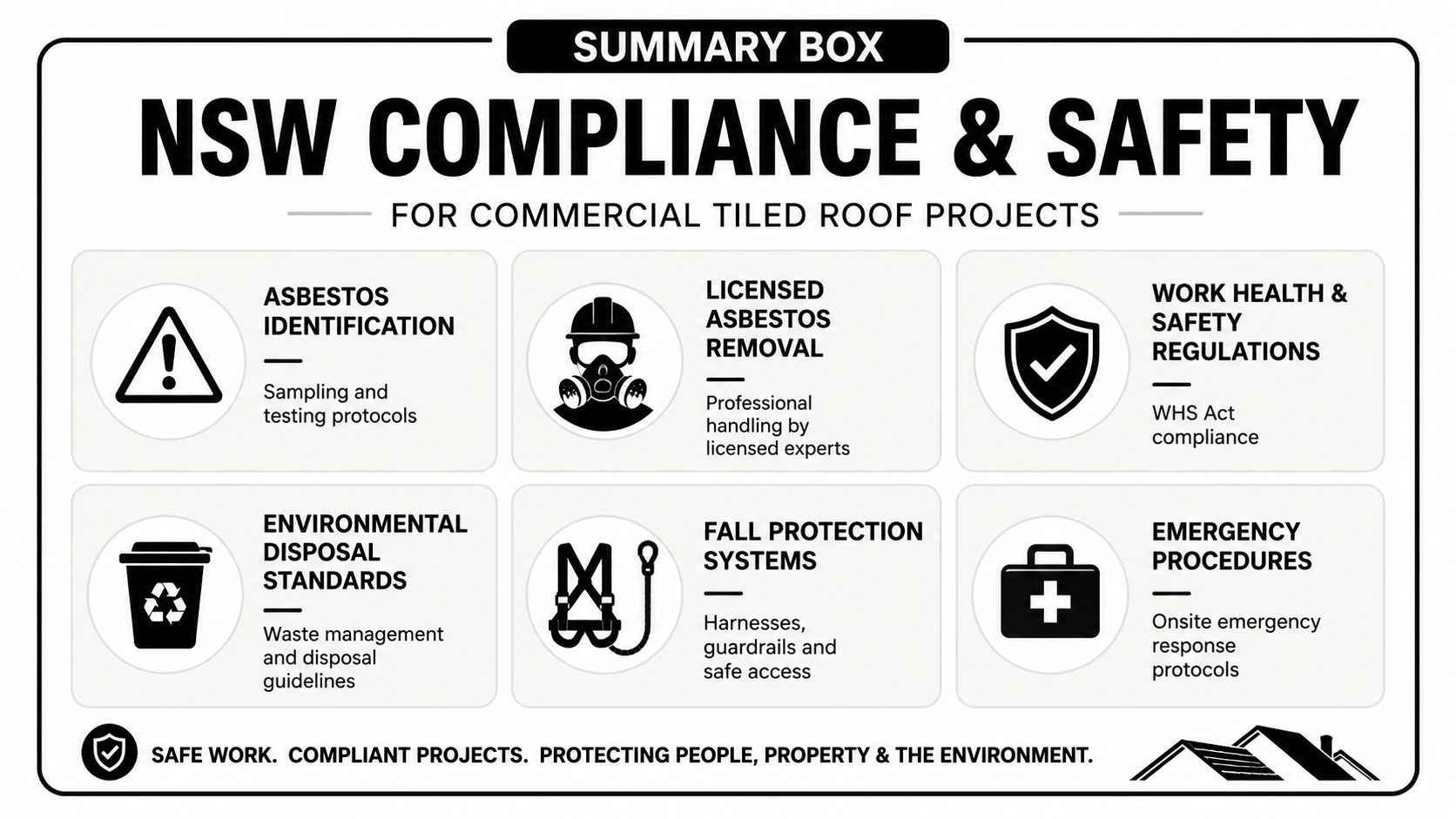
Fall protection, edge protection, harness use, and emergency procedures need to be in place before work starts. That's not just a site-safety preference, it's part of a defensible restoration program that can stand up to insurance scrutiny and internal audit. Documentation matters because it shows the roof was treated as a controlled commercial worksite, not a casual maintenance task.
Asbestos handling is a separate issue. If suspect materials are found, sampling, testing, licensed removal, and compliant disposal have to be handled under the proper NSW and Australian work health and safety framework. On sites with mixed-age construction, that can affect access planning, containment, and the order of works.
Standards and local pressure points
The roof specification should also align with relevant Australian Standards, including waterproofing and safety mesh requirements where they apply. For NSW commercial sites, the practical challenge is often not the standard itself, it's proving that the work sequence and the materials selected still suit a roof exposed to storm-driven water and heavy service use. The restoration should be judged on its durability in local weather, not on whether it only looks refreshed from street level.
Compliance note: a restoration that ignores detailing, access control, or waste handling can become a liability even if the coating looks clean on handover.
Commercial teams often work with contractors such as Commercial Roofers or other licensed providers that document inspections, safety controls, and handover records. The value is not the branding, it's the traceability, because a clear paper trail helps the owner defend the project later if a defect or insurance question comes up.
Australian roofing standards reference for commercial sites
Timeline Cost and Contractor Selection
Budget and schedule are where tiled roof restoration decisions become real. On the Australian market, guidance from Aussie Roof Revival places tiled roof restoration at $4,500–$10,000 in 2026, with a broader restoration range of $4,500–$12,000 depending on roof size, condition, and repair scope. Other national-market guidance positions tile-roof restoration at roughly $25 to $65 per square metre, while tile repairs alone are usually quoted at $55 to $65 per square metre (hipages). That spread matters because it shows restoration is priced as a full maintenance job, not a cosmetic repaint.
Benchmark the quote against roof area
| Roof Area (m²) | Restoration Cost ($/m²) | Replacement Cost ($/m²) |
|---|---|---|
| 150 to 200 | 25 to 65 | Not stated in verified data |
| Larger commercial roofs | 22 to 28 for medium roofs | Not stated in verified data |
For a standard single-storey home with 150–200 square metres of roof area, expected spend is about $6,500–$9,000. That figure is a useful benchmark, but commercial roofs can fall outside it because access, setup, containment, and weather windows affect labour more heavily. Fixed costs spread better across larger roofs, so unit pricing often falls as roof area increases.
Commercial and industrial tiled roofs in NSW add another layer of cost pressure. Traffic management, plant access, working around tenants, and staging works to suit weather windows can push a quote well beyond a simple area rate. A warehouse roof that needs partial shutdowns or staged access should be priced differently from a low-risk residential job, because delay and re-mobilisation are real costs.
Judge the contractor on what they inspect
The strongest quote is the one that explains hidden damage risk clearly. Ask the bidder how they checked for substrate failure, whether the ridge bedding is serviceable, and what gets excluded if the roof cannot complete the full restoration sequence. A contractor who gives a simple number without the inspection logic usually has not priced the full scope.
Look for clear insurance details, labour and material warranty terms, and a schedule that respects drying time and weather constraints. On commercial roofs, a hurried start often causes more disruption than a well-sequenced week of works, especially when staging, access, and storm forecasts all matter. In NSW, the contractor should also be able to explain how their program fits site rules, tenant access, and any local compliance steps that affect occupied buildings or sensitive operations.
Avoiding Pitfalls Warranties Maintenance and Case Studies
The most expensive restoration mistake is not poor coating, it's pretending a restoration can solve hidden structural failure. In commercial work, the failure pattern is usually familiar, a roof gets cleaned, a few tiles get swapped, and the quote skips the underlying underlay or ridge problem because the issue wasn't obvious at tender stage. That's how a supposedly economical job becomes a repeat call-out.
What goes wrong when scopes are too narrow
A common warning sign is a roof that keeps leaking after patch repairs but never gets a proper inspection beneath the ridge line. Another is coating laid over damp mortar or unstable surfaces, which can leave premature failure and warranty arguments later. A restoration only makes sense when the roof can support the full sequence of cleaning, tile replacement, rebedding, sealing, and coating without hidden defects breaking the system again.
Use warranties and maintenance as part of the asset plan
Ask for warranty terms that match the actual scope, not just the headline price. Material warranties matter, but workmanship and follow-up inspection matter just as much because the roof's condition after handover depends on installation quality and ongoing care. Keep a maintenance schedule that includes periodic visual checks, gutter clearing, and quick review of ridge lines after major storms.
A commercial restoration should leave the owner with more than a shiny roof. It should leave a documented asset history, a realistic maintenance plan, and enough condition data to decide whether the next intervention is another restoration, a partial repair, or a staged replacement.
If you're planning a tiled roof project on a commercial or industrial site in NSW, book a roof condition assessment before you lock in a scope. A documented inspection will tell you whether restoration still makes commercial sense, or whether replacement will protect the asset with less risk over time.