
A lot of commercial roof decisions start the same way. Someone notices a stain on insulation, a drip near stock, or rust around a lap joint, and the first reaction is to patch the obvious leak and move on. That can buy time, but it rarely solves the underlying problem on an ageing metal roof.
For warehouses, factories, strata complexes and retail sites in NSW, metal roof restoration sits in the space between minor repair and full replacement. Done properly, it can protect operations, defer capital spend and bring an older roof back to serviceable condition without the disruption of a complete tear-off. Done badly, it's just paint over defects.
The difference comes down to diagnosis, preparation, compliance and scope. If your roof has failed sealant, corroded fasteners, coating breakdown or isolated sheet damage, restoration can make sound financial sense. If the roof geometry is trapping water, the pitch is non-compliant, or corrosion has gone too far, restoration may only delay a bigger problem.
Table of Contents
- Beyond a Patch Job The Strategic Value of Restoration
- Signs Your Commercial Metal Roof Needs Restoration
- The Professional Restoration Process Explained Step by Step
- Coatings Materials and Critical Compliance Standards
- Restoration vs Replacement A Cost and Lifespan Analysis
- Managing Your Project Timelines Safety and Site Impact
- FAQs About Commercial Metal Roof Restoration
Beyond a Patch Job The Strategic Value of Restoration
It usually starts with a leak bucket in a plant room, a stained ceiling over a tenancy, or water tracking toward electrical services after a hard storm. At that point, the roof issue is no longer isolated to the roof. It is affecting operations, safety, maintenance budgets and, in some buildings, tenant confidence.
Restoration makes sense when the roof is still structurally recoverable and the objective is to get more service life from an existing asset without the cost and disruption of a full replacement. Done properly, it shifts spending away from recurring emergency repairs and toward a controlled program of defect correction, waterproofing renewal and lifecycle extension.
Restoration is an asset decision, not just remedial maintenance
A commercial metal roof works as a system. Sheets, laps, fasteners, flashings, penetrations, gutters and coatings all have to perform together under movement, UV exposure and heavy rain. If one part keeps failing, patching that point alone rarely fixes the cause.
That is why a sound restoration scope goes beyond washing and recoating. It examines whether corrosion is active, whether fixings are losing grip, whether laps are opening under thermal movement, and whether drainage falls are allowing ponding water to sit where it should clear. On many NSW sites, ponding is the issue that gets missed. A new coating over standing water areas will not give you a durable result. It often traps the same failure pattern under a cleaner surface.
I tell clients to listen carefully to how a contractor talks about the roof. If the first conversation is about colour, reflectivity or presentation, you are hearing about finishes. If the conversation starts with substrate condition, drainage behaviour, safe access, detailing and sequencing, you are hearing about restoration.
What owners actually gain from a well-scoped restoration
The main return is control. You reduce leak-related callouts, slow further corrosion, improve inspection outcomes and buy time to plan capital works properly instead of approving a replacement under pressure after the next major rain event.
There is also a compliance and risk-management benefit. Commercial roof work in NSW has to be planned around current WHS obligations, access controls and site-specific hazards. Older roofs were often built before current expectations around edge protection, penetrations, fragile areas, service coordination and maintenance access were applied consistently. A restoration project is one of the few points in the asset lifecycle where those issues can be assessed and corrected as part of the works, rather than left to create risk for the next contractor or your in-house team.
That has practical value for facilities managers. A roof that is easier to access safely and inspect properly is cheaper to maintain.
Restoration does have limits. It will not correct major structural failure, widespread substrate loss or roof geometry that guarantees chronic drainage problems unless those defects are specifically designed into the scope and are feasible to rectify. The right decision comes from inspection, not optimism. If the roof is recoverable, restoration is often the smarter asset-management move. If it is not, you are better off identifying that early and budgeting for replacement on your terms, not the weather's.
Signs Your Commercial Metal Roof Needs Restoration
A commercial metal roof rarely goes from serviceable to failed in one storm. The pattern is usually slower and more expensive than that. A few minor leaks, some staining around fasteners, water sitting where it should drain, then another wet season exposes how much condition the roof has already lost.
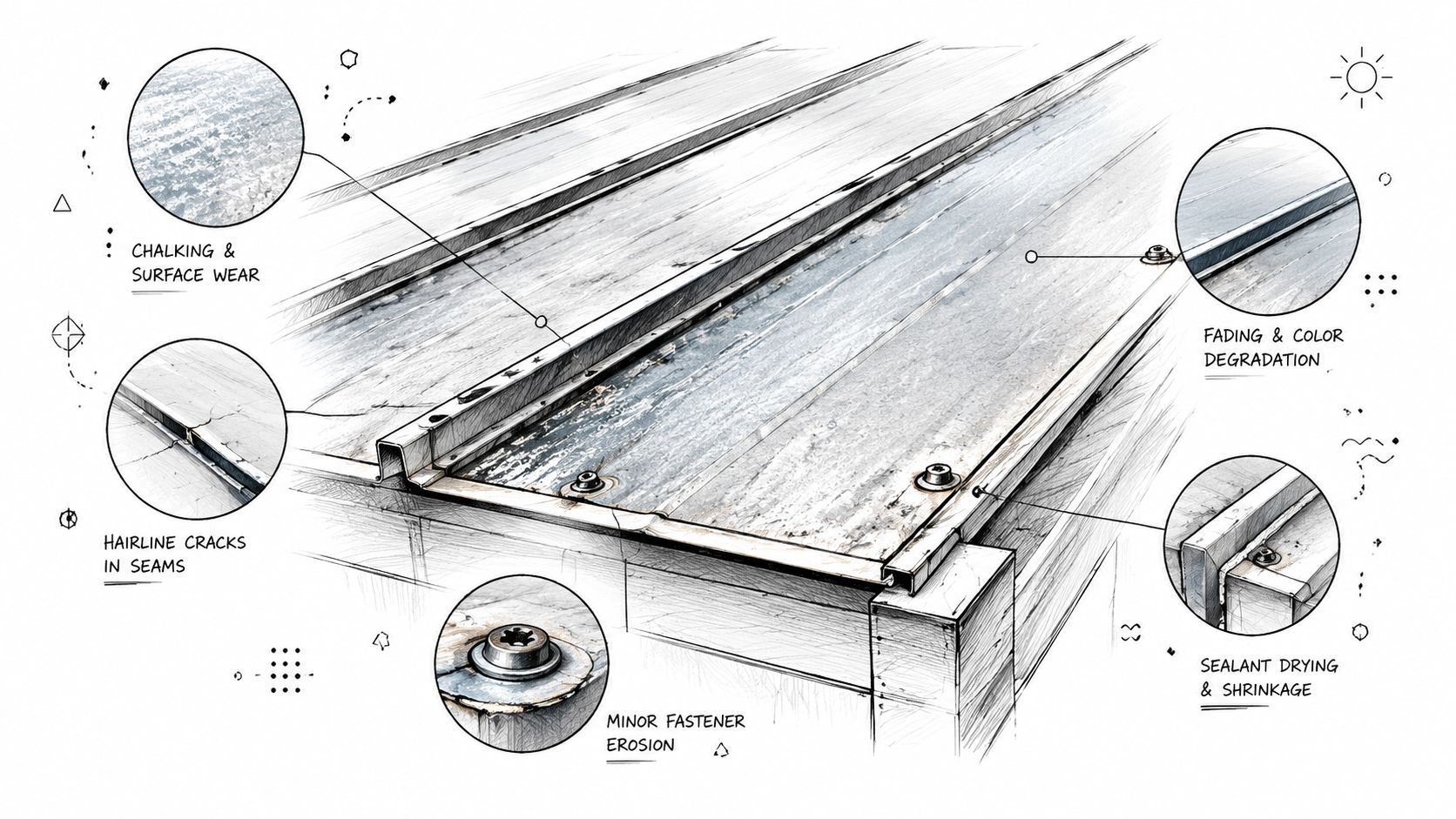
For facilities managers and owners, the job is to separate cosmetic ageing from signs that the roof is no longer protecting the asset properly. That decision affects maintenance budgets, compliance risk and whether you can plan works in an orderly way or end up responding after water reaches stock, ceilings or plant.
What you can spot from the ground and during access-safe checks
Some signs are straightforward. Visible rust, recurring leaks and loose sheets need investigation. Others are less obvious but often show up earlier.
Look for:
- Fading or chalking coatings that show the original protective finish has broken down and UV exposure is reaching the substrate.
- Cracked, split or shrunken sealant around penetrations, ridge caps, flashings and service entries.
- Fastener deterioration such as backed-out screws, failed washers, corrosion at fixing points or staining below fixings.
- Lap and joint movement where separation is opening water paths during wind-driven rain.
- Box gutter distress including debris build-up, overflow marks, staining, corrosion at laps and local sagging.
These defects matter because leak paths on commercial roofs usually start at details, not across the middle of a sheet. A roof can still present well from the car park while failing at fixings, laps, gutters and penetrations across the whole building.
The red flags owners miss most often
The most commonly missed issue on low-slope commercial metal roofs is ponding water.
If water sits on the roof after rain, the problem is no longer just surface wear. Standing water speeds up corrosion, shortens coating life and often points to a broader issue with falls, deflection, blocked drainage, poorly set penetrations or previous repairs that changed water flow. On warehouses and industrial buildings in NSW, this is one of the clearest signs that a basic patch-and-coat scope will not be enough.
The warning signs are usually consistent:
- Tide marks or dirt rings where water regularly sits and evaporates.
- Concentrated corrosion in low spots while surrounding areas remain in fair condition.
- Repeat leaks after rain even though obvious penetrations or flashings have already been patched.
- Blistering or premature coating failure in the same locations each season.
- Overflow staining near gutters, sumps or rainwater heads that suggests drainage capacity or flow path issues.
I see this missed often on ageing commercial roofs. The contractor fixes the leak entry point but does not correct why water is staying there. The result is another callout, another invoice and no real improvement in roof life.
Areas that hold water need diagnosis before coating starts. If the fall is wrong, the coating will wear first and the leak will return.
If several of these signs are present at once, the roof needs a proper condition assessment. That inspection should determine not just where water is getting in, but whether the roof still has a sound substrate, workable drainage and a restoration scope that will hold up under commercial use.
The Professional Restoration Process Explained Step by Step
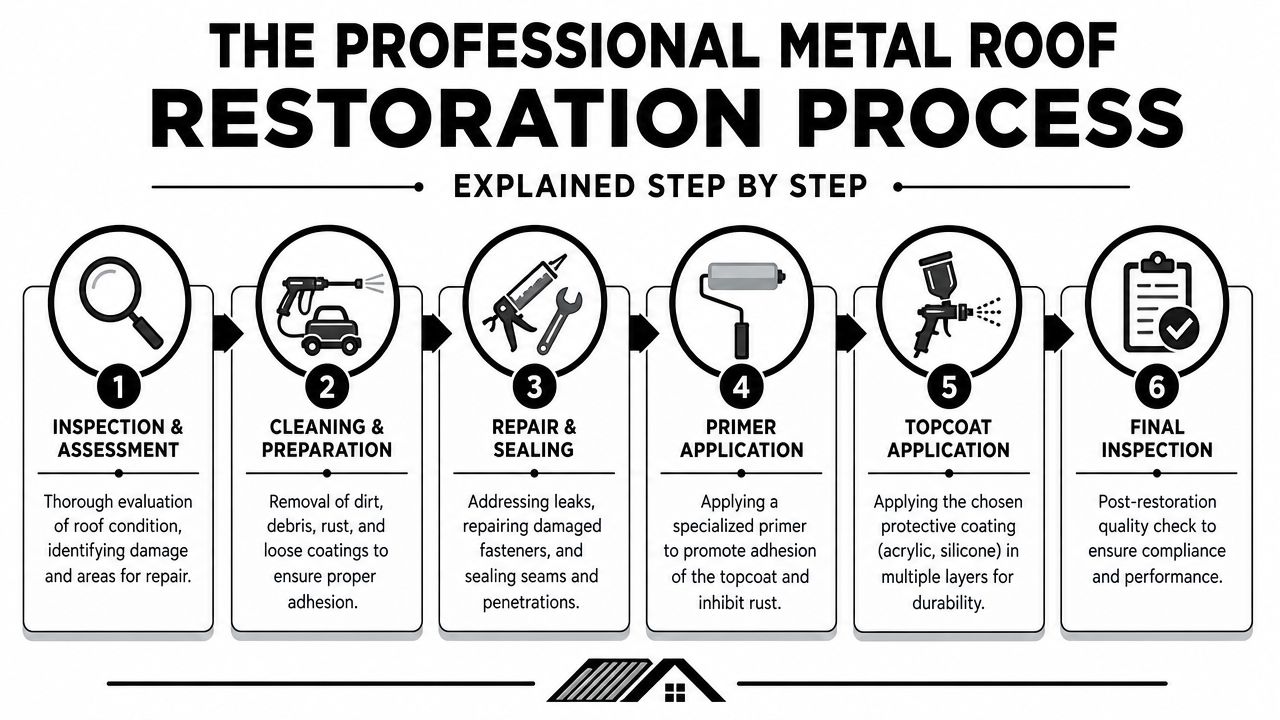
A commercial metal roof restoration succeeds or fails before the finish coat goes down. The outcome depends on inspection quality, substrate preparation, repair discipline and site control. If any of those are rushed, the coating becomes an expensive cosmetic layer rather than a long-term asset treatment.
What happens before coating starts
The first site visit should do more than confirm there is a leak. It should establish whether the roof is a good restoration candidate, what has to be repaired first, and where the scope must go beyond cleaning and recoating. On commercial buildings in NSW, that includes checking sheet thickness loss, fastener pull-out, movement at laps, flashing condition, gutter capacity, service penetrations, safe access and any areas where ponding suggests the roof geometry has changed over time.
Then the roof is cleaned properly. That usually means pressure washing to remove dirt, salts, oxidation, biological growth and loose surface material so the repair products and coating system can bond to sound substrate. Cleaning also exposes failed sealants, split laps, missed perforations and corrosion that were hidden under debris.
This is the point where a contractor earns their keep.
A sound pre-coating scope usually includes:
- Detailed defect marking so every failed area is identified before repairs start.
- Surface cleaning to remove contaminants that interfere with adhesion.
- Rust removal and treatment at affected sections, followed by the correct primer for the substrate condition.
- Repair of fasteners, laps, flashings and penetrations so water entry points are closed before coating.
- Local sheet replacement where metal loss or distortion makes restoration unreliable.
- Drainage correction measures in low areas where water retention would shorten system life.
That last item is often missed. If water is sitting on the roof because of deflection, blocked outlets or poor falls around plant and penetrations, the process has to address that cause. Otherwise the owner gets a fresh-looking roof with the same failure pattern.
For facilities managers reviewing tenders, weak scopes stand out. If the proposal says “clean, prime and coat” without listing repairs, detail treatment and drainage assessment, it is not a full restoration methodology.
| Stage | What should happen |
|---|---|
| Assessment | Defects, corrosion zones, drainage issues and access constraints are mapped and recorded |
| Cleaning | Contamination, chalking and loose material are removed so adhesion starts on sound metal |
| Repair | Failed fasteners, sheet laps, flashings, penetrations and damaged areas are repaired or replaced |
| Priming | Primer is selected for the substrate and corrosion condition, not used as a generic step |
| Detailing | Seams, fasteners, joints and high-risk transitions receive reinforcement and sealing |
| Coating | The specified system is applied at the required build, with wet and dry film checks |
A visual overview helps owners understand the workflow before work starts.
How the roof is rebuilt into a weathering system
After repairs are complete, the roof is treated as a system, not a collection of isolated defects. Fastener lines are sealed. Sheet laps are reinforced where needed. Flashings and penetrations are detailed to handle movement, water flow and service interfaces. Valleys, gutters and discharge points get closer scrutiny because they carry concentrated water load and often fail first.
Primer and coating application comes after that groundwork, not before it. On better-run projects, application is checked against the specification on site, including coverage rates, curing conditions and film build. If reflective performance is part of the business case, the coating choice also needs to match the roof's exposure and drainage behaviour, not just the desired finish colour. A good contractor should be able to explain where a reflective roof coating system for commercial buildings will help and where repair work matters more than solar reflectance.
The practical point is simple. Different roof details fail in different ways, so they need different treatment. Fastener heads need sealing and, in many cases, replacement. End laps need continuity. Penetrations need flexible detailing around movement points. Corroded sheets need an honest decision on whether they can be retained.
A coating system performs only as well as the substrate and detailing under it.
Ask direct questions before approving the scope. Which sheets will be replaced rather than coated over? How will failed washers and oversized fastener holes be handled? What is the plan for low areas that hold water? How will rooftop services affect access, sequencing and WHS controls? Clear answers at this stage usually mean fewer surprises, fewer shutdowns and a restoration that holds its value.
Coatings Materials and Critical Compliance Standards
Most owners focus first on the coating brand or finish colour. In practice, system suitability matters more than marketing language. The best coating on the wrong roof, or over the wrong preparation, won't perform.
Why coating choice matters less than system design
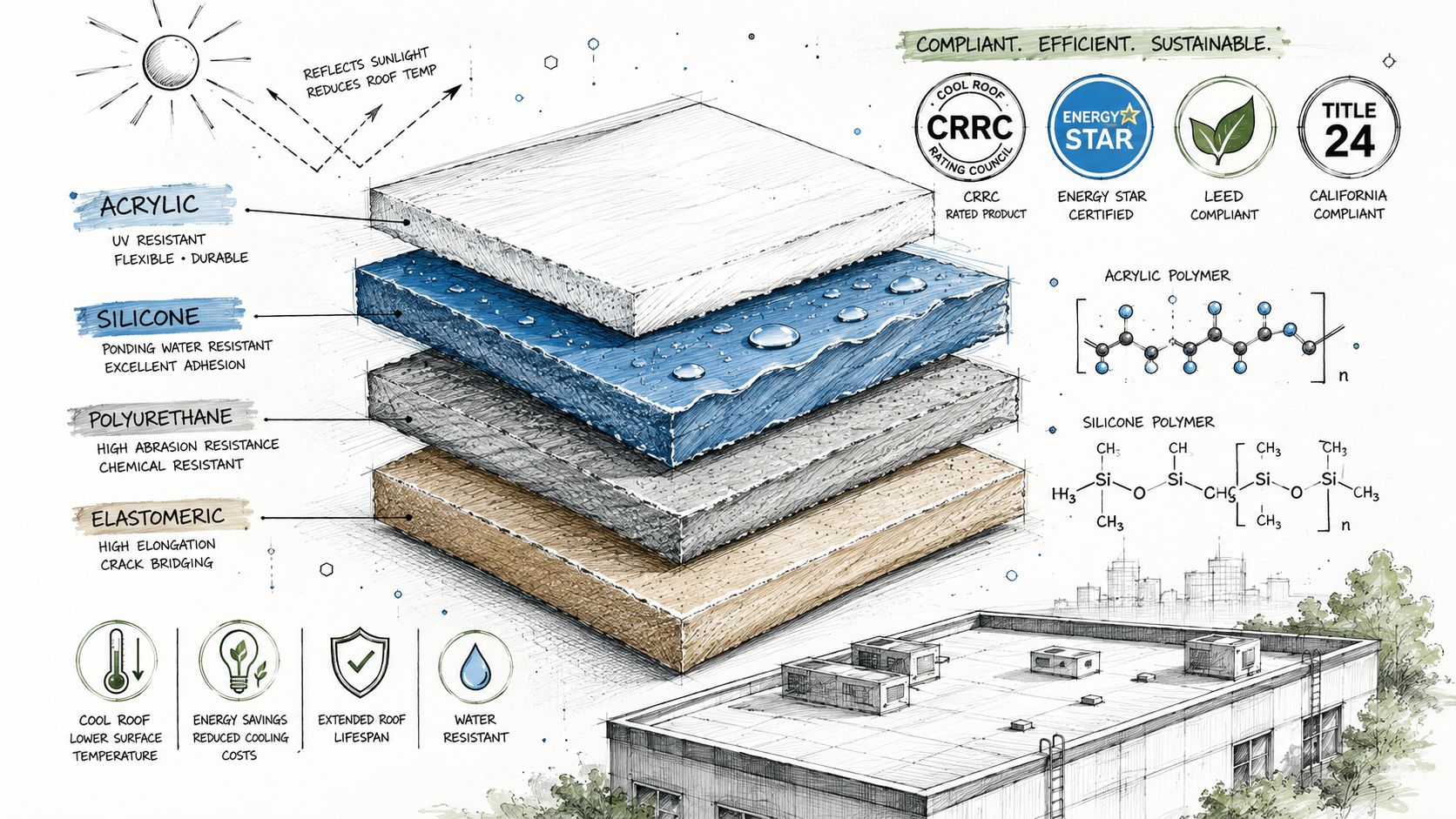
Commercial metal roof restoration in Australia commonly uses acrylic, silicone-modified polyester or polyurethane-based systems, depending on the roof condition and specification. What matters is compatibility with the substrate, drainage behaviour, exposure conditions and required detailing at seams and penetrations.
For liquid-applied polyurethane systems, restoration coatings must achieve a minimum dry film thickness of 50 dry mils (about 1.27 mm) over seams, fasteners and penetrations, with a finish coat thickness of 10 to 15 mils (about 0.25 to 0.38 mm) for warranty ranges cited in the technical guideline from this roof restoration specification document. That same document notes sealing fastener heads with 60 wet mils extending 1.5 inches radially to reduce corrosion migration.
That's a useful benchmark because it shows how serious restoration differs from ordinary painting. High-risk details need reinforced build thickness. They can't be treated the same as broad sheet pans.
In coastal and industrial parts of Sydney, fixings and coating specification also need closer scrutiny. The same technical guide notes that Ultra or Stainless-grade fixings and coatings may be needed near surf or heavy industry to avoid early corrosion and to satisfy warranty conditions.
If thermal performance is part of your brief, it's also worth reviewing how reflective roof coating systems fit into the restoration strategy rather than treating reflectivity as an afterthought.
The compliance checks that can't be skipped
A restored roof still has to behave like a compliant roof. In Australia, AS 1562.1:2018 sets minimum pitches to prevent capillary leaks. Corrugated profiles require at least 5 degrees, trapezoidal ribbed profiles require 2 degrees, and concealed clip-fix profiles are tested down to 1 degree only with sealed laps, according to this commercial roofing guide covering AS 1562.1:2018.
That standard matters on NSW warehouses because many older roofs run at very low pitch. If the existing profile is below its minimum, restoration won't change the underlying capillary risk. Water can continue to track at laps, and sealants won't permanently fix a profile used outside its design conditions.
For owners, the practical takeaway is simple:
- Check the roof pitch against the profile type before approving restoration.
- Check drainage behaviour at low points rather than assuming new coating will overcome water path defects.
- Check flashing materials because specialised metals such as lead, zinc or copper may require specialist trades and methods.
- Check fixing specification where the site sits near salt or industrial fallout.
Compliance isn't paperwork after the fact. It's part of deciding whether the roof is even a restoration candidate.
Restoration vs Replacement A Cost and Lifespan Analysis
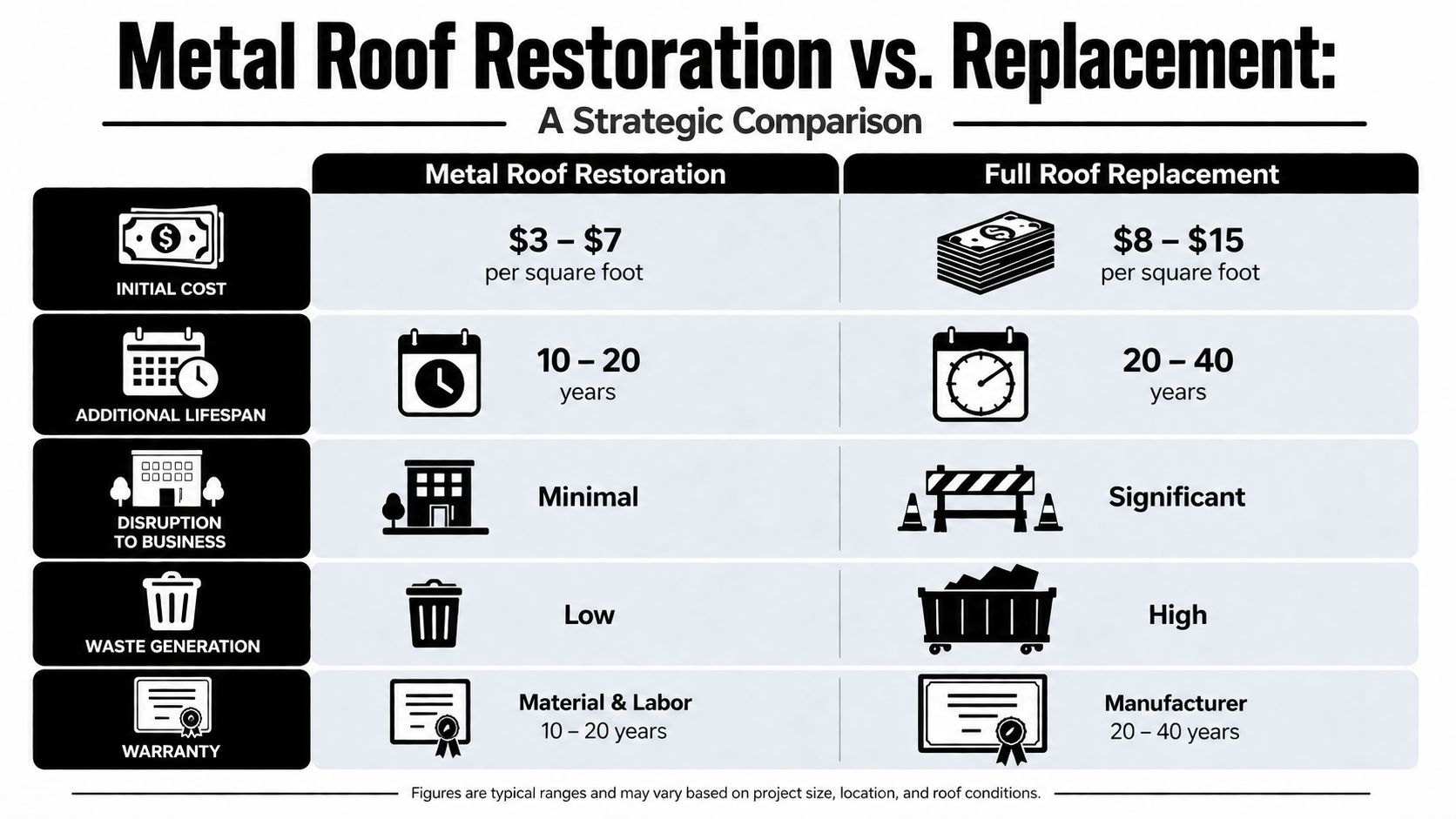
A facilities manager usually reaches this decision after the second or third leak event, when patch repairs have started to consume maintenance budget and tenants are losing patience. At that point, the question is not whether to spend money on the roof. The question is whether that money buys another service cycle or just postpones a larger failure.
The right call depends on substrate condition, corrosion level, drainage behaviour, roof geometry and compliance exposure. Age matters, but age alone does not decide it.
Where restoration usually wins
Restoration usually delivers better value where the roof sheet is still structurally recoverable, fixings can be upgraded, laps and penetrations can be detailed properly, and drainage defects are limited enough to correct without rebuilding the whole system.
In Sydney and wider NSW, the average cost for a complete metal roof restoration in 2025 ranges from $4,500 to $11,000, while metal roofing systems like Colorbond are typically priced at about $48 to $58 per square metre for restoration work, according to this NSW roof restoration cost guide. The same source notes that tile roof repairs average $55 to $65 per square metre, and that full restoration commonly allocates 20 to 30% of project cost to repairs and 30 to 40% to materials such as sealants, membranes and UV-resistant coatings.
For commercial owners, the appeal is straightforward. You keep the existing roof system in place, avoid immediate strip-and-dispose costs, and reduce disruption to warehousing, retail trading, plant operation or tenant access. That operational advantage has real value, especially on live sites where replacement creates more exposure to weather, access constraints and service interruptions.
| Option | Typical Sydney pricing |
|---|---|
| Metal roof restoration | $48 to $58 per square metre |
| Full commercial metal re-roof | $65 to $140 per square metre in 2026 projections |
For broader context on profiles, materials and new-build roof assemblies, this guide to metal roofing in Australia for commercial projects helps when you are comparing a restoration scope against full replacement.
When replacement is the smarter asset decision
Replacement becomes the better asset decision when the roof has moved past recoverable defects and into system failure. Common examples are widespread corrosion at laps and fixings, repeated leaks tied to low-pitch water tracking, extensive ponding that cannot be corrected within a restoration scope, or a roof configuration that falls short of current safety and access expectations.
A Sydney-focused commercial guide states that restoration costs approximately $48 to $58 per square metre, while full replacement ranges from $65 to $140 per square metre, and adds that for roofs over 20 years old with severe corrosion, replacement can offer better cost-per-year value and improve alignment with newer industrial safety standards, as outlined in this commercial restoration versus replacement guide.
That cost-per-year view is the one I would use on any serious asset review. A cheaper project is not cheaper if it leaves you with recurring callouts, ongoing water ingress risk, accelerated corrosion under trapped moisture, or another major spend in a few years.
A practical rule applies here. Restore a roof that still has sound structure and fixable defects. Replace a roof that is failing at the sheet, drainage or compliance level.
Owners should also be careful with roofs that have already had several rounds of isolated repairs. If an inspection identifies a defined, technically coherent restoration scope, restoration can still make sense. If defects are spread across the roof and driven by design limits or chronic drainage problems, coating over them usually turns capital works into repeat maintenance.
Managing Your Project Timelines Safety and Site Impact
A good roofing scope can still become a bad project if access, safety and sequencing are poorly managed. Commercial properties don't stop operating because the roof needs work. Trucks still arrive, staff still move through the site and tenants still expect normal conditions.
That's why the project plan matters almost as much as the technical scope.
How competent teams minimise disruption
On active sites, restoration is usually easier to phase than replacement because the existing roof stays in place. Crews can break work into zones, isolate access paths, plan around sensitive operations and keep penetrations weather-tight as they move across the roof.
For facility managers, the practical questions are straightforward:
- Can the work be staged by roof area so tenants or operations stay functional?
- How are noisy tasks scheduled around trading hours, production windows or occupied spaces?
- How are weather risks handled once cleaning and repairs expose vulnerable areas?
- Who is coordinating rooftop services such as condensers, vents, solar infrastructure and access restrictions?
A capable contractor should answer those questions before mobilising. Commercial Roofers, for example, handles metal roofing repair and restoration work with in-house crews across Sydney and NSW, which can simplify coordination where roof access, live sites and reporting need tighter project control.
Safety planning isn't separate from the roofing work
Safety on a commercial roof isn't just a compliance tick. It affects programme, access method, labour efficiency and the kind of solution you can realistically install.
For older industrial sites, one of the biggest issues is whether the roof and access setup align with current WHS expectations. Roof height, brittle materials, edge conditions, access points and anchor strategy all need review. If you're planning any major roof works, it helps to understand how roof anchor safety planning for commercial sites fits into the broader project.
A solid site plan should also consider:
- Edge protection and fall prevention before any cleaning, repair or coating starts.
- Exclusion zones below roof work to manage people, vehicles and debris risk.
- Service isolation planning where electrical or mechanical equipment is affected.
- Hazardous material controls if asbestos or other regulated materials are present on related roof elements.
The safest roofing project is the one that plans access first, then scopes the work around that reality.
Owners usually feel the difference quickly. Well-run projects communicate clearly, keep access disciplined and avoid turning everyday site operations into a moving hazard zone.
FAQs About Commercial Metal Roof Restoration
How long will a restored metal roof last
Service life depends on what you are restoring. If the roof sheets are still structurally sound, fixings can be brought back into spec, details are repaired properly, and the coating system matches the exposure conditions, restoration can buy a meaningful additional service period. If the roof has advanced section loss, failed substrate areas, chronic drainage defects, or structural movement, the result is usually short-lived.
I tell clients to judge the likely outcome by the defect report, not the headline promise. Good restoration extends asset life. Poor restoration delays replacement and adds rework cost.
What kind of warranty should you expect
Read the exclusions before you read the term.
A warranty only has value if the scope clearly states what preparation was completed, which products were applied, the dry film thickness required, and how seams, fasteners, flashings, gutters, and penetrations were treated. You should also check what maintenance obligations sit with the owner and whether unresolved defects are carved out of cover.
If the contractor cannot tie the warranty back to a clear specification, treat it cautiously.
What do roof inspections commonly miss
The recurring misses are simple but expensive. Inspectors often focus on visible rust and obvious leaks, then understate the cause of failure.
The common gaps are:
- Water retention areas, especially after rain rather than on a dry-day walkthrough
- Fastener fatigue or overdriven fixings
- Movement at laps and penetrations
- Early corrosion inside gutters, box gutters, and sheltered laps
- Access and safety constraints that affect what can be restored
Ponding water is a good example. It is not just a coating problem. It usually points to deflection, poor falls, blocked drainage paths, or detailing that needs correction before any coating work starts. If the inspection does not map where water sits and why, the scope is incomplete.
Can you restore a roof with solar panels installed
Often, yes. The project just gets more technical.
Solar changes access, staging, cleaning methods, detailing around mounts, and isolation planning. On some sites, sections of the array may need temporary removal to get proper access to seams or penetrations. On others, the roof can be restored around the installation with tight sequencing and clear responsibility between the roofing contractor and solar provider.
The key point is coordination. If no one has defined who handles isolations, panel protection, and remounting tolerances, delays and defects follow.
Is restoration suitable for every old metal roof
No. The decision should come from condition, risk, and remaining asset value, not age alone.
Some older roofs are strong candidates because the sheets remain sound and the main issues sit in fasteners, coatings, flashings, and local corrosion. Others have moved past restoration because the metal has lost too much thickness, drainage defects are built into the geometry, or the roof no longer aligns with current site safety requirements. In those cases, replacement is often the cleaner capital decision.
What should you ask before approving a quote
Ask for the scope in defect terms, not sales terms. A good quote should tell you exactly what problem is being corrected and how.
You want clear answers on:
- Which sheets are being retained, repaired, or replaced
- How fixings will be tested, re-fixed, or changed out
- How laps, flashings, penetrations, and gutters will be treated
- Whether drainage defects are being corrected or coated over superficially
- What access, edge protection, and WHS controls are included
- What disruption to plant, tenants, loading areas, or trading hours is expected
That detail lets you compare quotes on risk and whole-of-life value, not just price.
If you're weighing up metal roof restoration against continued repairs or a full replacement, Commercial Roofers can assess the roof condition, identify whether restoration is technically sound, and outline a practical scope for commercial and industrial properties across Sydney and NSW.