

The facilities manager has a quote on the desk for repainting a large Colorbond roof. The colour's faded, there's rust around some fasteners, and staff say the warehouse gets uncomfortable on hot afternoons. Before approving the work, the manager needs to know what the paint is meant to achieve, whether the steel is sound enough to repaint, and whether the proposed system suits the site's exposure. Those answers matter more than the colour name on the quote.
For commercial steel roof painting in NSW, treat the job as a capital decision, not a cosmetic refresh. The right specification starts by identifying the main objective: maintenance, corrosion control, heat-load reduction, or a trigger to investigate replacement. Then it ties preparation and coating choices to the roof's condition, location and performance requirements.
Table of Contents
- Why Steel Roof Painting Matters for NSW Commercial Buildings
- The Four Business Reasons to Repaint a Steel Roof
- Matching the Coating System to Sydney's Corrosivity Zones
- Choosing the Right Primer and Topcoat System
- Surface Preparation and Application Method
- Heat Load, Reflectance and Whether a Cool Roof Pays Back
- Repaint, Patch or Replace: Making the Capital Decision
- Hiring a NSW Commercial Roofer and Keeping the Warranty
Why Steel Roof Painting Matters for NSW Commercial Buildings
A warehouse roof can look weathered while the steel remains serviceable, or appear sound while corrosion has started around fixings and sheet laps. Those conditions call for different work. Assess the roof before approving a coating, because paint cannot repair perforated or structurally unsound steel.
On warehouses, factories, retail centres and strata buildings, the roof faces sun, airborne salt, industrial pollutants and debris. Its condition affects maintenance needs and appearance, while the roof assembly can also influence indoor heat. Painting makes sense only when the substrate and the project objective support it.
The National Construction Code classifies exposure environments by estimated mild-steel corrosion rate, from 1.3–25 micrometres per year in low exposure to 80–200 micrometres per year in very high exposure (NCC 2025, Volume One, Part F1). Categories account for conditions such as proximity to breaking surf, sheltered bays and aggressive industrial areas. A coating suitable for an inland building may not suit a coastal or industrial site. Check the relevant NCC durability requirements and the roof's actual exposure before specifying a system.
Start with the roof, not the paint colour. A sound roof with a tired finish is a different project from one with active corrosion, failed details or leaks.
Before requesting a quote, establish what the job must achieve: routine maintenance, corrosion control, lower heat gain, or an assessment of whether repainting remains viable. Then have the contractor inspect the sheets, fasteners, laps, gutters and existing finish. Ask for the proposed system and scope to reflect those findings, with the roof's condition and exposure recorded. That gives you a clear basis to assess the recommendation and the work proposed.
The Four Business Reasons to Repaint a Steel Roof
Name the main objective before comparing quotes. A Mt Druitt logistics warehouse might need corrosion control, while a Parramatta retail strata building may be focused on appearance. A Wetherill Park factory could prioritise heat-load reduction. The same coating job can serve more than one purpose, but the dominant objective should drive the specification.
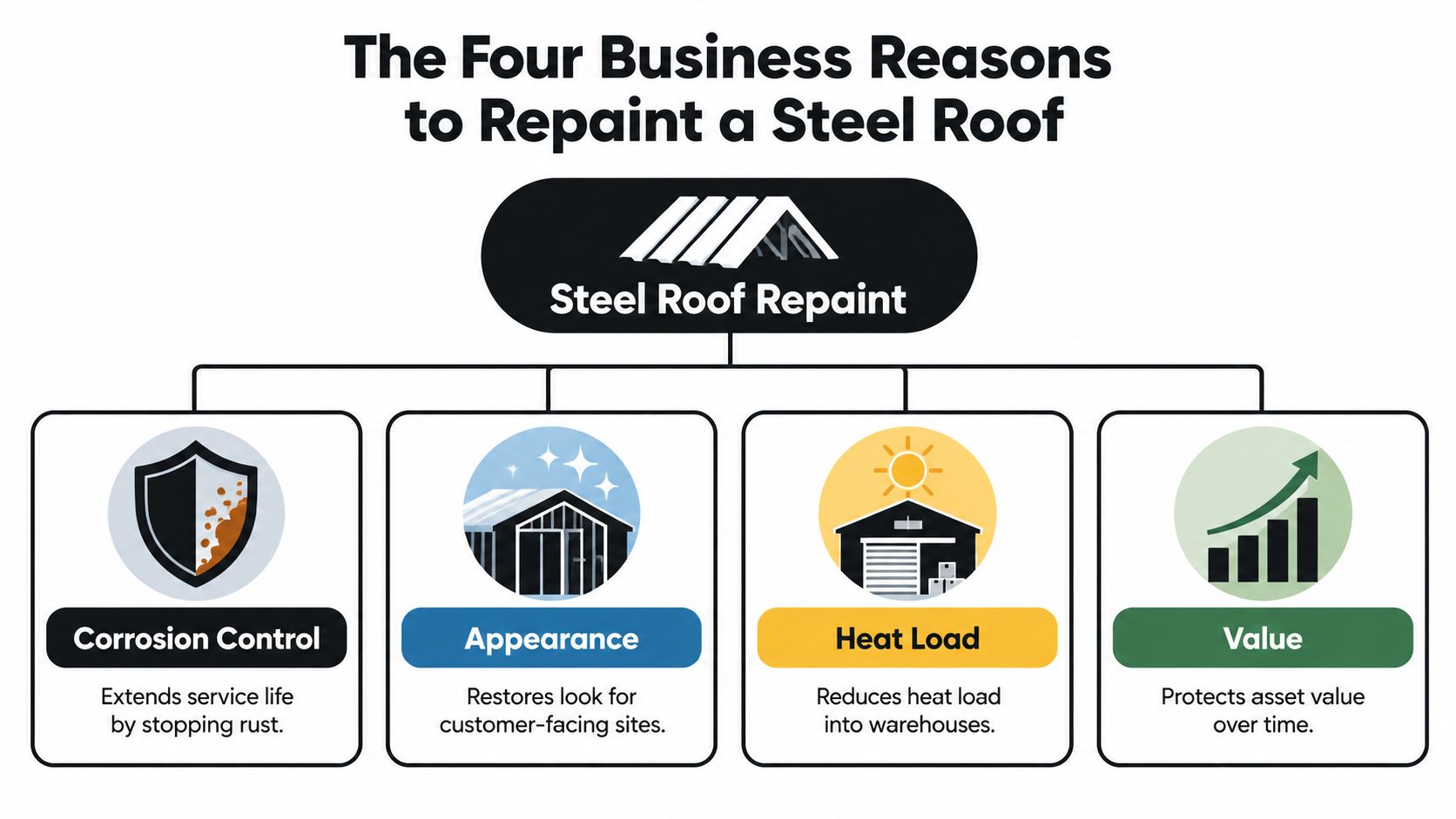
Corrosion control is the practical choice where the steel is still serviceable but the finish has deteriorated, or where exposed edges and fixings need attention. It drives the preparation method, primer compatibility and detailing. Don't accept a general topcoat recommendation where the scope includes bare steel or established rust.
Heat-load reduction changes the conversation from colour preference to measurable roof performance. Ask for the proposed finish's solar-performance information and consider whether the building's insulation, ventilation and cooling use make a reflective surface worthwhile. A light finish can be attractive and functional, but it isn't a substitute for assessing the whole roof build-up.
Appearance matters most on customer-facing sites and shared properties. A fresh, consistent finish can restore a cared-for look, but it shouldn't distract from repairs or corrosion that need to be addressed first. Choose a topcoat that's compatible with the existing roof and the site's exposure.
Warranty or compliance obligations make documentation central. The quote should identify the preparation standard, coating products, application requirements and inspection records, rather than only name a brand or colour. Where a warranty applies, check its conditions before work starts. A coating system that looks right but conflicts with the manufacturer's requirements can create a dispute later.
The distinction is simple: corrosion control drives primer choice, heat reduction drives measured reflectance, appearance drives finish selection, and compliance drives records. Tell contractors which outcome matters most. You'll get a more useful specification than you will by asking for a price per square metre alone.
Matching the Coating System to Sydney's Corrosivity Zones
Two warehouses can use the same steel and still need different coating specifications. Coastal salt, industrial emissions, shelter, roof pitch, drainage and contaminant build-up around gutters or laps all affect exposure. Use the site conditions, not its Sydney address alone, to set the coating system. AS 4312:2019 classifies atmospheric corrosivity by expected mild-steel corrosion rate, from C2 at 1.3–25 µm/year to CX at 200–700 µm/year (AS 4312:2019).
| AS 4312 category | Expected mild-steel corrosion rate | What to assess on site |
|---|---|---|
| C2 | 1.3–25 µm/year | Inland and sheltered conditions |
| C3 | 25–50 µm/year | Suburban exposure and urban pollutants |
| C4 | 50–80 µm/year | More aggressive industrial or coastal conditions |
| C5 | 80–200 µm/year | Very high corrosivity |
| CX | 200–700 µm/year | Extreme exposure conditions |
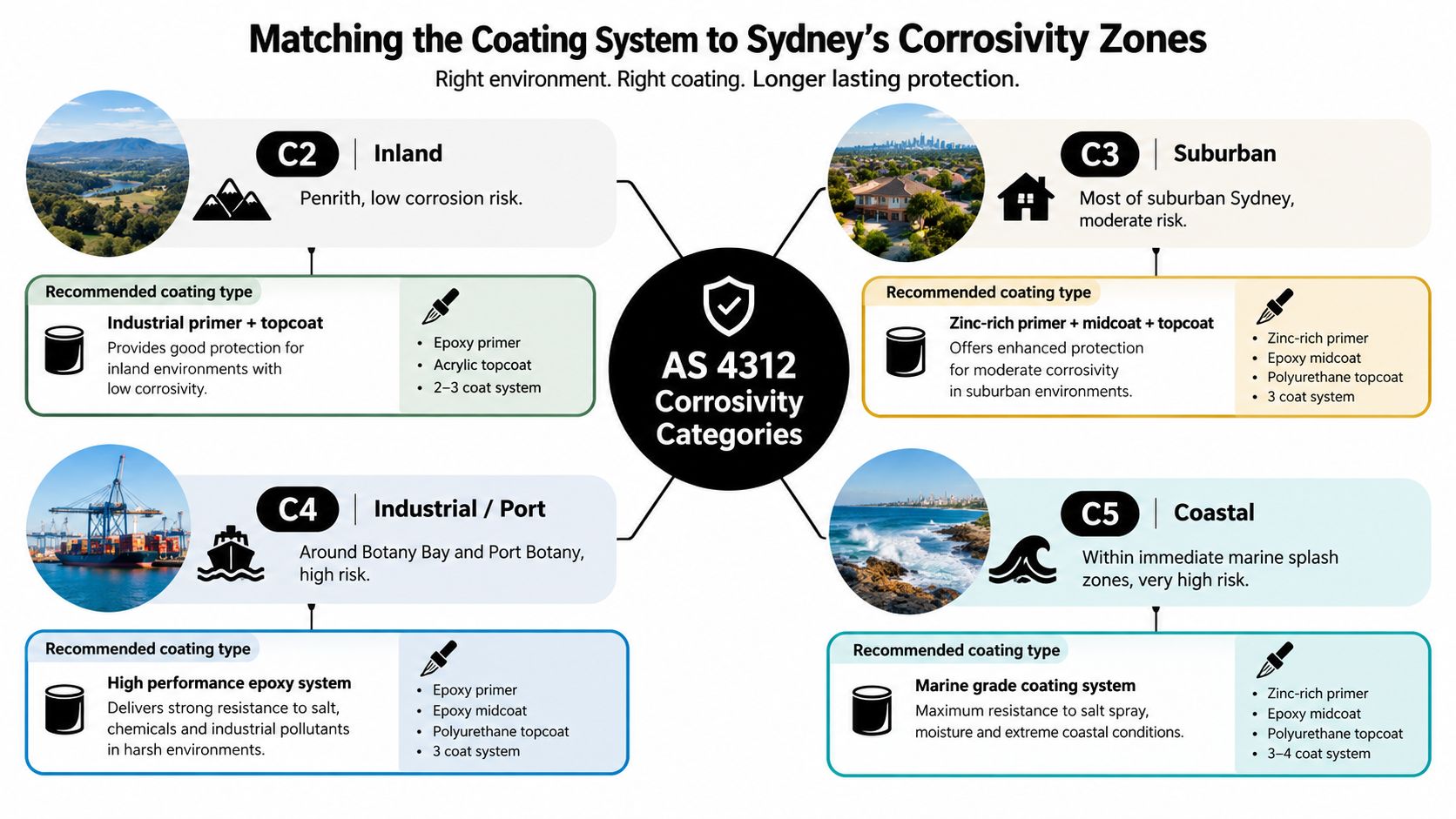
A coastal roof can face a higher corrosion burden than an inland roof, even when both use similar steel. NCC examples classify areas within 100 metres of breaking surf as very high exposure, while areas more than 1 kilometre from sheltered bays generally fall into lower categories. Treat these as guidance, not a site map. Local shelter, industrial conditions and roof design can change the assessment.
What the classification changes
The metallic coating on the steel also matters. AS 1397:2011 lists Z275 galvanised steel, AZ150 aluminium/zinc, or AM100 aluminium/zinc/magnesium for organic-coated steel in low or medium environments, increasing to AZ200 or AM150 systems in very high environments. Some uncoated options are unsuitable for higher exposure.
For a repaint, identify the existing substrate and metallic coating before specifying paint. A new paint layer cannot compensate for an unsuitable or badly corroded sheet. Check cut edges, fasteners, laps, gutters and any area where contaminated water sits. On commercial projects, ask the contractor to explain how the relevant steel-protection guidance, including AS 2312.1 and AS/NZS 2312.2, informs preparation, primer selection and detailing.
A quote that specifies one system for every site is not a site-specific specification. Require an exposure assessment and a clear explanation of how it shapes the proposed coating.
Choosing the Right Primer and Topcoat System
The primer and topcoat must work with the existing roof, the site exposure and the job's objective. A product name alone tells you little. The quote should specify the full system and give you the product data sheets needed to check compatibility, application conditions and the required dry-film thickness.
| System | Typical build-up | Best suited to | Indicative service life |
|---|---|---|---|
| Anti-corrosive primer and acrylic topcoat | Compatible primer over prepared, sound pre-painted steel, followed by acrylic finish | General maintenance and appearance work on suitable roofs | Confirm against the specified product and warranty |
| Zinc-rich or epoxy primer with compatible topcoat | Targeted primer on properly prepared bare steel and corrosion-prone details, plus specified finish | Corrosion-control work where the substrate and system permit | Confirm against exposure, preparation and product data |
| Primer with two-pack polyurethane finish | Compatible primer and a two-pack finish applied to its specified build | Higher-spec applications where the system is approved for the substrate and exposure | Confirm with the system specification |
| Primer with fluoropolymer finish | System components specified by the coating manufacturer | Projects requiring a high-spec finish and a documented compatible build-up | Confirm with product documentation and warranty |
For an ordinary warehouse repaint, a compatible acrylic system may be appropriate if the roof is sound and the surface is prepared correctly. For exposed details or bare steel, the primer needs to suit the substrate and the specified topcoat. A two-pack polyurethane or fluoropolymer finish may be considered for higher-spec work, but don't assume the more elaborate system is automatically the right one. Compatibility and application control matter.
Read the specification, not just the label
Check the product data sheet for dry-film thickness, recoat window, substrate requirements and compatibility with the existing metallic coating. Confirm whether the system is single-pack or two-pack, and whether the quoted application matches the manufacturer's instructions. If a project warranty calls for a particular build-up, a cheaper single-pack acrylic isn't an acceptable substitute unless the warranty requirements allow it.
For appearance-led work, choose a finish that suits the site and existing cladding. For a heat objective, request measured solar-performance details instead of relying on names such as “white” or “cool grey”. For corrosion control, make the contractor explain the primer and the treatment of vulnerable details. The specification should describe layers and application requirements, not just a brand and a colour.
Surface Preparation and Application Method
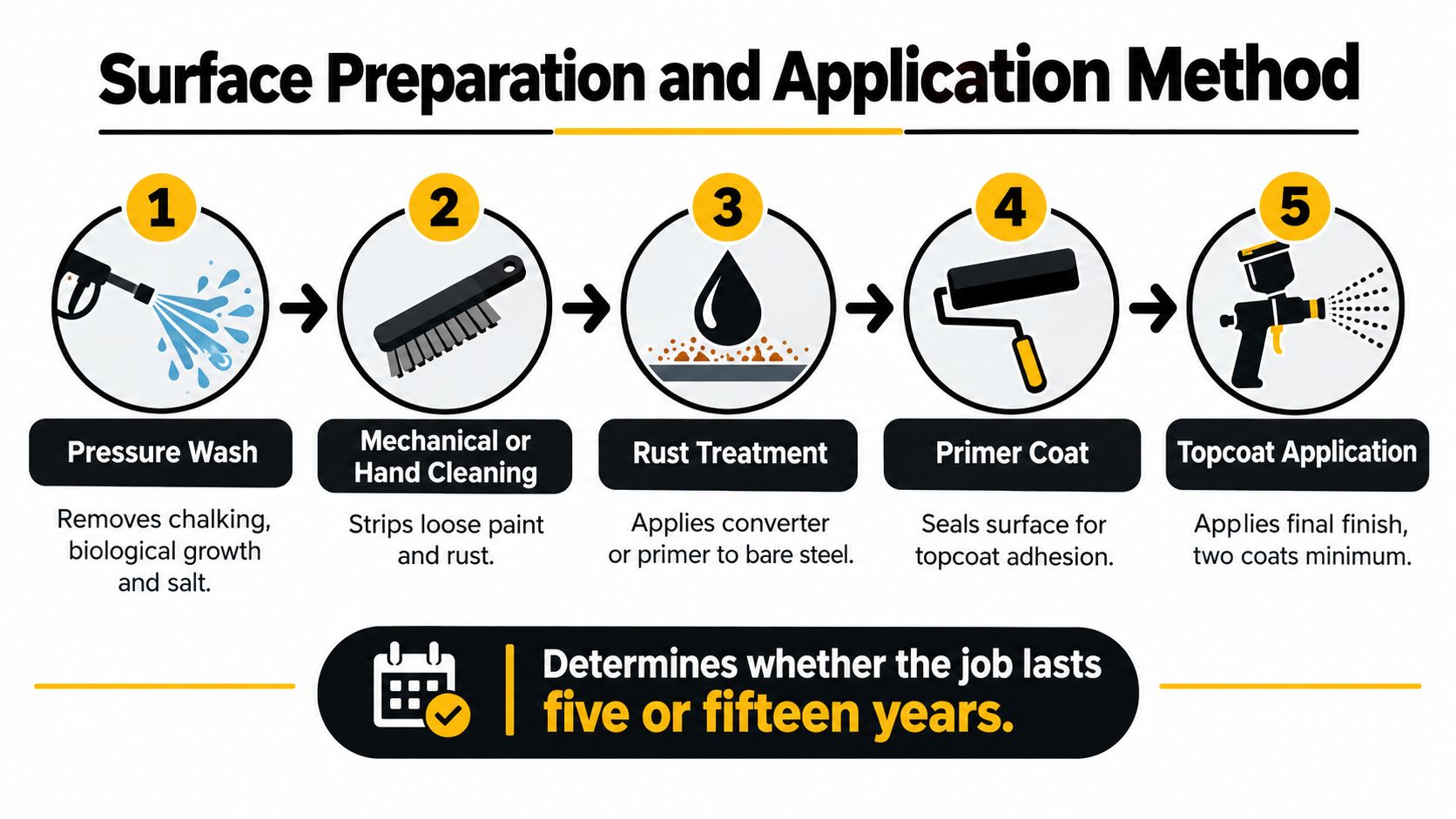
Preparation decides whether a coating can adhere to the roof. A clean-looking surface isn't necessarily ready: chalking, salt, loose paint, corrosion products and moisture can all undermine the new system. Ask for a written method of work that describes what the crew will inspect, clean, remove, treat and coat.
Follow the sequence
Wash first. Pressure washing removes dirt, chalking, biological growth and salt. The contractor should manage wash-down so debris and contaminants don't move into box gutters or onto adjoining areas. Let the roof dry as required by the coating manufacturer.
Prepare defects. Remove loose or poorly adhered coating and treat rust spots using a preparation method suited to the substrate and the project specification. For larger or more serious corrosion, the scope should say how the metal will be assessed and whether damaged sheets need repair or replacement.
Prime and detail. Apply a compatible primer where the system requires it, especially at prepared bare steel and vulnerable details. Specify how the crew will treat fasteners, cut edges, laps and gutters. These areas need deliberate attention because paint can't reliably compensate for trapped moisture, failing fixings or defective sheet joins.
Apply the finish. Choose spray, roller or brush according to access, substrate and detailing. Airless spray can suit broad roof areas, while brushes or rollers may be needed for local work and edges. Confirm the number of coats and required film build from the selected product data sheet.
If the method statement says only “wash and paint”, send it back for detail.
Application weather matters as much as preparation. The crew should check the roof and forecast against the product's limits for surface moisture, dew point, temperature and recoat windows. Sydney's humid conditions can make a roof look dry before it's ready for coating. A contractor should document the product, preparation and application conditions, and explain how the crew will verify the finished work.
Heat Load, Reflectance and Whether a Cool Roof Pays Back
A reflective finish is an energy decision only if the building's roof and cooling profile make it one. Older warehouses with limited insulation, factories with large roof areas and retail buildings with substantial cooling demand are stronger candidates for an assessment than buildings where the existing roof build-up already limits heat transfer. Start with the building's condition and operation, not a promise attached to a paint colour.
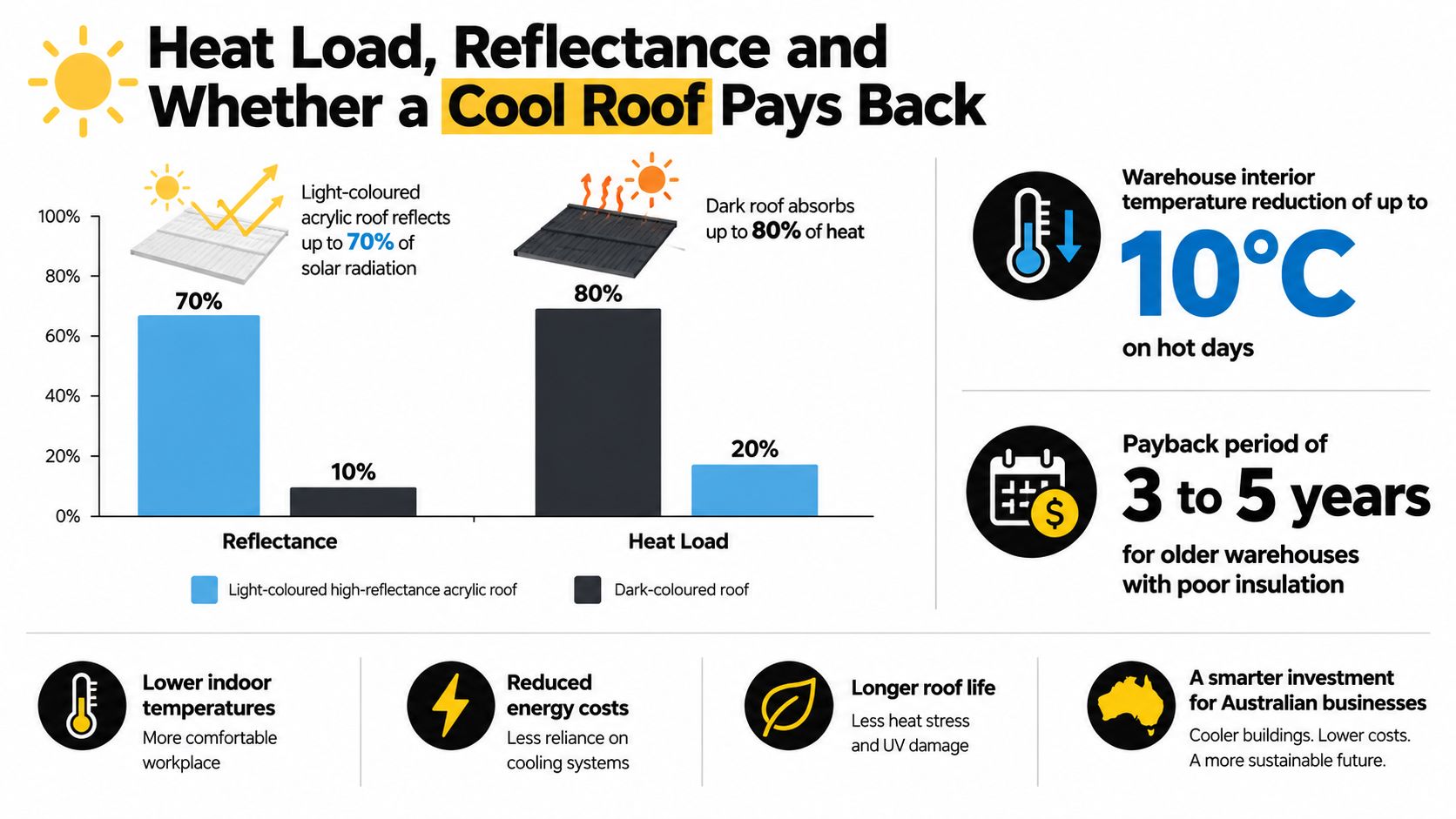
Australian Government guidance says lighter colours reflect more solar energy, while darker colours absorb more. It states that adding two coats of white exterior acrylic roofing paint can improve internal comfort by around 3°C and reduce air-conditioning requirements by as much as 20% in suitable conditions (Australian Government guidance on hot, arid living). These are guidance-level outcomes, not guaranteed savings for every NSW building. Insulation, ventilation, roof geometry, occupancy, climate, equipment efficiency and application quality all affect results.
The NCC provides a more useful basis for specifying performance than a colour name. It identifies roof solar absorptance below 0.4 as a low-absorptance surface typically associated with white, off-white or cream finishes; indicative values include 0.45 for light grey and 0.35 for off-white. Relevant NCC 2025 commercial provisions recognise combinations including total solar reflectance above 0.55 with thermal emittance above 0.85, or solar absorptance no greater than 0.35 with emittance above 0.85 for applicable metal-roof uses (NCC roof energy-efficiency provisions).
Set a realistic target
Ask the coating supplier or contractor for certified reflectance, emittance or SRI data for the proposed finish. Check whether the roof's insulation and ventilation need work as well. A reflective coating can't correct an under-insulated roof by itself, and dirt or weathering can reduce effective reflectivity, so include cleaning and inspection in the maintenance plan. For a practical overview of reflective finishes, compare your project requirements with reflective roof coating considerations.
Repaint, Patch or Replace: Making the Capital Decision
Don't approve a repaint until someone has checked whether the roof is still fit to keep. Painting can be sensible when the sheets are sound and the problem is a deteriorated finish or localised surface corrosion. It's the wrong response when defects point to failing steel, widespread water entry or a substrate that can't support the proposed coating.
Use the inspection to separate the options:
- Repaint when the roof is structurally sound, the existing finish can be prepared, and the coating system suits the exposure and objective.
- Patch and repair when defects are localised. The scope should identify affected sheets, fasteners, laps or penetrations, then specify compatible repairs and coating.
- Replace when the roof has extensive corrosion, failing sheets, repeated leaks or other conditions that make a durable coating unrealistic.
A repaint quote should identify repairs separately from coating. That lets you compare the cost and scope without confusing a low headline price with a complete job. If the contractor recommends replacement, ask for the inspection findings and the reasons a coating won't address the defects. For a staged project on an occupied warehouse, have the contractor explain how they'll sequence the work, protect operations and maintain weatherproofing while sections are completed.
Don't use a cost-per-cycle calculation unless the contractor can support the assumptions. Get the proposed coating system, maintenance expectations and warranty in writing, then compare those with a replacement scope and its documented product and installation conditions. A generic claim about how many years a coating or new roof will last isn't a basis for a capital decision.
Older industrial roofs need particular care if asbestos-containing materials may be present. Confirm whether the roof has been assessed before any disturbance, preparation or removal is planned, and ensure any asbestos work is handled under the applicable requirements. A coating scope mustn't become a reason to disturb a material that needs a different process.
For a structured comparison of the options, use this guide to roof restoration versus replacement. The decision should follow the roof inspection, not the preference of the contractor who happens to be quoting.
Hiring a NSW Commercial Roofer and Keeping the Warranty
The safest way to compare roof-painting quotes is to ask every contractor to price the same documented scope. A written specification should state the roof condition, preparation method, coating system, application requirements, repair allowances, access plan and warranty terms. If the quote names a brand but not the system, you can't reliably compare it with another offer.
Before approving work, check that the contractor can explain site safety and working-at-height controls, including how crews will access the roof and manage edges, openings and fragile areas. For older industrial buildings, ask what asbestos checks are required before work begins. Confirm who will do the work, whether labour is in-house or subcontracted, and who is accountable for quality checks and defects.
Buyer checklist
- Scope: Does the quote state what will be washed, prepared, repaired, primed and topcoated?
- System: Are the products, compatibility, film-build requirements and recoat conditions identified?
- Condition: Has the contractor recorded corrosion, failed fasteners, leaks and any limits on painting?
- Safety: Are access, fall protection, site coordination and asbestos considerations addressed?
- Warranty: Does it name the coating system and set out the conditions, exclusions and maintenance obligations?
- Records: Will you receive product data, preparation and application records, inspection findings and completion documentation?
Keep those records with your strata or facilities files. They're useful when you're planning maintenance, responding to an insurer, or checking whether the finished work matches the approved scope. If you're comparing providers, this guide to finding a commercial roofer near you can help you frame the questions.
Common question: Can you paint faded Colorbond? It may be suitable if the sheets and existing finish are sound and the proposed system is compatible. Have the contractor inspect and specify preparation before treating a repaint as a straightforward colour change.
Common question: Does reflective paint guarantee lower power bills? No. Government guidance gives potential outcomes under suitable conditions, but the result depends on the building and how it's used. Request measured coating data and assess insulation, ventilation and cooling demand before including energy savings in a business case.
Commercial Roofers carries out commercial roof painting, inspections, repairs and replacement work across Greater Sydney, with written scopes and project coordination for operating sites. If you're assessing a warehouse, factory, retail property or strata roof, visit Commercial Roofers to discuss the roof condition and the right next step.