
A warehouse owner discovers the leak halfway through a morning shift. A ceiling stain has spread above palletised cartons, water is dripping near a light fitting, and the facilities manager is already calling a roofer, the broker and the insurer. In a strata complex, the same event can produce three separate calls from tenants, each reporting damage to a different unit.
The immediate question is usually, “Does roof leak insurance cover this?” That question is too narrow. A commercial claim can involve the roof component, internal building damage, stock, equipment, emergency works, lost trading time and a dispute about whether the leak began with a storm or old deterioration. The fastest way to protect the property and the claim is to separate those issues from the first hour.
Table of Contents
- When Water Hits the Warehouse Floor
- Policy Types That Respond to a Roof Leak
- What Insurers Typically Cover and What They Exclude
- Who Is Responsible in a Commercial or Strata Building
- The First 48 Hours of a Roof Leak Claim
- Beyond the Roof, the Bigger Loss Inside the Building
- Pressure Testing Your Cover Before the Next Storm
- Engaging a Commercial Roofer for Assessments and Quotes
When Water Hits the Warehouse Floor
The first job is safety. Keep people away from wet electrical areas, isolate affected equipment where it's safe to do so, move stock out of the drip path and prevent forklifts or staff from spreading water through the building. Don't send an employee onto a wet roof to search for the entry point.
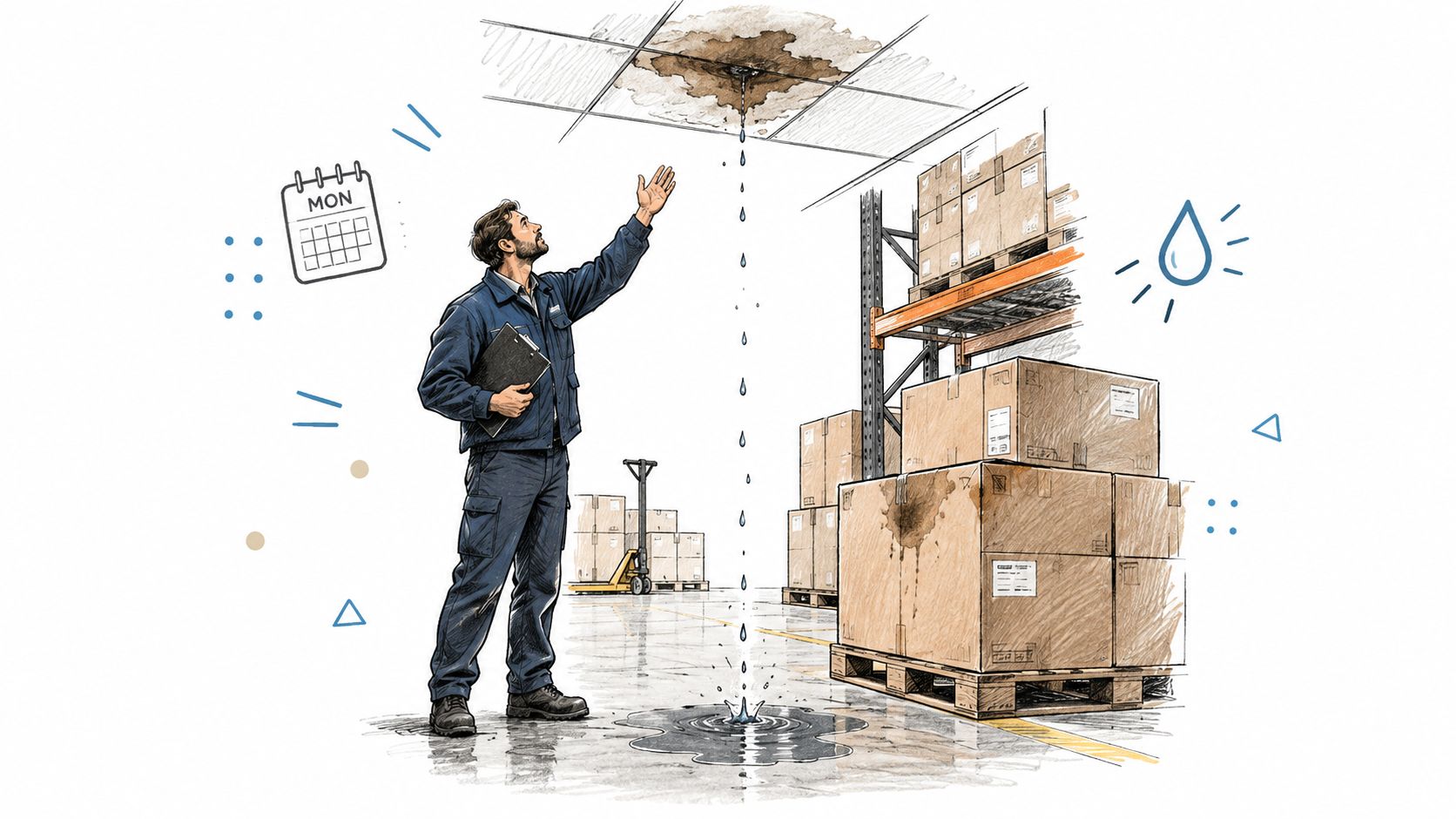
Take photographs before cleaning or moving damaged material. Record the time the leak was found, the weather, the exact location, affected stock, ceiling or wall damage, visible roof defects and any temporary protection installed. A strata manager should create one incident file for the common property and separate records for each affected lot or tenant.
The central insurance distinction is simple but often mishandled. The roof itself and the damage caused by the roof are not automatically treated as one loss. A sudden storm may damage a panel or flashing, while the resulting water damages stock, fit-out, electrical equipment or internal finishes. An insurer may assess each part under different policy terms.
Practical rule: Report the event before authorising permanent rectification, but take reasonable steps to stop further damage.
Call the insurer or broker, then engage a licensed commercial roofer who can inspect safely and provide temporary weatherproofing. Ask the roofer to identify the likely failure mechanism, preserve damaged materials where practical and distinguish emergency make-safe work from permanent repair. That evidence gives the assessor something more useful than a vague statement that “the roof is leaking”.
Policy Types That Respond to a Roof Leak
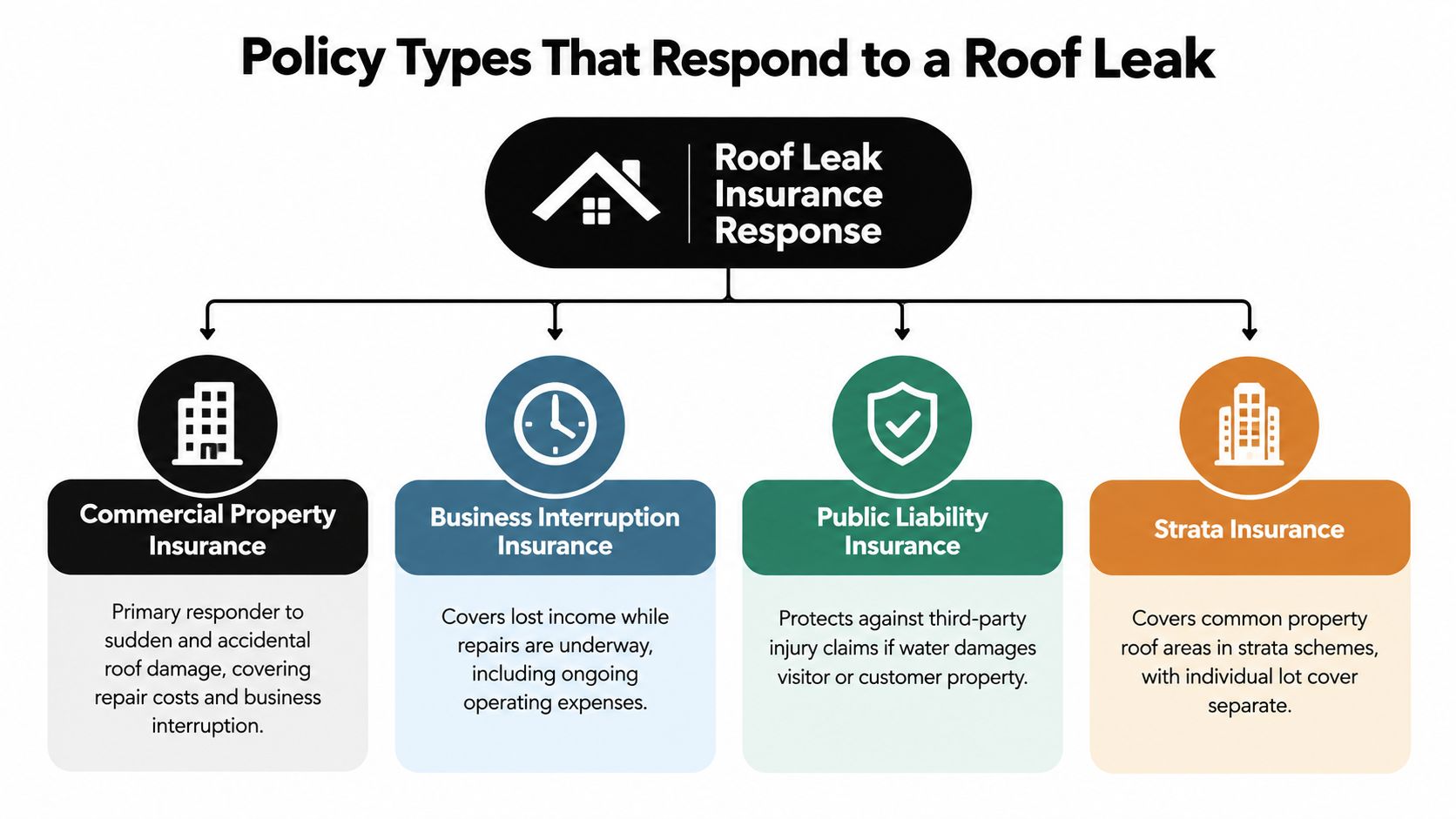
“Roof leak insurance” usually describes a group of policies, not a standalone product. Start by identifying which policy protects each loss.
Commercial property insurance
This is normally the first policy considered for the building and roof shell. It may respond when a sudden insured event, such as storm, hail, wind, impact or accidental damage, causes the breach. The policy may then address the damaged roof component and resulting damage to ceilings, fit-out or other building elements, subject to the wording, excess and exclusions.
It usually won't turn an old roof replacement into a storm claim. Ageing sheets, corrosion, defective installation, failed sealants and poor maintenance can remain the owner's responsibility even when a storm reveals the problem.
Business interruption insurance
A roof breach can close part of a warehouse, restrict access to a retail site or stop production while electrical systems and stock are assessed. Business interruption cover is designed to address eligible lost trading income and continuing expenses when an insured property event interrupts operations.
Check the indemnity period before a storm arrives. Re-roofing, drying, stock replacement, approvals and electrical recommissioning can take longer than a simple patch. The cover must reflect how the business operates, not just the time a roofer expects to spend on the first repair.
Public liability insurance
Public liability is not the policy that normally pays to repair your roof. It becomes relevant if a visitor, customer, contractor or another party alleges that water from your premises caused injury or damaged their property. Notify the liability insurer before admitting fault or promising payment.
Strata insurance
In a strata scheme, the owners corporation or body corporate generally arranges insurance for common property, including shared roof areas. Individual lot owners and tenants still need their own cover for contents, stock, internal fit-out and business interruption.
A re-roofing project adds another question. Contract works or construction insurance may apply while work is underway, particularly where materials, temporary works or an unfinished structure face a separate construction risk. Confirm responsibility with the contract administrator, builder and broker before stripping the existing roof.
What Insurers Typically Cover and What They Exclude
An assessor doesn't start with the stain on the ceiling. They work backwards to the initiating event. On a metal commercial roof, the investigation may involve sheets, fasteners, flashings, penetrations, sealants, gutters and box gutters. One failed component can admit water, but its condition and history help determine whether the loss was sudden or gradual.
A storm-torn sheet or impact-damaged flashing points towards a discrete event. Corroded fasteners, split sealant, blocked drainage, deteriorated box-gutter joints and long-term ponding point towards condition or maintenance. The internal damage can still be significant, but the policy may treat the failed component and the resulting damage differently.
Commercial property guidance from Marsh on property insurance reflects the practical distinction between sudden insured events and deterioration, while the policy wording and Product Disclosure Statement control the actual outcome.
| Loss element | Often included when | Often excluded when |
|---|---|---|
| Roof sheet, tile or panel | Storm, hail, wind or impact caused the failure | Age, corrosion, fatigue or gradual deterioration caused it |
| Flashing, fasteners or sealant | A defined event displaced or damaged the component | The component had failed through poor upkeep or defective workmanship |
| Internal ceiling and fit-out | Water entered because of a covered event | Long-term seepage, mould or pre-existing damage is established |
| Stock and equipment | The insured water event caused direct physical damage | The loss reflects poor storage, existing moisture or an excluded cause |
| Temporary protection | The work reasonably limited further insured damage | The expense was unnecessary, excessive or unrelated to the event |
| Full roof replacement | The policy and damage justify replacement of the insured roof | The claim seeks an upgrade or replacement of sound sections solely because the roof is old |
Read the exclusion section alongside definitions for storm, rainwater, flood, escape of liquid and consequential loss. A roof can be damaged during heavy weather without every type of water entry falling within the same cover.
For practical guidance on the boundary between repair obligations and warranty promises, review what a roof warranty covers. A warranty isn't a substitute for insurance, and insurance isn't a maintenance programme.
Who Is Responsible in a Commercial or Strata Building
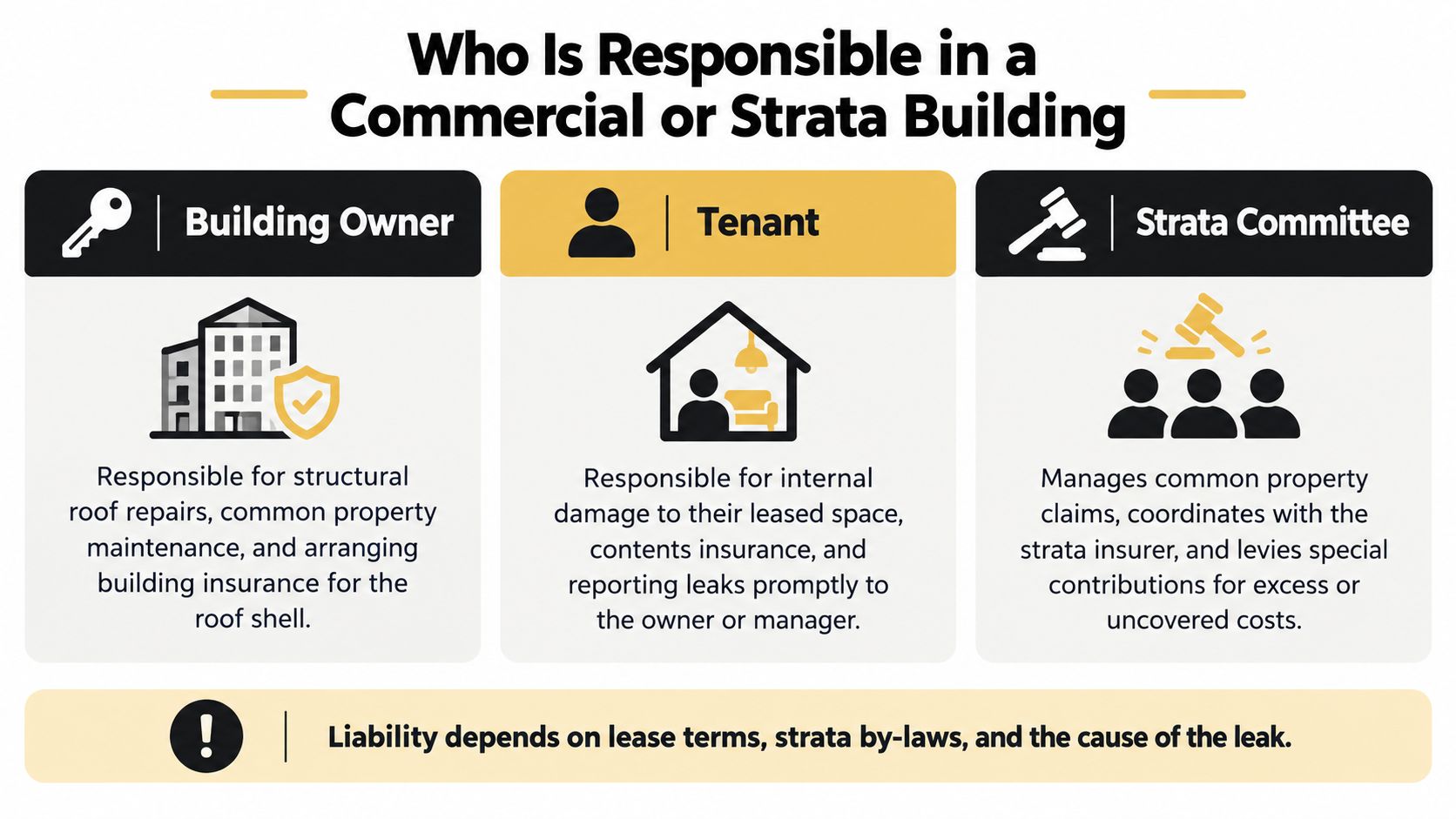
Responsibility starts with the legal arrangement, not with whoever notices the drip first. A tenant may be first on site, but that doesn't mean the tenant owns the roof or controls the building policy.
Commercial ownership and leasing
The building owner usually manages the roof shell, structural repairs and building insurance. The tenant normally protects its stock, equipment, internal fit-out and trading income. The lease can change that allocation, especially for repairs, make-good obligations, outgoings and damage caused by the tenant.
A tenant should report the leak immediately in writing, protect its contents and keep a record of lost operations. It shouldn't authorise permanent roof replacement without checking the lease and notifying the owner, unless an urgent safety or damage-control response is required.
The owner should preserve roof inspection reports, maintenance records, photographs, quotes, invoices and correspondence with the tenant. Those records help establish whether a storm created a new failure or exposed an existing defect.
Strata schemes
The strata committee or owners corporation generally manages common property claims and coordinates with the strata insurer. A lot owner protects the contents and fit-out within the lot, while a business tenant also considers stock and interruption cover. By-laws and strata legislation determine the finer allocation.
The committee should nominate one claim contact, keep minutes of decisions and avoid allowing multiple contractors to alter the same evidence. Each affected lot should maintain its own damage schedule, photographs and invoices, while the common-property file records the roof inspection and any shared-area impact.
The person who first sees the water should report it. The party responsible for the roof should control permanent rectification.
If responsibility is disputed, ask the insurer, broker, strata manager or solicitor to identify the relevant lease clause, by-law or policy section. Don't let an argument about liability delay temporary protection.
The First 48 Hours of a Roof Leak Claim
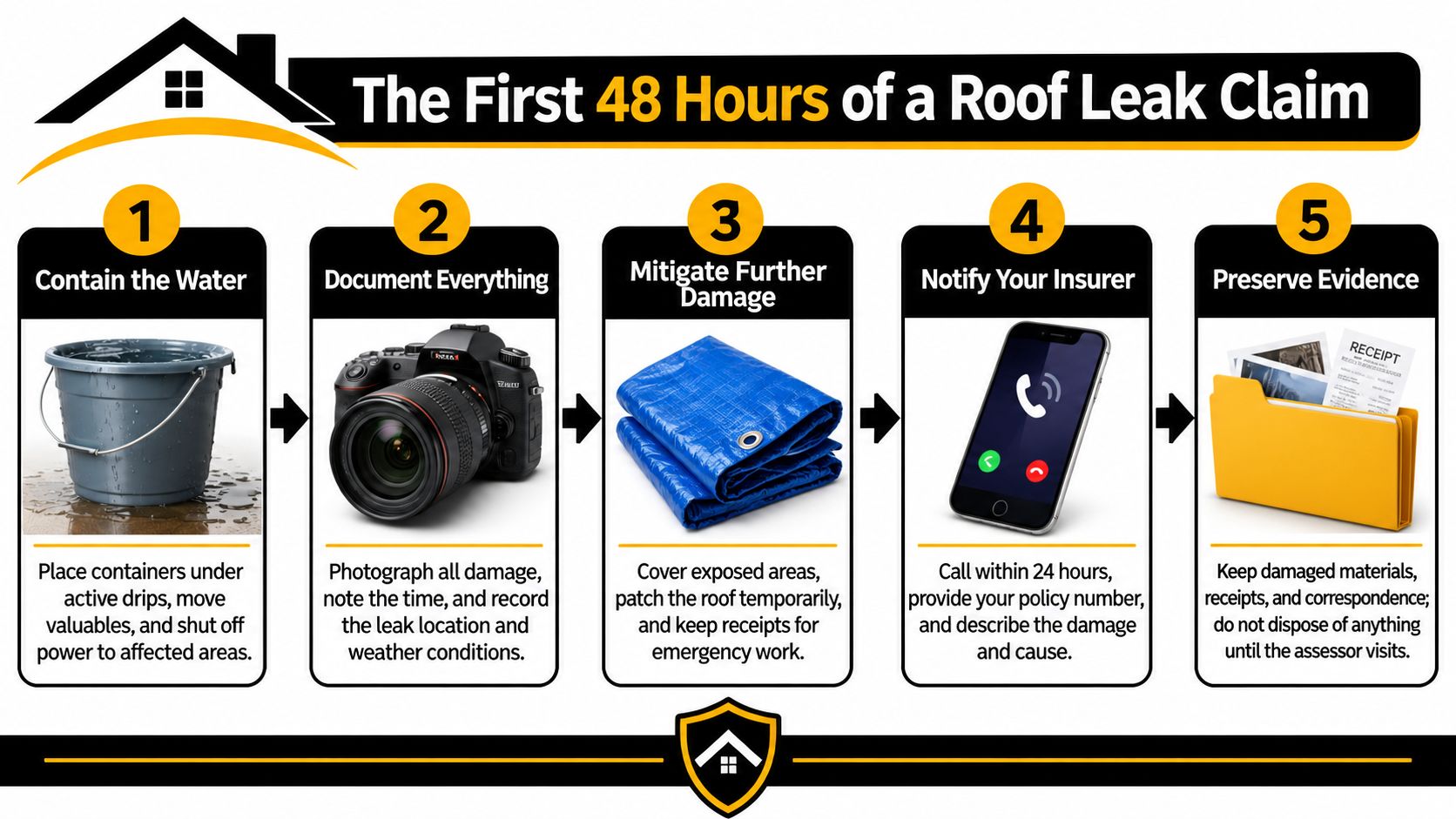
Use this order. It protects people first, the building second and the evidence throughout.
Contain the water. Place containers under active drips, move stock and equipment, isolate unsafe electrical areas and restrict access. A wet ceiling, distribution board or slick floor can create a more serious incident than the original leak.
Document the untouched condition. Photograph the roof from safe locations, ceiling stains, pooled water, damaged cartons, machinery, electrical fittings and any visible impact. Note the time discovered, weather conditions, affected areas and who attended.
Arrange temporary protection. A licensed commercial roofer can install a temporary cover, patch an exposed penetration or redirect water without concealing the original failure. Keep itemised invoices, photographs before and after the work, and details of materials used.
Notify the insurer and broker promptly. Give a factual account. State what happened, when it was discovered and what emergency steps were taken. Don't guess at the cause, admit negligence or promise that the insurer will pay.
Preserve evidence. Keep damaged sheet metal, broken flashing, failed fasteners, packaging, stock samples and removed ceiling material where safe. Don't discard items or authorise demolition until the insurer or assessor confirms what they need.
Emergency mitigation is not automatically the same as permanent rectification. Ask the insurer whether it wants a preferred contractor, an assessor or competitive quotes, but don't wait for administrative approval where delay would increase damage. Explain the safety issue, document the decision and limit the work to what is reasonably necessary.
A structured inspection file is easier for a claim handler to assess. This commercial roof inspection report template can help organise locations, observations, photographs and recommended actions.
The following video can help facility managers understand the visual inspection process before engaging a contractor.
Beyond the Roof, the Bigger Loss Inside the Building
The roof repair is often the easiest line item to identify. The larger exposure sits underneath it.
Water can damage palletised stock, racking, machinery, lighting, insulation, ceilings and tenant fit-out. It can also create slip hazards, corrode electrical components and leave moisture inside wall cavities or insulation. A small entry point above a production line can disrupt a much larger area than the visible stain suggests.
Trace the chain of loss
Start with the direct physical damage, then document every operational consequence.
- Stock and materials: Separate wet, contaminated, salvageable and unaffected stock. Photograph labels, quantities and storage locations before disposal.
- Plant and electrical assets: Have a qualified person inspect affected equipment. Don't re-energise wet systems just to test whether they still work.
- Fit-out and building elements: Record damage to ceilings, walls, flooring, lighting, racking protection and installed equipment.
- Mould and hygiene: Drying and remediation should begin quickly, particularly in healthcare, food, retail and occupied strata environments.
- Trading interruption: Log restricted access, production stoppages, cancelled deliveries, relocation costs, overtime and additional operating expenses.
The cover may be split among property, stock, machinery, business interruption and specific extensions. A roof claim should therefore include an operations contact, finance contact and facilities contact, not only a roofer.
Claim file standard: Show the path from the weather or impact event, to the roof failure, to the water entry, to each item of physical and financial loss.
Insurers also expect policyholders to take reasonable steps to prevent further damage. Temporary tarping, water extraction, isolation of unsafe areas and controlled drying may protect the asset and support recovery of eligible mitigation expenses. Keep approval emails, call notes, receipts and contractor reports.
Pressure Testing Your Cover Before the Next Storm
Having a policy doesn't prove that the business is adequately protected. Cover can fail at the point of loss because the sum insured is outdated, flood isn't included, stock limits are too low or the interruption period doesn't match the recovery timeline.
Australia's recent catastrophe environment makes that review difficult to dismiss. The Insurance Council of Australia reported 409,094 claims and $11.3 billion in insured losses between 2022 and 2026, with the average claim costing slightly more than $27,500. Those figures cover many forms of property damage, not roof leaks alone, but they show the claims environment in which commercial water-entry losses occur. The Insurance Council catastrophe report provides the wider context.
Ask the broker harder questions
Request clear written answers to these questions:
- What water event is insured? Confirm how the policy treats storm, storm water, rainwater, flood and escape of liquid.
- What is the roof basis of settlement? Ask whether repair, replacement, depreciation, matching materials and code upgrades are handled differently.
- What sits outside the building limit? Check stock, machinery, refrigeration, electrical equipment, tenant improvements and debris removal.
- How long can the business recover? Match the interruption period to drying, approvals, manufacturing lead times, access restrictions and full reoccupation.
- What maintenance evidence will matter? Keep gutter and box-gutter cleaning records, inspection reports, repair invoices and photographs of known defects.
Flood exposure deserves particular attention. Average annual flood losses increased from $129 million in the 2000s to about $2 billion per year since 2020, according to the Insurance Council material cited above. The figures are not roof-leak totals, but they underline why a storm-water assumption can be dangerous when the policy definition says otherwise.
If an insurer declines or limits the claim, request the decision and precise exclusion in writing. Separate the sudden event from unrelated maintenance. AFCA has found that an insurer may rely on an exclusion where poor maintenance or a building defect caused the loss, but it can't withhold payment for an otherwise covered loss until unrelated maintenance work is completed. The AFCA-related discussion of maintenance and claim payment is useful when preparing questions for the insurer.
Engaging a Commercial Roofer for Assessments and Quotes
A leak claim gets stronger when the roofer can show exactly what failed, what was made safe, and what still needs investigation. Use a contractor who works on commercial roofs, understands safe access, and can write for an insurer. The report should identify the roof profile and materials, affected areas, photographs, moisture readings, the likely failure point, temporary protection completed, permanent repair options, and defects that are unrelated to the incident.
Ask for separate prices for emergency make-safe and temporary weatherproofing, repair of the identified storm or impact damage, consequential building and internal rectification, full replacement or upgrade if justified, and optional improvements such as box-gutter redesign or a better profile.
A useful quote draws a clean line between insured rectification and owner-funded maintenance. It should also name the proposed system, whether that is Colorbond, copper, zinc, architectural cladding, or another suitable profile for the building.
For Sydney owners and managers comparing contractors, this checklist for choosing a commercial roofer near me gives a practical starting point. Commercial Roofers provides documented inspections, photographs, written reports, emergency leak repairs, roof replacement, and gutter or box-gutter work across commercial, industrial, and strata properties.
If water is on the floor today, secure the area, photograph the damage, notify the broker and insurer, and arrange a licensed commercial roof inspection before permanent work begins. Visit Commercial Roofers to request an assessment and a written scope that separates emergency protection, claim-related repairs, and longer-term roofing work.