

A ceiling stain over a top-floor corridor. A tenant calling after a storm because water has started dripping near a light fitting. A warehouse supervisor who's noticed cracked ridge caps from the loading yard but hasn't had time to deal with it. That's usually how tile roofing repair starts on commercial properties in Sydney. Not with a tidy maintenance plan, but with a problem that's already interrupting operations.
For a strata committee, facilities manager, or commercial owner, the roof isn't just a building element. It's a risk register item, a budget decision, and sometimes an insurance discussion. Tile roofs can perform well for a long time, but once defects show up, the cost of delay usually isn't limited to the roof surface. Water gets into insulation, ceilings, services, tenancy fit-outs, and sometimes the argument over who should've acted sooner.
That's why this needs a commercial approach. Sydney sites bring extra pressure. Coastal weather drives rain where weak laps and flashing details get exposed. Older properties can carry legacy issues, including brittle tiles, failed bedding, and possible asbestos in associated materials. And unlike a detached house, a repair on a strata block, school, retail site, or warehouse has to be planned around access, safety, and continuity of use. The broader roofing services market reflects that steady demand. The Australian Roofing Services industry is projected at $4.4 billion in 2026, with tile roofing repair remaining a substantial part of ongoing maintenance across NSW, according to IBISWorld's Australian roofing services industry profile.
Table of Contents
- Your Guide to Commercial Tile Roof Repair in Sydney
- How to Identify Tile Roof Damage Early
- Common Tile Roof Repair Methods Explained
- Repair or Replace Making the Right Financial Decision
- Navigating Sydney Compliance Safety and Asbestos Risks
- Understanding Cost Drivers and Choosing a Contractor
- FAQs and Proactive Maintenance Planning
Your Guide to Commercial Tile Roof Repair in Sydney
Commercial tile roof problems rarely stay small. A cracked tile near a valley can look minor from the ground, then turn into stained ceiling tiles, tenant complaints, and an urgent access issue after the next storm. On strata sites, one leak report often uncovers several older defects that nobody could see from the street.
That's the difference between residential advice and what commercial owners need. On a house, the question is often, “Can this be patched?” On a Sydney commercial or strata building, the better question is, “What's the lowest-risk compliant fix that protects the asset and doesn't create another shutdown in three months?”
The commercial reality in Sydney
Tile roofing repair on a warehouse office, school block, retail strip, or apartment complex has more moving parts than a simple patch job. You have occupants below, delivery access to preserve, public areas to isolate, and sometimes ageing roof components that were installed to an older standard. If the site sits near the coast or in an exposed corridor, wind-driven rain will test every weak point.
A sound repair approach usually starts with three things:
- A defect map: not just the obvious broken tiles, but ridge capping, valleys, flashing lines, drainage paths, and previous patchwork.
- A risk view: what happens if the issue is left alone through another weather event or busy trading period.
- A compliance check: whether the planned repair method meets current fixing and detailing requirements.
Practical rule: A commercial roof repair should solve the leak path, not just replace the visible broken piece.
What works and what doesn't
What works is targeted diagnosis, controlled access, matching materials properly, and fixing adjacent weak details while the area is open. What doesn't work is sending someone up to swap a few tiles without checking why they moved, why the bedding failed, or whether the flashing detail is letting water in behind them.
For owners comparing contractors, an option like Commercial Roofers may be suitable. The company handles commercial and industrial roof inspections, leak repairs, tile work, and asbestos-related roofing projects across Sydney. That kind of scope matters when the issue isn't isolated to one broken tile, which is common on older sites.
How to Identify Tile Roof Damage Early
A Sydney strata block can go months with a roof defect that nobody notices until water marks show up in a corridor ceiling after heavy rain. On a warehouse or retail site, the first sign might be a stained ceiling tile, a trip call from a tenant, or moisture near stock. By then, the entry point has often been open long enough to affect more than one area.
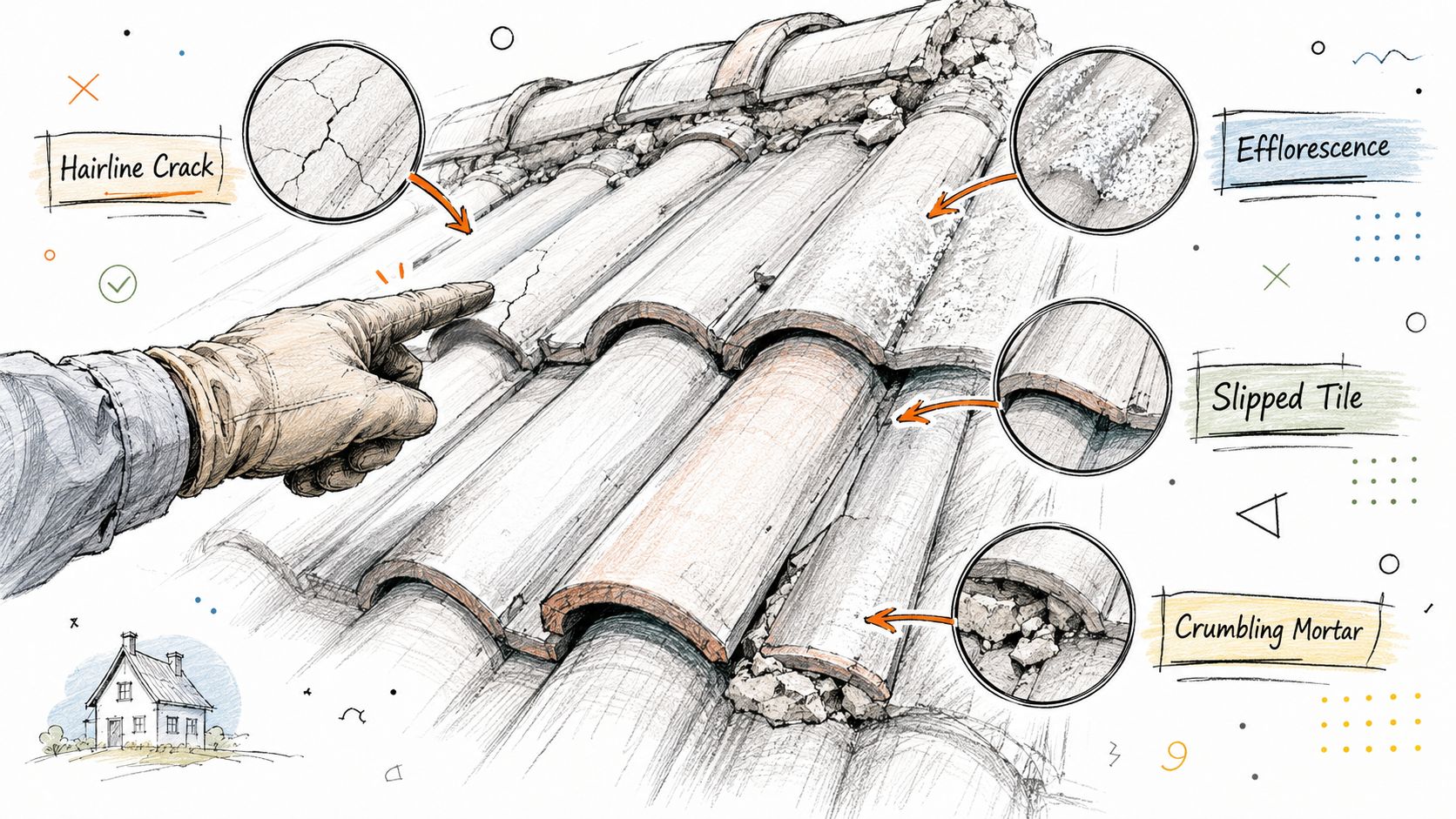
Tile roofs on commercial, industrial, and strata properties usually fail in small ways first. A cracked tile, a slipped course, failed pointing at ridge capping, or lifting flashing can all let wind-driven rain track under the system. On larger Sydney sites, that is harder to pick up early because the roof is rarely viewed close-up and access may need permits, traffic control, or tenant coordination.
What you can spot from the ground
A ground-level check is a sensible first screen. If your site permits drone use, that can help cover larger roof areas without creating access risk. The goal is not to diagnose the full repair scope. It is to identify signs that justify a controlled inspection.
Look for:
- Cracked or broken tiles with visible fractures, chipped corners, or impact marks after storms or service traffic
- Slipped or uneven tile lines that suggest movement, failed fixings, or disturbance around penetrations
- Missing or loose ridge and hip capping sections where bedding or pointing has started to break down
- Persistent staining, efflorescence, or moss growth in areas that stay damp longer than the surrounding roof
- Flashings that have lifted, separated, or deformed at vents, skylights, parapet junctions, and wall abutments
- Debris build-up in valleys because blocked discharge points often push water sideways under adjacent tiles
If you already have water entry inside the building, this guide on how to detect roof leaks on commercial properties can help narrow the likely entry zone before the roofer arrives.
What the building is already telling you
Internal symptoms matter because water rarely appears directly below the defect.
Facilities teams should pay attention to ceiling stains, bubbling paint, mould near upper wall lines, wet insulation, and rusting grid components above tenancies or common areas. Repeated moisture near perimeter walls or top-floor plant rooms is also a warning sign, especially after southerly storms or prolonged rain. On strata and occupied commercial sites, complaint patterns are useful. If the same unit, corridor, or tenancy reports moisture after each weather event, there is usually an established leak path rather than a one-off issue.
Water can travel a long way before it becomes visible. It follows laps, battens, flashings, sarking, and framing. That is why the stain inside the building is only a clue, not the repair location.
Damage patterns that deserve quicker action
Some defects can wait for scheduled inspection. Others should be escalated fast.
Prioritise a roofing assessment if you see movement along ridge lines, multiple displaced tiles after high wind, recurring leaks in the same zone, overflow at valleys, or signs that previous patch repairs have failed. On older Sydney properties, be more cautious where roof work may disturb brittle components, ageing underlays, or adjoining materials that raise asbestos questions. That risk is higher on sites built or altered decades ago, especially where the roof has been repaired in stages.
When to stop checking and bring in a roofer
Once the issue points to more than isolated surface damage, site staff should stop at observation and reporting. Walking a tile roof without the right access setup causes more breakage, and on commercial or strata buildings it also creates liability if someone gets hurt or debris falls into an occupied area.
Arrange a professional inspection when leak reports repeat, visible defects are spread across more than one section, or safe access is not straightforward. On Sydney commercial sites, that decision is not just about finding the leak. It is about protecting occupants, keeping operations running, and making sure the inspection method suits the building, the exposure, and the compliance risks.
Common Tile Roof Repair Methods Explained
Different defects need different repair methods. A good contractor won't prescribe the same fix for a few storm-damaged tiles and a long run of failed ridge capping. The method has to match the defect, the roof age, and the building's exposure.
Here's a simple visual summary before the detail.
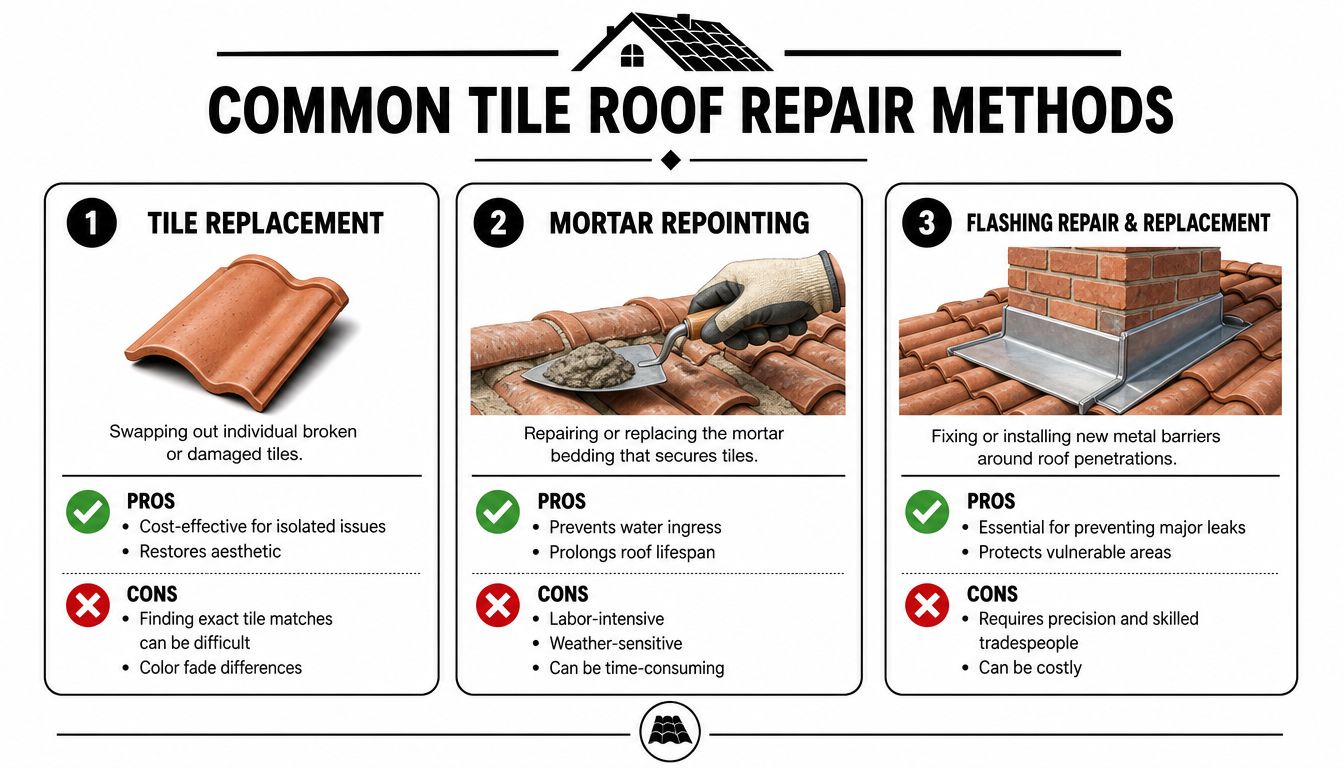
Replacing individual tiles properly
This is the most straightforward repair on paper and one of the easiest to get wrong in practice. The damaged tile is removed, the surrounding area is checked, and a matching replacement is fitted and secured. The catch is that the replacement has to suit the original profile and dimensions exactly.
Under NCC 2019 Part 3.5.2, roof tiles used in repair work must be fixed using specified galvanised clout nails or screws with at least 15 mm penetration into battens, or with purpose-made clips. The same NCC guidance also warns that incorrectly sized replacement tiles can create lift gaps that compromise watertightness during NSW storm events, as set out in the NCC roof tile fixing requirements.
What works here is careful lifting of adjacent tiles, proper matching, and checking the fastening system. What doesn't work is forcing in a near-enough tile because it “looks close”.
Rebedding and repointing ridge and hip capping
If the ridge line is loose, cracked, or shedding mortar, the problem usually isn't the field tile. It's the capping system. Older roofs often show brittle bedding, failed pointing, or patch repairs that have separated after thermal movement.
This type of work usually involves removing unstable material, resetting capping as needed, then restoring the weather seal. The reason it matters is simple. Once ridge lines open up, water and wind can attack the roof from its high points, and loose capping can become a safety issue on occupied sites.
A quick field note before moving on:
Don't accept “a bit of mortar over the cracks” as a repair method. Cosmetic patching often fails first because it doesn't address movement or substrate condition.
Later in the process, details around ridges and hips also need to align with broader Australian Standards requirements for bedding and flexible pointing, especially on roofs exposed to regular thermal movement.
For related problem areas around penetrations and junctions, this guide to roof flashing installation helps explain why leaks often persist even after tiles are replaced.
Flashing and hidden water-entry points
Flashing repairs are where many commercial leak issues are solved. The visible broken tile may be the symptom, but the underlying failure can sit where metal flashing meets tile, wall, skylight, vent, or valley.
On commercial buildings, these details matter because the roof often has more penetrations than a house. Mechanical services, upgraded vents, electrical conduits, and later fit-outs all create junctions that need proper weathering. If one of those details has been patched with incompatible sealant or poorly dressed metal, water can bypass the tile layer and enter the building well away from the obvious defect.
A short explainer can help non-roofers understand what's involved:
| Repair method | Best used for | Main risk if ignored |
|---|---|---|
| Tile replacement | Isolated breakage or impact damage | Under-roof exposure and local leaks |
| Repointing or rebedding | Loose or cracked ridge and hip capping | Water entry and unstable capping |
| Flashing repair | Leaks near penetrations, walls, valleys | Repeated internal water damage |
A brief walk-through of the work is useful here.
Repair or Replace Making the Right Financial Decision
Owners usually ask the wrong first question. They ask, “How much to repair it?” The better question is, “Will this repair buy reliable service life, or am I funding the next emergency?”
That decision should be commercial, not emotional. Tile roofs can often be repaired successfully, but only if the defects are localised and the surrounding system is still doing its job. Once failures start clustering across multiple areas, the economics can shift fast.
When repair still makes business sense
Repair is usually the sensible choice when the roof has isolated damage, the tile profile can still be matched, and the leak path is clear. A storm-damaged section, a local flashing failure, or a ridge line defect in one zone can often be handled without turning the whole roof into a capital project.
For commercial and strata owners, repair also makes sense when:
- The issue is contained: one building wing, one penetration cluster, or one impact zone.
- The roof is otherwise stable: no widespread movement, chronic leak history, or repeated patching in multiple sections.
- You need to preserve occupancy: a targeted repair can often be staged with less disruption than full replacement.
- The property plan is short to medium term: if an owner expects redevelopment, sale, or a larger refurb later, a compliant repair may be the right holding strategy.
A practical test is whether the repair solves a defined defect or merely chases symptoms. If every inspection finds a new nearby issue, the roof may be telling you the problem is systemic, not local.
When replacement is the cleaner decision
Replacement becomes the better financial move when the roof keeps producing “small” repairs that are no longer small in total. In commercial asset management, I look for repair clusters. That means repeated defects in ridges, valleys, flashings, and tile fields across more than one area. Once that pattern appears, each individual quote can look manageable while the overall risk keeps rising.
Here are the main triggers that push the decision toward replacement:
- Repeated leaks in different locations: not one stubborn defect, but multiple paths of water entry over time.
- Widespread tile deterioration or poor prior repairs: especially where matching becomes difficult and workmanship quality is inconsistent.
- Operational sensitivity below: hospitals, schools, tenanted offices, retail floors, and plant rooms don't tolerate recurring water ingress well.
- High access and safety overheads every time: if each small repair requires complex setup, repeated interventions become inefficient.
A roof doesn't have to be collapsing to justify replacement. It only has to be unreliable enough that continued repair stops being a controlled expense.
A decision framework owners can actually use
If you're weighing repair against replacement, use this lens:
| Question | Lean toward repair | Lean toward replacement |
|---|---|---|
| Is the damage local or widespread? | Local | Widespread or recurring |
| Can the tile and detail be matched properly? | Yes | No, or only with compromise |
| Are leaks tied to one known failure point? | Yes | No, several unrelated points |
| Will staged repair support your property plan? | Yes | No, it only delays larger works |
The biggest mistake is treating every quote in isolation. A cheaper repair today can still be the more expensive decision if it leaves you exposed to more callouts, tenant issues, and internal damage over the next wet season.
Navigating Sydney Compliance Safety and Asbestos Risks
Compliance isn't paperwork you do after the repair. It is part of the repair. On commercial, industrial, and strata sites in Sydney, the job scope has to include safe access, correct fixing methods, suitable materials, and site controls that reflect who is below the work area.
The owners who get into trouble are usually the ones who think roof repairs are simple maintenance. They can be simple in size, but they're still high-risk construction activity when workers are at height and when brittle materials, public access, or older building fabric are involved.
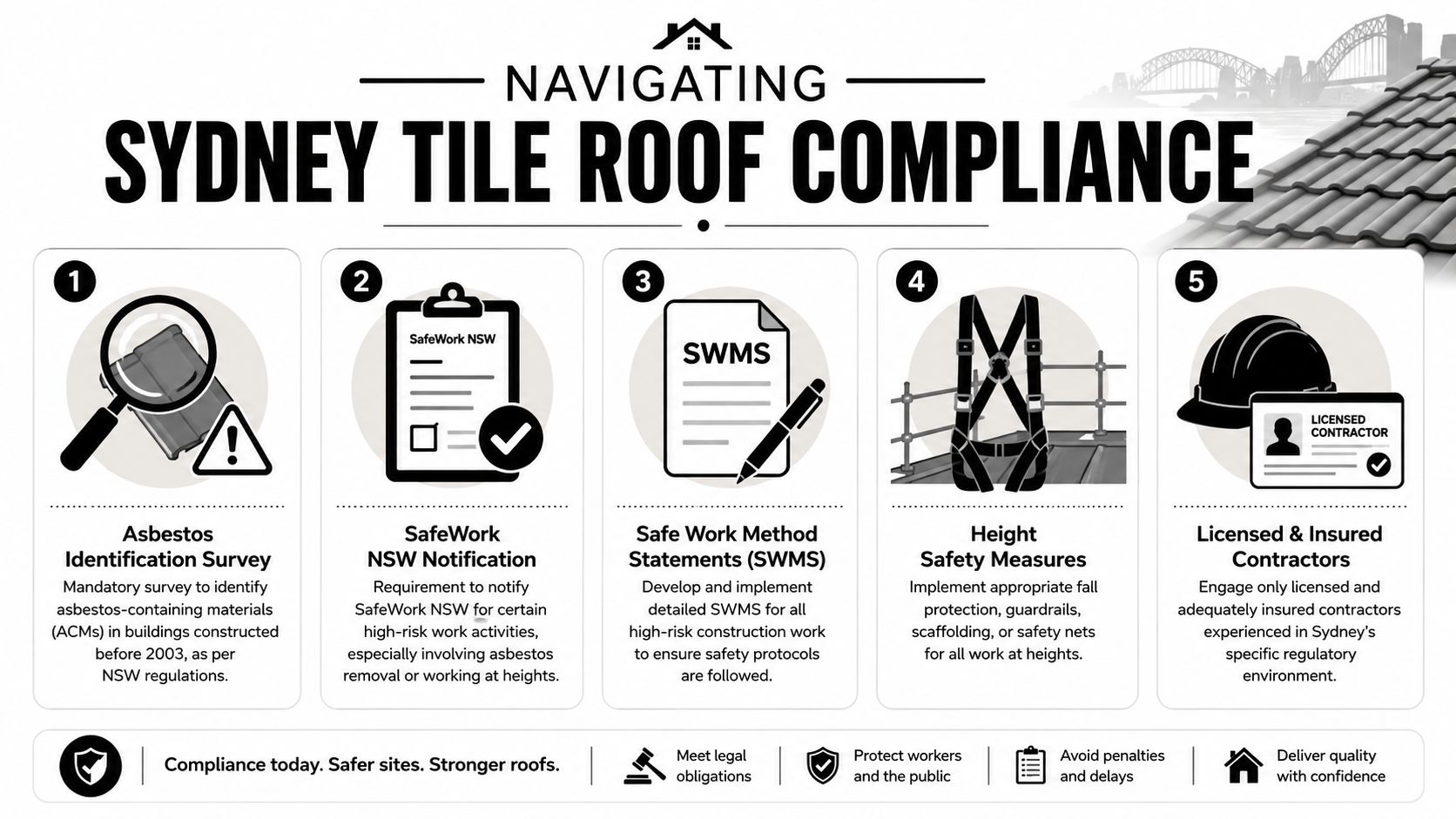
Compliance is part of the repair scope
A proper tile roofing repair needs the right method detail, not just a labour crew. For ridge and hip capping work, Australian Standards require mortar bedding at a 4:1 sand-to-cement ratio, with flexible pointing used to accommodate thermal movement. In high-rainfall zones such as greater Sydney, valley tile gaps may be increased to 150 mm to reduce water ponding during intense downpours, according to the Australian Standards discussion summarised by SCG International's guide to roof tile supplier and standard checks in Australia.
That matters because generic patch repairs often ignore local rainfall conditions. A valley that looks serviceable on a dry day can still overflow in a Sydney summer storm if the detailing is wrong.
On occupied sites, compliance also means planning around:
- Public protection: isolating entries, walkways, loading areas, and common property below the work zone.
- Access systems: scaffolds, edge protection, harness systems, or aerial work platforms suited to the actual roof geometry.
- Site documentation: risk assessments, SWMS, permits, and communication with building users.
- Material compatibility: making sure clips, nails, screws, pointing compounds, and replacement tiles suit the existing roof system.
Asbestos changes the job immediately
Older commercial and strata buildings need extra caution because the roof assembly may include asbestos-containing materials even where the tiles themselves are not asbestos. The risk can sit in associated components, linings, flashings, or penetrations from earlier construction periods.
If asbestos is suspected, the job should pause until the material risk is properly assessed. That's not overreaction. It's how you avoid unlawful disturbance, contamination, site closure, and liability exposure. Owners who want background on the process should review this guide to asbestos roof removal and replacement.
If a contractor wants to “just be careful” around suspected asbestos without clear identification and controls, that's a red flag.
Why cutting corners costs more on commercial sites
Cheap roof repairs can become very expensive once safety and compliance failures are involved. A non-compliant repair can leave you with repeated leaks, defect disputes, and questions from insurers or committees about why proper controls were skipped in the first place.
For bushfire-exposed regions tied to relevant roof system requirements, joint and sidelap detailing also matters because ember protection gaps must be tightly controlled. That level of detail is one reason commercial owners should insist on contractors who understand standards-based roofing work, not just general handyman patching.
Understanding Cost Drivers and Choosing a Contractor
A Sydney strata manager approves a low quote to replace a handful of cracked tiles. Once the crew gets on the roof, the job changes. Access is tighter than expected, matching tiles are hard to source, and the leak path runs past the visible breakage. The first price was never going to cover the full scope.
That is how commercial tile repair budgets blow out.
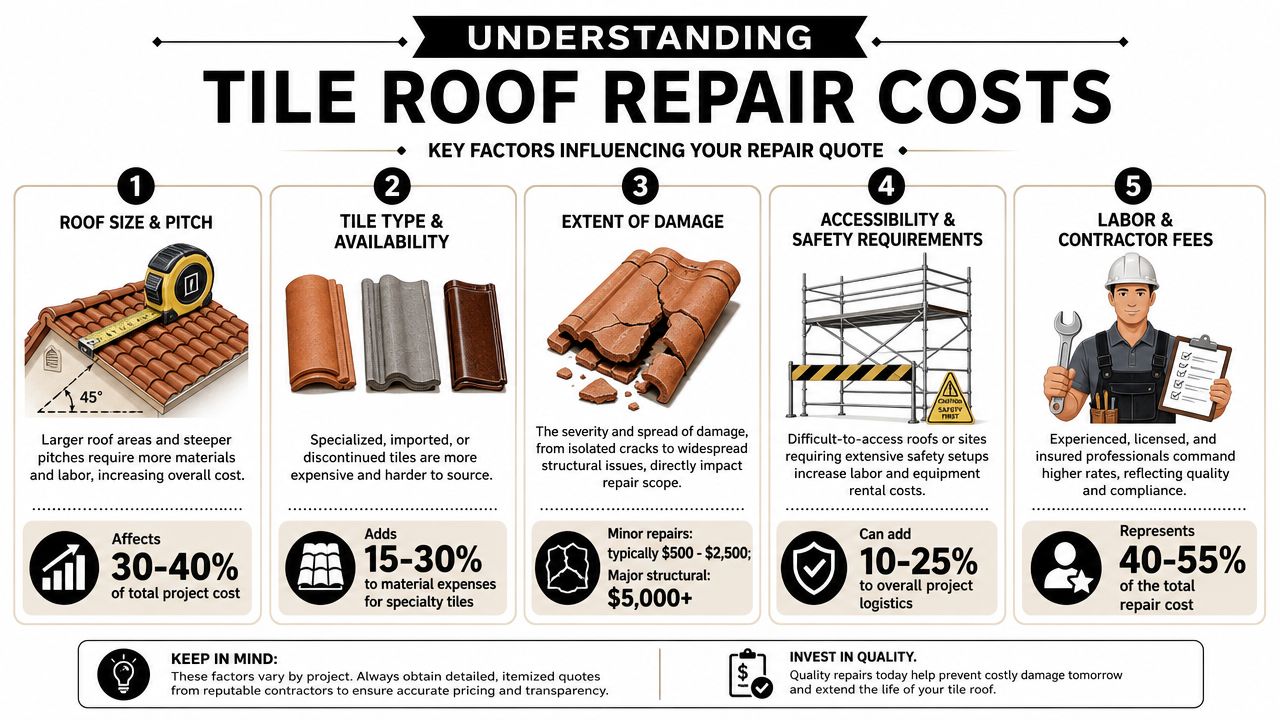
What pushes a tile roof repair quote up or down
On commercial, industrial, and strata sites, the price is driven less by the tile itself and more by what it takes to repair the roof properly while keeping the building operational. A warehouse with clear perimeter access prices very differently from an occupied apartment block with pedestrian controls, limited access points, and committee reporting requirements.
The main cost drivers are usually these:
- Access conditions and roof geometry: Height, pitch, set-down areas, and restricted site access change labour time and plant requirements fast.
- Tile matching: Concrete and terracotta repairs get more expensive when the profile is discontinued or the existing roof has weathered unevenly.
- Extent of hidden defects: A visible cracked tile may be the least expensive part of the job if bedding, pointing, flashings, or valleys nearby are already failing.
- Occupied-site controls: On Sydney commercial and strata properties, costs often include staging, exclusion zones, lift access coordination, and work hours that avoid tenant disruption.
- Inspection method: Some leaks can be priced from a targeted inspection. Others need more investigation because water has tracked well away from the entry point.
Published cost guides in Australia generally place minor tile repairs in the hundreds, with larger remedial works such as rebedding, repointing, or structural repair rising into the thousands. Those ranges are useful for rough budgeting only. They do not account for site-specific constraints, compliance paperwork, or the operational costs that show up on live commercial properties.
A simple budget table still helps frame the discussion.
| Repair Type | Typical Cost Range (AUD) |
|---|---|
| Minor tile repair | $300 to $1,200 |
| Repointing and rebedding | $1,500 to $3,500 |
| Major structural repair | Exceeds $3,000 |
| Full tile restoration | $3,500 to $13,000 |
| Tile roof inspection | $150 to $400 |
Use those figures as a starting point, not an approval basis. I have seen small quoted repairs turn into broader remedial work once safe access is installed and the surrounding tile field is checked properly.
Questions that separate a real commercial roofer from a cheap quote
A usable quote does more than list line items. It shows whether the contractor understands commercial risk, site control, and the difference between a visible fix and a durable repair.
Ask these before approving any works:
- What defect scope is included? Confirm whether the quote covers only broken tiles or also adjacent bedding, pointing, flashing details, and water-entry checks.
- What access method is allowed for this site? The contractor should be clear about scaffold, edge protection, aerial work platforms, or other access measures needed for the building.
- How will tile matching be handled if the profile is obsolete? Good contractors explain the options early, including salvage stock, nearest-profile alternatives, and any appearance trade-offs.
- What documentation will be provided? For strata and commercial owners, before-and-after photos, site reports, and a clear record of completed repairs matter for committees, asset files, and future defect tracking.
- How will the work affect tenants or operations? This should cover timing, noise, access restrictions, and any need to stage works around business activity.
- What is excluded from the price? This question saves arguments later. If latent defects, extra access equipment, or replacement quantities beyond the inspected area are excluded, that should be written clearly.
The lowest quote often wins when the roof is already leaking and the pressure is on. On Sydney commercial properties, that can be an expensive decision. A better contractor is usually the one who identifies the hard parts early, prices them plainly, and gives you enough detail to defend the spend internally.
FAQs and Proactive Maintenance Planning
Most owners don't think about the roof until it leaks. That's understandable, but it's also why repair spending becomes unpredictable. A better approach is to answer the common operational questions early, then put the roof on a maintenance cycle that fits the building.
Practical questions clients ask before approving works
Will the repair disrupt tenants or operations?
It can, but good planning limits it. On commercial sites, the main disruptions usually come from access restrictions, noise, temporary exclusion zones, and weather timing. Most targeted repairs can be staged around occupancy if the contractor plans site controls properly.
Can older tiles be matched perfectly?
Sometimes yes, sometimes no. The practical goal is a correct fit and watertight repair first. On older roofs, colour weathering can make new replacement tiles stand out at first even when the profile is right. A contractor should be upfront about that rather than promising an invisible patch.
How long should a repair last?
That depends on whether the issue is isolated or part of a broader failing roof. A properly specified local repair can perform well. A patch applied to a roof with multiple active defects usually won't solve the problem for long.
Do I need to act if the leak has stopped?
Yes. A leak that stops in dry weather hasn't fixed itself. It's inactive until the next rain event exposes the same path again.
The right time to investigate a roof leak is after the first report, not after the third internal damage claim.
A maintenance plan that prevents repeat callouts
Reactive repairs have their place, but commercial owners get better control when roof maintenance is scheduled. The point isn't to spend for the sake of it. The point is to turn surprise failures into manageable maintenance work.
A practical maintenance plan for a tiled commercial roof should include:
- Routine inspections: especially after major storms and before wetter periods.
- Drainage checks: valleys, gutters, downpipes, and discharge paths should be kept clear so water can leave the roof quickly.
- Ridge and capping review: early signs of cracking, movement, or failed pointing should be picked up before sections loosen.
- Flashing checks around penetrations: service upgrades often create weak points long before they leak visibly.
- Photo records and defect tracking: this helps owners see whether they're dealing with isolated issues or a growing pattern.
For strata managers and facilities teams, the value is predictability. You can budget smaller works, schedule safer access, and reduce the risk of emergency attendance during trading hours or bad weather.
The simplest rule is this. If you already know the roof has one defect, assume it deserves a proper inspection cycle from that point onward. That's how you protect the building, the tenants, and your maintenance budget.
If you're weighing up tile roofing repair on a Sydney commercial, industrial, or strata property, Commercial Roofers can assess the defect, advise whether repair or replacement is the cleaner option, and carry out compliant works with attention to access, safety, and operational continuity.