

A few cracked tiles on a warehouse office wing or strata block don't look like a capital works problem. Then the next storm hits, a tenant reports water staining, and the question changes fast. Are you dealing with a minor roof tile replacement job, or the first visible sign that the whole roof system is failing?
That distinction matters. On commercial buildings, the visible tile is only one part of the assembly. If the weak link sits in the underlay, flashings, battens, fixings, or substrate, swapping a handful of broken tiles can waste money and still leave the building exposed. I've seen owners spend repeatedly on patch repairs that kept the roof looking serviceable while water kept finding its way underneath.
In Australia, this isn't a niche issue. The country still has a huge base of detached low-rise buildings, and the ABS dwelling profile cited here notes 10,853,806 private dwellings nationwide in 2021, with 72.7% as separate houses, while NSW had 3,132,033 private dwellings and 66.2% separate houses. That building stock is a big reason tiled roofs remain a recurring asset-management issue across Sydney and broader NSW.
Table of Contents
- Introduction Is Your Tiled Roof a Ticking Time Bomb
- Identifying Critical Roof Tile Failure on Commercial Buildings
- Repair or Full Replacement A Strategic Decision Framework
- Navigating Asbestos and Modern Colorbond Replacement Options
- The Commercial Roof Replacement Process From Start to Finish
- Understanding Cost Drivers and Calculating Project ROI
- Compliance Contractor Selection and Tendering Tips
- Post-Replacement Care Maximising Your Investment
Introduction Is Your Tiled Roof a Ticking Time Bomb
Most owners call about roof tile replacement after a leak, not before one. That's understandable. A tile roof can look stable from ground level while the waterproofing layer underneath has already deteriorated, edge fixings have loosened, or battens have started to fail.
Think of the roof as a chain. The tile might be the visible link, but the leak often starts where another link has weakened first. If you treat every water entry point as a broken-tile problem, you risk paying for appearance instead of performance.
For strata managers, the pressure usually comes from competing priorities. You've got budgets, committee approvals, residents, insurance questions, and the need to keep the building watertight without turning the site into a construction headache. For warehouse owners, the equation is sharper. A small roof failure can interrupt stock, operations, electrical systems, and staff safety.
Practical rule: If leaks are recurring, don't ask only how many tiles need replacing. Ask whether the roof system is still doing its job.
The right decision usually comes from diagnosis first, scope second, and procurement last. That order saves money.
Identifying Critical Roof Tile Failure on Commercial Buildings
A commercial tiled roof rarely fails all at once. It usually gives warnings first. The problem is that owners often focus on the easiest sign to see, such as a cracked tile near a gutter or a stain on a ceiling tile, and miss the broader pattern.
Look past the obvious cracked tile
Start with what the building is already telling you. Internal water staining, repeat leak locations, damp insulation, and debris in gutters all point to more than isolated breakage. On older tiled roofs, surface wear can show up as brittle edges, porosity, or widespread weathering that makes the roof more vulnerable during storm events and maintenance traffic.
This visual checklist is useful during early inspection planning.
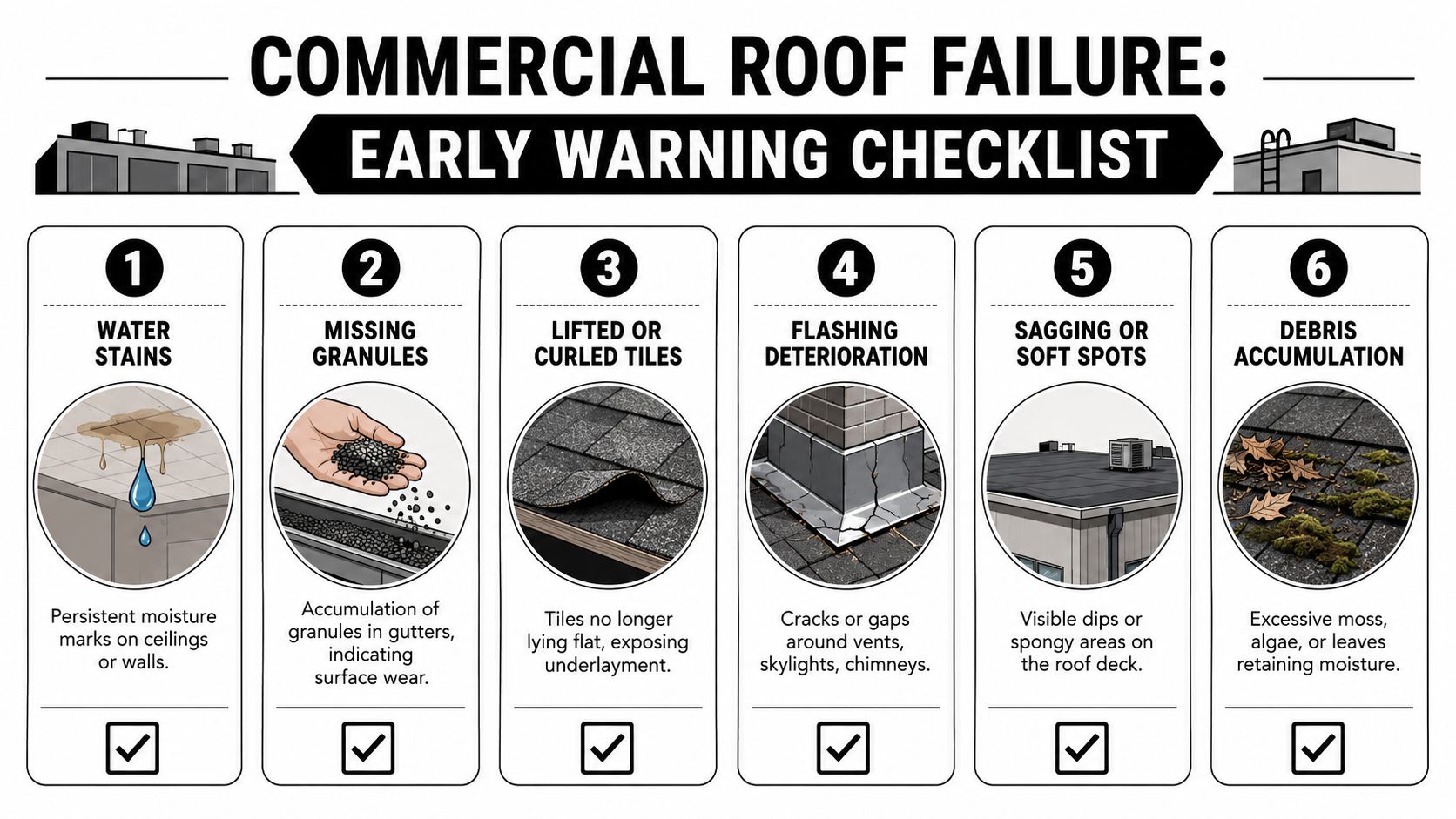
Some signs matter more on commercial sites because access is less frequent. If your maintenance team only gets onto the roof reactively, deterioration can continue for a long time before anyone sees it close-up.
- Ceiling and wall staining: Moisture marks often show up well away from the actual entry point.
- Tile fragments in gutters: Broken noses and edges can indicate traffic damage, storm movement, or brittle aging tiles.
- Movement around penetrations: Problems near vents, skylights, plant mounts, and parapet junctions often trace back to flashings or detailing.
- Edge-zone distress: Eaves, ridges, and top edges are exposed areas where poor fixing patterns show up early.
- Repeated repair history: If the same zone needs attention every season, the issue probably isn't one tile.
- Soft spots underfoot: That can indicate substrate or batten trouble and needs professional inspection.
When the tile is not the real problem
One of the most common misdiagnoses in commercial roof tile replacement is assuming the visible covering caused the leak. Independent technical guidance warns that tiled systems depend on correct lapping, drainage openings, and detailing at eaves, rakes, penetrations, and valleys. If those elements are wrong, the roof can leak even when the tiles look intact, as noted in this technical article on common tile roof mistakes.
That matters on older commercial assets where patching has happened over years. I often see roofs where tiles were swapped but the underlying issues remained untouched. The result is a roof that looks attended to on paper but still performs poorly in wind-driven rain.
Leaks don't always mean the tile has failed. They often mean the system beneath it has been overlooked.
A competent inspection should separate surface defects from systemic defects. Surface defects include broken or slipped tiles in otherwise healthy areas. Systemic defects include deteriorated underlay, corroded flashings, decayed battens, poor fastening patterns, and loss of weather integrity across a wider section of roof.
A practical repair versus replacement filter
Use this as an asset-management filter rather than a maintenance guess.
| Condition | Repair usually makes sense | Replacement or major rebuild usually makes more sense |
|---|---|---|
| Damage pattern | Isolated and localised | Repeated across multiple zones |
| Leak history | Infrequent, traceable to one event | Recurring or hard to pinpoint |
| Tile availability | Matching profile is available | Profile is discontinued or inconsistent |
| Substrate condition | Underlay, battens and flashings are sound | Underlay or support components show deterioration |
| Operational risk | Low consequence if repair window is short | High consequence from future failure |
| Budget approach | Tactical maintenance | Planned capital works |
If the roof passes most tests in the left column, targeted repair can be sensible. If it leans to the right, continuing to patch usually delays a bigger spend while increasing risk to interiors, tenants, and business continuity.
Repair or Full Replacement A Strategic Decision Framework
A warehouse roof fails at 2 am in heavy rain. By 7 am, the issue is no longer a roofing problem. It is wet stock, unsafe walkways, tenant complaints, emergency callout costs, and pressure to approve works without a clear scope. That is why the repair versus replacement decision should be made before the next leak, not after it.
For commercial and strata assets, the right question is simple. Which option gives the building the lowest total risk and the most defensible spend over the next 10 to 20 years?
Assess the asset as a business risk
Start with consequence, not just defect counts. A small leak over a plant room, electrical riser, common corridor, or tenanted area can create a larger financial problem than a visibly rough roof over low-value storage. I have seen owners approve repeated patching because the invoice looks manageable, then lose that saving in one weather event through stock damage, access restrictions, and after-hours labour.
Three factors usually decide the direction.
- Failure pattern. One damaged section after a storm is different from recurring issues across ridges, valleys, penetrations, and flashings.
- Remaining system life. Tiles might still be presentable while the underlay, bedding, battens, or fixings are near the end of service life.
- Operational consequence. A school, shopping strip, warehouse, and strata complex each carry different disruption costs, but all pay for unplanned failure.
If asbestos is suspected in any part of the roof assembly or associated elements, the decision framework changes immediately. What looked like routine maintenance can become a controlled project with testing, licensed removal, staging constraints, and disposal documentation. That affects budget, programme, contractor selection, and how the site is managed during works.
When repair still makes commercial sense
Repair is the right call when the defect is isolated, the roof system around it is still sound, and matching materials are available. It also helps when access is straightforward and the building can tolerate the risk of another localised issue without serious operational fallout.
That usually means:
- leaks can be traced to a specific area
- the roof has not developed a pattern of repeated failures
- flashings, underlay, and battens are still serviceable in the affected zone
- the owner needs to defer capital works for a defined reason, not out of habit
In those cases, targeted repairs can buy useful time. The key is to treat them as planned interim works with a known review point, not as an open-ended strategy.
When replacement is the stronger decision
Full replacement becomes the better commercial option when defects are spread across the roof, maintenance history shows repeat attendance, or the supporting components are deteriorating. At that point, patching often hides the true cost of ownership because the spend is split across small invoices, emergency callouts, and internal disruption.
Replacement also deserves serious consideration where:
- tile profiles are discontinued or inconsistent
- previous repairs have created mixed workmanship and unreliable detailing
- roof access is difficult, making every future repair slower and more expensive
- the building has compliance exposure tied to water ingress, safety, or hazardous materials
- the owner is holding the asset long enough to benefit from lower maintenance and better predictability
For many commercial owners, certainty has value. A planned reroof with staged access, clear procurement, and controlled tenant communication is usually easier to manage than ongoing reactive works.
Tile-for-tile replacement or conversion
Once replacement is justified, the next decision is whether to stay with tile or convert to metal. This is not just a material preference. It affects structural load, installation speed, maintenance planning, appearance controls, and long-term risk.
Tile-for-tile replacement suits buildings where the existing character matters, local planning settings are tight, or a strata scheme wants to preserve a consistent look across lots or stages. It can also be the lower-friction option where the roof geometry already suits tile detailing and no broader redesign is planned.
A conversion to metal, often Colorbond, is commonly chosen for low-rise commercial and industrial buildings that need a lighter roof system and a cleaner maintenance profile. Owners considering that path should review the practical implications of commercial metal roofing systems in Australia before finalising scope.
The trade-offs are straightforward:
- Dead load: Metal is lighter. That can matter on older structures or where structural margins are limited.
- Programme: Metal reroofing can offer faster sequencing on some sites, which helps reduce tenant and business disruption.
- Maintenance profile: Tiles tend to involve more individual unit failures over time. Metal shifts attention to flashings, fasteners, sealants, and drainage details.
- Appearance and approvals: Tiles often suit traditional or tightly controlled strata environments. Metal often suits industrial and contemporary commercial assets better.
The best option is the one that fits the building's use, approval constraints, and ownership horizon. If the asset needs reliability, easier future access, and lower ongoing intervention, replacement often wins. If the roof still has strong bones and the defects are local, repair can still be a disciplined commercial decision.
Navigating Asbestos and Modern Colorbond Replacement Options
When asbestos enters the picture, the job stops being a straightforward reroof and becomes a tightly controlled risk-management project. When Colorbond enters the discussion, the job becomes a strategic redesign decision as much as a material swap.
Asbestos changes the whole job
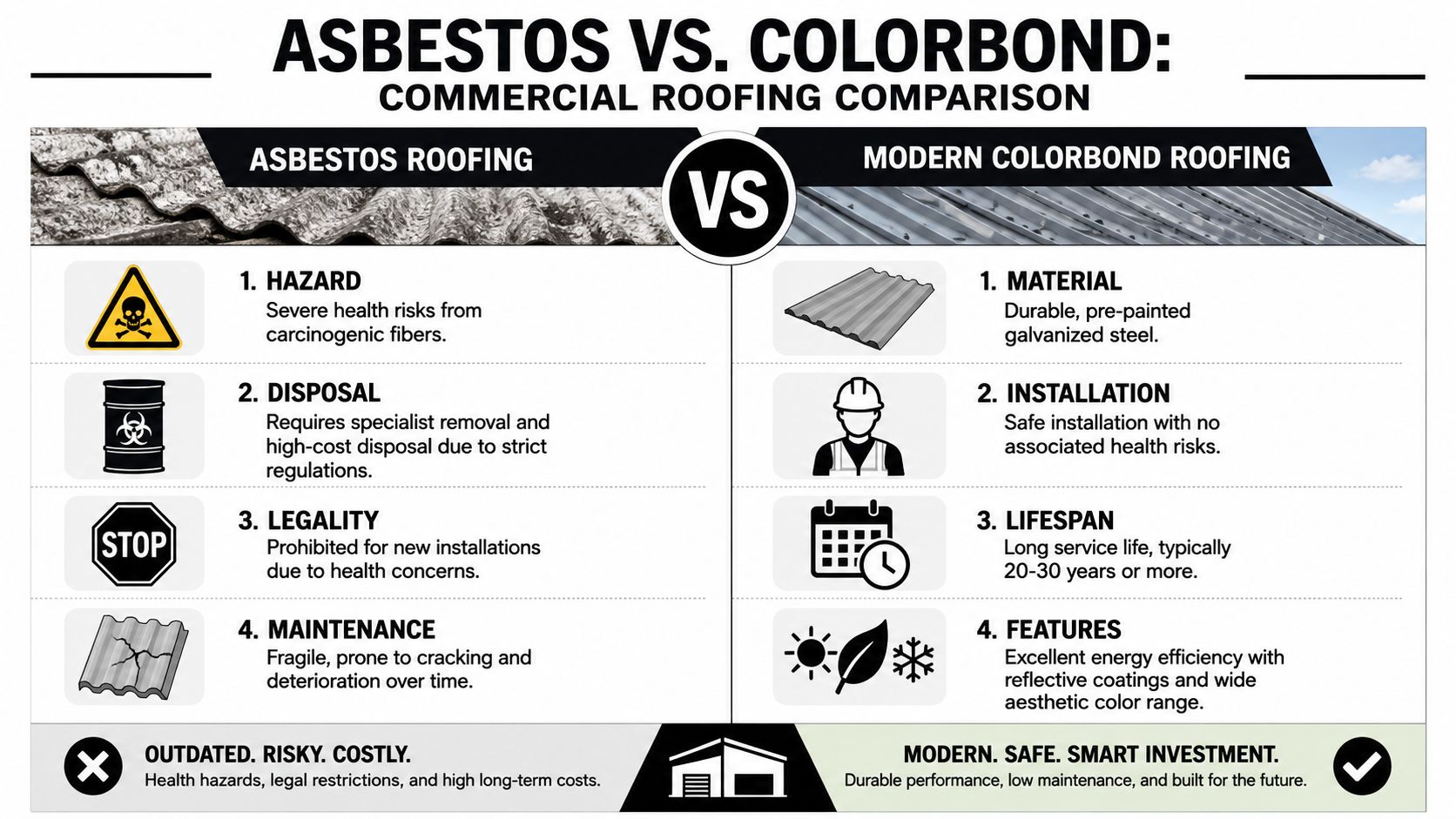
On older Australian commercial buildings, asbestos-containing materials can appear not only in roof sheets but in associated building elements and legacy components around the roofline. If there is any suspicion, the correct move is testing and a removal plan by licensed professionals. Owners should expect controlled access, site isolation measures, specialised removal procedures, and compliant disposal documentation.
Many project timelines go wrong because committees and owners budget for “roof replacement” but haven't allowed for asbestos investigations, approvals, staged works, or the communication needed with occupants and neighbours. Once asbestos is confirmed, safety, paperwork, and sequencing become central to the project.
This comparison helps frame the difference in practical terms.
What a conversion project usually involves
A tile-to-Colorbond conversion isn't just a new skin. It usually starts with structural review, demolition planning, and confirmation of what stays and what gets replaced. Then comes removal of the old roof system, inspection of the supporting structure, installation of the new substrate and weatherproofing components, and only then the final roof finish.
Communication is as important as workmanship. On occupied commercial sites, owners need clarity on access routes, noisy work periods, weather contingency planning, and what protection is in place while the building is temporarily exposed during changeover. Good contractors issue this information early and update it as the program moves.
For owners comparing metal systems in more detail, this guide to metal roofing options in Australia is a useful companion when you're evaluating profiles, finishes, and suitability for different commercial assets.
Material Comparison Tiles vs Colorbond Steel
If you stay with tiles, material compliance matters. AS 2049 is the Australian national specification for roof tiles used in buildings, and this overview of AS 2049 requirements is a useful reference point. In practice, that means replacement tiles need to meet current performance expectations for durability and weather resistance, not just look similar from the street.
| Factor | Modern Roof Tiles (Concrete/Terracotta) | Colorbond Steel Roofing |
|---|---|---|
| Appearance | Traditional, textured, suited to established suburban and strata styles | Cleaner commercial look, broad colour range, common on industrial and mixed-use sites |
| Structural load | Heavier roof assembly | Lighter roof assembly |
| Local repairs | Individual tiles can be replaced where matching stock exists | Repairs usually focus on sheets, flashings, fixings, penetrations and drainage details |
| Ongoing maintenance | More attention to cracked, slipped or brittle units over time | Often simpler visual inspection, but still needs regular checks of flashings and drainage |
| Compliance focus | Tile specification, compatibility, laps, fixings and underlay | Profile selection, fastening, penetrations, sheet layout and drainage detailing |
| Typical owner priority | Retain tiled appearance | Reduce weight and simplify long-term upkeep |
Owner's checkpoint: Don't choose Colorbond only because someone says it's lighter. Choose it because the building, budget, maintenance plan, and appearance controls all support that move.
The Commercial Roof Replacement Process From Start to Finish
Commercial owners don't need a DIY guide. They need to know what a properly managed replacement should look like, when risk is highest, and what should be happening on site at each stage.
Pre-start controls shape the whole project
Every sound project starts with investigation, scope confirmation, and site controls. That includes inspection access, hazard identification, edge protection planning, staging areas for materials, and agreement on how the site will remain operational during the works.
This process view is what a professional program should roughly follow.
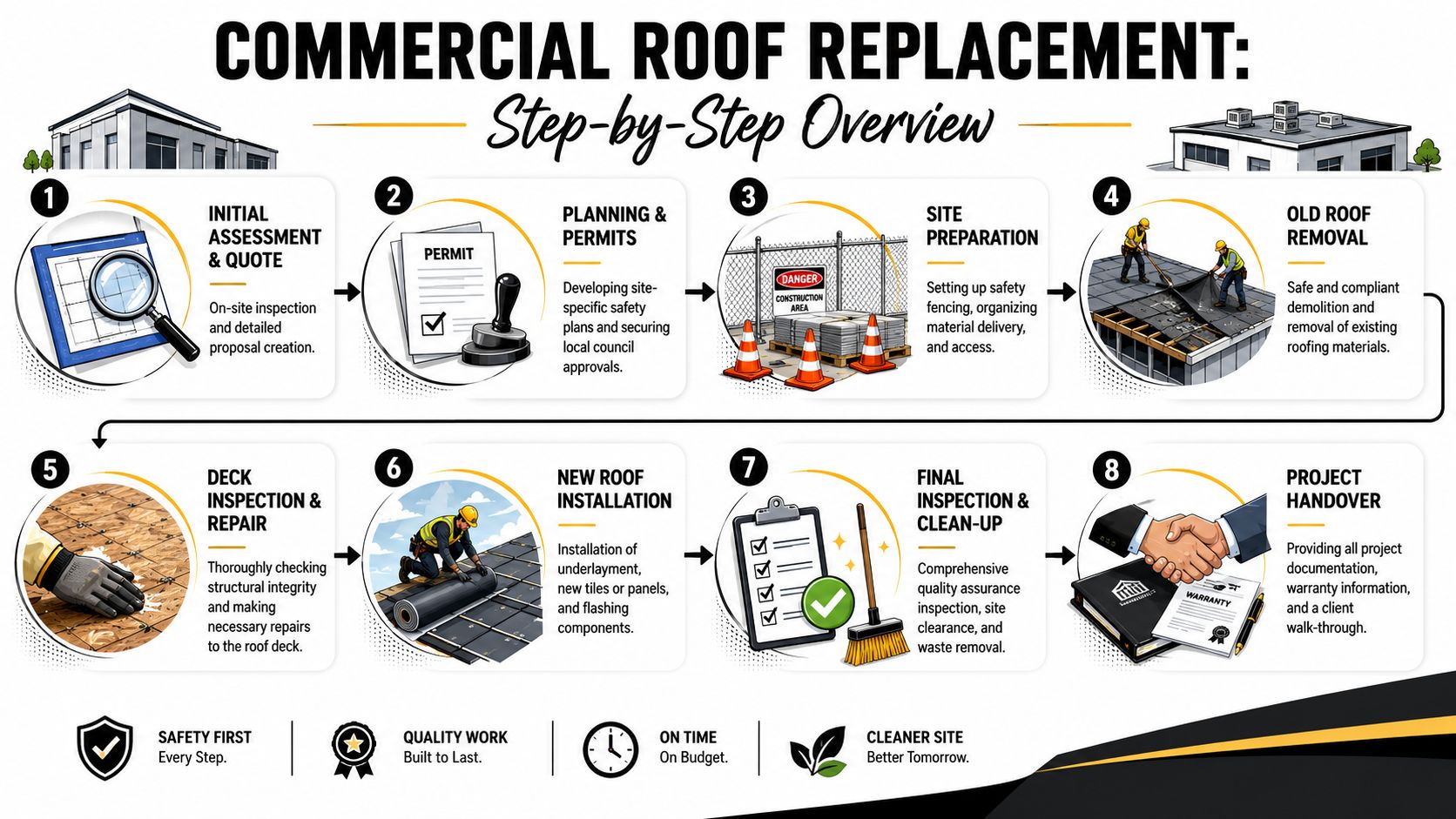
Two things matter early. First, the contractor must know how to keep the building safe and weather-protected during partial strip-off stages. Second, the client must know who is communicating disruptions to tenants, staff, delivery operators, or residents.
If you want a broader view of what proper roof installation staging should include, this outline on commercial roof installation practice is worth reading before tender review.
A short video can also help owners visualise the sequence and site logistics involved in replacement works.
Removal, inspection and rebuild
The risky point in any reroof is the transition between removal and reinstatement. That's why competent crews don't just race to strip the old roof. They work in controlled sections, manage weather windows, and inspect the roof structure as the covering comes off.
For tiled systems, technical detail is essential. This technical roof tile repair guidance notes that damaged tiles should be removed and adjacent tiles lifted and re-set so hidden fissures or cracked edges aren't missed. It also states that on lower-slope sections, underlayment requirements change. Below 3:12 slope, a minimum three-ply built-up roof felt is required. At 3:12 and above, underlayment with 6-inch side laps is required. The same guidance states the tile head lap must be at least 3 inches and that eave-course tiles need code-approved fastening.
Those are the details that separate a cosmetic reroof from a roof that performs.
- Strip and sort: The old roof comes off in planned sections, with salvage only where appropriate.
- Inspect the frame and deck: Hidden defects, such as corrosion, moisture damage, or unsupported areas, are revealed.
- Replace the weatherproofing layer: New underlay or sarking goes in before the final covering.
- Rebuild the fixing system: Battens, fasteners, flashings, ridge components, and penetrations are brought back to a compliant standard.
- Install the finish layer: Tiles or metal sheets are installed to the specified pattern and detailing.
If a quote talks mostly about tiles and barely mentions underlay, battens, flashings, access, and weather protection, it's incomplete.
What should appear in a professional quote
A commercial reroof quote should let you see where the money and the risk sit. It should identify demolition scope, access equipment, substrate repairs, material supply, flashing works, safety controls, waste removal, and project management responsibilities.
Look for line items or clear inclusions around:
| Quote component | Why it matters |
|---|---|
| Access and safety setup | Scaffolding, edge protection, site fencing, and fall controls affect both price and programme |
| Removal and disposal | Old tile, debris, contaminated waste, and transport can materially change scope |
| Structural or substrate repairs | Hidden defects often become visible only after strip-off |
| Underlay and battens | Core performance items, not minor accessories |
| Flashings and penetrations | Leak-prone details that can't be treated as afterthoughts |
| Final clean-up and handover | Essential for occupied sites and warranty close-out |
Owners who understand these moving parts tend to choose better tenders, even when they don't choose the cheapest one.
Understanding Cost Drivers and Calculating Project ROI
A reroof is rarely cheap, but “expensive” and “poor value” are not the same thing. The useful question is whether the project lowers your operating risk and future maintenance burden enough to justify the spend.
What actually moves the price
The biggest cost drivers are usually scope complexity rather than the visible roof area alone. Steep pitches, difficult access, busy occupied sites, heritage constraints, fragile interiors, penetrations, old flashing conditions, and structural repairs all push labour and programme pressure upward. So does asbestos, because it changes removal, containment, transport, disposal, and supervision requirements.
Material choice also changes the cost structure. New concrete or terracotta tiles, associated ridge systems, and compatibility issues create one type of budget. A Colorbond conversion creates another, often with different structural and detailing considerations.
You should also expect the quote to reflect how the contractor intends to protect your operations. Night works, staged access, temporary waterproofing, traffic control, tenant notices, and restricted loading windows all cost money, but they can save much larger amounts in disruption.
How to think about return on investment
Commercial owners often make the mistake of judging roof tile replacement only as a maintenance expense. It's better treated as an asset-protection decision. Return on investment comes from avoided losses as much as from direct savings.
A stronger way to assess ROI is to ask:
- Will this cut reactive repairs? Repeated leak callouts and internal make-good works add up quickly.
- Will this reduce disruption risk? Warehouses, schools, offices, and strata buildings all pay when operations are interrupted.
- Will this improve insurability or claims outcomes? Insurers care about building condition, maintenance history, and known defects.
- Will this support tenant retention or sale readiness? A documented new roof reduces a buyer's or tenant's perceived future liability.
- Will this lower lifecycle maintenance complexity? Some systems are easier to keep watertight over time.
For owners trying to benchmark where repair budgets start becoming false economy, this overview of commercial roof repair cost considerations helps frame when ongoing patching stops being efficient.
The tender shortcut that usually backfires
The most expensive tender mistake is choosing on the lump sum alone. Cheap quotes often get there by omitting substrate repairs, allowing minimal flashing replacement, assuming easy access, or staying vague on provisional items that are likely to become variations later.
Risk test: If two prices are far apart, don't ask which contractor is hungrier. Ask which scope is missing.
Rigorous vetting is the best cost-control tool you have because it catches under-scoped tenders before the contract is signed. That's where real savings happen.
Compliance Contractor Selection and Tendering Tips
A weak contractor selection process usually shows up halfway through the job, not at contract signing. That is when access proves harder than allowed for, hidden deck damage appears, asbestos procedures slow the programme, or the site team cannot keep the building dry during staged removal. On a strata complex or warehouse, those failures turn into complaints, downtime, variation claims, and insurance exposure.
Commercial tile replacement needs more than a roofer who can lay product neatly. You need a contractor who can run a controlled construction project on an occupied asset, with clear responsibility for safety, supervision, disposal records, weather planning, and final compliance documents.
What to demand before awarding the job
Start with current evidence. Ask for licences, insurance certificates, WHS documentation, site-specific safe work method statements, and a clear org chart showing who will supervise the works each day. If asbestos is in scope, or even suspected, confirm the removal licence class, air monitoring approach where required, clearance process, and who carries legal responsibility for waste tracking.
Tile work also has technical rules that affect wind performance, water entry risk, and warranty outcomes. Fixing patterns, sarking condition, roof pitch, edge restraint, and substrate integrity all need to be assessed before the price is accepted. Guidance aligned with AS 2050-based practice sets different fixing requirements depending on the roof configuration and tile type. On exposed or lower-pitch areas, the fixing schedule matters far more than appearance. A contractor who speaks vaguely about these details is not ready for a commercial reroof.
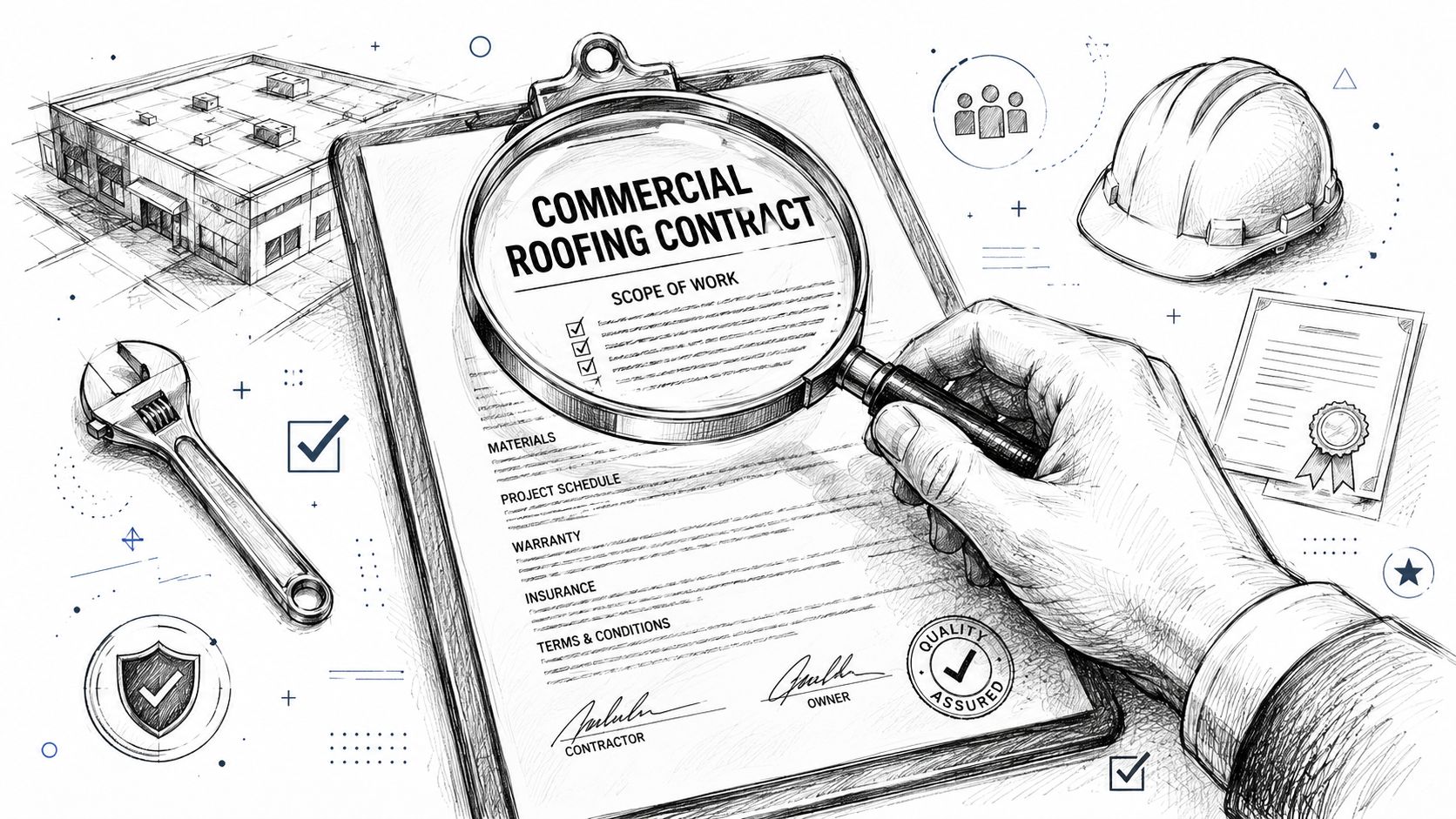
Use a tender checklist that reflects commercial risk, not just price review:
- Licence and insurance currency: Get current certificates and check expiry dates.
- Comparable project history: Prior work on occupied strata, schools, warehouses, or industrial sites carries more weight than residential reroofs.
- Named site supervision: Confirm who runs the site daily, who attends meetings, and who can approve changes.
- Scope precision: The quote should state inclusions, exclusions, assumptions, provisional sums, and hold points for latent defects.
- Safety and access planning: Look for a clear method for edge protection, loading zones, pedestrian separation, and wet-weather shutdowns.
- Asbestos and waste compliance: Confirm who manages testing, removal coordination, disposal dockets, and regulator-facing records where applicable.
- Defect and weather response: Ask what happens if rain hits during removal or if a leak appears before practical completion.
How to read a tender properly
A commercial tender should let the owner compare like with like. If one contractor includes full flashing replacement, cracked batten replacement, and disposal documentation, while another allows only tile swap-out, those prices are not competing on the same scope.
Read the exclusions first. They often reveal where future variations will come from.
I would also press each tenderer on a short set of operational questions:
- How will the building stay watertight during staged removal and bad weather?
- What is the process for discovering rotten battens, failed sarking, or substrate defects?
- Are flashings, valleys, penetrations, and edge details being replaced or reused?
- Who manages asbestos coordination if suspect materials are uncovered?
- What access restrictions, tenant constraints, or crane requirements could affect the programme?
- What documents will be issued at handover?
Some owners in NSW prefer a contractor with in-house crews across asbestos, metal roofing, and tiled roofing because it can reduce interface risk between trades. Commercial Roofers states that it delivers commercial and industrial roofing works across NSW, including asbestos removal, roof replacement, metal roofing and roof tiling, using in-house crews rather than subcontractors. That model can simplify communication and accountability, but it still needs to be tested against licence checks, methodology, programme control, and scope detail.
The handover is part of the contract
Handover should be written into the tender review, not treated as an afterthought. For a commercial asset, the close-out package matters because it supports future maintenance, insurance discussions, committee reporting, and sale due diligence.
Require a clear list of deliverables before award. That usually includes warranties, product data, completion photos, disposal records where relevant, inspection or sign-off records, and a written statement of maintenance obligations that affect warranty coverage.
A roof replacement is only fully finished when the paperwork is good enough for the next owner, insurer, facilities manager, or strata committee to understand exactly what was installed and how it should be managed.
Post-Replacement Care Maximising Your Investment
A new roof won't stay low-risk if nobody maintains it. Gutters still need clearing. Penetrations still need checking. After severe weather, someone should inspect the roof before a minor issue turns into moisture inside the building.
Keep the maintenance plan simple and disciplined:
- Schedule routine inspections: Especially after storms or major works by other trades.
- Keep drainage clear: Overflowing gutters and blocked sumps can undermine a good roof.
- Control roof access: Unmanaged foot traffic breaks tiles, damages flashings, and creates future leak points.
- Store your records: Keep warranties, product data, completion photos, and inspection reports together.
Pay close attention to the difference between a manufacturer's material warranty and a workmanship warranty from the installer. They cover different risks. If there's a leak later, you'll want to know quickly whether the issue sits with the product, the installation, or lack of maintenance.
A well-executed roof tile replacement does more than stop leaks. It strengthens compliance, protects operations, and gives the asset a more predictable future.
If you're weighing repair against full roof tile replacement on a strata, warehouse, or commercial building, Commercial Roofers can help you assess the roof system properly, define the exact scope, and plan a compliant replacement with minimal disruption to occupants and operations.