
If you’re looking up metal roofers in Sydney, you’re probably not doing it for fun. There’s usually a trigger. A warehouse roof has started leaking over stock. A strata building is burning cash on repeat repairs. A factory owner is trying to decide whether to patch an ageing roof one more time or replace it properly before it affects production.
That’s the right point to slow down and make a commercial decision, not a reactive one.
For commercial and industrial property, the roof isn’t just a weather barrier. It protects tenancy income, inventory, plant, compliance status, and site safety. A poor roofing decision can create shutdowns, water ingress, tenant disputes, and expensive rectification work. A good one improves operational continuity and preserves asset value for years.
Metal roofing also isn’t a niche category in Australia. It sits inside a mature national market. The Australian metal roof and guttering manufacturing industry is projected at $1.9 billion in 2026 with 113 businesses operating in the sector, according to IBISWorld’s Australian industry profile. That matters because Sydney asset owners aren’t buying into an experimental product class. They’re working within an established supply chain and a well-defined trade.
Table of Contents
- Why Your Commercial Roof is a Critical Business Asset
- Comparing Commercial Metal Roofing Systems in Sydney
- The Critical Process of Asbestos Roof Replacement
- Sydney Roofing Regulations and Safety You Must Know
- Budgeting for Whole-of-Life Value Not Just Upfront Cost
- Vetting and Selecting Your Commercial Metal Roofer
- Your Next Steps for a Successful Roofing Project
Why Your Commercial Roof is a Critical Business Asset
A commercial roof only gets attention when it fails. That’s a mistake. By the time water is entering the building, the roof has already started affecting operations, maintenance planning, and risk exposure.
For a warehouse, the roof protects stock, racking, electrical systems, and loading schedules. For strata, it protects common property budgets and resident confidence. For industrial sites, it protects production continuity and worker safety. Once you look at it through that lens, roofing stops being a maintenance line item and becomes an asset management issue.
Sydney owners also need to make roofing decisions in a market where metal roofing is mainstream, not specialist. The Australian Taxation Office places roofing services, including metal roofing, within a formal Australian industry category used for benchmarking and compliance in the ATO’s roofing services classification. That formal classification reflects how established the trade is.
What the roof really controls
A failing roof affects more than weatherproofing:
- Operational continuity: Leaks over dispatch zones, plant rooms, switchboards, or server areas can interrupt work immediately.
- Safety exposure: Wet floors, damaged ceilings, mould, and hidden structural deterioration create WHS problems fast.
- Budget certainty: Repeated patching often hides the true cost because disruption, emergency callouts, and tenant complaints sit outside the roofing invoice.
- Asset value: Buyers, tenants, and facility managers all look closely at roof condition because it signals broader building maintenance standards.
Practical rule: If the roof can stop trading, delay occupancy, or expose occupants to risk, it’s a business asset, not just a building component.
Why replacement is often a strategic move
The cheapest short-term repair isn’t always the lowest-risk decision. On commercial sites, owners usually get better outcomes when they assess roof condition, drainage performance, penetrations, safety controls, and future maintenance together instead of chasing isolated leaks one by one.
That’s why experienced metal roofers in Sydney look beyond the sheet profile. They assess traffic patterns on the roof, box gutter condition, flashing details, access constraints, and whether the current system still suits the building’s use. A roof over a logistics facility needs a different specification from one over a prestige retail tenancy, even if both are technically “metal roofs”.
Comparing Commercial Metal Roofing Systems in Sydney
Commercial clients often ask which metal roof is best. That’s the wrong starting point. The better question is which roof system suits the building’s exposure, use, drainage layout, maintenance access, and budget horizon.
A budget-minded warehouse may suit one path. A visible architectural facade or high-end mixed-use site may suit another. The wrong choice usually doesn’t fail because the material itself was bad. It fails because the specification ignored how the building performs in practice.
Start with the building use, not the brochure
For straightforward industrial buildings, common steel systems remain the practical workhorse. Corrugated, Trimdek-style and clip-lock style profiles are widely used because they suit large roof areas, familiar detailing methods, and efficient installation programmes.
Architectural metals such as aluminium, zinc, copper, and standing seam systems come into play when appearance, concealed fixing, movement control, and premium detailing matter more. These systems can be excellent, but they also demand tighter design discipline. On those projects, sheet selection, substrate, thermal movement allowance, gutter design, and penetration detailing all need to align.
The key point is that “metal roofing” is not one product. It’s a family of systems with different strengths.
Commercial Metal Roofing Material Comparison
| Material | Typical Lifespan | Corrosion Resistance | Best Use Case | Maintenance Needs |
|---|---|---|---|---|
| Steel roofing systems such as Colorbond-style profiles | Varies by environment, specification, installation quality, and maintenance | Good when correctly specified for the site environment | Warehouses, factories, strata reroofing, retail canopies | Regular inspection of fasteners, laps, flashings, gutters, and penetrations |
| Zincalume-style steel systems | Varies by environment and detailing | Moderate to good depending on exposure and roof design | Industrial and commercial roofs where appearance requirements are secondary | Ongoing inspection and maintenance, especially around cut edges and drainage points |
| Aluminium roofing and cladding | Depends on system design and environment | Strong option in demanding environments when detailed correctly | Coastal projects, premium commercial facades, complex architectural roofs | Lower corrosion concern in some environments, but detailing and movement still need attention |
| Zinc and copper systems | Depends heavily on design, substrate, and specialist installation | Typically selected for architectural performance rather than commodity pricing | Signature commercial buildings, prestige developments, bespoke facades and roofs | Specialist maintenance and system-specific review of joints, drainage, and movement details |
Don't overread the table. Material choice matters, but it never overrides poor detailing. A well-chosen mid-range system installed correctly will usually outperform a premium system installed badly.
For a broader view of roof types used across the country, this guide to metal roofing in Australia is useful background before you compare contractor proposals.
The build-up matters as much as the sheet
One of the most common commercial mistakes in Sydney is treating the roof sheet as the whole roof. It isn't. The roof build-up includes insulation, sarking or vapour control, fixings, flashings, penetrations, gutters, falls, and drainage strategy.
In NSW commercial applications, the build-up should be coordinated so internal humidity doesn't condense on the underside of metal sheets, especially in warehouses, logistics buildings, and other large-span structures, as noted by Technical Roofing's discussion of commercial metal roof design. That issue gets missed all the time. Owners focus on corrosion resistance and forget that condensation can damage insulation, stock, services, and internal finishes even when the outer sheet looks fine.
Condensation problems don't announce themselves with dramatic leaks first. They often show up as dripping over stock, stained insulation, damp purlin lines, and recurring moisture complaints that people misdiagnose for months.
In practice, here's what works better on commercial sites:
- Match the system to moisture load: A dry storage shed and a humid processing area don't need the same roof build-up.
- Design for drainage early: Box gutters, sumps, overflow paths, and falls need to be resolved before installation starts.
- Control movement: Concealed-fix and standing seam systems need room to move with temperature changes.
- Reduce service penetrations where possible: Every new penetration creates a future maintenance point.
What doesn't work is buying on profile appearance alone, then trying to solve condensation, ponding, and flashing failures afterwards.
The Critical Process of Asbestos Roof Replacement
Older commercial and industrial sites across Sydney still carry asbestos risk in roofing and associated materials. If your building falls into that category, the reroofing project stops being a simple material change. It becomes a controlled removal, safety, disposal, and compliance exercise.
That's where many owners lose time. They compare quotes for the new metal roof without understanding that the higher-risk part of the project happens before the first new sheet goes on.
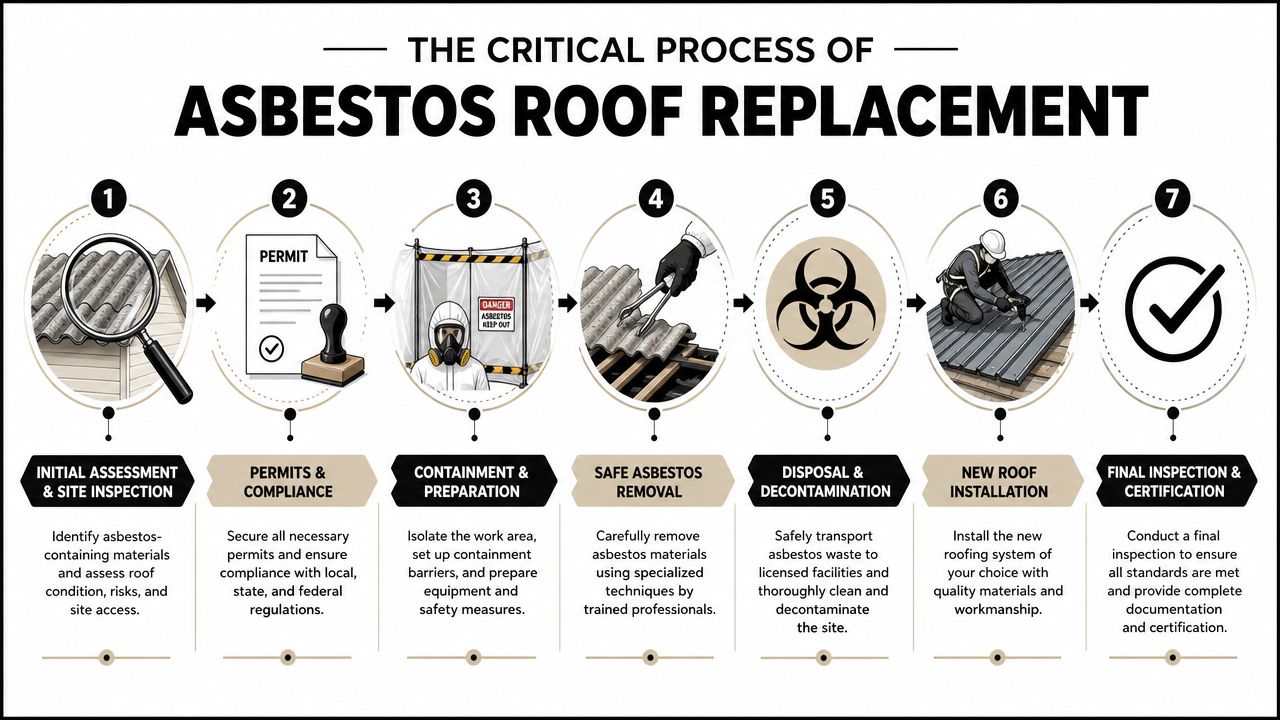
What a compliant replacement process looks like
For commercial reroofing, a key consideration is often approvals and safety controls, not just product selection. That point is stated clearly in this discussion of commercial reroofing approvals and asbestos-related project risk, which notes that the central question is often what approvals, notifications, and controls are required before work starts.
A sound asbestos roof replacement process usually follows this order:
-
Identification and assessment
Confirm what material is present and where. Don't rely on assumptions based on building age or visual appearance alone. -
Scope and approvals review
Check whether the project triggers specific notifications, waste handling requirements, site controls, council issues, or heritage considerations. -
Site isolation planning
Separate work zones from occupants, vehicles, neighbouring properties, and sensitive operations. -
Licensed removal methodology
Removal must be carried out under the correct licensing and safety framework. This is not a general demolition task. -
Transport and disposal control
Waste handling, containment, and disposal records matter. Owners should expect documentation, not verbal assurances. -
Substructure inspection before reroofing
Once the old material is off, inspect purlins, fixings, framing condition, and any latent deterioration. -
Installation of the new roof system
Only after the site is cleared and structure checked should the new metal roof package proceed.
Where owners get caught out
The recurring problem isn't that owners ignore risk. It's that they're given incomplete scopes.
A quote can look competitive because it excludes key items such as shutdown planning, tenant protection, traffic management, contaminated waste handling, or temporary weatherproofing. Then the variation cycle starts. On a live site, that can be more damaging than the original roofing defect because operations are already disrupted.
Watch for these pressure points:
- Mixed-use sites: Offices, warehouses, and public-facing tenancies need tighter staging and communication.
- Occupied buildings: Access control, exclusion zones, and dust management need more planning.
- Heritage or planning overlays: These can affect timing, methods, and allowable alterations.
- Staged replacement: Sometimes the business can't shut fully, so the roof has to be replaced in sequenced work areas.
If asbestos is involved, the cheapest quote is often the one that has left the most risk with the owner.
A capable contractor should explain who handles notifications, who controls the safety perimeter, what documents you'll receive at handover, and how the programme protects trading continuity. If those answers are vague, the project isn't ready.
Sydney Roofing Regulations and Safety You Must Know
A Sydney warehouse owner approves a roof replacement on a tight programme. Halfway through delivery, the contractor discovers the nominated fixing pattern does not suit the site wind loading, the access plan does not match live operations, and the documentation set is too thin to support a clean handover. The contract sum has not changed yet, but the owner is already carrying more programme, safety, and defect risk than expected.
That is how compliance failures usually show up on commercial roofing projects. Not as a dramatic breach on day one, but as delay, rework, warranty disputes, and avoidable exposure for the asset owner.
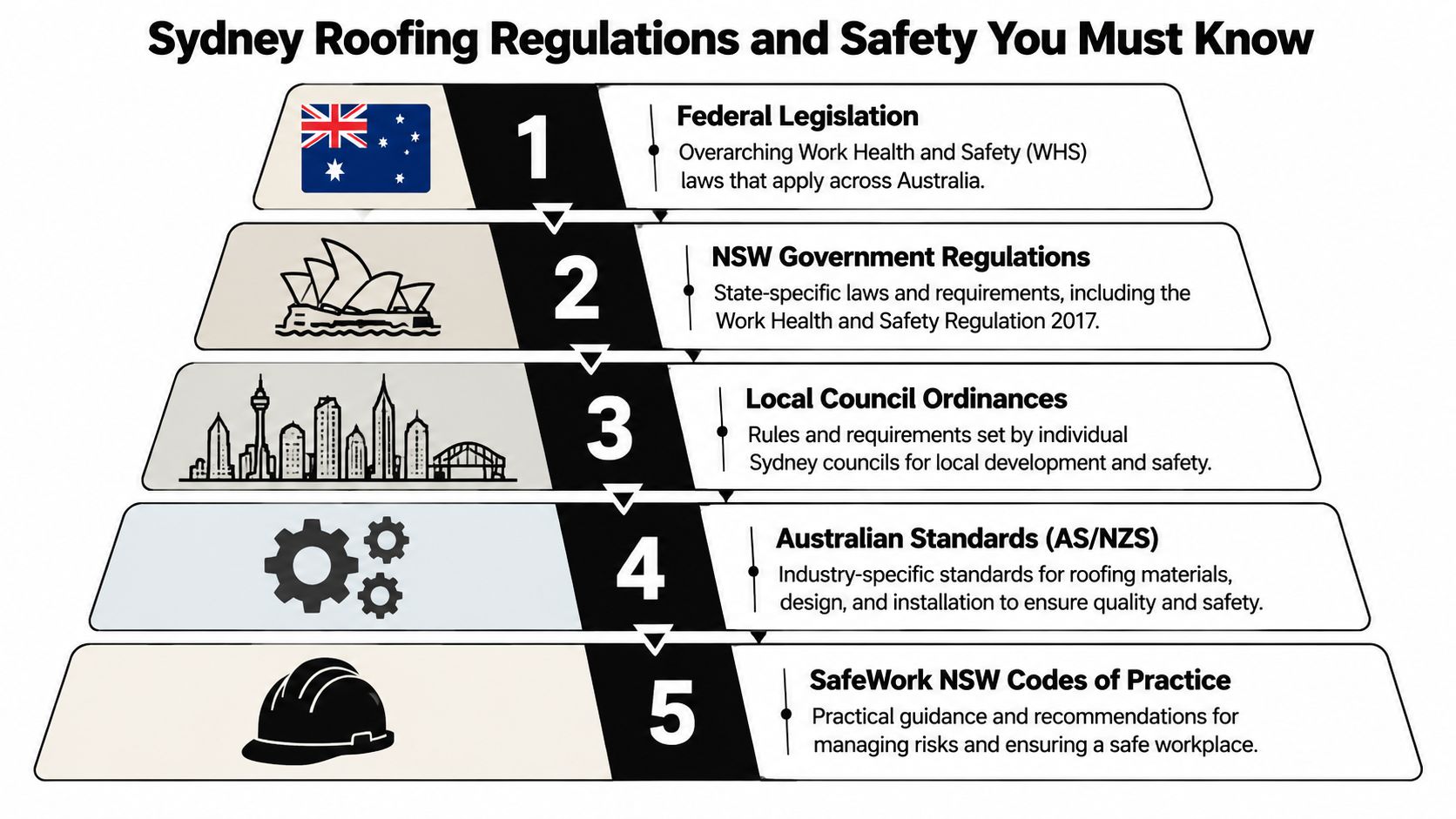
For a commercial metal roof in Sydney, compliance sits across five layers. Building and planning controls set the boundary for what can be altered on the site. Australian Standards and tested product requirements set the performance baseline. Work health and safety duties govern access, edge protection, sequencing, and hazardous materials. Manufacturer requirements protect the system warranty and tested installation method. Project records tie the whole package together through drawings, SWMS, inspections, and handover documents.
Owners do not need to read every standard. They do need enough visibility to confirm the contractor has priced and documented the actual job, not a stripped-back version that pushes risk downstream.
The University of Sydney roofing system standard is a useful reference because it brings those obligations together in a practical way. It requires metal roofing systems to meet minimum technical criteria, align with applicable Australian Standards, and account for wind design under AS/NZS 1170.2 in the University of Sydney roofing system standard.
Why wind classification changes commercial risk
Wind classification is not an engineering footnote. It affects the fixing pattern, support assumptions, edge detailing, and the points where water ingress usually starts after a storm event.
On a large industrial roof, the perimeter and corner zones often carry higher uplift demand than the middle of the roof. That can change screw spacing, clip selection, flashing design, and installation time. If a contractor prices the job as a simple like-for-like replacement without checking those inputs, the quote may be low for the wrong reason.
That matters to asset owners because under-designed edge conditions rarely fail neatly. They tend to show up as recurring leaks, storm damage claims, and emergency callouts. If you need a benchmark for how reactive work can distort budgets, review these commercial roof repair cost factors.
Safety documentation is part of the scope
On an occupied commercial site, safety compliance has direct cost and programme consequences. Roof access, exclusion zones, material handling, weather controls, and tenant interface planning all affect how the works can proceed. A contractor who treats safety paperwork as an admin exercise usually has not allowed properly for live-site delivery.
The same standard also reinforces a point owners should keep in focus. Product performance depends on installation that matches the specified system. If the selected roof profile, insulation build-up, or fixing method changes on site, the supporting documents need to change with it.
Ask to see the documents that prove the project has been thought through:
- Site-specific design inputs: wind region, building height, exposure, geometry, and any unusual loading conditions
- Manufacturer-approved details: penetrations, flashings, turn-ups, terminations, and compatible components
- Safety planning for occupancy: access control, fall protection, delivery routes, and staged work areas
- Inspection and handover records: evidence that the installed roof matches the approved scope and can be maintained properly
Good contractors do not hide behind broad statements like "built to code." They show the basis of design, the approved details, and the records that protect the owner if a defect, insurance issue, or warranty claim appears later.
For commercial and industrial assets, regulation is not a box-ticking exercise. It is part of controlling total cost of ownership. A compliant roof system reduces failure risk, protects insurability, supports warranty claims, and limits unplanned disruption to the business operating below it.
Budgeting for Whole-of-Life Value Not Just Upfront Cost
A Sydney warehouse owner accepts the lowest reroofing quote, then discovers halfway through the job that drainage corrections, penetration detailing, traffic management, and shutdown staging were only partly allowed for. The contract sum looked competitive. The delivered cost did not.
That is why roof budgeting should be tied to business risk, not just procurement optics. For a commercial or industrial asset, the cheaper number on day one can become the more expensive decision over the service life of the roof.
What low quotes leave out
The weak point in many tenders is not the sheet metal itself. It is the scope around it. If the quote is light on the items below, the owner usually pays later through variations, repairs, or disruption to tenants and operations.
Common gaps include:
- Penetration detailing: Plant supports, services, skylights, vents, and future trade interfaces need proper flashings and compatible components.
- Drainage remediation: Replacing roof sheeting without addressing poor falls, blocked sumps, or failing gutters keeps leak risk in place.
- Staging on occupied sites: Warehouses, schools, strata buildings, and industrial sites often need after-hours work, exclusion zones, and tighter delivery controls.
- Access for future maintenance: A roof that is difficult to inspect or service costs more every time a contractor returns.
- Allowance for latent conditions: Corroded purlins, wet insulation, hidden damage, and asbestos-related controls can change the project cost fast.
These are not edge cases. They are standard cost drivers on commercial reroofing jobs in Sydney.
Budget against ownership cost, not contract price
A better budgeting method starts with one question. What does roof failure cost this asset?
On some buildings, a leak is a manageable maintenance issue. On others, it stops production, damages stock, disrupts tenants, triggers insurance friction, or creates a safety problem. Once that consequence is clear, material and scope decisions become more rational.
Use these filters when comparing proposals:
- Consequence of failure: Measure the operational and financial impact of water ingress, not just the repair bill.
- Expected maintenance load: Fastener replacement, sealant ageing, gutter cleaning, and corrosion exposure all affect recurring cost.
- Detail density: Roofs with more penetrations, junctions, and plant interfaces carry more long-term defect risk.
- Service access: Difficult access increases the cost of inspections, repairs, and compliance-related works.
- Upgrade timing: If insulation, guttering, safety access, or rainwater goods will need work soon anyway, bundling them into one project often reduces total spend.
For owners building a replacement budget, this guide to commercial roof repair cost factors is a useful reference point. It helps frame what reactive works cost once access, labour, disruption, and repeat attendance are taken into account.
A roof can be cheap to install and still be expensive to own.
There are projects where a straightforward industrial roof system is the right decision. Spending more does not automatically produce a better asset outcome. But cutting scope on drainage, flashings, corrosion protection, asbestos controls, or live-site staging usually shifts cost into the future, where it arrives as downtime, defects, and harder warranty conversations.
The owner's job is to buy down avoidable risk. In practice, that means choosing a scope that matches the building's exposure, operations, compliance burden, and expected holding period. A roof should be budgeted like any other business-critical asset. On whole-of-life value, the best option is often the one that reduces interruption, controls maintenance demand, and protects the building's insurability and leaseability over time.
Vetting and Selecting Your Commercial Metal Roofer
Once you know the right roof strategy, the contractor decision becomes simpler. Not easy, but simpler. You're no longer comparing sales pitches. You're checking whether each roofer can manage risk, document compliance, and deliver a roof that performs under commercial conditions.
This checklist is where many owners save themselves from a bad hire.
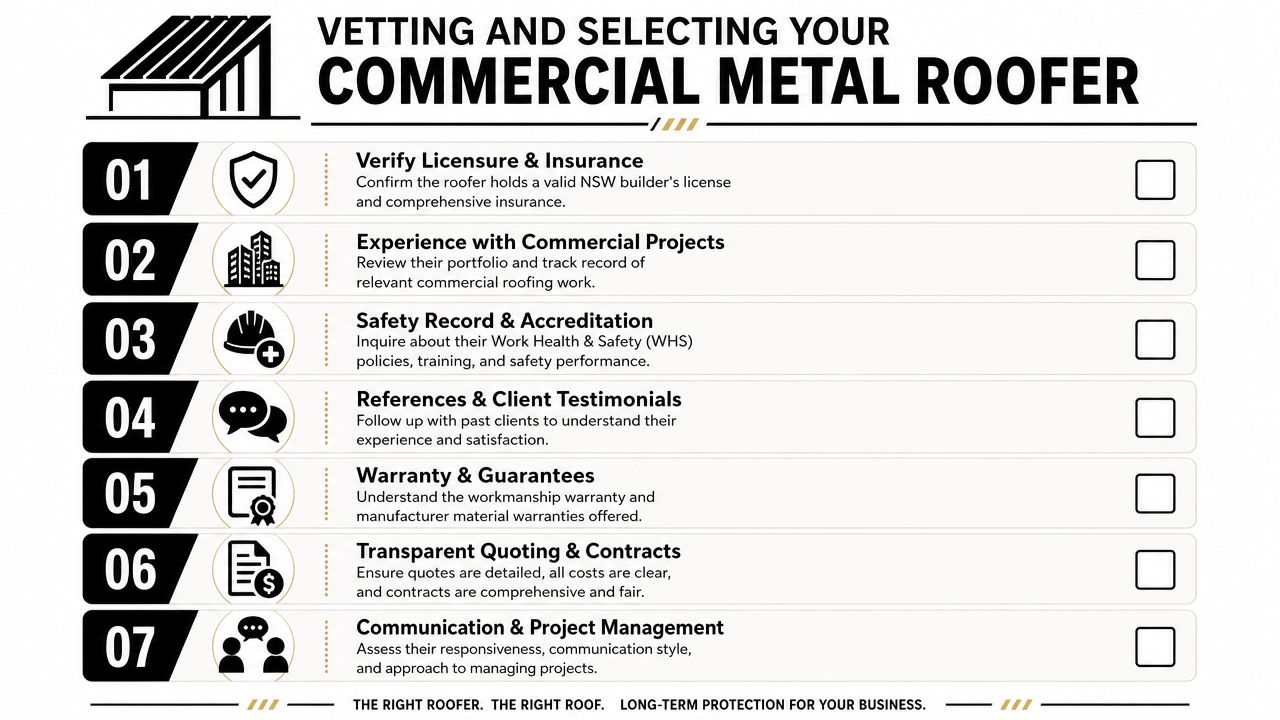
The shortlist test
Before you discuss colour charts or programme dates, confirm the basics.
- Licence and insurance are current: Ask for evidence, not reassurance.
- Commercial experience is relevant: A contractor strong in houses may not be strong on warehouses, strata complexes, or occupied industrial sites.
- Delivery model is clear: Find out who is doing the work, including supervision and subcontractor involvement.
- Scope is specific: You should see exclusions, assumptions, staging notes, and handover items in writing.
A useful comparison point is this guide on choosing a commercial roofer near you, especially if you're filtering local Sydney contractors.
This short video is also worth reviewing while you compare providers:
Questions that expose weak contractors fast
Good contractors won't struggle with direct questions. Weak ones usually become vague, defensive, or overly general.
Ask them:
-
How are you dealing with wind classification and fixing design on this site?
If the answer is generic, they may be pricing from habit rather than site conditions. -
What's your plan for penetrations, gutters, and perimeter flashings?
Those are common failure points. You want specifics. -
How will you protect operations during the job?
This matters on occupied warehouses, retail sites, schools, and strata buildings. -
Who manages asbestos or hazardous material risk if it's identified?
The answer should be procedural, not casual. -
What documents do I receive at handover?
Expect warranty information, maintenance guidance, and compliance-related records.
The roofer you want is the one who talks clearly about interfaces, sequencing, safety, and exclusions. Not the one who only talks about sheet colour and lead time.
Red flags that should end the conversation
Some warning signs are immediate disqualifiers.
- Cash-driven pressure: Serious commercial contractors don't need to rush you into undocumented arrangements.
- Vague exclusions: If the quote hides assumptions, disputes will follow.
- No discussion of live-site risk: That usually means poor planning.
- No interest in building use: A contractor who doesn't ask what happens under the roof doesn't understand commercial consequences.
Metal roofers in Sydney vary widely. The right choice is rarely the fastest quote or the friendliest salesperson. It's the team that can explain your project back to you in operational terms and prove they've planned for the risks you'll carry as the owner.
Your Next Steps for a Successful Roofing Project
If your roof is leaking, ageing, or carrying compliance risk, don't reduce the decision to material price alone. For a Sydney commercial asset, the right roofing decision protects revenue, reduces disruption, and lowers the chance of being forced into emergency works later.
For a warehouse in Wetherill Park, that might mean prioritising drainage correction, condensation control, and staged works that protect dispatch. For a strata building in Parramatta, it might mean tighter attention to access, resident communication, and long-term maintenance obligations. For an older industrial building, it may start with confirming whether asbestos and approval issues shape the whole programme.
The practical sequence is straightforward:
- Inspect the existing roof properly
- Define the building's operational risks
- Choose a roof system that suits the site, not just the quote
- Confirm compliance and safety controls before work starts
- Select a contractor who can document the whole process
That's how owners avoid paying twice. Once for the reroof, and again for the defects, delays, or compliance issues that a rushed decision creates.
If you're speaking with metal roofers in Sydney, push the conversation beyond materials. Ask about approvals, staging, wind design, penetrations, maintenance, and what happens if the building must remain operational during the work. The contractor who can answer those questions clearly is usually the one worth taking seriously.
If you need a site-specific assessment, Commercial Roofers can inspect a commercial or industrial roof, identify compliance and operational risks, and outline practical options for repair, replacement, or asbestos-related reroofing work across Sydney and NSW.