
A roof replacement usually starts the same way. Someone notices a stain spreading across a ceiling tile, a tenant reports drips near stock, or the maintenance team keeps patching the same leak line after every hard rain. By that point, the question isn't just whether the roof needs work. It's whether you'll handle it as a controlled capital project or let it turn into an operational problem that disrupts tenants, staff, inventory and insurance conversations.
For commercial owners and strata managers, installation for roof projects isn't a cosmetic exercise. It's a decision about risk, compliance, service life and how much uncertainty you're willing to carry into the next storm season. The right scope protects the building envelope and stabilises future maintenance. The wrong scope leaves you with a new-looking roof that still leaks at penetrations, overheats the building, or fails early at laps and transitions.
Table of Contents
- Why Commercial Roof Installation Is a Critical Business Decision
- Choosing the Right Commercial Roofing System for Sydney
- The Commercial Roof Installation Process From Start to Finish
- Navigating Compliance Safety and Environmental Controls
- Understanding Timelines Costs and Risk Management
- Warranties and Long Term Roof Maintenance
- How to Choose a Commercial Roofing Contractor in Sydney
Why Commercial Roof Installation Is a Critical Business Decision
A failing roof rarely stays a roof-only problem. Water gets into insulation, ceiling systems, electrical pathways, plant areas and wall junctions. If the building is occupied, every delay increases the chance of tenant complaints, damaged stock, slip hazards and after-hours emergency callouts.
That's why a major installation for roof works should be treated as an asset management decision, not a patch-and-go maintenance item. In Australia, housing stock has grown to more than 11 million dwellings, and rental dwellings made up 31.7% of occupied private dwellings in the 2021 Census, which underlines why roof replacement and upgrades remain a recurring long-term maintenance issue across the built environment, including strata and commercial property (Australian roofing market context). The takeaway for owners is simple. There is nothing unusual about planning for re-roofing as part of lifecycle management.
Reactive spending feels cheaper until it isn't. Emergency leak repairs often focus on the visible symptom, not the actual failure path. Water can enter at one transition and appear metres away. By the time the issue is obvious inside the building, the roof system may already have multiple weak points.
Practical rule: If you're seeing repeated leaks at different locations, the real decision is often whether to keep funding disruption or invest in a controlled replacement with a clear scope.
The better approach starts with condition assessment, staging and a design that suits how the building is used. A warehouse owner cares about watertightness over racking and loading areas. A strata committee cares about disruption, access and future maintenance liability. A retail site may prioritise appearance, tenant trading hours and drainage performance around signage and services.
A commercial roof isn't just there to cover the building. It protects revenue, occupancy and the resale value of the asset.
Choosing the Right Commercial Roofing System for Sydney
The right system depends on the building, not the brochure. Sydney projects vary from low-slope warehouses and factories to mixed-use strata buildings, retail centres and architect-designed commercial sites. The best choice is usually the one that matches the roof geometry, plant load, drainage layout, access conditions and the owner's holding period.
Australia's climate has warmed by around 1.5°C since 1910, increasing thermal stress on roof systems, fasteners, sealants and membranes, which is why material selection and installation quality matter so much for commercial assets (Australian climate and roofing conditions). In practice, hotter roof surfaces punish poor detailing first.
What matters most in Sydney conditions
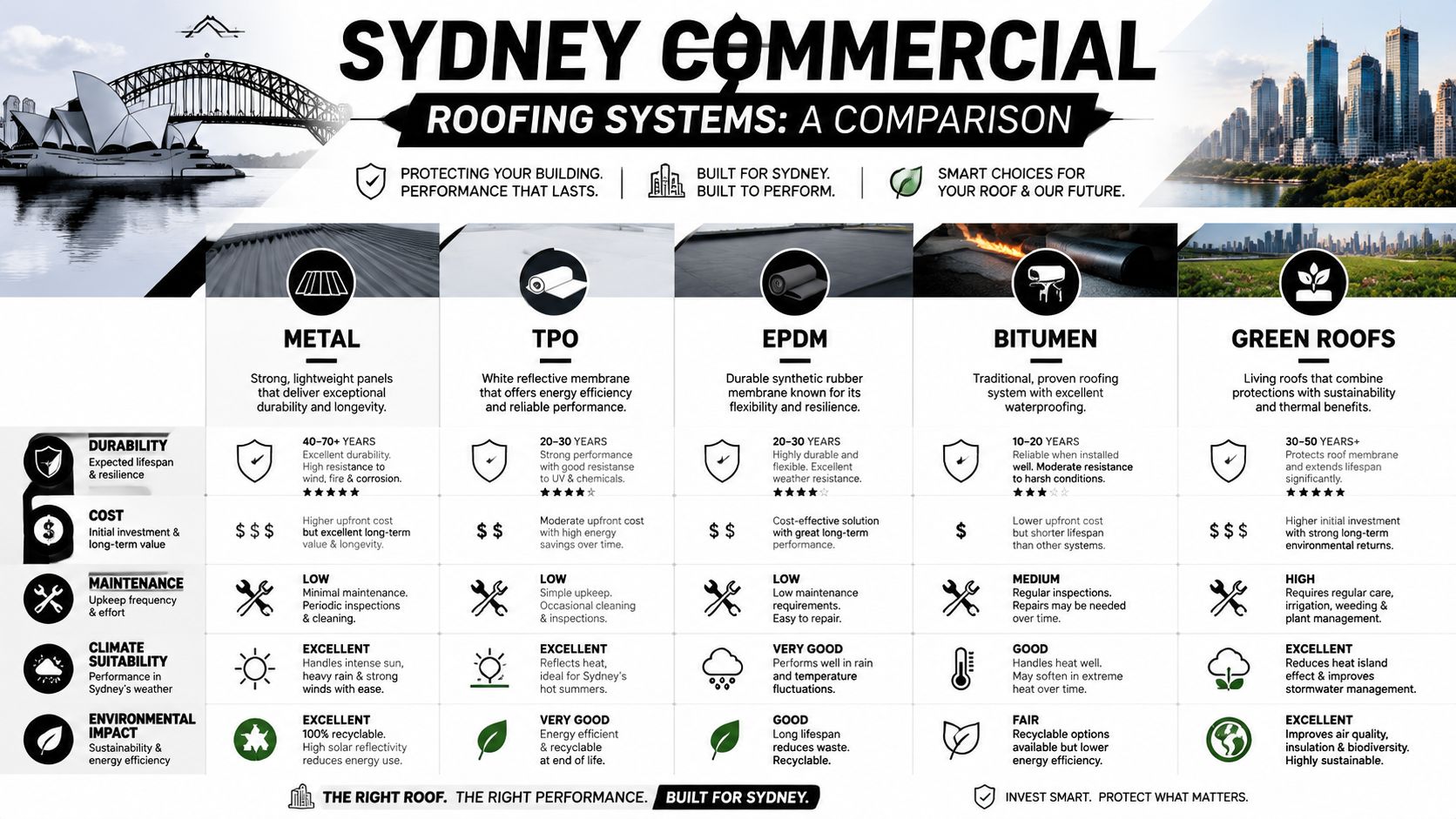
Metal roofing remains a common commercial choice because it suits many industrial and logistics buildings, handles large roof areas efficiently and integrates well with flashings, gutters and wall cladding systems. Profiles such as Klip-Lok, Trimdek and corrugated sheets each have their place. Standing seam systems also suit projects where appearance and concealed fixing matter.
Single-ply membranes such as TPO and PVC are often considered on low-slope roofs with lots of services, plant and penetrations. They can deliver a neat finish and can be practical where sheet metal geometry becomes cumbersome. Modified bitumen still has a place on some substrates and refurbishment scopes, particularly where multi-layer build-ups are preferred.
EPDM is often discussed in broader roofing comparisons, but in Sydney commercial work the actual decision usually comes down to what local contractors can detail, install and maintain properly over the life of the asset. Availability of skilled installers and compatible accessories matters as much as product literature.
For owners weighing metal specifically, this guide to metal roofing in Australia is a useful reference point for profile and application differences.
Commercial roofing material comparison
| Material | Typical Lifespan | Relative Cost | Key Advantages |
|---|---|---|---|
| Metal roofing | Varies by profile, coating, environment and installation quality | Moderate to higher upfront depending on specification | Strong fit for warehouses and industrial sites, efficient coverage, good compatibility with gutters and cladding |
| TPO membrane | Varies by system design, substrate and maintenance | Moderate | Suitable for low-slope roofs, clean appearance, can support reflective roof strategies |
| PVC membrane | Varies by manufacturer system and detailing quality | Moderate to higher | Useful around complex penetrations and plant-heavy roofs, welded seams can support watertight detailing |
| Modified bitumen | Varies by build-up and exposure conditions | Moderate | Layered system, familiar for some remedial applications, adaptable on certain roof forms |
| Green roof system | Project-specific | Higher | Can support design and amenity goals, but requires structural review, drainage planning and ongoing maintenance |
How to narrow the choice
Start with failure points, not brand names. If the current roof leaks around penetrations and junctions, a replacement should improve those details first. If the building overheats, the specification should address insulation and reflectivity, not just the outer skin.
Then test the options against site realities:
- Access and staging: A CBD or tight suburban site may favour systems that reduce on-roof handling time or simplify cranage.
- Roof shape: Long straight runs suit some metal systems very well. Complex penetrations and low-slope areas may lean toward membrane solutions.
- Future service traffic: If HVAC contractors will be on the roof regularly, the system needs walkways and durable detailing around plant.
- Presentation: Retail, education and architect-led projects often care more about visible lines, fascia finish and integration with cladding.
A good specification doesn't chase the cheapest square metre. It matches the roof system to how the building earns money and how often the owner wants to revisit the problem.
The Commercial Roof Installation Process From Start to Finish
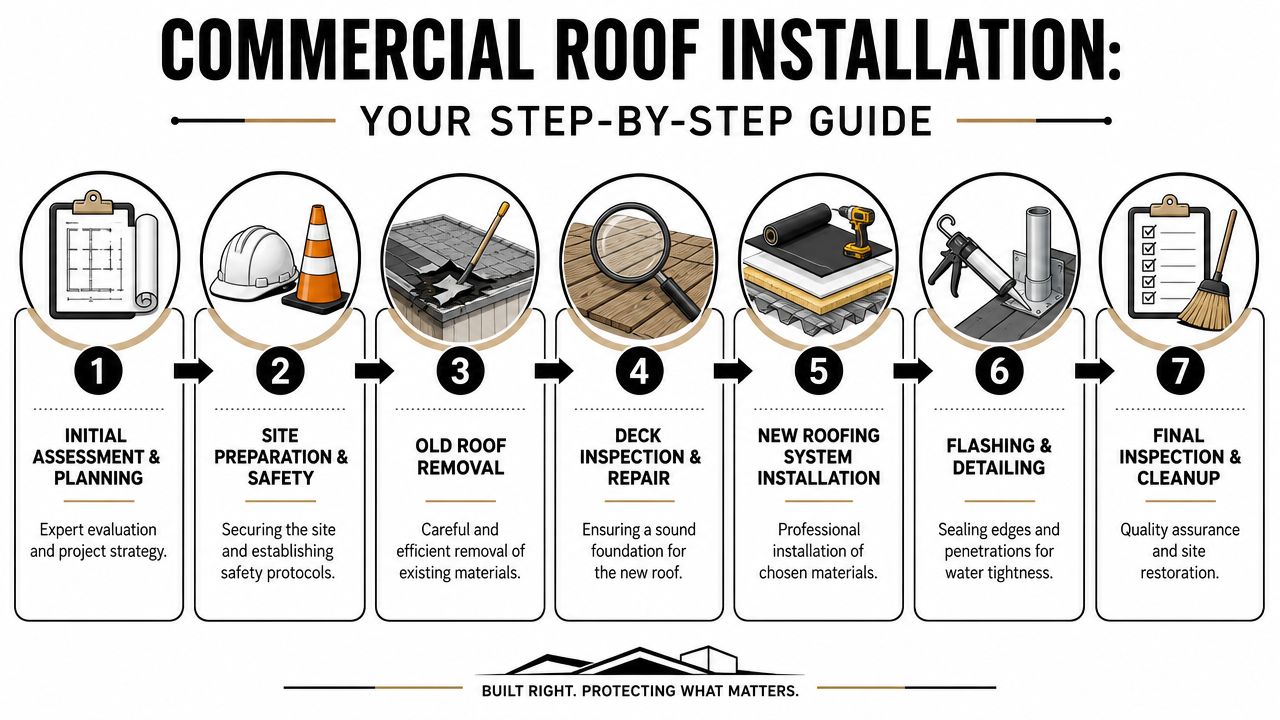
Clients usually want two things during a replacement. They want to know what's going to happen on site, and they want confidence that the contractor is controlling the risky parts properly. A professional installation for roof works follows a sequence for a reason. Each stage protects the next one.
A quick visual overview helps before looking at the finer detail.
Site preparation and safety setup
Before any sheet or membrane comes off, the contractor should lock down site logistics. That includes access points, exclusion zones, loading areas, waste handling, edge protection, fall arrest arrangements, weather monitoring and communication with tenants or occupiers.
This stage often tells you how organised the project will be. If crews arrive without clear material zones, protection for public areas or a plan for keeping parts of the building watertight overnight, the rest of the job tends to follow the same pattern.
Typical early controls include:
- Public separation: Barriers, signage and controlled delivery paths keep staff, customers and residents clear of overhead work.
- Protection of operations: Sensitive areas such as server rooms, stock zones and reception entries may need staged work or temporary coverings.
- Weather response: A serious crew plans what happens if conditions turn mid-shift. They don't improvise after the roof is open.
Later in the project, the client should still be able to walk the site perimeter and see order, not chaos.
Demolition and asbestos removal if required
Removal is where hidden conditions start to reveal themselves. Existing sheets may come off cleanly, or the team may uncover corroded fixings, failed insulation, ponding damage, degraded sarking or patch history that never appeared in the initial inspection.
If asbestos-containing materials are present, that work needs a licensed and controlled removal process. Owners should expect a clear sequence for isolation, handling, disposal and clearance, not vague promises. This isn't an area for shortcuts.
A disciplined demolition phase does three things well:
- It strips only what can be made safe and watertight within the programmed window.
- It protects internal operations below.
- It preserves enough substrate visibility for accurate repair decisions.
Substrate inspection and repair
No new roof system performs properly over a bad base. Once the old covering is removed, the substrate has to be checked for corrosion, rot, movement, loose fixings, deflection and damaged supports. On metal deck roofs, fixings and sheet bearing conditions matter. On other substrates, moisture damage and structural integrity become the main concern.
This is also the moment where honest contractors separate themselves from sales-driven ones. A proper team documents what they find, explains what must be repaired before the new roof goes on, and distinguishes essential remedial work from optional upgrade items.
If the deck is unsound, every layer above it is compromised. A new roof over a failing substrate is just deferred failure.
Insulation and vapour control
Many owners focus on the visible roof finish and ignore what sits beneath it. That's a mistake. Insulation, vapour barriers and condensation control directly affect internal comfort, energy performance and durability.
The right build-up depends on building use. A warehouse with large air volume behaves differently from an air-conditioned office or a food-related facility with humidity concerns. Good installers don't just ask what roof covering you want. They ask what happens inside the building all day, what temperature range the site operates under, and whether the roof will carry plant or solar later.
What works well:
- Continuous insulation planning: Gaps around penetrations and perimeter details can undermine the whole system.
- Compatible layers: The membrane, underlay, fixings and insulation system need to work together, not just fit together.
- Condensation thinking: Internal moisture loads matter, especially where warm moist air can meet cooler roof layers.
What doesn't work is treating insulation as a line item to cut late in procurement. That decision often creates longer-term cost elsewhere.
Membrane or metal roof installation
This is the stage most clients imagine when they think about roofing, but by now the job has already been won or lost in preparation. For metal roofs, sheet alignment, fixing patterns, clip placement, expansion considerations and sequencing matter. For membrane roofs, surface preparation, seam quality, adhesion or fastening method and termination details matter.
On simple roof planes, installation is straightforward. On real commercial buildings, the challenge is geometry. Mixed pitches, hips, valleys, parapet transitions, wall interfaces and longline profiles all require careful set-out and custom cuts. Installers often need to calculate major and minor roof angles, backing angles and bevels to make irregular junctions close properly. Such challenges often cause inexperienced crews to create rework.
Flashing penetrations and final details
Most roof failures don't start in the open field. They start at transitions, penetrations and edge conditions. That's why professional installation treats the roof as a system, not just a panel or membrane choice. Installation guidance commonly calls for a minimum 4-inch lap on flashings, aligned with water flow and sealed, while valleys require a 12-inch lap to better manage ingress risk at those locations (metal roof flashing detail guidance).
Look closely at these areas:
- Pipe penetrations: Boots, sealants and mechanical restraint must suit movement and weather exposure.
- Parapet and wall abutments: Termination details should shed water cleanly and protect against backflow.
- Valleys and box gutters: These areas need room for flow, proper laps and clean discharge paths.
- Skylights and plant curbs: These details often fail when trades work in sequence without one coordinator owning the waterproofing outcome.
Final inspection should include not just a visual finish check but a detail review. Clean-up matters too. Loose swarf, abandoned fasteners and blocked outlets can damage a new roof almost immediately.
Navigating Compliance Safety and Environmental Controls
A commercial roof replacement is a high-risk construction activity carried out over occupied property. If a contractor treats compliance as paperwork to be filed after the fact, that's a warning sign. The same discipline that keeps people safe usually shows up in workmanship, sequencing and communication.
What compliant project management looks like
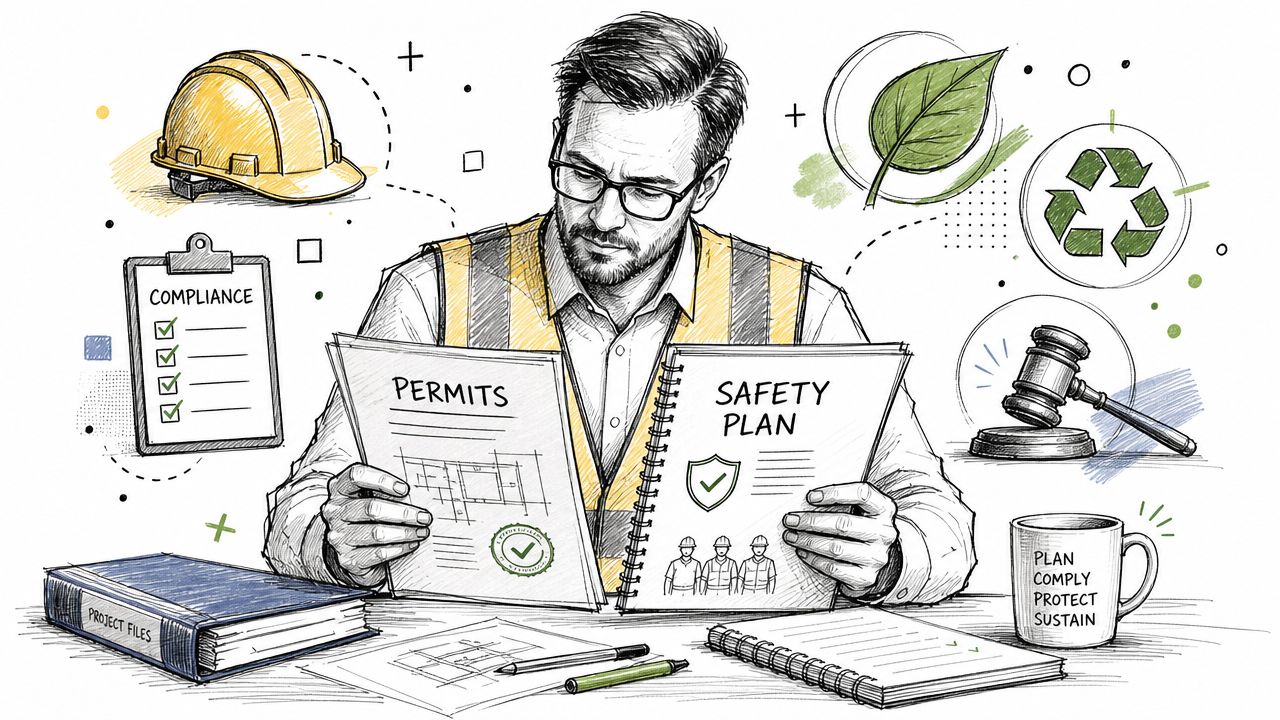
Owners don't need to become safety specialists, but they should know what to ask for. A capable contractor should be able to explain permits, access controls, Safe Work Method Statements, rescue planning, edge protection, traffic management and site-specific risks in plain language.
A few checks quickly separate serious operators from risky ones:
- Licence and insurance clarity: You should know who is licensed, who is insured, and who is doing the work on site.
- Documented high-risk controls: Roof access, fall prevention, weather response and public protection shouldn't be vague verbal assurances.
- Occupied-building planning: Work over retail entries, apartment access points, school areas or loading docks needs more than cones and tape.
If your current issue is active water ingress, it's also worth understanding how temporary and permanent fixes differ. This article on roof leak repair in Sydney gives useful context on why emergency works often need a broader follow-up scope.
Compliance isn't overhead. It's evidence that the contractor knows how to manage consequence before something goes wrong.
Environmental controls are part of the job
Environmental performance on a roofing project isn't limited to product selection. It includes how the contractor handles hazardous materials, separates waste, prevents runoff issues and leaves the site after completion.
Asbestos is the obvious example, but it isn't the only one. Old insulation, contaminated debris, damaged flashings and site runoff all need controlled handling. On live sites, housekeeping becomes an environmental control as much as a presentation issue. Debris in gutters, sharp offcuts in plant zones and packaging blowing across neighbouring properties all point to poor management.
Owners should expect:
- Clear waste streams: Separate removal and disposal processes for general waste, metal scrap and hazardous material.
- Protection of drainage points: Roof outlets and ground drains should be kept clear during works, not cleaned only at handover.
- End-of-day housekeeping: The site should be left stable, safe and weather-ready every day, especially on staged replacements.
A contractor's environmental discipline often predicts how they'll treat the fine details elsewhere.
Understanding Timelines Costs and Risk Management
Clients usually ask for a price and a programme first. That's reasonable. But on a major commercial roof replacement, those answers only make sense when tied to scope quality and risk allocation. A cheap number with vague exclusions can become the most expensive option on the table.
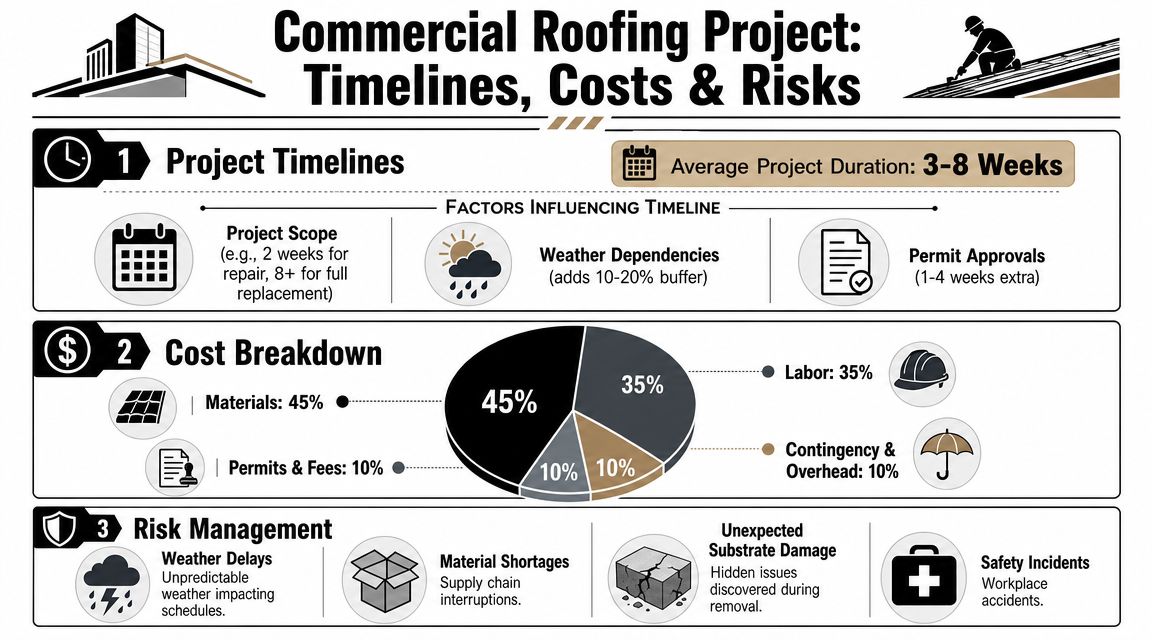
This visual sums up the moving parts owners should think about.
What actually drives cost
Roof replacement cost isn't determined by area alone. Two buildings of similar size can price very differently because the labour, access and detail complexity are completely different.
The main drivers are usually these:
- Roof geometry: Long simple runs are easier to install than roofs with constant penetrations, level changes and awkward junctions.
- Material and specification: A basic replacement scope differs from a system upgrade that includes insulation, drainage improvements and higher-grade accessories.
- Access constraints: Crane time, restricted delivery windows, public protection and staged works all add planning and labour intensity.
- Removal conditions: Existing roof layers, contamination risk and disposal requirements can change the job materially.
- Substrate surprises: Corroded deck sections and hidden structural deterioration affect both scope and programme.
If you want a deeper framework for budget planning, this guide to roof repair cost is useful for understanding how scope detail changes pricing discussions.
Why timelines move
Timelines depend less on ambition and more on sequence. A contractor can give a neat programme, but several variables sit outside a simple start-and-finish promise. Weather is the obvious one. Access windows, occupied-site restrictions, permit timing, material lead times and discovered substrate damage all matter.
What clients should look for isn't just a short timeline. It's a contractor who can explain:
- what has to happen before roof opening starts
- how much of the roof will be exposed at one time
- how weather contingencies are managed
- what happens if hidden defects are found
- whether the building can remain fully operational throughout
Those answers usually tell you more than the stated completion date.
Risk decisions that affect long term value
The biggest mistake owners often make is when they compare replacement options as if the roof itself is the only output. It isn't. Roof installation choices affect internal temperature control, storm readiness, maintenance burden and the likelihood of future leak-related disruption.
Modern commercial roofing practice increasingly treats re-roofing as a system-level upgrade, pairing the new roof with better insulation, drainage and profile selection to improve cooling performance and resilience in Australian conditions (roof system upgrades and resilience). That matters because a replacement that ignores heat gain, runoff behaviour or penetration detailing may lock in operating problems for years.
One practical example is drainage. Owners often focus on the field of the roof and leave undersized or poorly laid gutters in place. Then the new roof gets blamed when water backs up in an old box gutter during a storm. The same goes for insulation. A cheaper outer roof covering can look attractive until the building keeps absorbing heat and the plant works harder than it should.
The strongest commercial roofing budgets are built around avoided future loss. Leak prevention, thermal control and fewer operational disruptions have real value even when they don't sit neatly on a quote line.
A sensible client brief doesn't ask only, “What will this cost now?” It also asks, “What risks are we paying to remove?”
Warranties and Long Term Roof Maintenance
A warranty matters, but owners often rely on it for the wrong reason. It's there to define responsibility if something covered fails. It doesn't replace inspection, cleaning or routine maintenance after handover.
Material warranty versus workmanship warranty
These are different protections. A material warranty generally relates to the roofing product supplied by the manufacturer, subject to terms, approved use and installation requirements. A workmanship warranty relates to how the contractor installed the system.
That distinction matters because many post-install issues sit at the interface between materials and detailing. If a penetration is modified later by another trade, or if roof traffic damages a finished area, warranty discussions can become complicated fast.
When reviewing warranty documents, owners should check:
- What is covered: Product defect, installation defect, or both.
- What is excluded: Unauthorised penetrations, lack of maintenance, storm damage, third-party trade works and structural movement.
- What is required from the owner: Inspection intervals, cleaning obligations and records of maintenance.
A practical maintenance rhythm
The best way to protect a new roof is to treat maintenance as part of the asset plan from day one. That doesn't mean constant intervention. It means regular checks focused on the parts that fail first.
A useful maintenance routine typically includes:
- Drainage checks: Keep gutters, sumps and outlets clear so water leaves the roof as designed.
- Detail inspections: Review flashings, laps, sealants and penetrations for movement or damage.
- Surface condition monitoring: Look for loose fasteners, coating wear, punctures, corrosion or trade damage.
- Post-weather review: After significant storm activity, inspect vulnerable details before minor issues become internal leaks.
Owners should also control roof access. Plenty of leaks start after mechanical, electrical or solar trades have walked the roof, added penetrations or disturbed flashings without coordinated waterproofing review.
A well-installed roof begins earning its value after completion. Maintenance is what keeps that value intact.
How to Choose a Commercial Roofing Contractor in Sydney
Most roofing problems don't come from a lack of products. They come from poor assessment, weak detailing, rushed supervision and unclear responsibility on site. Choosing a contractor for installation for roof works is largely about reducing those failure points before the job starts.
What to verify before you compare quotes
A quote is only useful if you know who stands behind it and how the work will be delivered. Start with the basics, but don't stop there.
Check these items carefully:
- Licensing and insurance: Verify the contractor's trade licensing, public liability cover and workers compensation position.
- Relevant commercial experience: Ask for recent project examples that match your building type, roof form and occupancy conditions.
- Safety systems: Request examples of their SWMS process, edge protection approach and occupied-site controls.
- Asbestos capability where relevant: If your building may contain asbestos materials, confirm who handles identification, removal coordination and compliance.
- Crew structure: Ask whether the contractor uses in-house crews or layers of subcontractors. Accountability is clearer when supervision and labour aren't fragmented.
One Sydney option in this market is Commercial Roofers, which states it handles commercial and industrial roofing with in-house crews, asbestos roof removal and replacement, inspections, guttering and metal roofing systems across Greater Sydney. That kind of scope is useful to compare factually against other contractors offering similar services.
Questions that expose weak contractors quickly
You can learn a lot from a short meeting if you ask the right questions.
Ask them:
How will you stage the works to keep the building weather-tight?
Good contractors answer with sequencing, temporary protection and occupancy planning.What usually causes delays on roofs like ours?
Experienced teams talk about access, substrate findings, weather and approvals.How do you handle penetrations, box gutters and irregular junctions?
Weak contractors stay general. Strong ones talk details.Who will supervise the project day to day?
You want a named person, not a rotating chain of responsibility.What assumptions have you made in the quote?
Exclusions and hidden risk usually appear here.
A professional contractor doesn't just sell a roof. They show you how they'll control water, safety, communication and disruption before the first sheet comes off.
The cheapest quote can still be the highest-risk decision. If the contractor can't explain their detailing approach, site controls and handover process clearly, the savings on paper may disappear the first time the roof is tested under pressure.
If you're planning a major replacement, dealing with recurring leaks, or need a clear scope before committing capital, Commercial Roofers can assess the roof, explain practical options and provide a detailed proposal for commercial and industrial sites across Sydney.