
Minor commercial roof repairs in Sydney can start around $500 to $2,000, but most substantial repairs land in the $5,000 to $25,000+ range. The final roof repair cost depends heavily on roof size, material, access complexity, safety setup, and whether the problem is a simple leak repair or a wider failure involving flashings, sheets, membranes, insulation, or hidden water damage.
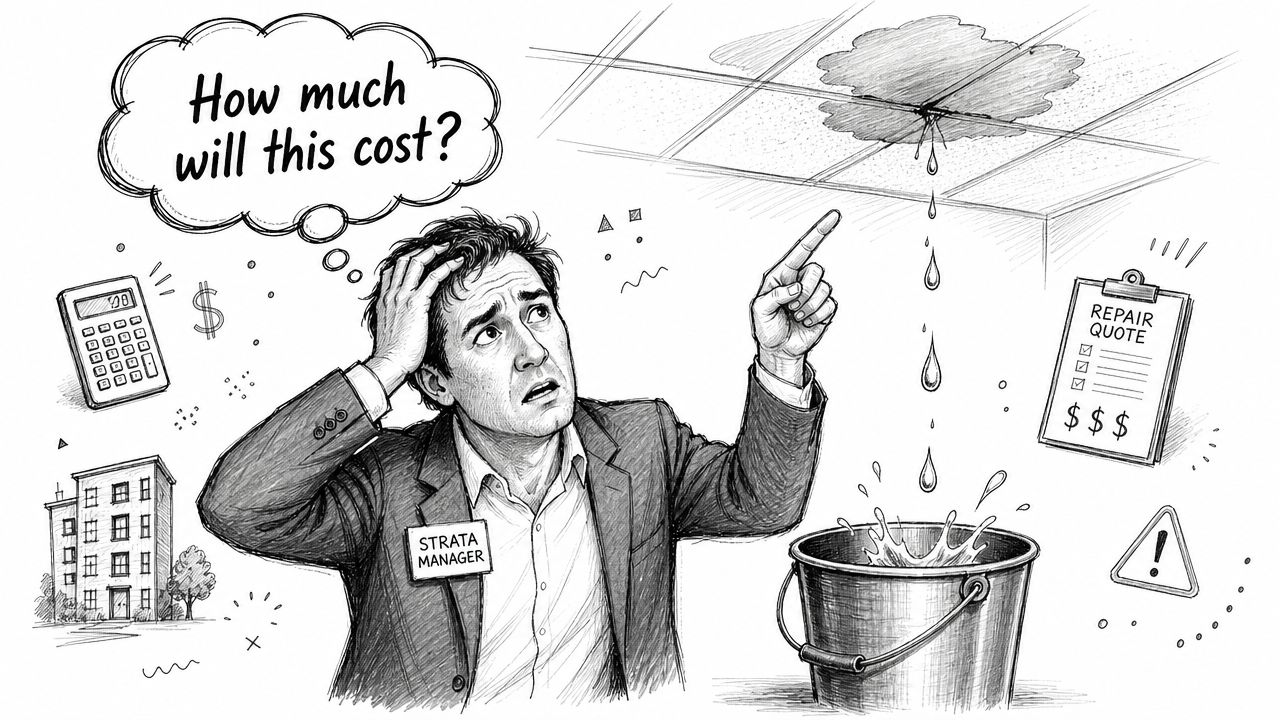
If you're reading this after spotting a ceiling stain in a warehouse office, water tracking down a wall in a strata common area, or a tenant ringing you after the last storm, you're probably asking the same thing every owner asks first. How much is this going to cost, and is this a repair job or the start of something bigger?
That question is harder to answer than it should be. Most online guides are built around U.S. houses, shingles, and small domestic patch jobs. They don't reflect Sydney commercial roofs, where WHS compliance, live-site access, asbestos risk, drainage complexity, and Colorbond or membrane systems change the whole pricing equation.
Table of Contents
- Understanding Your Commercial Roof Repair Cost
- Sample Commercial Roof Repair Costs in Sydney for 2026
- Key Factors That Determine Your Roof Repair Cost
- Real-World Examples of Sydney Roof Repair Costs
- How to Get an Accurate and Reliable Roofing Quote
- Smart Ways to Manage Costs and When to Consider Replacement
- Checklist for Selecting Your Commercial Roofing Contractor
Understanding Your Commercial Roof Repair Cost
A common Sydney scenario goes like this. The rain hits sideways overnight, a tenant sends photos of a stained ceiling tile at 6:30 am, and by 8:00 am the owner or strata manager is trying to line up a roofer, explain the urgency, and guess whether the bill will be manageable or ugly.
That first phone call usually starts with the wrong frame. People ask for a rate, but commercial roof repair cost isn't like ordering carpet tiles by area. A small leak over a stairwell can cost more than a larger open-area patch if access is difficult, the site can't shut down, or the roof sits behind parapets and plant equipment.
The reason so many owners get confused is simple. Most published guides talk about residential fixes and U.S. shingle pricing. As this overview of roof repair costs for residential buyers shows, mainstream content often focuses on pipe boots, flashing, and shingles, and even cites averages around US$900 to US$1,150, which don't translate to Sydney commercial or industrial work.
Commercial buyers don't need a generic average. They need to know what access, compliance, staging, weather exposure, and building use will do to the invoice.
For Sydney owners, builders, and strata managers, the useful questions are more practical:
- Is this localised or widespread: One penetration, one bay, or a failing roof section.
- Can it be repaired safely without major setup: Edge protection, static lines, scaffolding, traffic control, or shutdowns all matter.
- What roof system are we dealing with: Colorbond sheet roofing, box gutter junctions, membrane roofing, skylights, penetrations, and old patch history all affect labour.
- Is there asbestos in the mix: If there is, the conversation changes immediately.
A sound commercial decision starts with understanding that the roof repair cost isn't just about fixing the visible leak. It's about what it takes to reach it, isolate it, remove failed components, make the roof watertight again, and do it in a way that doesn't create a bigger problem next storm.
Sample Commercial Roof Repair Costs in Sydney for 2026
Commercial owners usually want a working range first. That's fair. You need a budget figure before you can decide whether to approve repairs, escalate to capital works, or call in a consultant.
These are practical Sydney commercial estimates for 2026, not a one-size-fits-all price list. Final pricing still depends on access, roof system, compliance requirements, and whether hidden damage appears once the roof is opened.
Estimated cost ranges
| Repair Type | Typical Cost Range | Notes / Common Scenario |
|---|---|---|
| Minor leak investigation and patch repair | $500 to $2,000 | Small isolated leak, basic access, short-duration attendance, local sealant or fastener remediation |
| Localised Colorbond sheet repair or replacement | $1,500 to $6,000 | Damaged metal sheets, failed laps, corrosion around fixings, limited section replacement |
| Flashing, capping, or box gutter rectification | $2,000 to $8,000 | Common where water tracks from parapets, penetrations, skylights, or poorly detailed junctions |
| Membrane roof section repair | $2,500 to $10,000 | Split seams, punctures, failed upturns, ponding-related repairs, partial membrane replacement |
| Major leak repair with substrate inspection and wet-area rectification | $5,000 to $15,000 | Water has spread below the surface and the scope grows after sheet or membrane removal |
| Extensive commercial roof remediation | $10,000 to $25,000+ | Multiple failure points, staged works, safety setup, drainage correction, widespread sheeting or flashing issues |
| Asbestos roof sheet removal and replacement by licensed specialists | Project-specific | Cost changes sharply based on access, containment, disposal, replacement scope, and compliance requirements |
Why ranges matter more than a flat rate
A cheap-looking roof problem can turn expensive fast. A loose flashing on a low warehouse roof with clear perimeter access might be a straightforward day job. The same flashing failure on a multi-tenant site with no safe edge access, tight loading dock operations, and after-hours restrictions won't be priced the same.
Commercial roofing also doesn't follow the residential habit of reducing everything to a simple area rate. Two roofs with the same footprint can produce very different quotes because one has clean access and the other has plant platforms, fragile sheets, brittle skylights, and tenants operating underneath.
Practical rule: Use these ranges as planning numbers only. The real cost sits in the site conditions and the repair method, not the headline description of the defect.
If you're budgeting for a larger project, keep room for discoveries after opening the roof. That matters most on older metal roofs, aging membrane systems, and buildings with a history of reactive patching instead of organised maintenance.
Key Factors That Determine Your Roof Repair Cost
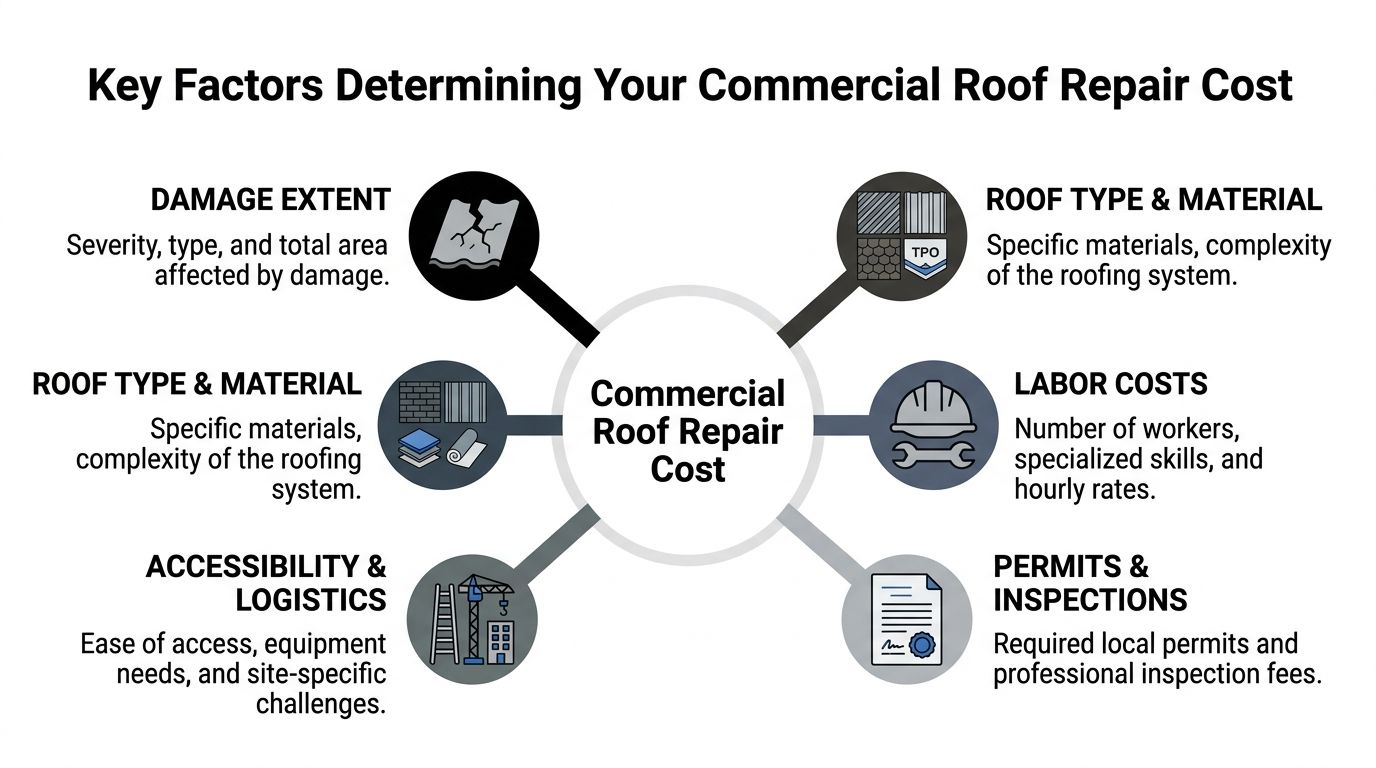
The fastest way to misunderstand a commercial roofing quote is to focus only on the damaged spot. On major Sydney sites, the expensive part often isn't the leak itself. It's the controlled, compliant process needed to reach the leak and repair it safely.
Access changes everything
In Australia, commercial roof repair cost is heavily shaped by access and compliance overhead, not just by how many sheets or flashings need replacement. Where edge protection, scaffolding, static lines, or other height-safety controls are required, setup can become a large share of the invoice before the crew replaces any roofing component. Industry data discussed by Roofing Calculator in its labour cost breakdown notes that labour can account for about 60% of roof replacement cost, which helps illustrate how workmanship and setup can dominate total pricing.
That aligns with what happens on real Sydney projects. A small leak above a tenancy can still be a costly exercise if the roof is steep, surrounded by parapets, blocked by plant, or located above live pedestrian and vehicle zones.
Key access cost drivers include:
- Perimeter protection: Temporary edge protection, harness systems, anchor points, or scaffolding.
- Site logistics: Crane or raised platform needs, loading constraints, narrow laneways, or occupied docks.
- Live-site conditions: Work done above staff, stock, machinery, or public access areas.
- Restricted hours: Night works, weekend programming, or staged attendance to avoid disrupting operations.
For owners considering larger capital works, it's worth understanding how metal systems can improve long-term planning when they replace failing roofs. This guide on industrial and commercial metal roof replacement for long-term savings gives a useful overview of the broader asset strategy.
A quick visual helps frame what sits inside a quote:
Materials and roof system type
Materials have been a major force behind pricing volatility. The ABS reported that the Producer Price Index for building construction materials rose by 30.9% over the five years to the September quarter 2022, with strong price pressure continuing after 2020, as noted in this discussion of Australian roof repair pricing pressures. For commercial buyers, that affects steel, insulation, membranes, flashings, fasteners, and other components that appear in almost every repair scope.
The roof type also changes both labour method and material selection:
- Colorbond and other metal roofs: Often need sheet matching, compatible fasteners, lap detailing, and corrosion assessment around penetrations and gutters.
- Membrane roofs: Require system-compatible patching, seam treatment, substrate prep, and careful detailing at upturns.
- Older mixed roofs: Frequently hide layers of previous repairs, incompatible sealants, and drainage defects.
Damage scope and compliance items
The visible entry point isn't always the full repair area. Water can track along purlins, insulation, slab soffits, and internal framing before it shows up inside. That's why a quote often includes allowance for investigation, sheet lifting, wet insulation removal, or opening up around penetrations.
A few cost multipliers show up repeatedly on Sydney jobs:
- Asbestos management: If the roof contains asbestos sheeting or adjacent asbestos-containing materials, licensed handling, containment, and disposal requirements can reshape the entire project.
- Drainage problems: Blocked or undersized box gutters, failed sumps, and ponding push a simple patch job into rectification work.
- Repeated patch history: If several contractors have sealed over the same issue for years, the repair often needs a proper rebuild of the junction rather than another surface treatment.
Cheap usually means one of two things. Either the contractor hasn't allowed for what the site actually requires, or the scope is only designed to stop today's leak, not solve the roof failure.
Real-World Examples of Sydney Roof Repair Costs
The easiest way to understand roof repair cost is to look at the kind of projects that show up every week. Not polished brochure jobs. The messy, inconvenient ones where access, weather, and building use drive the final number.
Western Sydney warehouse leak
A warehouse manager notices drips over pallet racking after heavy rain. On inspection, the problem isn't a giant hole. It's failed fasteners, deteriorated lap seal, and water tracking from a roof penetration near mechanical services.
The repair itself is moderate. The costs climb because the site needs safe access planning, work around operating warehouse hours, and a staged approach so stock below stays protected. This is the kind of job that often falls into the $5,000 to $15,000 bracket when the contractor needs to investigate, replace localised sheet sections, rectify flashings, and test for additional entry points after opening the area.
North Shore strata roof with asbestos sheeting
A strata building shows repeated top-floor ceiling staining after storms. The initial assumption is failed flashing near the ridge. Once the site is assessed, the roof is found to include old asbestos cement sheeting, and the defective area can't be safely repaired as a routine metal-roof patch.
At that point, the roof repair cost stops being about simple materials. Licensed removal, controlled handling, disposal, replacement planning, resident communication, and site protection become the job. These projects are always project-specific, and that's exactly why owners should be cautious of anyone giving a quick verbal price before confirming material type and compliance requirements.
Retail site with repeated flashing failures
A small retail complex has had three leak call-outs in recent years. Each time, someone has resealed the same parapet and penetration area. The latest storm finally pushes water into insulation and internal ceiling linings.
Owners often get caught by false savings. What looked like a series of cheap fixes turns into a broader remediation because earlier repairs treated the symptom, not the failed detail. The final invoice usually lands in the substantial repair range, not because the leak point was huge, but because repeated temporary patching let moisture spread into adjoining components.
A roof doesn't care what you approved last year. If the detail is wrong, the water comes back until someone rebuilds it properly.
These examples all point to the same lesson. The first defect you can see is rarely the full commercial scope. Access, live-site constraints, hidden damage, and hazardous materials decide where the number ends up.
How to Get an Accurate and Reliable Roofing Quote
A good roofing quote should let you compare method, risk, and scope. A bad one gives you a lump sum and a vague promise to fix the leak. On commercial property, that isn't enough.
If the contractor hasn't inspected the roof properly, checked access, looked at drainage, and noted site conditions, the number may be low for the wrong reason. That usually ends in variations, delays, or a repair that fails early.
What a proper quote should include
Ask for detail. If it's missing, ask again.
A reliable commercial quote should cover:
- Clear scope of works: Exact repair area, defect description, and what will be removed, replaced, resealed, or rebuilt.
- Material specification: Sheet profile, flashing metal, membrane type, fasteners, sealants, and whether Colorbond or compatible products are being used where required.
- Access and safety allowances: Edge protection, scaffolding, aerial work platforms, exclusion zones, and site-specific WHS controls.
- Investigation assumptions: Whether the contractor expects hidden damage and how variations will be handled if wet insulation, rusted purlins, or failed substrate is found.
- Warranty detail: Materials warranty, workmanship warranty, and any exclusions.
- Exclusions: Ceiling repairs, electrical isolation, crane hire, asbestos handling, or after-hours works if not included.
If you need a baseline condition report before seeking prices, a structured commercial roof inspection in Sydney helps you compare contractors on the same scope instead of collecting three different guesses.
How to compare quotes properly
The cheapest quote often leaves out the hardest part of the job. That's why comparing totals alone is risky.
Use this filter instead:
- Look at method first. Did the contractor explain how they'll access the roof and make the site safe?
- Check what problem they're solving. Are they patching a symptom or rectifying the failed detail?
- Review assumptions. If the quote acts as though nothing hidden will be found on an old roof, be cautious.
- Confirm insurance and licensing. Particularly important for complex sites and any asbestos-related work.
- Watch for vague language. “Repair leak as required” isn't a commercial scope. It's an escape hatch.
A proper quote should tell you what the roofer plans to do when things go right and what happens if the roof looks worse once opened.
One more warning. If one contractor asks a lot of questions and another gives a price in five minutes, the slower quote may be the more honest one.
Smart Ways to Manage Costs and When to Consider Replacement
The most effective way to control roof repair cost is to stop buying emergency work. Reactive call-outs are the most expensive way to manage a commercial roof because decisions get made under pressure, with water already inside the building.
What usually saves money
Early intervention matters. For Australian commercial roofs, the most cost-effective repairs are usually the ones done before water ingress reaches the substrate, because once leaks move into insulation, decking, or structural members, the scope can escalate from surface work to partial reconstruction. As noted in this roof repair cost discussion focused on damage escalation, minor repairs such as patching leaks or replacing flashing stay in the low hundreds, while water-damage and structural repairs move into the thousands once rotten decking or framing has to be opened and rebuilt.
For commercial owners, that means a sensible maintenance approach usually includes:
- Scheduled inspections: Check sheet laps, fasteners, penetrations, box gutters, downpipes, and signs of ponding before storm season.
- Drainage housekeeping: Overflowing gutters and blocked sumps create repair bills that look like leak issues but start as maintenance failures.
- Proper defect records: Keep photos, previous scopes, and marked-up plans so recurring issues can be traced instead of repeatedly patched.
- Targeted repairs: Rebuild the failed detail when needed. Don't keep paying for sealant over bad design.
When repair becomes false economy
Some roofs reach the point where repair still works technically, but no longer works financially. That's the part many owners struggle with.
A useful rule of thumb appears in this repair versus replacement discussion, which notes the common 25% of replacement heuristic and broader warnings that major repairs can climb well beyond minor-fix territory. That guidance isn't written for Sydney commercial roofs specifically, but the principle still helps frame the decision.
Replacement starts to make more sense when:
- Repairs are recurring: The roof keeps leaking in new areas or after each major storm.
- The roof has multiple weak points: Flashings, sheets, penetrations, gutters, and previous patches are all failing together.
- Compliance and access costs repeat every time: You keep paying for the same setup just to chase isolated defects.
- Business disruption is becoming the bigger cost: Tenant complaints, stock protection, shutdowns, and ceiling damage start outweighing the benefit of another patch.
- Asbestos is present: Partial repair may preserve a short-term problem instead of resolving the long-term risk.
If you're weighing that decision, this guide on replacing roofing materials, costs and benefits is a helpful reference for the bigger-picture comparison.
Insurance can also influence timing, especially after storm damage. Australia's roof repair market is strongly affected by weather events. The Insurance Council of Australia reported that the February 2022 South-East Queensland and Northern New South Wales floods generated more than 225,000 claims and over A$5.6 billion in insured losses, which shows how major events can overload repair capacity and affect pricing across a region, as discussed in this overview of storm-driven roof repair pressures. If storm damage is involved, document the condition early and move quickly before contractor availability tightens.
Checklist for Selecting Your Commercial Roofing Contractor
Hiring the right contractor has a direct effect on roof repair cost because the wrong one usually creates a second bill. Either the repair fails, the scope blows out, or the paperwork around safety and compliance is missing when you need it most.
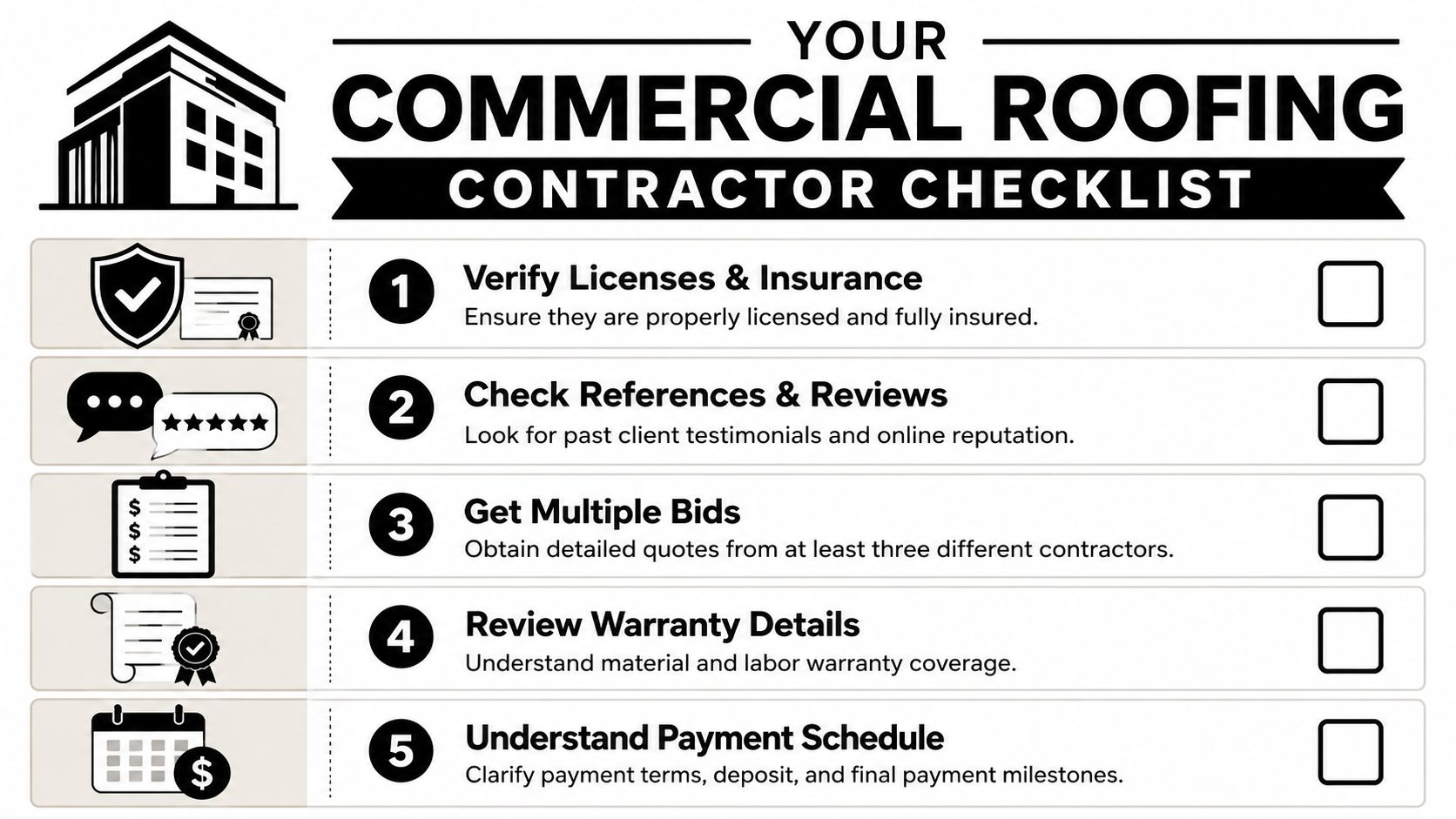
Use this checklist before approving any commercial roofing works.
What to verify before you sign
- Licences and insurance are current: Confirm NSW contractor licensing and public liability cover. If asbestos may be involved, check that the contractor is properly licensed for that work and not outsourcing critical compliance without telling you.
- They've done similar projects: Ask for examples of warehouses, strata complexes, factories, retail centres, or office buildings, not just houses.
- Their quote shows the safety method: If WHS controls, access systems, and exclusion zones aren't named, the quote may be incomplete.
- Materials are specified properly: You want to know what sheeting, flashings, membrane products, and fixings are being installed.
- The warranty is written down: Clarify both workmanship and material coverage, plus what would void it.
Questions worth asking in the meeting
Don't just ask, “Can you fix it?” Ask better questions.
- What do you think is causing the leak?
- What part of the roof do you need to open to confirm the scope?
- What happens if you find wet insulation or rusted substrate underneath?
- Can the building stay operational during the works?
- Are you proposing a repair that should last, or a temporary stabilisation?
The contractors who answer clearly are usually the ones who have thought the job through. The ones who stay vague usually haven't.
A commercial roof is an asset, not a disposable surface. Treat the buying decision that way, and the roof repair cost will make a lot more sense before the work starts.
If you're dealing with leaks, storm damage, asbestos roofing, or an ageing commercial roof that keeps draining money, Commercial Roofers can help assess the condition, clarify whether repair or replacement makes more sense, and provide practical advice for Sydney commercial and industrial sites.
Powered by Outrank