
There's no single Colorbond roof lifespan: Australian roofs can fail in under 20 years in harsh coastal or industrial conditions, while well-maintained roofs inland may remain serviceable for many decades. The difference comes down to site exposure, installation and detailing, and ongoing maintenance, not the product name alone.
The popular advice to expect one tidy lifespan number is misleading for commercial owners. A roof can still have sound sheets while its fasteners, flashings or drainage need repair, and an attractive paint finish doesn't prove the whole system is sound. The useful question isn't just "How old is it?" It's "What's happening at this site, and which parts of the roof are deteriorating?"
Table of Contents
- Why No Single Colorbond Roof Lifespan Exists
- How the Colorbond System Is Actually Built
- Australian Corrosivity Zones and What They Mean for Your Site
- What Shortens or Extends a Colorbond Roof
- Inspection Cadence That Matches Your Exposure
- Warranty Length Is Not the Same as Roof Lifespan
- Maintenance, Repair and Replacement Decisions for Commercial Owners
- Next Steps for NSW Commercial Property Owners
Why No Single Colorbond Roof Lifespan Exists
A fixed lifespan figure makes for easy reading, but it's a poor basis for planning commercial roof work. Two buildings with the same roof product can face very different conditions: one may sit inland with clear drainage and little contamination, while another is exposed to salt, industrial fallout, condensation or persistent moisture.
Pre-painted finishes such as COLORBOND® were introduced in Australia in the mid-1960s. That history shows the material has been used here for decades, but it doesn't make every roof the same age, condition or risk. NSW Government heritage guidance warns that steel can corrode when water and oxygen reach it, and identifies coastal salt, industrial pollutants, condensation, damaged coatings and incompatible metals as factors that can speed deterioration. (NSW Government guidance on corrugated roofing maintenance)
Treat lifespan as a site outcome
For a commercial building, roof age is only one clue. Exposure, roof design, workmanship and maintenance all affect how long the system remains serviceable. A roof in a mild inland setting may keep doing its job for many decades, while a roof near breaking surf or industrial contaminants may deteriorate much sooner.
Condition matters more than a broad promise. Look for corrosion around cut edges and fixings, damaged paint, ponding water, blocked gutters and signs of moisture ingress. A roof may need targeted repairs well before full replacement, or it may have widespread deterioration that makes patching a false economy.
Practical rule: Don't approve a roof budget from age alone. Ask for an assessment of the sheets, fixings, penetrations and drainage as a connected system.
The mistake is to treat “lifespan” as a guaranteed number of years. For commercial owners, it's a maintenance-and-environment outcome. A defensible decision starts with the site and the condition of the whole roof, not a generic figure copied from a product summary.
How the Colorbond System Is Actually Built
A COLORBOND® roof isn't just a painted sheet. It's a layered system: the steel provides structure, metallic and paint coatings help protect it, and compatible fasteners, flashings and drainage details keep water from finding a path into vulnerable areas.
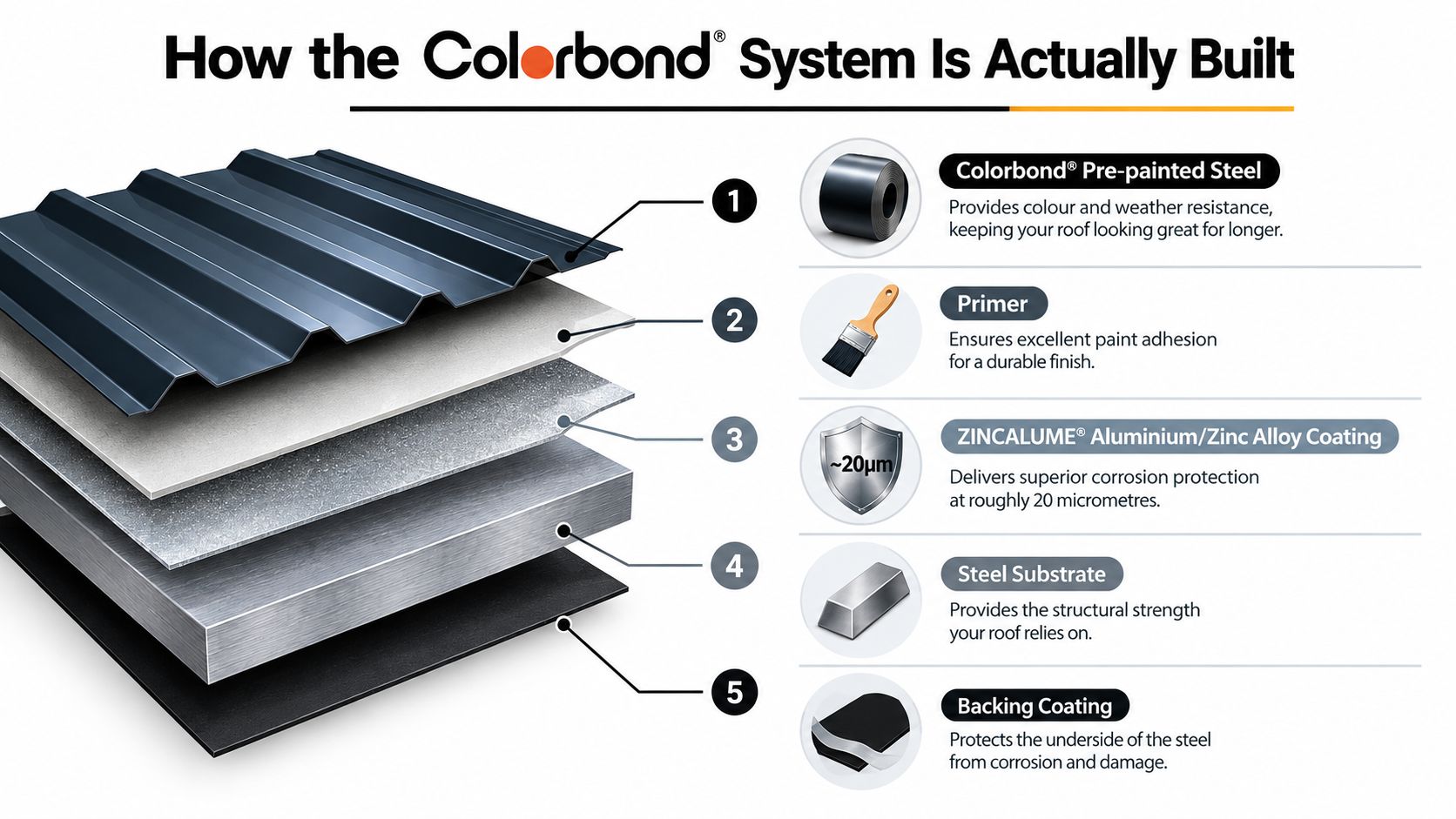
The Australian Steel Institute describes a typical roofing system with approximately 20 micrometres of ZINCALUME® metallic coating beneath an approximately 25-micrometre COLORBOND® topcoat. It also reports that maintenance-free performance well beyond 20 years has been demonstrated with high-quality coatings and controlled application. That's a coating-durability benchmark, not a guarantee that every roof will stay leak-free for the same period. (Australian Steel Institute guidance on painting over galvanised coatings)
Several timelines sit under one roof
The paint finish has its own appearance timeline. The coated sheet has a separate corrosion-protection timeline. Then there's the service life of the complete roof, which also depends on fixings, flashings, penetrations, gutters, box gutters and sealants.
That's why fading isn't the only sign worth checking. A roof can look tired while its sheets remain serviceable, or look presentable while corrosion develops around cut edges or screw heads. A failed box gutter or penetration can admit water even when the roof sheets are in reasonable condition.
What to assess together:
- Coating and edges: Check for peeling, damaged paint and corrosion where sheets have been cut or scratched.
- Fasteners and laps: Look for loose or corroded fixings, and for moisture or debris caught at sheet overlaps.
- Roof details: Assess penetrations, flashings, gutters and sealants for defects that can allow water in or keep it trapped.
For asset planning, record sheet condition separately from the condition of the roof's other components. That gives you a more useful picture than a single label such as “old roof” or “new roof,” and helps distinguish a local repair from a system-wide problem.
Australian Corrosivity Zones and What They Mean for Your Site
A suburb name won't tell you enough about roof exposure. A building's distance from salt water or industry matters, but so do surrounding activities, rain-washing, drainage and sheltered areas that hold contaminants. Use atmospheric corrosivity as a guide, then assess the actual roof and its immediate environment.
AS 4312:2019 classifies atmospheric exposure using mild-steel corrosion rates. Its categories run from C1 Very Low, below 1.3 micrometres per year, to CX Extreme, at 200–700 micrometres per year. That is a more than 500-fold difference in the listed annual corrosion rates. These figures describe environmental stress on mild steel, not a direct prediction of when COLORBOND® sheets will need replacing. (AS 4312:2019 atmospheric corrosivity classification)
| Category | Mild-steel corrosion rate (μm/year) | Typical NSW site examples |
|---|---|---|
| C1 Very Low | Below 1.3 | Sheltered inland settings with little contamination |
| C2 Low | 1.3–25 | Lower-exposure inland commercial sites |
| C3 Medium | 25–50 | General urban or light industrial settings |
| C4 High | 50–80 | More exposed coastal or industrial locations |
| C5 Very High | 80–200 | Aggressive marine or industrial environments |
| CX Extreme | 200–700 | Extreme corrosive exposure, requiring site-specific assessment |
Use the classification as a starting point
An inland warehouse, a western Sydney industrial site and a facility close to surf aren't interchangeable, even if all three use the same sheet profile. Chemical exposure, pool treatment products, industrial fallout and places shielded from rain can create additional stress on a roof. A sheltered roof section may need more attention than an exposed section because it doesn't get washed clean.
For a commercial site, use the classification to prompt the right questions: What contaminants reach the roof? Does rain wash the surface? Where do salt and debris collect? Are nearby activities affecting the building? If you're comparing roofing metals and their suitability, consider the practical differences in ZINCALUME® and COLORBOND® roofing.
Don't assign a product grade or inspection plan from the postcode alone. Have the site assessed, especially if the roof sits near the coast, heavy industry, swimming pools or metal components that may not be compatible.
What Shortens or Extends a Colorbond Roof
The environment sets the level of risk, but roof details decide where damage concentrates. Parapets, rooftop equipment and sheltered corners can trap moisture or debris. Poor falls and blocked drainage leave water sitting where it shouldn't. Laps, penetrations, fasteners and cut edges also deserve close attention because moisture and corrosion can concentrate at these points.
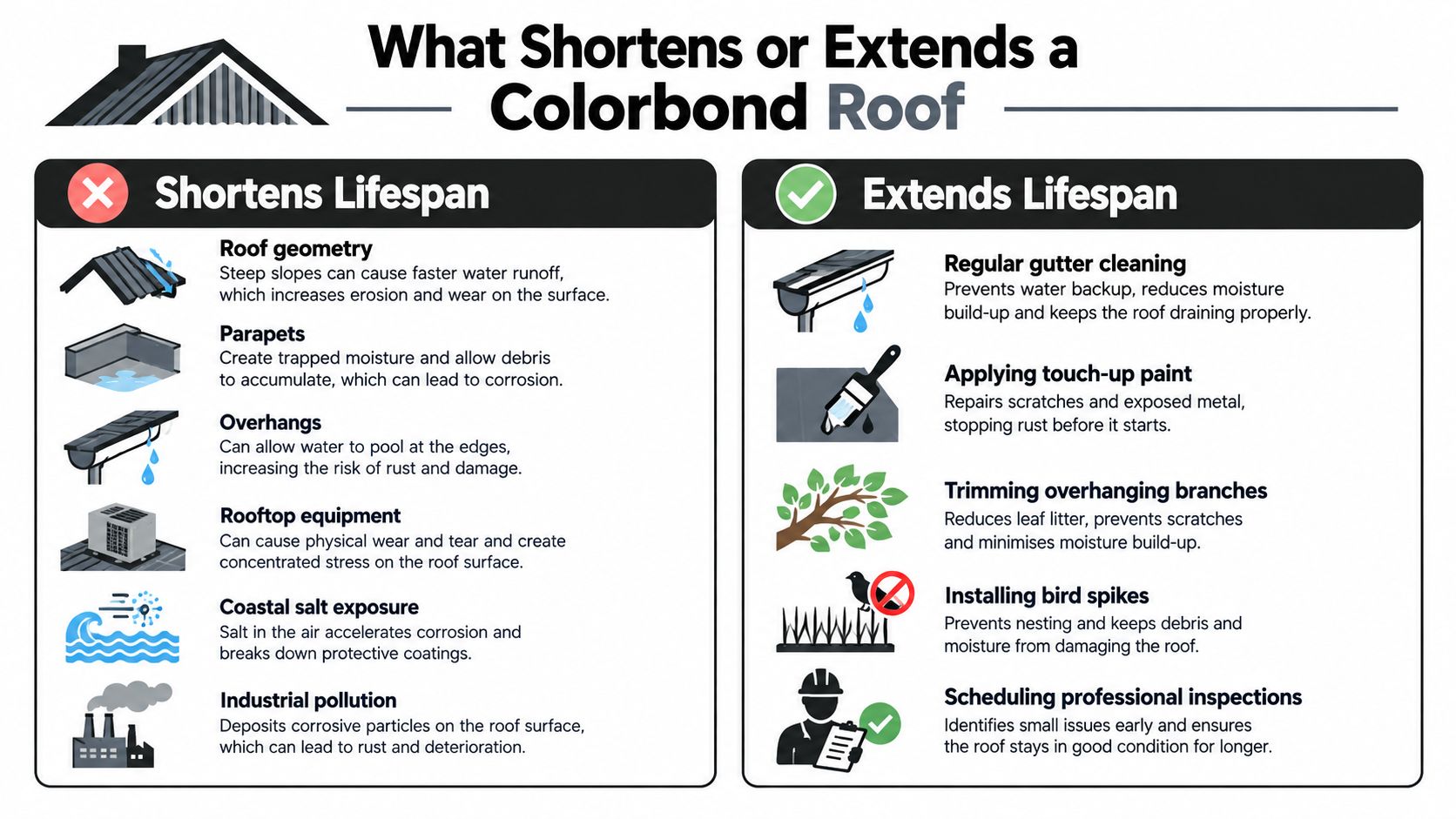
Corrosion performance depends on more than the sheet itself. The Australian Steel Institute identifies material selection, design, storage, correct installation and ongoing maintenance as relevant factors. Moisture around fasteners, laps and crevices, along with accumulated detritus, keeps surfaces wet longer. Conductive salts can accelerate corrosion, which may become concentrated around screw heads. (Australian Steel Institute guidance on corrosion and coated steel)
Compatibility is not a cosmetic detail
A flashing or fastener that looks close enough can still be the wrong choice. Tweed Shire Council heritage guidance warns that adjacent incompatible metals can corrode faster, and cautions against unsuitable contact between COLORBOND® or ZINCALUME® and galvanised steel or lead flashings. Get the material interfaces right before installation, and isolate dissimilar metals where the design requires it.
BlueScope also cautions that standard COLORBOND® steel may be unsuitable in exterior applications within 1 kilometre of salt-marine locations, in severe industrial or abnormally corrosive environments, in areas that aren't washed by rain, or where the steel is partly buried. Check the manufacturer's site requirements and warranty conditions before specifying a product for those locations. (BlueScope COLORBOND® steel data sheet)
If the site is severely marine, discuss whether a higher-corrosion-resistance product such as COLORBOND® Ultra and more detailed detailing are appropriate. The trade-off is simple: the right product and compatible roof components may require more careful specification, but a cheaper choice that doesn't suit the exposure can leave you managing avoidable corrosion.
Inspection Cadence That Matches Your Exposure
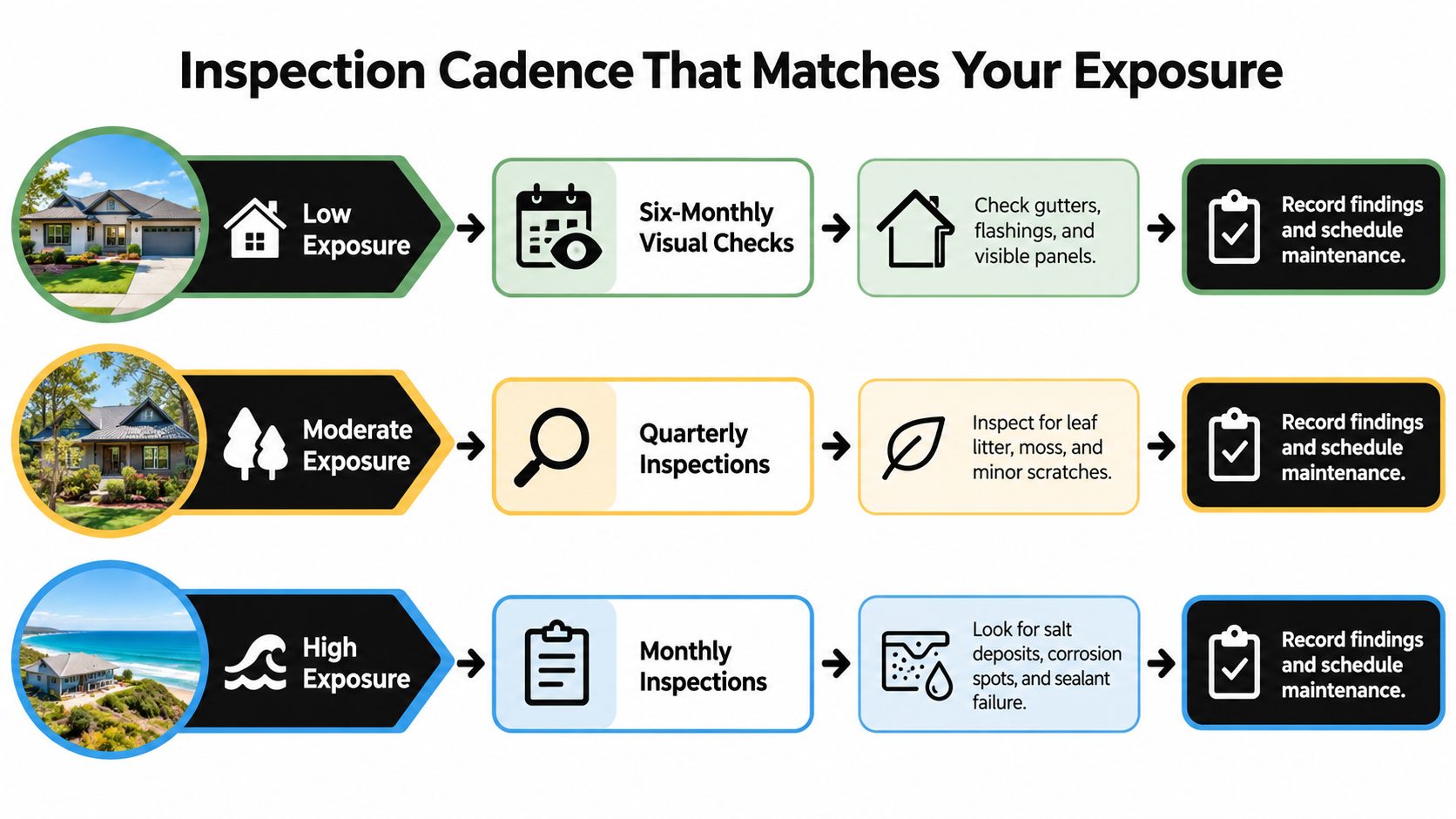
A useful inspection plan reflects what lands on the roof and how quickly the site can be checked after a problem. For a practical starting schedule, use six-monthly visual checks for low-exposure inland sites, quarterly checks for coastal or industrial sites, and monthly checks where exposure is high. Inspect after a significant storm wherever the building is located, because wind and debris can loosen components or reveal drainage problems.
Record the condition, not just the date
During each inspection, note what you found and where. A repeatable record lets a facility manager distinguish a new defect from an existing one and track whether repairs worked.
- Fasteners and laps: Flag loose fixings, corrosion around screw heads and debris caught between sheets.
- Coating and cut edges: Record scratches, peeling and any visible rust.
- Water paths: Check ponding, box gutters, outlets and signs of water backing up.
- Penetrations and sealants: Look for gaps, failed seals and water staining below roof openings.
- Accumulated material: Note leaf litter or other debris, particularly in sheltered areas.
A written condition audit is sensible when several roof zones, tenancies or maintenance teams are involved. Ask the assessor to map defects by location, describe their severity, and separate immediate repairs from longer-term capital work. That report gives owners and strata managers a clearer basis for budgeting and handover.
Set up the schedule in your maintenance system, name who will inspect, and keep dated photographs with the record. For a broader maintenance plan, use this guide to commercial roofing and maintenance.
Warranty Length Is Not the Same as Roof Lifespan
A warranty is a contract with defined terms, not a prediction that every component of a roof will perform equally for the same period. BlueScope's sample COLORBOND® warranty separates corrosion-through-perforation from paint flaking or peeling, and makes coverage conditional on correct installation, application, maintenance and site conditions. Some Australian terms provide coverage of up to 45 years, but that doesn't guarantee the complete roof will remain leak-free for that long. (BlueScope sample COLORBOND® roofing warranty)
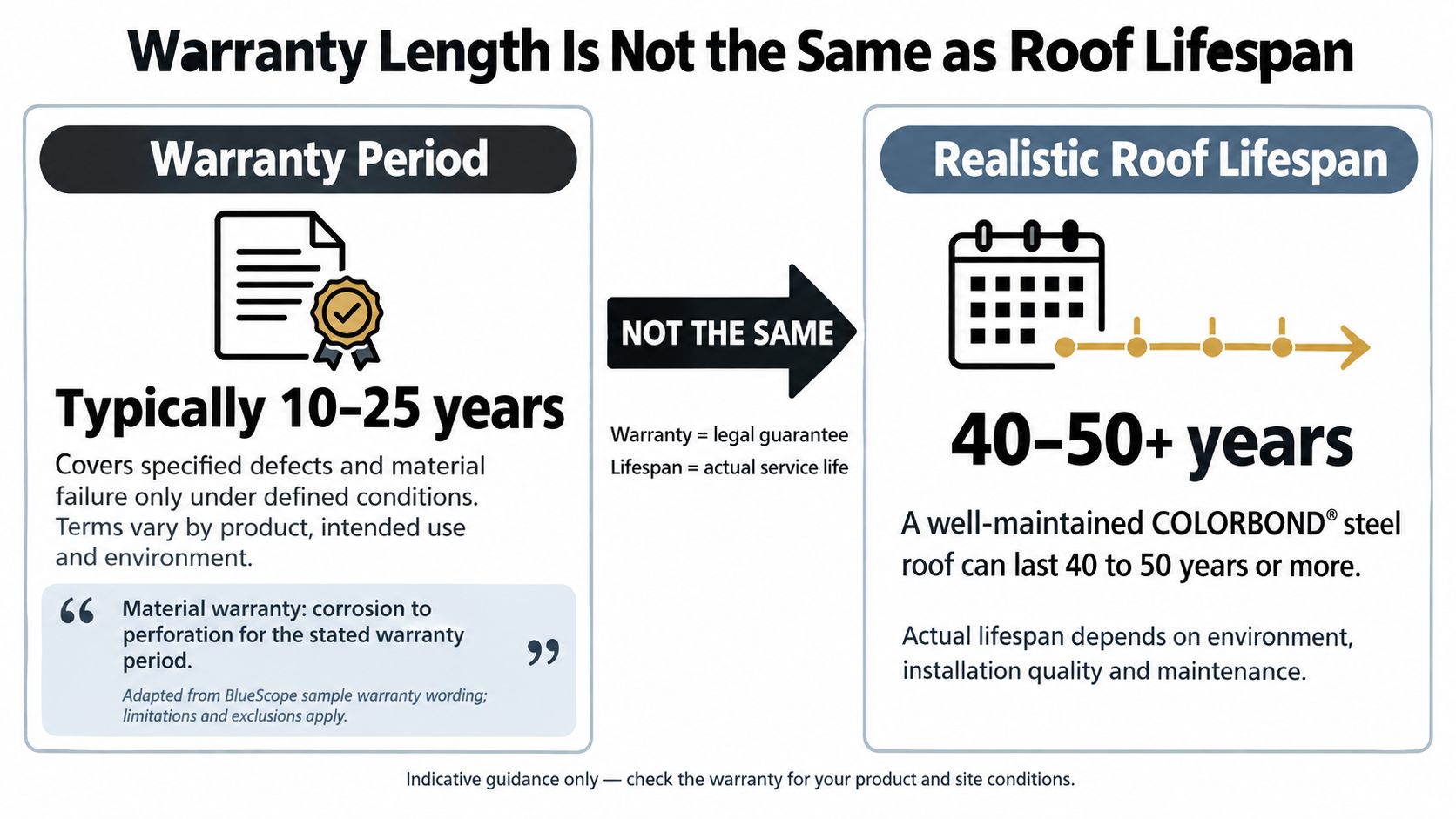
Separate the three clocks
| What you're assessing | What it tells you | What it doesn't tell you |
|---|---|---|
| Product warranty | Which specified defects may be covered, and under what conditions | That all roof components are covered or that the roof won't leak |
| Coating condition | Whether the paint finish is retaining its appearance and integrity | Whether fixings, flashings or drainage are sound |
| Whole-system serviceability | Whether sheets and connected components still perform as a roof | Whether future exposure or maintenance needs will stay unchanged |
Before you sign a tender, check which product and failure modes the warranty names, what installation and site conditions apply, and whether the contract clearly identifies the components included in the work. A sheet warranty won't automatically settle responsibility for a failed box gutter, penetration or fastener.
If you're comparing cover terms, read the project documents alongside a practical guide to what a roof warranty covers. Don't use the headline warranty duration as a substitute for a roof condition assessment.
Maintenance, Repair and Replacement Decisions for Commercial Owners
Choose the work that matches the defect. Patching a local problem makes sense when the surrounding sheets and details remain sound. Replacing the whole roof because of a small isolated issue wastes good material; repeatedly sealing widespread corrosion or failing drainage only delays a larger job.
Match the response to the condition
- Repair local defects: If damage is limited, repair the affected area and renew failed sealant or fixings where appropriate. Check why the defect developed, or it may return.
- Restore the finish: If the coating is deteriorating but the steel substrate remains in serviceable condition, ask whether cleaning, preparation and repainting are suitable. Surface treatment won't restore corroded-through sheets.
- Replace the system: Consider re-roofing when corrosion has reached the substrate, fasteners are failing broadly, or flashings and box gutters have reached the end of their serviceability.
A good inspection report should explain the condition of the sheets separately from the condition of gutters, fixings, penetrations and flashings. It should also identify which work is urgent and which can be planned, so you can compare repair and replacement proposals on scope rather than headline price.
Specify for the site, not the sales pitch
If exposure is severe, ask the contractor to justify the proposed product grade and detail choices against the building's actual conditions. That may include checking compatibility at metal junctions, addressing trapped debris and improving drainage. A cheaper quote can become the expensive option if it leaves known corrosion risks unresolved.
Commercial Roofers offers commercial roof inspections, cleaning, repairs, restoration and replacement, with reporting that distinguishes finish deterioration from substrate and detailing problems. Compare its scope with other qualified contractors and ask each to state what they'll inspect, repair and exclude.
Next Steps for NSW Commercial Property Owners
Start with the records you have, then get the roof assessed against the conditions it faces. A practical plan gives owners, developers and strata managers a defensible basis for repair budgets and tender decisions.
- Gather the basics: Collect roof age, product details, previous repair records and any available warranty documents.
- Assess the exposure: Have the site's atmospheric corrosivity and local contaminants considered, not just its suburb or distance from the coast.
- Commission a written report: Request a mapped condition assessment if the roof is over 10 years old or sits in a coastal or industrial zone. Ask the contractor to separate sheet condition from fixings, flashings, gutters and penetrations.
- Set clear specifications: Require compatible flashings, gutters and fasteners, and ask how the selected product suits the building's exposure.
- Test the recommendation: Before approving repair or replacement, ask what evidence supports the proposed scope, what can be repaired, and what will remain at risk.
Choose a licensed contractor who can explain the findings in plain terms and provide a written scope. That's a better basis for deciding whether to maintain, restore or replace than a lifespan figure on its own.
If you manage a commercial or industrial roof in NSW, ask Commercial Roofers for an inspection and written condition report that separates coating wear from corrosion and detailing problems. Compare the recommended repairs with your exposure, warranty documents and replacement plans, then visit Commercial Roofers to discuss the next step.