

The most popular advice about roof warranties is also the least reliable: keep the certificate and you're covered. In commercial roofing, a certificate rarely answers the questions that matter when water enters a warehouse, retail tenancy, healthcare facility or strata building. Who investigates the leak, who pays for access equipment, who repairs the installation defect, and who covers internal damage?
A roof warranty is usually a set of separate obligations, not a universal promise. Contractor workmanship terms, manufacturer product terms, statutory protections and the signed construction contract may all apply, but they don't cover the same risks. The practical answer to what does a roof warranty cover depends on the failure, the responsible party, the exclusions and the records available when you make a claim.
Table of Contents
- The Myth of the Universal Roof Warranty
- Separating Workmanship Guarantees from Material Warranties
- Navigating NSW Statutory Protections for Commercial and Strata Properties
- Standard Exclusions That Void Your Coverage
- The Critical Role of Documented Maintenance Schedules
- Executing a Successful Warranty Claim Process
- Securing a Project-Specific Warranty Matrix Before Signing
The Myth of the Universal Roof Warranty
A new roof doesn't automatically come with blanket protection against every future leak. The word “warranty” often appears prominently in a quotation or sales conversation, while the actual protection is divided across detailed documents with different conditions.
For a commercial owner, the first distinction is between defective work and an event or condition that arose after completion. Faulty design, poor workmanship, unsuitable materials and failure to comply with the contract or applicable building requirements can fall within warranty obligations. Persistent leaks caused by defective installation, badly formed flashings, inadequate falls or non-compliant materials may therefore be warranty issues. Routine maintenance, storm damage, accidental damage, unauthorised alterations and deterioration caused by neglect generally sit outside that protection, subject to the wording of the contract and manufacturer terms. The NSW Government guidance on keeping new building work trouble-free sets out the expectation that building work must be carried out with due care and skill, use suitable materials, comply with approved plans and laws, and be fit for its intended purpose.
Why commercial projects need closer reading
Residential owners in NSW may have statutory protection generally lasting six years for major defects and two years for other defects, measured from completion, as explained by the NSW Government. Those periods primarily concern residential building work. A warehouse owner, factory operator or commercial developer shouldn't assume the same protection applies automatically to a standalone commercial contract.
That difference changes the purchasing decision. A residential owner may have statutory rights that supplement the contract. A commercial owner must usually negotiate the contract carefully enough to address leak rectification, workmanship, products, inspections, response times, exclusions, access and claim procedures. A verbal assurance that “the roof is under warranty” is too vague to protect an operating asset.
Practical rule: Treat the headline warranty period as an invitation to ask questions, not as the coverage itself.
The useful test is simple. Can the documents identify the party responsible for each likely failure? If the answer is no, the warranty hasn't been translated into an enforceable operating arrangement. Before signing, request the full contractor warranty, every manufacturer certificate, exclusions, maintenance requirements, start date, transfer provisions and claim process.
Separating Workmanship Guarantees from Material Warranties
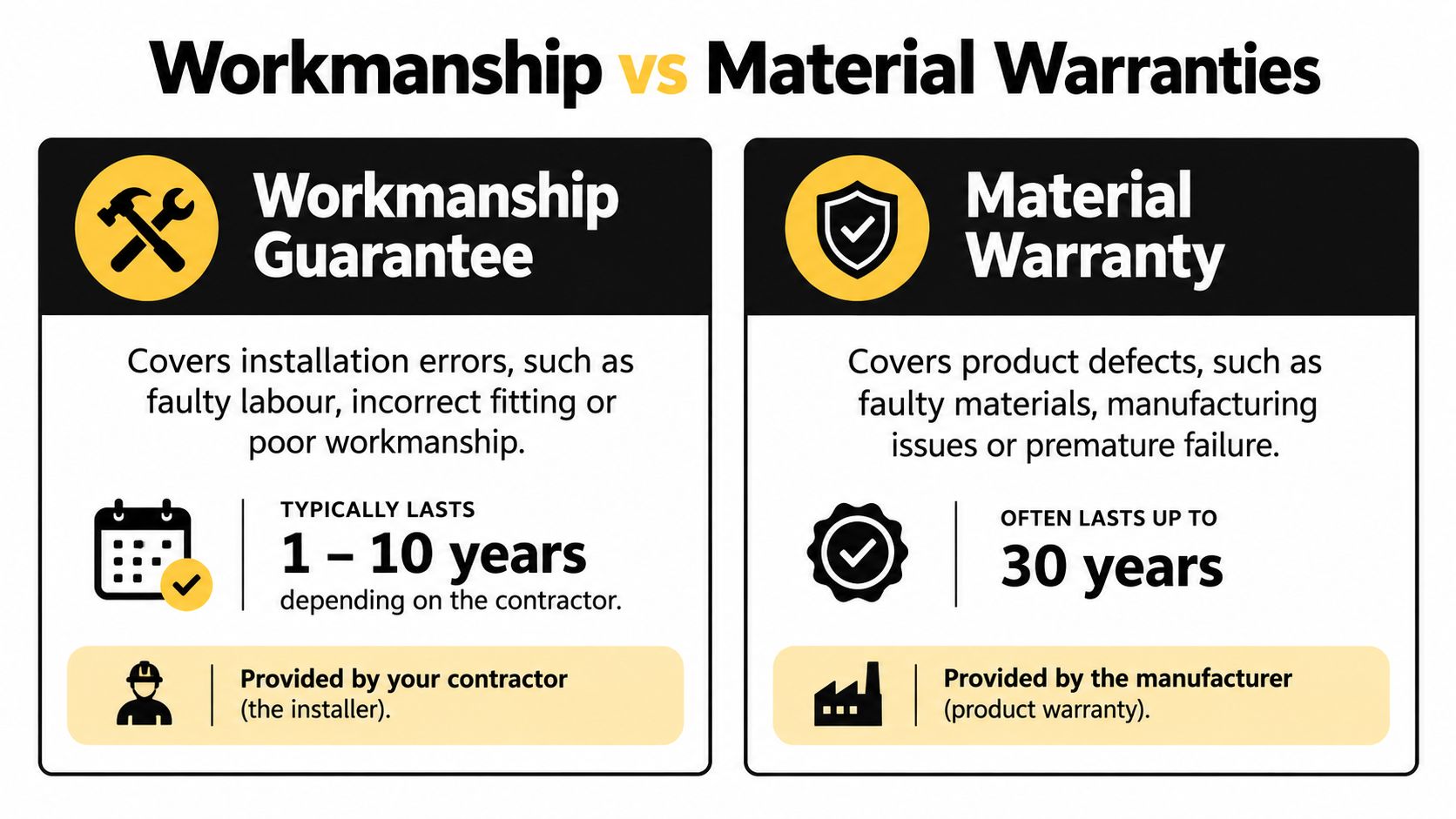
A roof warranty generally operates in two layers. The contractor's workmanship warranty addresses installation-related failures, while the manufacturer's product warranty addresses defined failures in the roofing materials. The NSW Government explanation of warranties confirms that warranty-against-defects protections sit alongside statutory consumer guarantees rather than replacing them.
The division matters because most roof systems combine many components. A metal sheet, membrane or coating may be sound, while the flashing, fasteners, laps, penetrations or drainage detailing fail. In that situation, a manufacturer may have no responsibility for the installation, even though its product is present at the failure point.
What the contractor should stand behind
A workmanship warranty should deal with defects created by the installation process. Typical examples include:
- Flashings: Incorrectly formed or fitted flashings can allow persistent water ingress around edges, penetrations and junctions.
- Sealing and laps: Inadequate sealing, poorly executed laps or incorrect fastener placement can undermine an otherwise suitable roofing product.
- Drainage detailing: Poor falls, defective outlets or badly connected box gutters can leave water where the design didn't intend it to remain.
- System interfaces: Solar supports, plant penetrations, skylights and wall junctions need coordinated detailing, not just a patch applied after another trade has finished.
The contractor's obligation should state whether it will investigate the underlying cause, rectify the defective work, remove and reinstall affected sections, provide access equipment and repair resulting internal damage. If the document only promises to “repair the roof”, it may not resolve those costs.
What the manufacturer should cover
A product warranty applies to defined material failures, such as premature corrosion, coating breakdown or loss of watertight performance. It doesn't necessarily cover labour, investigation, access equipment, removal, reinstallation or consequential damage. Those exclusions can make a long product warranty less useful than its marketing suggests.
Disputes commonly start here. The contractor says the product failed. The manufacturer says the installation caused the problem. The owner is left with water entering the building while each party narrows its own responsibility.
The contract should address mixed-cause failures directly. It should identify who coordinates the investigation, who preserves the failed component, whether the contractor will assist with the manufacturer claim and which party pays while responsibility is being determined. A product warranty can replace a defective sheet or membrane, but the asset still needs someone to make the roof watertight again.
Navigating NSW Statutory Protections for Commercial and Strata Properties
A lot of owners assume "roof warranty" means the law gives them a fallback if the contract is thin. In NSW, that assumption is where commercial and strata projects go wrong. Residential statutory protections can matter, but they do not roll across every warehouse, factory, or owners corporation roof by default.
For residential building work, statutory protection is generally six years for major defects and two years for other defects, beginning when the work is completed. A defect that becomes apparent during the final six months of the applicable period may receive an additional six months to commence proceedings, as described in NSW guidance on resolving building disputes.
In roofing disputes, the argument usually turns on classification. A roof issue may be treated as a major defect if it affects a load-bearing element tied to building stability, or if defective work causes a serious failure to meet required performance standards. Waterproofing, structural performance, and the building envelope are the areas that usually attract attention first, but a leak on its own does not decide the question.
The residential and commercial divide
The practical comparison looks like this:
| Project context | What may assist the owner | What the owner must not assume |
|---|---|---|
| Residential building work | Statutory protections for major and other defects, subject to the applicable legislation and facts | That every roof leak is a major defect |
| Strata common property | The relevant strata duties, building arrangements and applicable defect protections | That a strata manager can rely on a generic commercial certificate |
| Standalone warehouse or factory | The negotiated construction contract, product terms and applicable commercial-law rights | That residential statutory periods apply automatically |
For strata property, the first question is basic but often missed. Who controls the roof, and is the affected area common property? Approval pathways, repair responsibility, and defect enforcement can shift depending on that answer. The owners corporation may have the repair role, but that does not create a universal roofing warranty or fill gaps in a weak contract.
Commercial owners need to protect themselves before the first sheet goes down. Specify the warranty terms in the contract, not after a leak. The document should identify the roof system, flashings, gutters, box gutters, fasteners, coatings, insulation, penetrations, and any agreed internal consequences, then set clear notice requirements, inspection access, and response times.
Compliance also matters because warranty arguments often start with whether the work matched the standard that applied on day one. For context on workmanship and specification issues that commonly affect enforceability, review these Australian roofing standards and compliance considerations.
Standard Exclusions That Void Your Coverage
Warranty exclusions aren't minor legal wording. They describe the conditions under which the contractor or manufacturer can refuse responsibility. Commercial sites create more exposure because several trades may work on the roof after completion.
Start with every item that changes the roof system or its drainage:
- Unauthorised penetrations: Solar panels, air-conditioning plant, signs, vents and services can puncture membranes or metal roofing. If another trade performs the work without the original roofer's approval, responsibility may move away from the original warranty.
- Alterations by later contractors: A patch, bracket or new penetration may interrupt flashings and seals that formed part of the original installation.
- Blocked drainage: Leaves, packaging, silt and trade waste can obstruct gutters, outlets and box gutters. Ponding caused by blocked outlets is commonly treated differently from a defect in the original drainage design.
- Neglect: If the owner doesn't follow documented inspection and cleaning requirements, the roof may deteriorate in a way the warranty excludes.
- Storm and accidental damage: Severe weather, impact and accidental damage aren't the same as defective workmanship. The owner may need to consider insurance or a separate repair arrangement.
- Incompatible metals: Contact between incompatible metals can contribute to galvanic corrosion. The resulting damage may be excluded if the site condition wasn't part of the original approved system.
- Condensation and site conditions: Internal moisture, ventilation conditions, chemical exposure and operational environments can produce symptoms that look like leaks but arise outside the contractor's warranty boundary.
Control the trades, not just the roof
The facility manager should keep a permit and approval record for anyone accessing the roof. Before a solar or HVAC contractor starts, require a written method, approved penetration details, compatible materials and confirmation of who carries responsibility for the altered area.
Don't accept a generic “warranty void” statement without asking what part is affected. Some documents exclude the entire system after an unauthorised alteration, while others limit the exclusion to damage caused by that alteration. The exact wording controls the dispute.
A roof warranty can't allocate responsibility clearly if the owner allows several contractors to modify the same waterproofing layer without records.
When a new service is unavoidable, involve the original roofer or obtain a written technical approval. Keep photographs before and after the work, record the installer and preserve drawings. That evidence won't make an excluded alteration covered, but it can prevent an avoidable argument about what changed and when.
The Critical Role of Documented Maintenance Schedules
A roof warranty stands or falls on records. In commercial and strata matters, that matters even more because many disputes turn on contract wording and maintenance compliance, not the broader protections owners often assume apply across the board. If you cannot show what was inspected, what was cleaned, what was reported and when, the argument usually shifts from the original defect to alleged neglect.
That is the gap many owners discover too late. A leak may be obvious. The cause, the timing and the responsibility are not.
Documented maintenance ties the legal position to the roof's physical condition. Without it, a contractor or manufacturer can point to blocked outlets, accumulated debris, failed sealant, corrosion or delayed reporting and say the system was not maintained as required. With a proper file, the owner can show that inspections occurred, defects were identified early and reasonable steps were taken to protect the asset.
Build a useful roof record
A maintenance log has to be specific enough to survive an argument. Record the inspection date, who attended, the areas accessed, weather where relevant, defects observed, photographs taken, work completed and any action still outstanding. On metal roofs, note fasteners, laps, flashings, penetrations, coatings and early corrosion. On box gutters, record debris levels, outlet condition, joints, overflow paths and any ponding seen after rain.
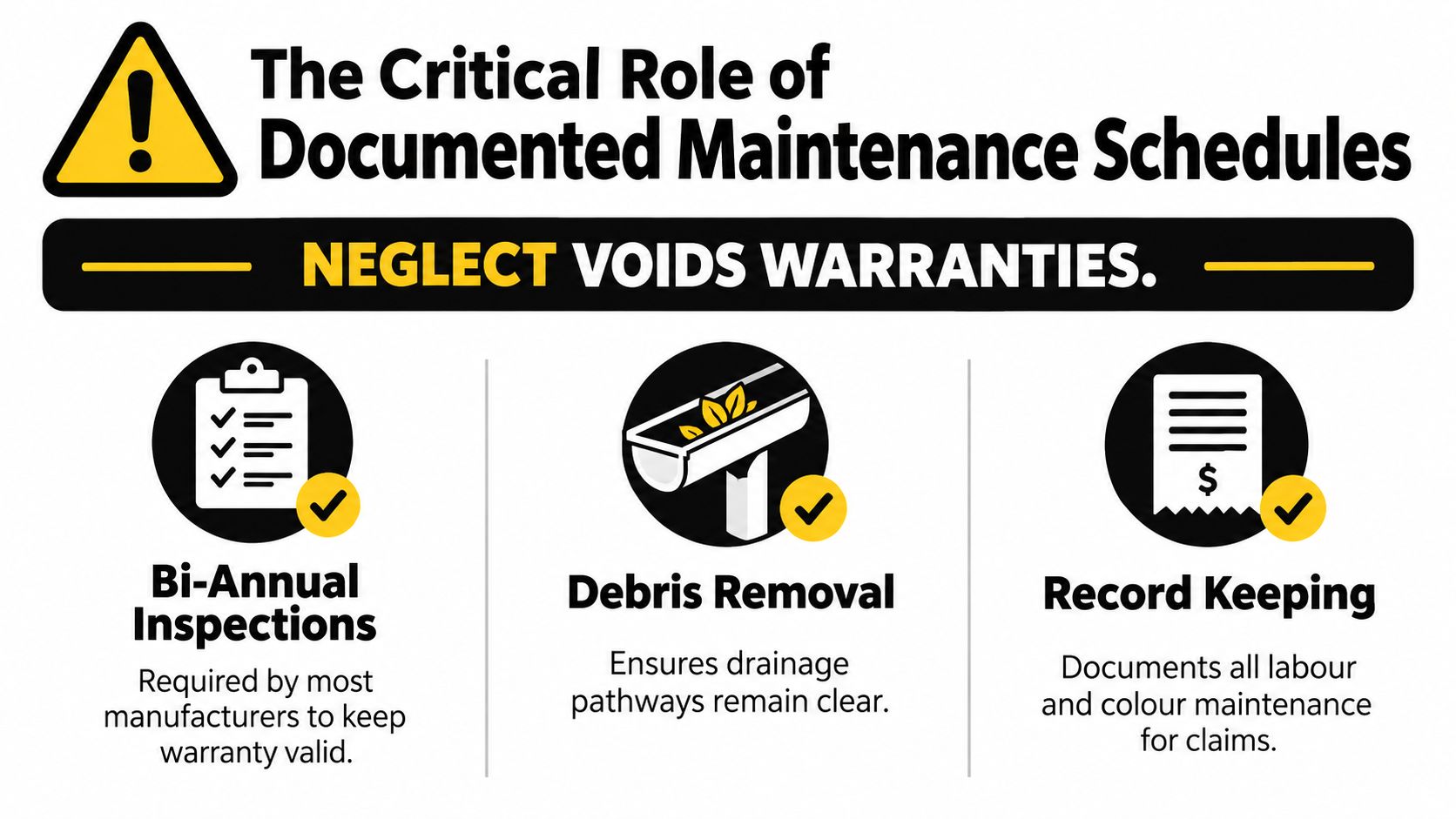
A useful record includes:
- Condition photographs: Take wide shots and close-ups of flashings, penetrations, gutters, sealants, fasteners and any visible defect. Include enough context to identify the exact roof area.
- Maintenance evidence: Keep invoices, inspection reports, access records, waste removal notes and repair recommendations in one file.
- Communication history: Save written notices, responses, proposed attendance dates, temporary protection instructions and completion confirmations.
The schedule that matters is the one in the warranty and contract documents. If the manufacturer requires periodic inspection and cleaning, follow that schedule. If the contractor warranty requires prompt notice or documented maintenance, the log needs to prove compliance, not just assert it.
For practical inspection and cleaning guidance, use this commercial roofing and maintenance resource.
Good records also improve day-to-day asset management. They help pick up minor drainage or sealant issues before they become internal damage, and they give a strata manager or warehouse owner a defensible position when coverage is disputed.
Executing a Successful Warranty Claim Process
A leak claim becomes harder when the owner starts with an unauthorised patch, discards failed materials or waits until internal damage has spread. The first response should protect people and the building while preserving the evidence needed to establish cause.
Act when water ingress appears
- Make the area safe. Isolate electrical hazards, protect stock and control access below the affected area. Temporary protection is appropriate where it limits further damage, but it should be recorded.
- Notify the responsible parties in writing. Describe when the leak appeared, where water entered, what weather occurred and whether the problem is recurring. Send the notice to the contractor and, where relevant, the manufacturer or managing agent.
- Photograph before disturbing the area. Capture ceiling stains, wet insulation, stored goods, roof-level defects, blocked outlets and any temporary measures.
- Preserve failed components. Don't throw away damaged sheets, fasteners, flashing pieces or membrane samples if they may help determine whether the cause was product or installation failure.
- Request a coordinated inspection. Ask the contractor to investigate the underlying defect, not just apply sealant to the first wet spot found.
The supporting file should contain completion records, product data sheets, manufacturer compliance documents, installation photographs, inspection reports, maintenance logs and the written contract. The NSW Government consumer-building guidance supports prompt written notification and retaining records when a problem is identified.
Don't confuse a temporary fix with rectification
A temporary tarp, controlled water diversion or isolated seal can limit damage while the inspection is arranged. It shouldn't become the final repair without agreement from the warranty party. A rushed repair may hide the original failure, complicate causation and allow the contractor to say that evidence was removed.
Ask for a written outcome after inspection. It should identify the observed defect, proposed remedy, responsible party, exclusions relied upon, access arrangements and whether the work addresses consequential damage. If responsibility is disputed, obtain a technical report that separates the product condition, installation quality, site modifications, maintenance history and weather exposure.
Securing a Project-Specific Warranty Matrix Before Signing
The biggest warranty mistake in commercial roofing happens before the first sheet goes down. Owners sign a contract assuming the warranty language will sort itself out at handover, then discover the actual terms sit in separate manufacturer documents, installer exclusions, and maintenance conditions that were never lined up. In NSW, that gap matters. Residential-style assumptions do not protect a warehouse, factory, or many strata assets in the way people expect. The contract has to do that work.
A project-specific warranty matrix puts the allocation of risk in writing before price pressure takes over. Ask for the full warranty set before signing, including the certificate form, exclusions, claim steps, commencement trigger, transfer rules, and any maintenance obligations. If the contractor cannot show how the installer warranty and product warranty fit together, the owner is buying uncertainty.
| Coverage element | Standard inclusion | Negotiated requirement |
|---|---|---|
| Roofing sheets, membranes and coatings | Defined product defects | Product certificate, batch details, exclusions and remedy |
| Workmanship | Installation-related defects | Clear rectification obligation, investigation responsibility and access costs |
| Flashings, laps and fasteners | May be treated as workmanship | List each component and define repair or replacement scope |
| Gutters and box gutters | Often limited by maintenance conditions | State drainage performance, inspection duties and blocked-outlet exclusions |
| Future penetrations | Commonly excluded or restricted | Approval process, compatible details and responsibility for later trades |
| Consequential internal damage | Frequently unclear | State whether investigation, drying, stock protection and internal repairs are included |
| Storm and accidental damage | Usually excluded from defect warranty | Identify insurance responsibility and reporting procedure |
| Transferability | May require approval or may not exist | Confirm whether the warranty transfers with the asset and how |
| Claim administration | General notice requirement | Named contact, written notice method, inspection process and response commitment |
The matrix also needs a performance boundary. State the intended rainwater-shedding performance, design falls, drainage assumptions, substrate compatibility, corrosion category, exposure conditions, and any reliance on sealants or periodic maintenance. Without that detail, a contractor can say the roof performed as specified while the owner argues it failed in service. Both positions can be partly true if the scope was vague.
Experienced buyers save money later. They compare exclusions and investigation responsibility with the same attention they give to the lump sum. A contractor that documents system selection, installation records, and maintenance support usually gives a clearer warranty position than one selling a headline term. For a practical example of how a contractor may set out systems, delivery scope, and supporting services, review commercial roofing services and project solutions.
Before work starts, attach the final matrix to the contract, not just to an email chain or proposal. At handover, collect the executed warranty documents, product details, and maintenance schedule, then store them with the asset records. Commercial Roofers offers commercial and industrial roof inspections, leak repairs, replacements, gutter and box-gutter work, architectural cladding and documented project support across NSW, with materials and workmanship warranty arrangements subject to the applicable terms. Visit Commercial Roofers to discuss a project-specific warranty matrix before you sign.