
A warehouse manager in Sydney often finds out about a tile roof problem at the worst possible time. The loading dock is busy, tenants are working underneath, and a leak appears just before an insurance inspection or maintenance audit. The first instinct is usually to blame a cracked tile. On many commercial sites, that's not the main fault at all.
For Sydney commercial tile roofs, 78% of leaks stem from non-compliant ridge flashing rather than broken tiles, according to Commercial Roofers' tile roofing repair overview. That single figure changes the whole conversation. Tile roof restoration isn't just about washing, painting, and replacing a few visible tiles. On industrial buildings and strata complexes, it's often about finding hidden compliance failures that keep letting water in.
A proper commercial tile roof restoration keeps the existing roof system where it still has serviceable value, then repairs the defects that matter most. That can mean ridge work, flashing corrections, tile resetting, fastening upgrades, coatings, and documented inspection findings. If you manage a warehouse, school, retail site, or strata block, that distinction matters because the wrong scope can leave the leak path untouched.
Table of Contents
- Introduction to tile roof restoration for commercial properties
- Benefits of tile roof restoration for commercial buildings
- Restoration steps and timeline
- Cost drivers and budgeting for commercial restoration
- Compliance and safety requirements for commercial tile roof restoration
- Decision guide for restoration vs replacement
- Maintenance warranties and choosing a contractor
- Commercial case studies and FAQs
Introduction to tile roof restoration for commercial properties
Commercial tile roof restoration means preserving a serviceable roof structure instead of stripping and replacing the whole assembly. On a warehouse or strata building, that usually involves investigating leak paths, cleaning the roof surface, replacing damaged tiles, correcting ridge and flashing defects, and restoring the weather seal. If the roof frame and broad tile field are still sound, restoration can solve the problems without turning the site into a major capital works project.
That's where many owners get caught out. Residential advice often treats tile roofs as simple cosmetic jobs. Commercial roofs are different because access is harder, compliance rules are stricter, and one defect at the ridge line can affect multiple tenancies underneath.
A useful way to think about it is this. A commercial roof is less like repainting a house and more like servicing a fleet vehicle that still has a strong engine but worn seals, loose fittings, and neglected maintenance points. The shell might still be worth keeping. The weak points need proper diagnosis.
For readers wanting a plain-language overview of the basics, this explanation of what roof restoration is gives a useful starting point before you move into commercial-specific compliance questions.
Practical rule: On commercial tile roofs, don't assume the leak sits directly above the wet ceiling stain. Water often enters at ridges, flashing edges, or laps, then travels before it shows internally.
Benefits of tile roof restoration for commercial buildings
For a commercial building, the main benefit of tile roof restoration is practical asset preservation. If the roof frame and most of the tile field are still serviceable, restoration can extend roof life by correcting the parts that usually fail first: cracked tiles, deteriorated ridge bedding and pointing, and poorly performing flashing details.
That matters more in commercial settings than many owners expect. A leak over a warehouse aisle, plant room, tenancy corridor, or top-floor apartment rarely stays a small roof issue. It can interrupt operations, damage fit-outs, trigger tenant complaints, and create compliance questions about whether known defects were addressed early enough.
A better comparison here is foundation repair versus full demolition. If the main structure still stands firm, the sensible move is to repair the weak joints and water entry points before they spread damage through the rest of the building. Tile roof restoration works the same way. The value comes from fixing the failure points that are letting water in, not from making the roof look newer.
That distinction is often missed on Sydney industrial and strata properties. Many leak investigations start with stained ceilings or weathered tiles, but the recurring problem is often higher up at the ridge line or where flashing meets adjoining surfaces. Non-compliant ridge flashing and related junction defects are a common reason leaks keep returning even after surface work.
Why commercial owners often choose restoration
Owners and strata committees usually prefer restoration when the roof still has a sound base and the defects are localised enough to repair in place. In that situation, restoration can provide clear operational benefits:
- Lower initial capital outlay: Repairing defective ridges, flashings, and broken tiles usually costs less than removing and replacing the full roof assembly.
- Less site disruption: Work can often be staged around loading zones, retail trading hours, school operations, or occupied strata buildings.
- Sharper defect control: A restoration scope lets the contractor trace and repair specific leak paths instead of treating the whole roof as a cosmetic problem.
- Reduced material waste: Keeping serviceable tiles and roof components in use means less demolition and less waste leaving the site.
For commercial owners, the budgeting benefit is often as important as the technical one. A full replacement can force a large, immediate capital decision. Restoration gives facility managers and owners corporations a way to address active defects now while planning longer-term works with better information.
Where the benefits show up fastest
The clearest gains appear on older commercial roofs that look tired but have not reached structural failure. A strata complex may have repeated water entry complaints on the top floor after wind-driven rain. An industrial site may see drips above dispatch areas only during certain storm directions. In both cases, the visible symptom can tempt people to blame the whole roof.
The better approach is narrower and more disciplined. Trace the leak path. Check ridge caps, bedding, pointing, flashing terminations, penetrations, and transitions between roof sections. Guidance from the NSW Building Commission on roof plumbing and flashing compliance helps explain why these junction details matter so much on larger buildings with multiple water entry paths.
A commercial tile roof restoration delivers the most value when it solves the compliance and detailing faults that keep causing leaks, especially at ridges and flashing junctions.
For that reason, restoration is often less about surface appearance and more about risk reduction. A well-scoped project can improve weather resistance, reduce repeat call-outs, and help owners avoid the expensive cycle of patching the same leak after every major storm.
Restoration steps and timeline
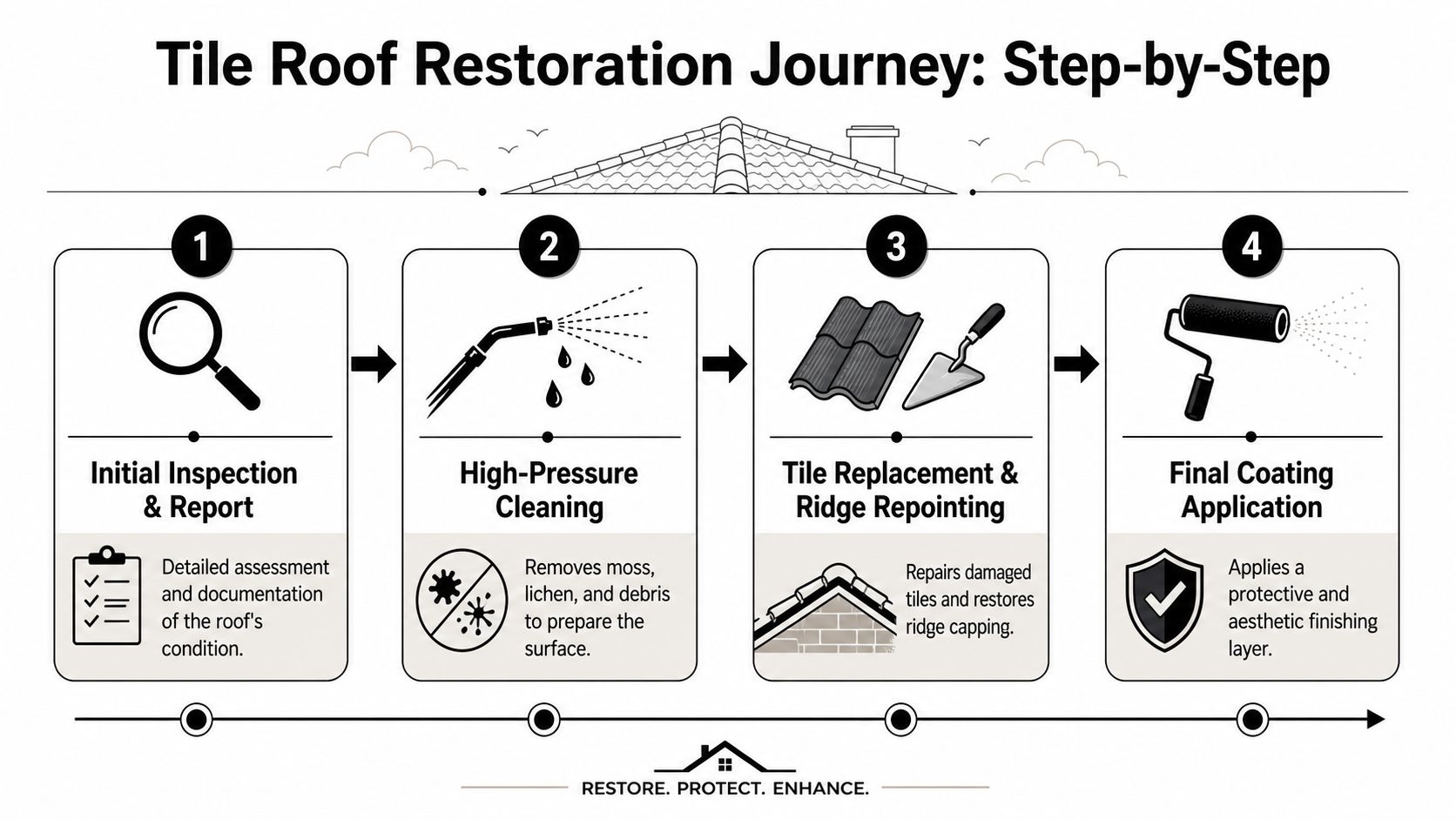
Commercial tile roof restoration follows a sequence for a reason. If crews coat first and investigate later, they can trap problems under a fresh-looking surface. The better model is staged, like airport works done without shutting the whole terminal. One zone is assessed, prepared, repaired, and finished while the rest of the site stays managed.
What the first inspection should uncover
The first phase is the inspection and report. On a commercial building, that should go beyond “tiles look old” and identify likely water entry points, damaged ridge sections, failed pointing, flashing defects, unsafe access points, and any areas that may need more invasive repair.
Then comes cleaning. In the AU region, tile roof restoration requires high-pressure water blasting to remove moss, lichen, and mould before applying a protective coating that acts as a UV barrier. That same process helps seal micro-cracks that can allow water ingress under Sydney conditions, as explained in Roof Restoration Sydney's outline of what's involved in a tile roof restoration.
Cleaning matters because coatings only adhere properly when the roof surface is prepared. On a commercial roof, dirt and biological growth can hide small cracks and stop crews from seeing whether the ridge and valleys are failing.
How the work is sequenced on active sites
After cleaning, crews move into repairs. That usually means replacing cracked or displaced tiles, resetting unstable sections, and carrying out ridge rebedding or repointing where needed. On larger sites, contractors often split this work by roof zone so access equipment, deliveries, and tenant movements can still be coordinated underneath.
A typical sequence looks like this:
- Inspect and document: mark leak paths, access issues, and visible defects.
- Clean the roof surface: remove growth, debris, and residue that hide faults.
- Repair the roof system: replace damaged tiles and correct ridge-related failures.
- Apply the final coating: add the protective finish after repairs are complete and the roof is ready.
The video below shows the kind of staged work involved in tile roof restoration.
On active commercial properties, the timeline depends on roof size, access, weather, and the amount of defect rectification needed. That's why the inspection report matters so much. It gives building managers something they can schedule around deliveries, school hours, tenant access, or strata notifications.
Cost drivers and budgeting for commercial restoration
Commercial restoration quotes can look close on page and end up far apart in practice. The reason is simple. One quote may cover cleaning and coating, while another includes ridge rectification, tile replacement, access equipment, and the compliance defects that cause many leaks in Sydney commercial buildings.
That gap matters on industrial and strata sites. A warehouse with wide clear spans may need lift access and traffic control around loading areas. A strata complex may need staged work, resident notices, and extra ridge repairs where earlier work does not meet current installation expectations. The coating is the visible part of the job. The hidden cost often sits in the details at ridges, hips, valleys, and penetrations.
For 2026, the average cost for tile roof restoration in Australia ranges from $4,500 to $10,000, with concrete tile restoration typically costing $4,500 to $8,500 and terracotta tile restoration ranging from $6,000 to $10,000, based on Aussie Roof Revival's 2026 roof restoration cost guide. That same source states that a full tile roof restoration is roughly $25 to $65/m², while paint-only work on a structurally sound roof is about $20 to $40/m².
For NSW, the pricing band tends to sit higher. The same source notes an average range of $4,500 to $11,000 in 2025 for tile roof restoration in NSW, including Sydney.
Where the money usually goes
A useful way to budget is to split the project into parts, the same way a facility manager separates base building costs from tenant-specific works. That helps you see whether a low quote is genuinely low, or whether it just leaves out the items most likely to fail later.
Common cost components include:
- High-pressure cleaning: $400 to $1,200
- Roof repointing: $1,200 to $3,000
- Tile replacement: $150 to $600 per quantity
- Painting: $2,000 to $4,500
Repair rates also tend to be higher for tiled roofs than for simpler roof types because each tile can shift, crack, or need individual handling, and ridge lines often need more careful rectification.
Three factors usually push budgets upward:
- Tile type: Terracotta often costs more to restore than concrete because replacement tiles can cost more and handling needs more care.
- Roof form and access: Multi-level strata buildings, schools, and warehouses with operating yards usually need more planning, more labour hours, and in some cases special access equipment.
- Defect depth: A roof with failed ridge pointing, flashing defects, and unstable capping will cost more than one that only needs cleaning and isolated tile swaps.
There is another cost driver that gets missed early and shows up late. Compliance rectification. On many Sydney commercial projects, the expensive part is not the cracked tile everyone can see from the car park. It is the non-compliant ridge flashing or ridge detail that has to be taken back and rebuilt correctly. If you need background on why those details affect both pricing and leak risk, see these Australian roofing standards and compliance considerations.
Budget for defect rectification and compliance-related repairs, not just surface finish. On commercial tile roofs, the waterproofing detail is often what protects the asset, not the final coat.
Average tile roof restoration costs in NSW
| Restoration Component | Cost Range (AUD) |
|---|---|
| Full tile roof restoration in Australia | $4,500 to $10,000 |
| Concrete tile restoration | $4,500 to $8,500 |
| Terracotta tile restoration | $6,000 to $10,000 |
| NSW tile roof restoration range | $4,500 to $11,000 |
| Full restoration rate | $25 to $65/m² |
| Paint-only work on sound roofs | $20 to $40/m² |
| High-pressure cleaning | $400 to $1,200 |
| Roof repointing | $1,200 to $3,000 |
| Tile replacement | $150 to $600 per quantity |
| Painting | $2,000 to $4,500 |
For budgeting, strata managers and facilities teams should ask for separate pricing for access, ridge work, tile replacement, coatings, and compliance-related rectification. That makes quote comparisons clearer. It also reduces the chance of approving a cheaper proposal that excludes the ridge and flashing defects most likely to cause the next leak.
Compliance and safety requirements for commercial tile roof restoration
Commercial tile roof restoration in NSW isn't just maintenance. It intersects with wind loading rules, installation standards, working-at-heights controls, and in some cases hazardous material procedures. The leak may seem minor, but if the underlying detail is non-compliant, a cosmetic repair won't fix the risk.
Why ridge flashing defects matter so much
One of the most overlooked issues is ridge flashing failure. As noted earlier, 78% of commercial tile leaks in Sydney stem from non-compliant ridge flashing rather than broken tiles, according to Commercial Roofers' roofing standards article for Australian compliance context.
That matters because many people judge a roof from ground level. They see a few stained tiles and assume a few replacements will solve it. On commercial properties, the more serious problem may be hidden where ridge lines, bedding, pointing, and flashing interfaces have been installed incorrectly or deteriorated over time.
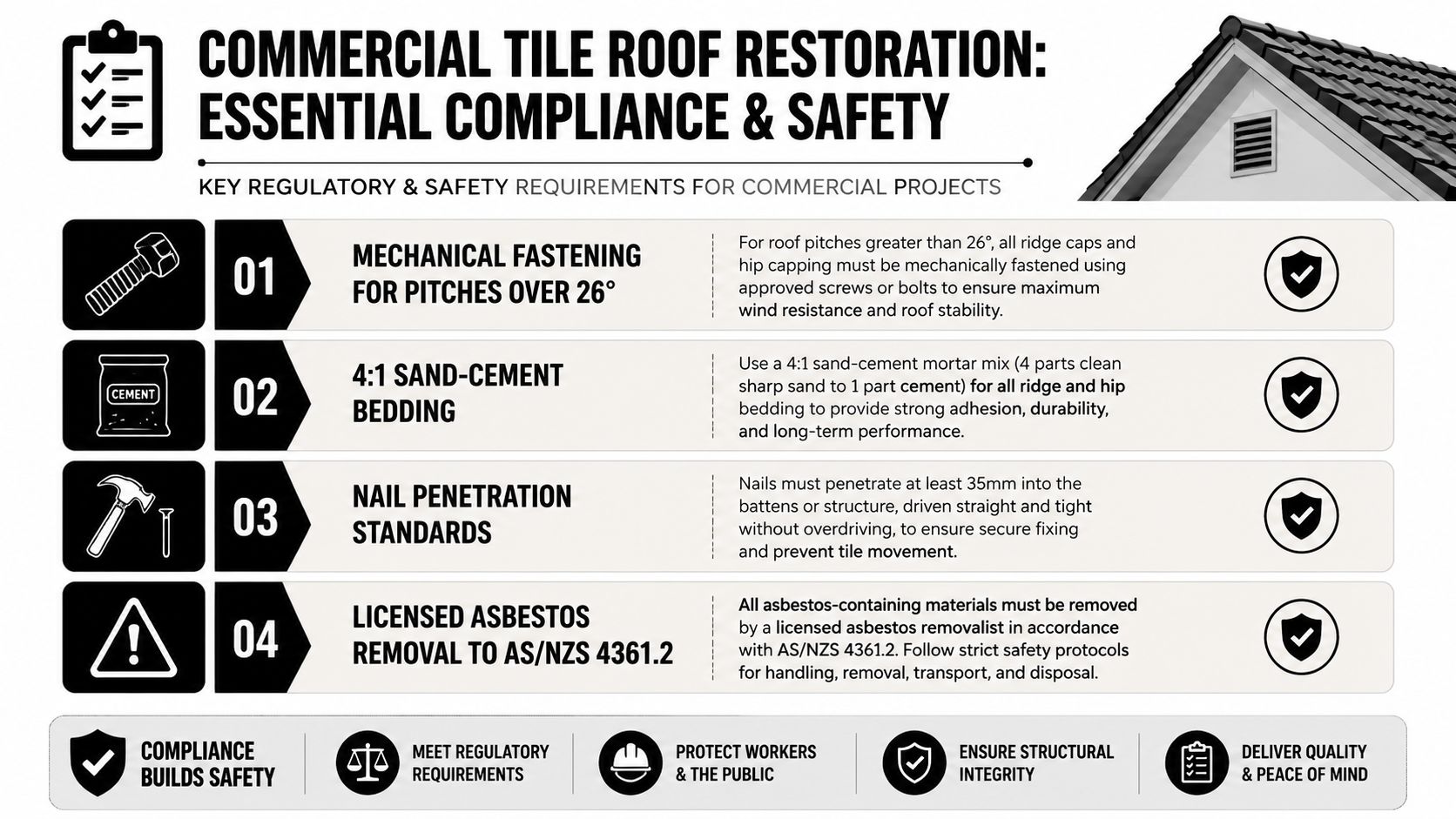
There's also a fastening issue that owners often miss. In NSW wind zones and on roof pitches above 35°, restoration must include mechanical fastening of every tile to meet structural wind loading requirements. The same manual notes that NSW Contour tiles require mechanical fixation for every tile at pitches greater than 26°, as set out in the Midland Brick roof tile manual used for NSW structural guidance.
This is not optional. Flexible pointing alone doesn't provide the tensile resistance required in high-wind conditions.
A practical compliance checklist
Before approving a commercial restoration scope, building managers should ask for a checklist that covers:
- Roof pitch review: confirm whether the roof pitch triggers mechanical fastening requirements.
- Tile fixation review: check whether every tile needs mechanical fastening under the applicable conditions.
- Ridge condition assessment: identify failed bedding, failed pointing, and non-compliant flashing details.
- Work-at-heights planning: confirm safe access, edge protection, and site controls for occupied premises.
- Coating and waste handling: verify that materials and disposal methods match the site's safety requirements.
- Documentation: request an inspection report with marked defect areas rather than a simple paint proposal.
For strata and industrial sites, this checklist becomes part of risk management. It gives owners a way to test whether the proposed contractor has diagnosed the roof properly or just priced a surface refresh.
Decision guide for restoration vs replacement
A good commercial roof decision starts with one question: are you fixing defects in an otherwise serviceable system, or are you trying to save a roof that no longer meets performance and compliance expectations?
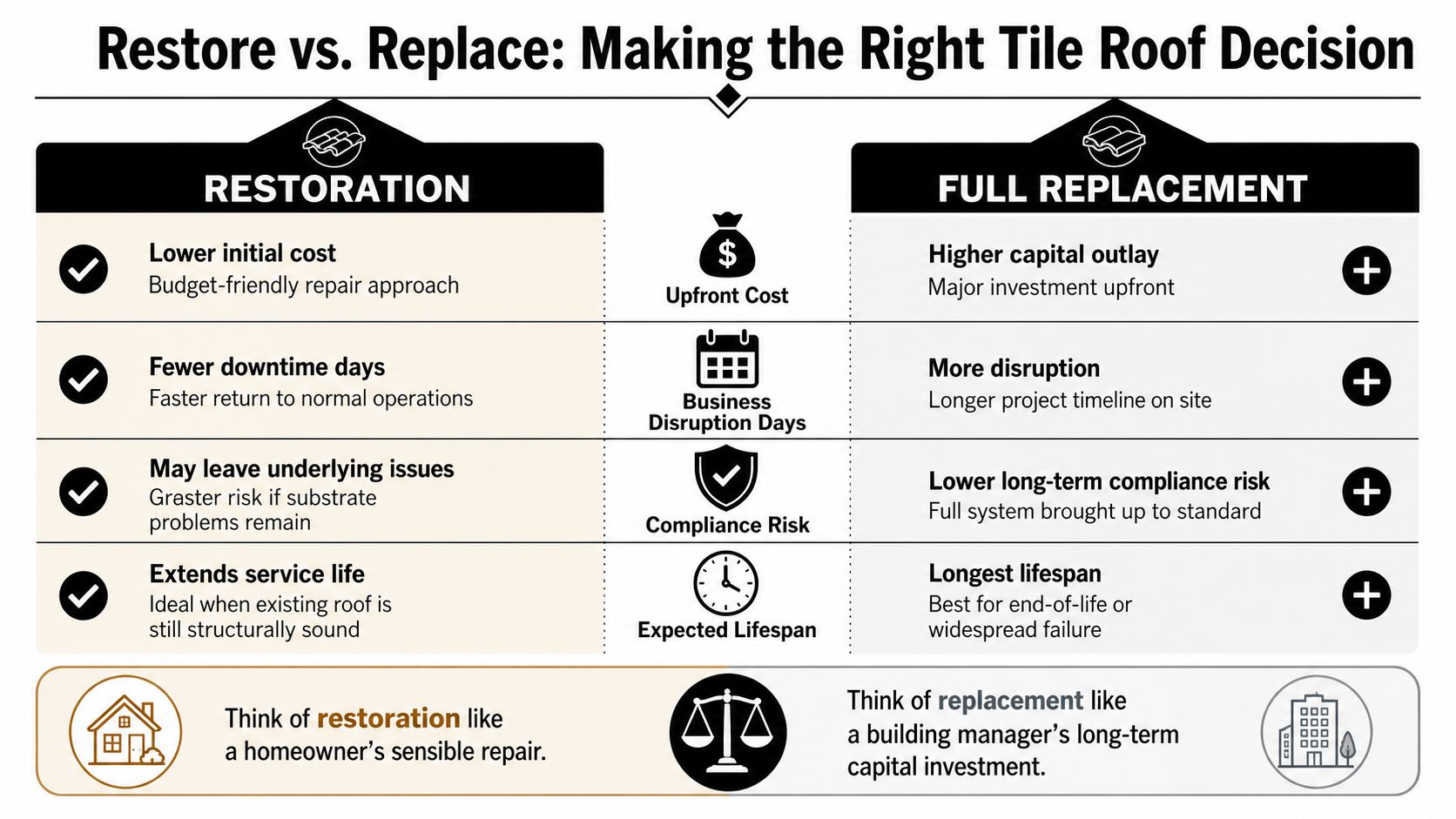
For strata blocks and industrial sites in Sydney, that distinction often turns on overlooked compliance failures rather than tile age alone. A roof can look repairable from ground level but still fail at ridge lines, flashing junctions, or tile restraint details. Those hidden faults are often what keep leaks returning after a low-scope restoration.
When restoration usually makes sense
Restoration works best when the roof is still doing its main job and the defects are concentrated in repairable areas. A useful analogy is servicing a commercial delivery vehicle. If the chassis is sound and the faults sit in worn components, you repair the parts causing trouble rather than replacing the whole asset.
That approach usually suits sites where:
- The roof structure is sound: the rafters, battens, and substrate do not show broad failure.
- Defects are identifiable and contained: cracked tiles, failed ridge bedding, aged pointing, or isolated flashing problems can be rectified methodically.
- Leaks follow a pattern: repeated entry at ridge caps, penetrations, or junctions often points to a correctable defect path.
- Operations need to continue: staged restoration can reduce disruption for occupied warehouses, schools, and strata complexes.
A common example is a strata building with recurring top-floor leaks near the ridge after heavy rain. If inspection shows the field tiles are largely intact and the main issue is non-compliant ridge flashing with localised ridge deterioration, restoration may still be the sensible option. The key is that the scope must fix the cause, not just coat the surface.
When replacement is the safer path
Replacement becomes the better choice when the roof has multiple failure layers at once. In practice, that means the visible leak is only the symptom. Under it, you may find widespread broken tiles, failing battens, substrate deterioration, repeated patch repairs, and compliance gaps large enough that rectification starts to resemble rebuilding.
This is common on older commercial roofs that have been repaired in fragments over many years. One contractor replaces a few tiles. Another repoints ridges. A third applies coating. The result can be a roof that looks refreshed but still has weak junctions and inconsistent fixing methods across the system.
Replacement is often the safer path when:
- Structural or substrate defects are widespread: restoration would leave major risk in place.
- Tile damage is broad across the roof field: sourcing matching tiles and carrying out repeated repairs becomes inefficient.
- Compliance upgrades change the whole scope: steep pitch, wind exposure, or fixing requirements can turn partial repair into a full-system problem.
- Leak sources are numerous and shifting: if water entry is appearing across multiple zones, defect tracing becomes less reliable.
Mechanical fixation is often the dividing line. If the roof needs extensive re-fixing to meet current performance expectations, the labour and access costs can move the project closer to replacement territory. For building managers comparing those broader works, this guide to commercial roof tile replacement options is a useful reference point.
A practical way to decide
For commercial properties, the decision is less about age and more about recoverability. Ask whether a restoration scope can return the roof to reliable service with clear defect rectification and a manageable compliance risk. If yes, restoration can protect the asset at lower cost and with less disruption. If no, replacement usually gives the owner a clearer long-term outcome.
The biggest mistake is choosing restoration because it sounds cheaper before the diagnosis is complete. On Sydney industrial and strata roofs, that is exactly how non-compliant ridge flashing and related junction defects stay in service long enough to keep causing leaks.
Maintenance warranties and choosing a contractor
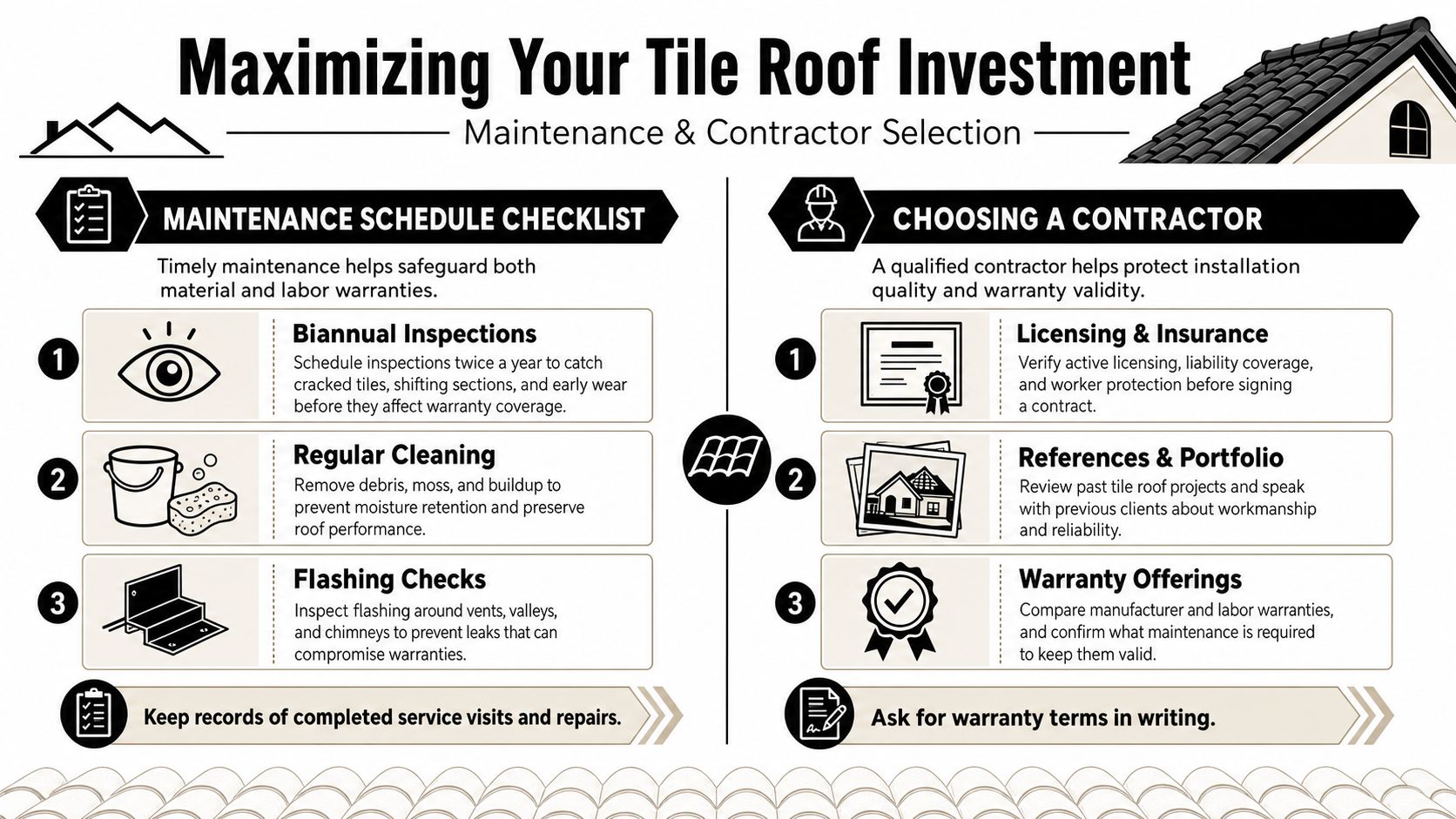
A restored tile roof won't stay reliable if the building owner treats it as a one-off job. Warranties usually depend on ongoing care, site access discipline, and timely attention to small defects before they spread.
How to protect warranties after the work
For commercial roofs, a simple maintenance routine is usually more valuable than waiting for another major leak event.
A practical checklist looks like this:
- Biannual inspections: review ridge lines, tiles, flashings, and known leak-prone zones.
- Regular cleaning: remove debris and biological growth so water can drain properly and defects stay visible.
- Flashing checks: inspect junctions and ridge areas where movement and weathering often appear first.
- Prompt minor repairs: small defects tend to be cheaper and less disruptive when addressed early.
- Maintenance records: keep photos, reports, and invoices so warranty and insurance discussions stay clear.
How to vet commercial roofing contractors
The contractor choice matters as much as the product choice. On a commercial tile roof, you need a team that understands active worksites, compliance, and defect diagnosis.
Ask potential contractors about:
- Licensing and insurance: commercial roof work needs current, appropriate cover and credentials.
- Relevant project history: look for experience with warehouses, strata blocks, and industrial tile roofs.
- Inspection quality: ask whether they provide marked reports that separate leak causes from cosmetic issues.
- Work delivery model: in-house crews can simplify coordination and accountability. Commercial Roofers is one example of a Sydney contractor that states it uses in-house crews for commercial roofing work.
- Quote transparency: the scope should distinguish cleaning, tile replacement, ridge work, coatings, and compliance rectification.
- Warranty terms: confirm what's covered, what maintenance is required, and what exclusions apply.
Good contractor selection starts with one question: “Show me the defects you're fixing, not just the finish you're applying.”
Commercial case studies and FAQs
Two commercial examples
A strata complex in western Sydney had recurring top-floor leaks after storms. The committee first assumed they needed a full new roof because several ridge sections looked weathered from the ground. A closer inspection found the key issue in ridge-related defects and localised tile failures, not wholesale roof collapse. The owners approved restoration works with corrective ridge detailing and targeted tile replacement, which avoided a much larger capital project and reduced disruption for residents.
A logistics warehouse faced intermittent leaks above a dispatch area. Management initially planned reactive patching around the visible drips. The smarter move was to inspect before peak weather and trace the entry path across the roof line. Once the roof defects were identified and restored in stages, the operator could schedule work around site activity instead of reacting during a shutdown-risk event.
FAQs
How should strata managers handle multi-building roof contracts?
Separate the inspection findings by building or roof zone. That helps prioritise urgent defects and avoids paying for blanket works where only certain sections need restoration.
Can insurers be involved before the scope is finalised?
Yes. Owners often benefit from documenting active leaks, visible defects, and prior repair history before final scopes are approved.
Do roof warranties matter when lots in a strata scheme change hands?
They can. The practical step is to keep all reports, invoices, maintenance records, and warranty terms with the building records so future committees or owners can verify what was done.
When is the best time to schedule tile roof restoration?
Plan work for periods that give contractors safe access and enough weather stability to complete cleaning, repairs, and coatings properly. On busy commercial sites, the best timing is also the period that least disrupts operations.
If you're assessing leaks, ageing ridge work, or compliance concerns on a warehouse, strata complex, or industrial property, Commercial Roofers provides commercial roofing inspections, tile roof repair, restoration, and replacement services across NSW. A documented site assessment can help you decide whether restoration is enough or whether a larger replacement scope is justified.