
A facilities manager approves what looks like a straightforward gutter replacement on a warehouse. By the time the scope is checked properly, the job also needs high-level access, custom box gutters, extra downpipes, overflow provisions, and a licensed contractor to manage asbestos risks near the eaves. The budget changes fast.
Commercial rain gutters price out very differently from residential work because the hidden costs sit outside the simple per metre figure. On a house, the main variables are usually material and length. On a warehouse, strata block, school, or industrial site, the actual cost often comes from access, roof geometry, shutdown constraints, stormwater capacity, and compliance requirements.
That is why cheap headline rates can mislead owners.
Australian guidance from the NSW Government asbestos business guide makes the risk clear. If asbestos-containing material is present or suspected around soffits, eaves, or adjacent building elements, the guttering scope can no longer be treated as a simple remove-and-replace job. Inspection, containment, licensed handling, and disposal can become part of the price before new metal even goes up.
Commercial pricing also changes when the design itself changes. Many larger buildings use box gutters, sumps, and oversized downpipes that must be sized and detailed correctly to control overflow and protect the building envelope. If those elements are undersized, poorly supported, or replaced like-for-like without checking hydraulic performance, the owner can end up paying twice. First for the install, then again for internal water damage, ceiling repairs, stock loss, or tenant disruption.
Use early pricing as a budget marker only. The contract value usually depends on what the site inspection uncovers, what the drainage design requires, and what safety controls the contractor must carry to complete the work legally and without avoidable risk.
Table of Contents
- Introduction to Commercial Rain Gutter Pricing
- Deconstructing Your Guttering Quote What Are You Paying For
- Commercial Gutter Materials Compared Price vs Performance
- Key Factors That Drive Your Final Guttering Price
- Sample Commercial Guttering Estimates For 2026
- Budgeting For Maintenance and Lifecycle Costs
- How to Get an Accurate and Reliable Guttering Quote
Introduction to Commercial Rain Gutter Pricing
A facilities manager approves what looks like a simple gutter replacement on a warehouse. Once the crew gets on the roof, the job changes. The box gutter falls short of current overflow requirements, access needs a raised work platform, and the soffit linings near the eaves raise asbestos concerns. The metre rate was never the actual price.
That is the main problem with commercial rain gutters price. Owners often start with a linear-metre allowance, but commercial guttering is tied to roof drainage design, safe access, weatherproofing details, and the condition of the structure supporting the new work. On larger industrial buildings, the gutter itself can be one of the cheaper parts of the job.
A commercial gutter replacement also shifts in scope very quickly when the existing system has been underperforming. If the building has ponding in box gutters, poor overflow provision, corroded supports, failed outlets, or downpipes placed for convenience rather than hydraulic capacity, the work becomes corrective rather than like-for-like. That usually means design checks, custom fabrication, and more site time.
The number that matters first
A per-metre rate is still useful for early budgeting. It helps set expectations before drawings, access plans, and site inspections firm up the scope.
On a commercial site, though, that headline rate can move fast once the quote has to account for box gutters, roof height, crane or EWP access, traffic management, staged works around tenants, and any suspected asbestos in adjacent materials. On older factories and strata buildings, those are common cost drivers, not edge cases.
Practical rule: If the building has internal box gutters, multiple roof planes, restricted access, or any chance that asbestos is present in nearby elements, treat the metre rate as a rough allowance only.
Why commercial owners get caught out
Residential pricing guides miss the items that often decide the final number on a commercial project:
- Access and safety controls: Scaffold, EWPs, edge protection, exclusion zones, permits, and traffic control can add substantial cost before replacement starts.
- Operational constraints: Warehouses, schools, shopping strips, and strata sites often need staged works to keep entrances, loading areas, or tenancies open.
- Drainage compliance risk: A poor commercial gutter design can send overflow into stock areas, switchboards, ceilings, or wall cavities.
- Custom fabrication: Box gutters, oversized outlets, sumps, and non-standard flashings are often made to suit the building, not pulled off a shelf.
- Hazardous-material implications: If asbestos is suspected in eaves, soffits, backing boards, or adjacent roof elements, inspection and removal controls can affect both programme and price.
Cheap commercial gutter quotes usually fail in one of two places. They either leave out the hard parts, or they assume the existing system can be replaced like for like without checking whether it should be. Both mistakes cost more once the project is underway.
Deconstructing Your Guttering Quote What Are You Paying For
A commercial gutter quote can look tidy on page one and still miss the items that blow the budget on site. I see this most often on factories, shopping strips, and older warehouses where the gutter line is only part of the job. The actual cost sits in how the system is built, how the crew can reach it, and what gets uncovered during removal.
A quote you can trust usually breaks into three parts. Product, installation, and site-specific extras. If any one of those is vague, the number is only an allowance.
Product and fabrication
Material cost is only the starting point. Commercial pricing changes fast once the gutter is custom-made instead of standard-length roll formed sections.
External gutters on a simple roof edge are usually straightforward to price. Internal box gutters are not. They often need folded metal to suit exact dimensions, sumps sized to suit discharge points, overflow provisions, and matching flashings at penetrations and upstands. If the quote only says “replace guttering” and the building has box gutters, the scope is incomplete.
Check for these details in the product allowance:
| Quote component | What to check |
|---|---|
| Material type | The specified metal, coating, thickness, and whether it suits the building exposure |
| Gutter type | External eaves gutter, fascia gutter, valley gutter, or custom box gutter |
| Fabrication | Off-the-shelf sections or site-measured custom folded components |
| Drainage parts | Sumps, nozzles, outlets, spreaders, overflow measures, and downpipe connections |
| Finish items | Flashings, stop ends, brackets, sealants, fixings, and making good to adjacent roofing |
On commercial sites, the drainage components often decide whether the price is realistic. A long gutter run with undersized outlets is cheaper to install and more expensive to live with.
Installation labour
Labour in a commercial quote covers more than fitting metal. It includes measuring, set-out, safe removal, lifting, fixing, sealing, testing falls and discharge points, and dealing with the roof conditions you only see once the old gutter is off.
This is also where cheap quotes hide risk. A lump-sum labour figure with no assumptions attached usually means one of two things. The contractor has allowed for best-case access, or they have not allowed enough time for staging and rectification.
Labour usually rises when the crew has to work around:
- operating warehouses, schools, retail entries, or loading docks
- restricted hours, shutdown windows, or tenant access requirements
- long carry distances because crane access or roof-edge loading is limited
- high-set roofs that need EWPs, scaffold, or multiple setup points
- tie-ins to existing downpipes and stormwater points that are out of plumb, undersized, or blocked
If drainage performance is part of the issue, it also helps to review how the roof and outlets work together, not just the gutter profile. This commercial gutter and drainage guide gives the right context for that discussion.
Site-specific extras
This part causes the most disputes because it is where hidden conditions show up.
Access equipment is a clear example. Two buildings can have the same lineal metres of gutter and very different prices because one has open ground for an EWP and the other needs scaffold over awnings, services, or public walkways. On larger industrial buildings, travel time across the roof, material handling, and exclusion zones can add real labour and plant cost before installation starts.
Older sites carry another pricing risk. If asbestos is present or suspected in soffits, backing boards, wall cladding, or adjacent roof materials, the gutter job stops being a straight replacement. Inspection, sampling, licensed removal, controlled disposal, and revised sequencing can all sit outside the base gutter rate. If asbestos is even a possibility, the quote should state what has been assumed and what will trigger a variation.
You should also expect site extras for:
- scaffold, EWPs, edge protection, and traffic control
- waste removal and disposal
- temporary weather protection where gutter removal exposes the building
- minor rectification to fascias, sheet ends, supports, and flashings uncovered during demolition
- after-hours work where the site cannot be shut down during normal trading or production
The best quotes make these assumptions visible. That protects both sides. You can see what you are paying for, and the contractor is less likely to chase variations for conditions that should have been discussed before the order was signed.
Commercial Gutter Materials Compared Price vs Performance
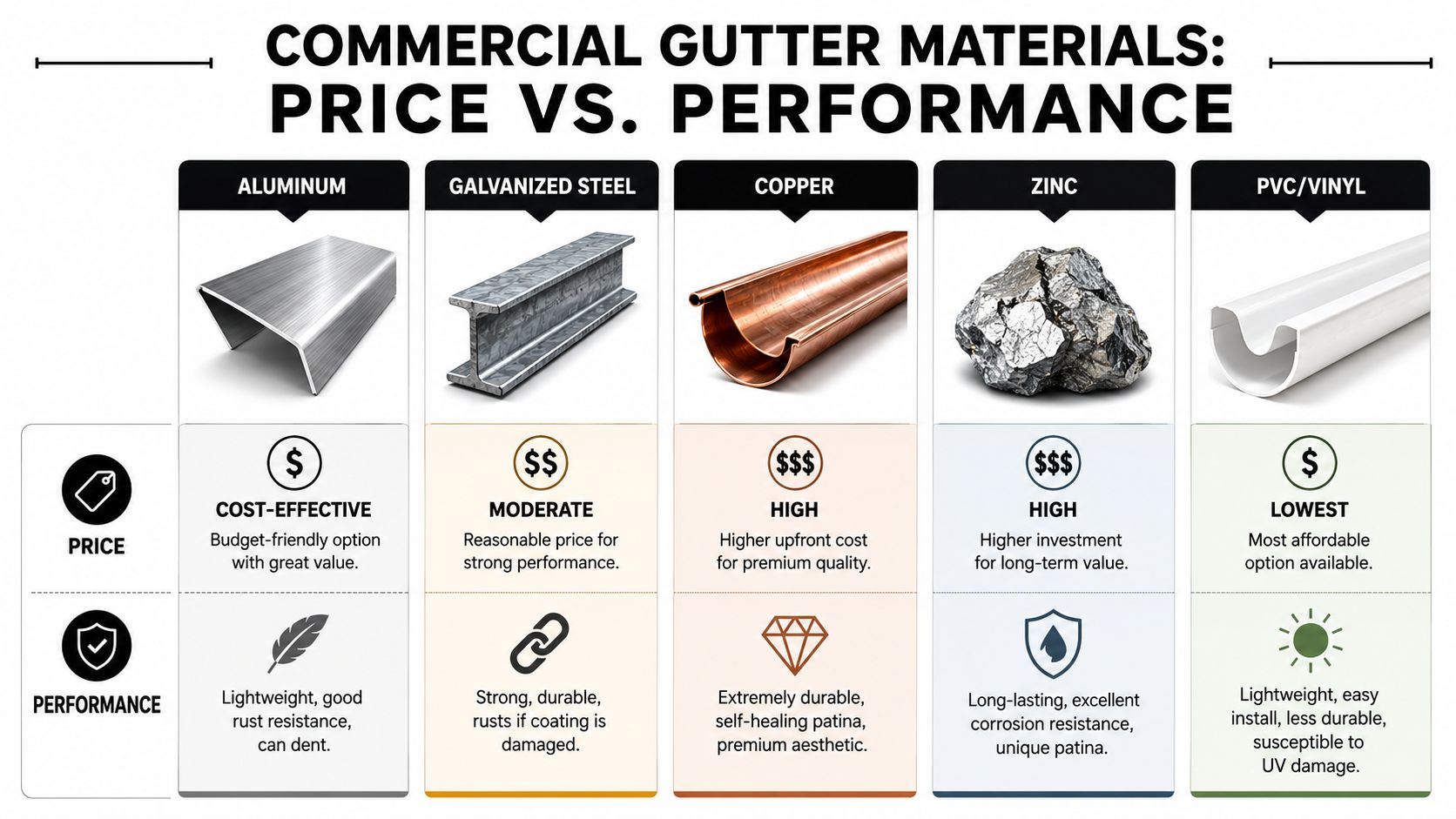
Material selection sets the maintenance burden long before the first overflow call. On a commercial building, the cheapest line item often becomes the most expensive decision once corrosion, joint failure, cleaning access, or non-compliant discharge starts affecting operations.
Where the material decision starts
Commercial pricing is not just a metal comparison. Profile, support spacing, jointing method, finish, exposure category, and whether the job uses external gutters or internal box gutters all impact the final cost. A low metre rate can disappear quickly if the building needs custom sump outlets, oversized gutters, overflow provisions, or thicker material to suit long runs.
Here is the practical view.
| Material | Price position | What it does well | Where it can fall short | Best fit |
|---|---|---|---|---|
| Zincalume | Lower-cost | Common on industrial buildings, easy to specify, usually economical for straightforward replacements | Shorter service life in aggressive environments, less forgiving if drainage design is poor | Warehouses, factories, simple commercial sheds |
| Colorbond | Mid-range | Better presentation, broad colour range, suitable where appearance matters | Finish choice does not fix undersized gutters or poor outlet placement | Offices, strata, schools, retail buildings |
| Stainless steel | Premium | Handles corrosion well, stands up better in coastal or contaminated air | Higher supply and fabrication cost, over-spec on mild sites | Coastal assets, food processing, chemical or high-exposure sites |
| Copper | Premium to very high | Long service life, strong architectural finish | High upfront cost, theft risk on some sites, rarely justified for standard industrial stock | Premium architectural and heritage projects |
| Aluminium | Project-specific | Lightweight, corrosion resistant, useful where weight matters | Can deform more easily, not always the best choice for heavy-duty industrial abuse | Light commercial buildings and selected facade applications |
Material should match the building risk, not the brochure.
Box gutters deserve separate attention because residential price guides barely touch them. On commercial roofs, a box gutter can trigger custom fabrication, internal overflow rules, more complex waterproofing interfaces, and stricter consequences if it fails. An external eaves gutter that leaks is a nuisance. A failed box gutter can dump water into insulation, stock, plant, ceilings, and electrical services.
For clients comparing layouts as well as materials, this guide to commercial gutter and drainage systems helps frame the bigger drainage picture.
Choosing for building type, not product marketing
Zincalume often suits large industrial stock because it keeps replacement practical and predictable. If the site is inland, runoff is not especially corrosive, and the building has simple geometry, it is usually the right starting point. The mistake is treating that as a universal answer. Near the coast, near exhaust discharge, or on buildings with persistent ponding and debris, a cheaper metal can shorten the replacement cycle.
Colorbond is commonly selected where presentation matters to owners, tenants, or strata committees. That can be a sound decision, but only if the specification also deals with capacity, falls, overflow, and compatible flashings. A better-looking gutter still fails if the hydraulic design is wrong.
Later in the project, it helps to see installation details in context:
Stainless steel earns its keep on the right building. I recommend clients consider it where replacement access is difficult, shutdowns are expensive, or the site atmosphere is harsh enough to punish standard coated steel. The upfront spend is higher, but repeat access costs on a tall warehouse or live industrial site can wipe out any saving from a cheaper gutter system.
Copper sits in a narrower lane. It works on heritage and premium architectural projects, but it is rarely the best use of budget on mainstream commercial property. On many buildings, money is better spent on correct sizing, compliant overflows, safe cleaning access, and details that reduce leak risk at joints and outlets.
Key Factors That Drive Your Final Guttering Price
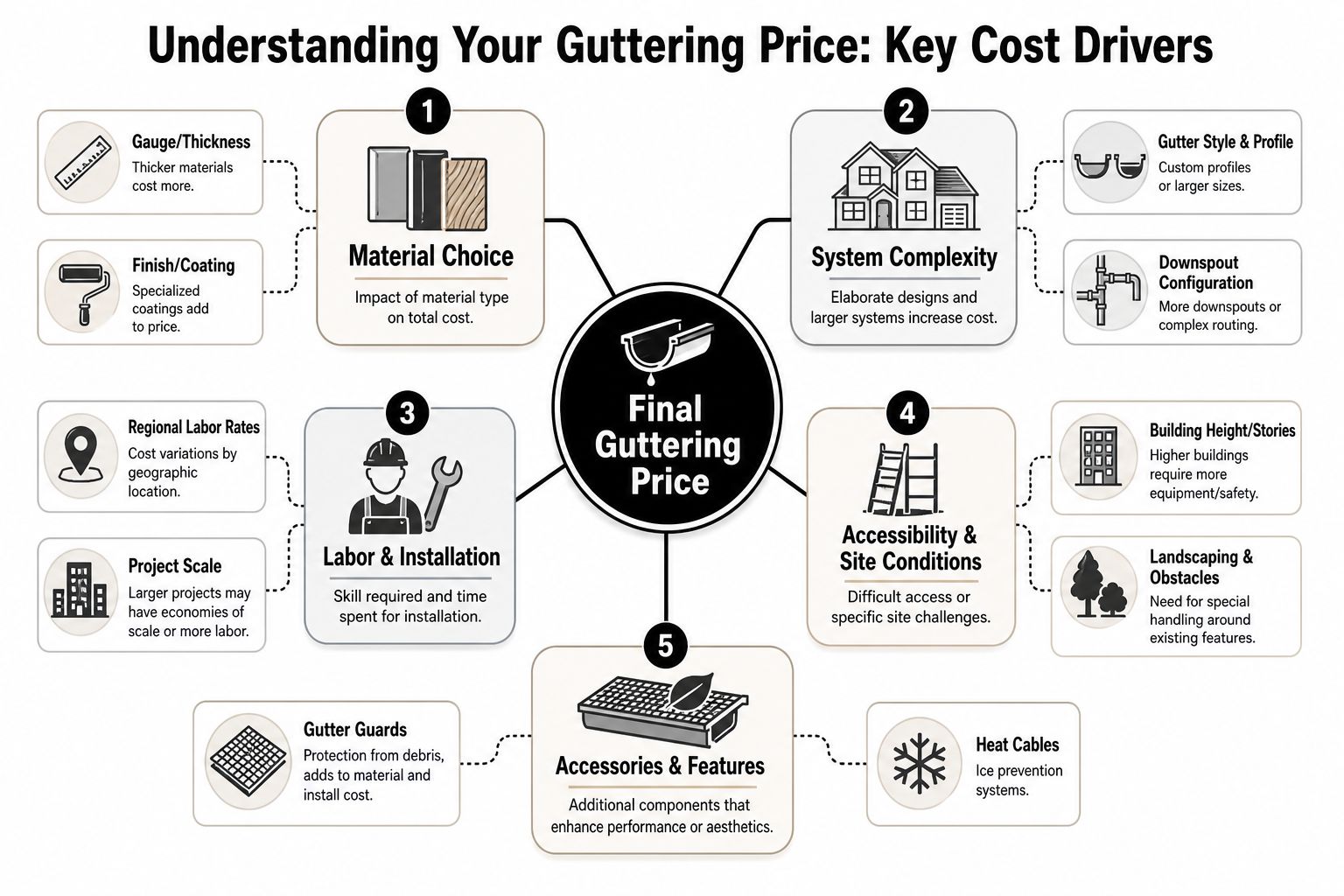
The final rain gutters price usually jumps because of the building, not because the contractor changed their mind. Commercial jobs carry cost drivers that a house guide won't capture.
Access and building geometry
A single-storey warehouse with clear perimeter access is one thing. A taller site with awnings, adjoining tenancies, live traffic areas, plant, or brittle roof sections is another. Every access obstacle slows handling, increases safety controls and can force different equipment.
The biggest practical drivers are usually:
- Building height: Higher edges often require stronger access systems and stricter exclusion zones.
- Roof pitch and geometry: Valleys, offsets, parapets and awkward corners extend labour time.
- Site congestion: Parked vehicles, loading docks, fences and landscaping make material movement harder.
- Working hours: Some strata and retail sites only allow noisy works in narrow windows.
These aren't overheads a contractor invents. They are the actual conditions the crew has to work through to deliver the replacement safely.
Commercial issues residential guides miss
The most overlooked pricing factor on commercial sites is the box gutter. Residential guides often cite standard gutter ranges, but they don't reflect what happens when a commercial building needs custom box gutter fabrication, structural reinforcement and waterproofing integration.
For NSW commercial properties, box gutter retrofits can increase project costs by 30 to 50 per cent over standard installations because they often involve custom welding, fascia reinforcement and compliance with AS 4654.2, according to commercial box gutter retrofit guidance for NSW.
That matters because many older warehouses and industrial buildings don't need a cosmetic replacement. They need a corrective upgrade.
Other hidden drivers include:
Old gutter removal
Removing corroded sections is simple only when the surrounding roof edge is sound. Once the existing gutter comes off, crews may find rusted fascias, failed fixings or poorly detailed outlets that need rectification.Asbestos proximity
On older industrial sites, guttering work can sit next to asbestos roofs, wall sheeting or associated materials. Even if the gutter itself isn't asbestos, nearby disturbance changes the method, the controls and the disposal pathway. That affects programme and cost.Drainage compliance
Overflow paths, sump capacity, outlet sizing and discharge points have to suit the building. If the old installation was undersized or poorly arranged, replacement often becomes redesign.
A low quote that ignores asbestos adjacency or assumes standard external gutters on a box gutter building isn't competitive. It's incomplete.
For commercial owners, the safest budgeting approach is to ask the contractor what assumptions sit behind the price. If they haven't inspected access, roof edge condition and discharge arrangement, the number is only provisional.
Sample Commercial Guttering Estimates For 2026
A client with a large factory roof might ask for a simple rate per metre. On commercial work, that number rarely holds once the site walk starts. Height, traffic management, discharge points, tenant operations, fabrication, and compliance checks can shift a gutter package from routine replacement to a roof edge upgrade.
The examples below are budgeting scenarios, not tender rates. Use them to set an allowance, then confirm the actual scope with a site inspection and a measured quote.
Estimate one single-storey warehouse replacement
A single-storey warehouse with standard external guttering is usually the closest thing to a predictable commercial job. If access is clear around the perimeter, the roof edge is in fair condition, and the contractor can work without disrupting loading zones, the price often tracks with gutter length and material choice.
For a 100-metre warehouse replacement in Zincalume, a practical quote should break out the cost of:
- Gutter supply and installation
- Removal and disposal of existing sections
- Stop ends, outlets, and connection points
- Local repairs to fascia or support brackets
- Site access equipment and safety controls
If those items are bundled into one line, it is hard to see where the risk sits. On industrial buildings, hidden cost usually appears at the outlets and fixings, not in the straight runs.
Estimate two-storey strata building with new downpipes
A 150-metre replacement on a two-storey strata building usually costs more per metre than a warehouse, even before premium materials enter the picture. The reason is site control. Crews may need scaffold, raised work platforms, protection over entries, staged access around residents, and stricter work hours.
Adding new downpipes changes the value of the job because the contractor is no longer replacing one roof edge element. They are modifying how water leaves the building. That can involve extra bends, offsets around balconies, wall penetrations, spreaders, or making good where old fixings come out.
This type of quote should identify:
- Number and size of replacement downpipes
- Access method for each elevation
- Any traffic or pedestrian management
- Allowance for making good to painted or rendered surfaces
I usually tell clients to compare these projects by method, not just by metres. A cheaper quote can become expensive fast if it leaves out scaffold, resident protection, or wall repairs.
Estimate three stainless steel box gutter on a coastal site
A 50-metre stainless steel box gutter replacement on a coastal commercial building sits in a different pricing category. Shorter length does not mean a smaller contract. Box gutters are often custom-fabricated, tied into the roof system, and checked more closely for falls, overflow provision, and waterproofing compatibility.
On older industrial buildings, this is also where residential price guides stop being useful. A box gutter job may involve opening up roof sheeting, correcting poor sump layout, replacing sections of substrate, or changing details to suit current compliance expectations. If asbestos-containing materials are present nearby, the work method can change again, along with isolation, disposal, and programme.
The main cost drivers are usually:
- Custom fabrication and material grade
- Complexity at sumps, outlets, and overflow points
- Access to internal gutter lines or high roof zones
- Corrosion risk from coastal exposure
- Associated roof edge or membrane rectification
A short stainless box gutter run can outprice a much longer external gutter replacement because the labour, set-out, and risk are higher.
For owners building a budget, the smart approach is to pair these examples with a broader commercial roof maintenance cost plan. That helps you separate routine replacement from jobs that also carry access, compliance, and remedial roof work.
Budgeting For Maintenance and Lifecycle Costs
The installation price matters, but the ownership cost matters more. A gutter system that's cheap to install and difficult to maintain can become the expensive option by year two or three.
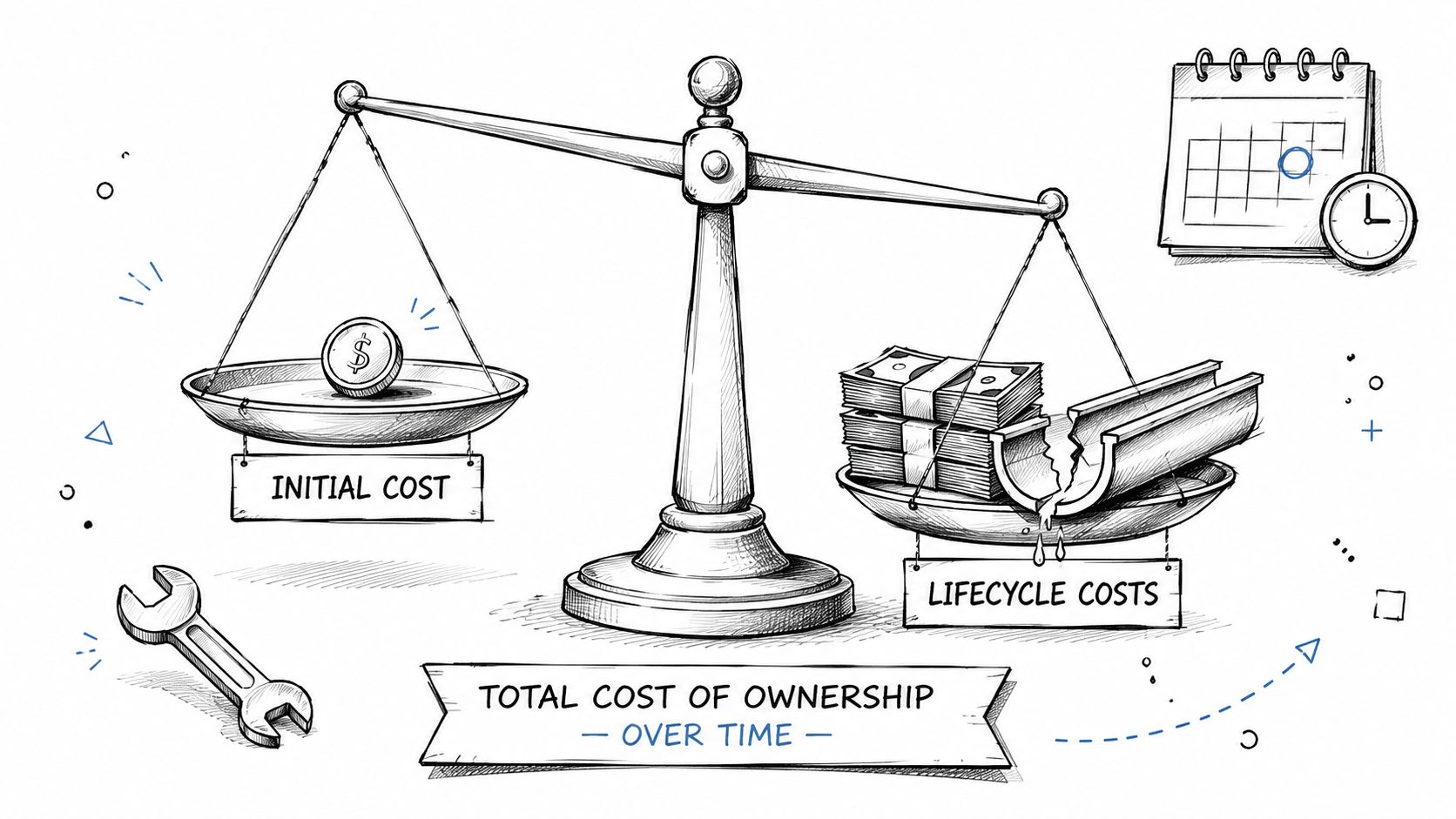
Cheap now can cost more later
Commercial owners usually pay for gutter failure in indirect ways before they pay for replacement again. Overflow stains facades. Water tracks into wall cavities. Stock gets wet. Ceiling tiles fail. Tenants complain. Internal maintenance teams keep patching the symptom instead of fixing the discharge path.
That's why the better budgeting question is: what will this system cost to keep serviceable?
A sensible maintenance plan usually includes:
- Scheduled inspections: Check outlets, joints, brackets and discharge points before small defects become ingress issues.
- Routine cleaning: Clear debris before ponding starts, especially on large roof catchments.
- Targeted repairs: Fix isolated failures early so the whole run doesn't need replacement sooner than expected.
For a broader planning view, it helps to review how guttering fits into total commercial roof maintenance cost planning, especially on older industrial and strata assets where several roof elements are ageing together.
Where gutter guards often disappoint owners
Gutter guards are often sold as a maintenance saver. On some sites they help with large debris, but the pricing story is not as simple as the sales pitch suggests.
Recent data shows that cleaning gutters with guards installed can cost $600 to $1,400 per session, which can be up to three times the standard rate, according to gutter guard cleaning cost analysis for 2025 to 2026.
That catches owners off guard because guards don't remove the need for cleaning. They can make access and debris removal more labour-intensive, especially on commercial sites with leaf drop, fine debris or long runs.
A better decision framework is this short checklist:
| Question | Why it matters |
|---|---|
| What debris does the site get? | Large leaves and fine sediment behave differently under guards |
| Can the guards be serviced easily? | If removal and reinstatement are awkward, maintenance cost rises |
| Who will clean them later? | The install decision should reflect the actual servicing method |
| Is the roof already difficult to access? | Guards can compound labour on a hard-access site |
Guards can reduce some blockages. They don't eliminate maintenance, and on the wrong building they make that maintenance more expensive.
For commercial assets, lifecycle value usually comes from a well-sized, accessible, inspectable system. Not from adding accessories that look good in a proposal but complicate service work later.
How to Get an Accurate and Reliable Guttering Quote
A reliable quote starts with good site information. If you give a contractor rough dimensions and one street photo, you'll get a rough number back. That's fine for a budget placeholder, but it's not enough for approval, procurement or contractor comparison.
What to give the contractor upfront
Send the practical details first. That saves time and reduces qualification clauses in the quote.
Provide:
- Building photos: Include roof edge, downpipes, access points and any visible corrosion or overflow staining.
- Plans if available: Roof plans, reflected plans or marked-up sketches help identify lengths and outlet locations.
- Access notes: Mention height, nearby awnings, loading docks, tenancy constraints and site operating hours.
- Known risks: Flag asbestos history, prior leak areas, or any recent stormwater issues.
If you're still at concept stage, this overview of how new gutters are installed on commercial buildings helps you ask better scope questions before the inspection.
What a proper quote must include
A complete quote should spell out what is included, what is assumed and what will trigger a variation. If it doesn't, you can't compare it properly with another contractor's price.
Use this checklist:
Material specification
The quote should name the metal, profile and finish. “New gutters” is not enough.Scope of works
It should state whether the contractor is replacing gutters only, or also outlets, downpipes, sumps, flashings, fascias and fixings.Access method
You want to know whether the contractor has priced scaffold, EWPs, edge protection or any other site controls.Waste and disposal
Old material removal must be explicit. On older sites, ask how contaminated or asbestos-adjacent waste will be handled if discovered.Insurance and warranties
Request evidence of relevant cover and clear wording on workmanship and material warranties.Compliance approach
Ask direct questions about drainage performance, overflow detail and safety planning. If the answers are vague, the quote usually is too.
A quote that seems unusually cheap often excludes the exact items that create disputes later. Owners don't save money by buying an incomplete scope. They just delay the actual cost.
If you need a detailed, transparent assessment for a warehouse, strata block or industrial facility in Greater Sydney, Commercial Roofers can inspect the site, identify the hidden cost drivers early, and provide a clear guttering scope that reflects access, compliance, drainage performance and long-term maintenance.