

Think of your commercial roof as a series of large, tough panels. They do a brilliant job of shedding water across the main surfaces, but what about the joins? What happens where the roof meets a wall, a skylight, or a vent pipe? These intersections are the most vulnerable spots on any roof, and without the right protection, they're just an open invitation for water to get in.
This is where roof flashing comes in. It’s the unsung hero of any watertight roofing system.
Table of Contents
- What Is Roof Flashing and Why Does It Matter?
- Exposed vs. Concealed Flashing: What’s the Difference?
- Identifying Common Roof Flashing Types
- Choosing the Right Flashing Materials
- Why Professional Installation Is Non-Negotiable
- Your Roof Flashing Questions, Answered
What Is Roof Flashing and Why Does It Matter?
Put simply, flashing is a thin, custom-shaped layer of material—usually metal—that directs water away from critical joints and seams. It acts as a bridge, ensuring a continuous, waterproof seal between different building elements, like where a metal roof sheet abuts a brick parapet wall.
Without effective flashing, your roof is fundamentally incomplete. A tiny gap or a failed seal is all it takes for water to start seeping in, and from there, the problems only get bigger.
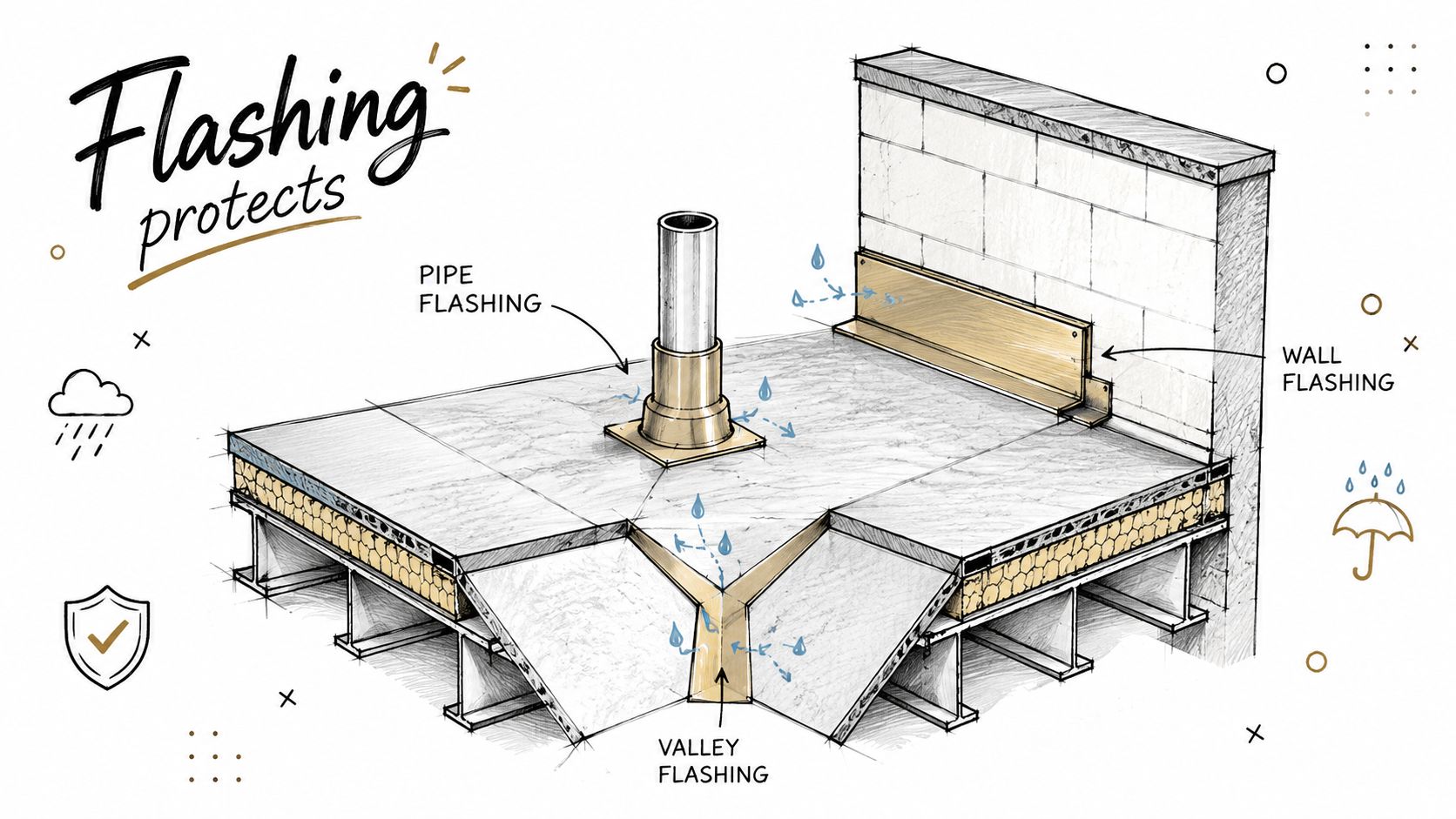
The Role of Flashing in Asset Protection
For anyone managing a commercial property, understanding flashing isn't just about roofing jargon; it's about protecting a major asset. Properly installed flashing is your primary defence against a whole host of expensive issues:
- Water Damage: It's the number one thing preventing water from ruining ceilings, insulation, internal walls, and valuable stock or equipment.
- Structural Decay: Flashing protects the hidden roof structure—the timber or steel battens and supports—from the rot and rust that leads to catastrophic failure.
- Mould and Health Hazards: By keeping the building cavity dry, flashing stops mould and mildew from ever getting a foothold, protecting the health of everyone inside.
In essence, flashing is what transforms a collection of individual roof panels and penetrations into a single, seamless waterproof membrane. Its failure is one of the most common causes of roof leaks, which is why getting the installation right and performing regular checks is non-negotiable.
Spotting the early signs of a flashing problem can save you tens of thousands in future repair bills. You can learn more about what to look for in our detailed guide on how to detect roof leaks.
Exposed vs. Concealed Flashing: What’s the Difference?
When we talk about roof flashing, it really boils down to two main approaches: the flashing you can see, and the flashing you can't. Deciding between exposed and concealed flashing is a fundamental choice in roofing, and it has big implications for everything from the installation cost to how you'll manage maintenance down the track.
Think of it like the plumbing in a building. Some pipes are exposed under a sink, making them easy to get to for repairs. Others are hidden inside the walls, which looks cleaner but can be a nightmare to fix if something goes wrong. The same logic applies to how we protect a roof from water.
The Case for Exposed Flashing
Exposed flashing is exactly what it sounds like—it’s fixed to the outside of the roof, where you can see it. In Australia, this is by far the most common method for commercial and industrial buildings, and for very good reason.
The biggest advantage is accessibility. Because the flashing is out in the open, it’s simple to inspect for damage, wear and tear, or potential failure points. A roofer can quickly walk the roof and check all the seals without needing to pull anything apart, which makes routine maintenance much faster and more affordable.
This visibility is a huge plus for asset management. Small issues like a loose screw, deteriorating sealant, or a dent from storm debris can be spotted and sorted out long before they turn into a major, business-halting leak.
Here in Australia, exposed flashing is the standard for almost all commercial jobs. This covers all the critical areas—barge, valley, apron, and ridge flashings—which are usually fabricated from tough sheet metals. These visible components are doing the heavy lifting to protect roof edges and keep water flowing where it should.
Why Concealed Flashing Is Less Common
Concealed flashing, on the other hand, is tucked away underneath the main roofing material, hidden from sight. You’ll see this approach used quite a bit in residential construction, especially on tiled roofs where flashings are layered between the tiles for a seamless look.
While it can be perfectly effective when first installed, this method poses some serious headaches for commercial properties. The number one drawback is its complete inaccessibility. If a hidden flashing fails, there is simply no way to inspect or repair it without ripping up the overlying roof sheets or wall cladding. This quickly turns what should be a minor fix into a massive, expensive project.
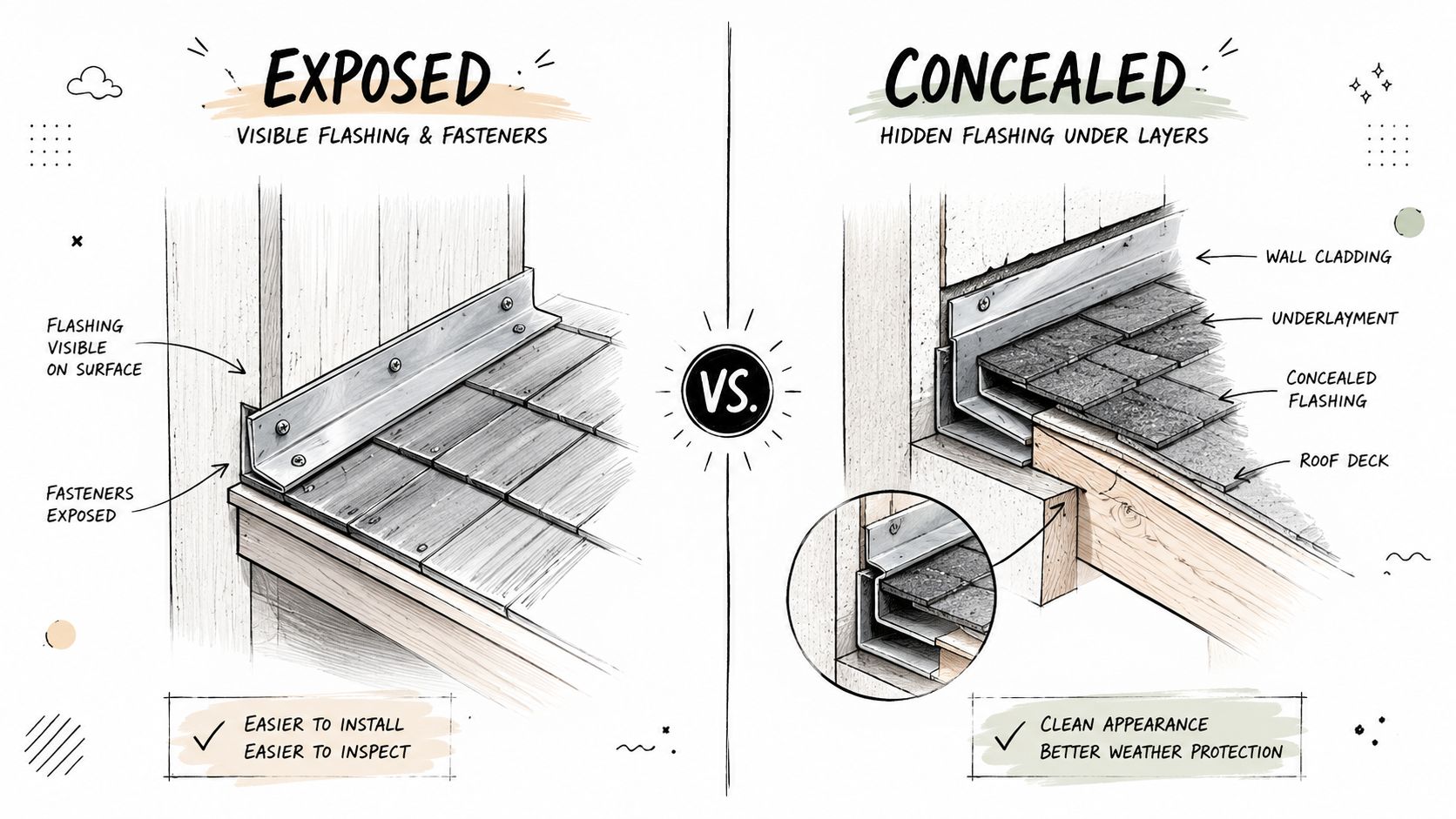
For the huge roof areas on commercial and industrial buildings—where any downtime costs real money—the risk and potential expense of concealed flashing just don't add up. The simple, inspectable design of an exposed system makes it the most practical and reliable choice. In NSW, the most common exposed flashings are made from incredibly durable, weather-resistant materials like COLORBOND® or ZINCALUME® steel, which are engineered to last for decades. You can discover more about these options at Stratco.
Identifying Common Roof Flashing Types
Walk across any large commercial roof, and you’ll notice metal strips lining every edge, corner, and projection. To the untrained eye, they might all look like simple trim. In reality, each piece is a purpose-built component, and knowing the different roof flashing types is the first step to spotting a potential disaster before it happens.
Think of it this way: water is relentless, and it will always find the path of least resistance. Flashing is what creates a stronger path for it to follow—one that leads safely off your building. Each type is designed and installed very differently to manage water at a specific junction.
Flashings for Roof-to-Wall Transitions
Some of the most vulnerable points on any roof are where the flat or sloped roof surface meets a vertical wall. Wind-driven rain loves to attack these joins, so the flashing here has to be spot-on.
Apron Flashing: You'll see this as a long, continuous piece of metal where a sloped roof butts up against a wall, like at the high side of a skillion or lean-to roof. Its job is simple but crucial: it acts as a ramp, directing water running down the wall's face straight onto the roofing sheets and into the drainage system.
Step Flashing: Now, what if the roof slope runs parallel to the wall, like the side of a tall parapet or a chimney? A single piece of flashing won't work. Instead, we use step flashing. This is a series of L-shaped metal pieces, woven into the roofing material course by course, almost like scales on a fish. This layered approach ensures every single join is sealed while still allowing the building to expand and contract naturally.
Counter Flashing: This is the belt-and-braces of flashing systems, especially against porous masonry like brick or concrete. After the primary flashing (like an apron or step flashing) is in place, the counter flashing is installed over the top of it. It’s physically cut and wedged into a groove in the masonry wall, then sealed. This creates a two-part shield that completely covers the top edge of the base flashing, making it impossible for water to sneak in from behind.
You'll almost always find counter flashing on commercial chimney stacks and parapet walls. It’s the final "lid" on the system, giving you a truly robust, long-term seal against surfaces that would otherwise soak up water.
Flashings for Roof Intersections and Penetrations
Of course, roofs aren't just flat, uninterrupted planes. You have sections meeting at different angles and essential services like pipes and vents poking through. Every one of these penetrations is a potential leak unless it’s sealed with the right type of flashing.
To make sense of it all, here's a quick breakdown of the most common types you’ll encounter on a commercial property.
Common Roof Flashing Types and Their Applications
| Flashing Type | Primary Function | Common Location on a Commercial Roof |
|---|---|---|
| Valley Flashing | Channels a high volume of water from two intersecting roof planes. | In the "V" created where two sloped roof sections meet. |
| Pipe Flashing | Creates a waterproof seal around cylindrical penetrations. | Around plumbing vents, electrical conduits, and exhaust pipes. |
| Curb Flashing | Seals the base of large, box-shaped, roof-mounted equipment. | At the base of skylights, large HVAC units, and roof access hatches. |
| Drip Edge | Directs water away from the fascia and into the gutter system. | Along the entire lower edge (eaves) of the roofline. |
As you can see, each flashing has a highly specialised role. Valley flashing, for instance, is absolutely critical because it handles a massive, concentrated flow of water. It's usually a W-shaped piece of metal; that central ridge stops the torrent of water from one roof plane from shooting straight under the roofing sheets on the other side.
Pipe flashing—often called a pipe boot or dektite—is typically a cone-shaped fitting that slides snugly over a pipe, with a wide flange at the bottom that is sealed to the roof. For bulky items like air conditioning units, we build a custom curb flashing. This creates a raised, waterproof box for the unit to sit on, effectively lifting the entire penetration well above the water level. Each one of these roof flashing types is non-negotiable for keeping the building dry.
Choosing the Right Flashing Materials
Just like there are dozens of flashing shapes, there’s also a range of materials they can be made from. Choosing the right one isn't just about what looks good; it's a critical decision based on long-term durability, how well it works with your existing roofing, and whether it meets Australian standards—especially given our harsh climate.
For most commercial and industrial buildings in Australia, steel is king. You’ll find that products like Colorbond and Zincalume steel are the go-to choices for fabricating flashings. We rely on them for their fantastic corrosion resistance, strength, and the ability to be perfectly colour-matched to the main roofing, which gives the entire building a seamless, professional look. If you're weighing up these two excellent options, we've broken down the details in our Zincalume vs Colorbond roofing guide.
Of course, other materials do pop up for specific architectural projects. Aluminium is a good choice when you need something lightweight and easy to shape. Copper is the premium option; it’s incredibly durable and develops that classic, distinctive green patina over time, but it definitely comes with a higher price tag.
The Critical Shift Away from Lead
For decades, lead was the standard for flashing because it’s incredibly flexible. You could mould it into just about any shape. However, its use is now heavily restricted, and for a very good reason: water safety.
Lead used to be everywhere, but it's now effectively banned in new installations where rainwater is collected for use. This is a direct response to serious health risks. Australian standards now forbid lead in any system connected to rainwater tanks to prevent the water supply from being contaminated. It's a non-negotiable.
This change in regulations has thankfully pushed the industry toward modern, safer alternatives. You can see how lead-free systems are installed to get a feel for how these new materials are used on site.
A new standard in flexibility and safety: Today, flexible, non-toxic products like Wakaflex have become the go-to solution for tricky shapes and roof penetrations. These modern composite flashings give you all the workability of lead without any of the health or environmental headaches, making them a fully compliant and much smarter choice for any roofing project.
The infographic below shows some of the most common flashing profiles you'll encounter on a commercial roof.
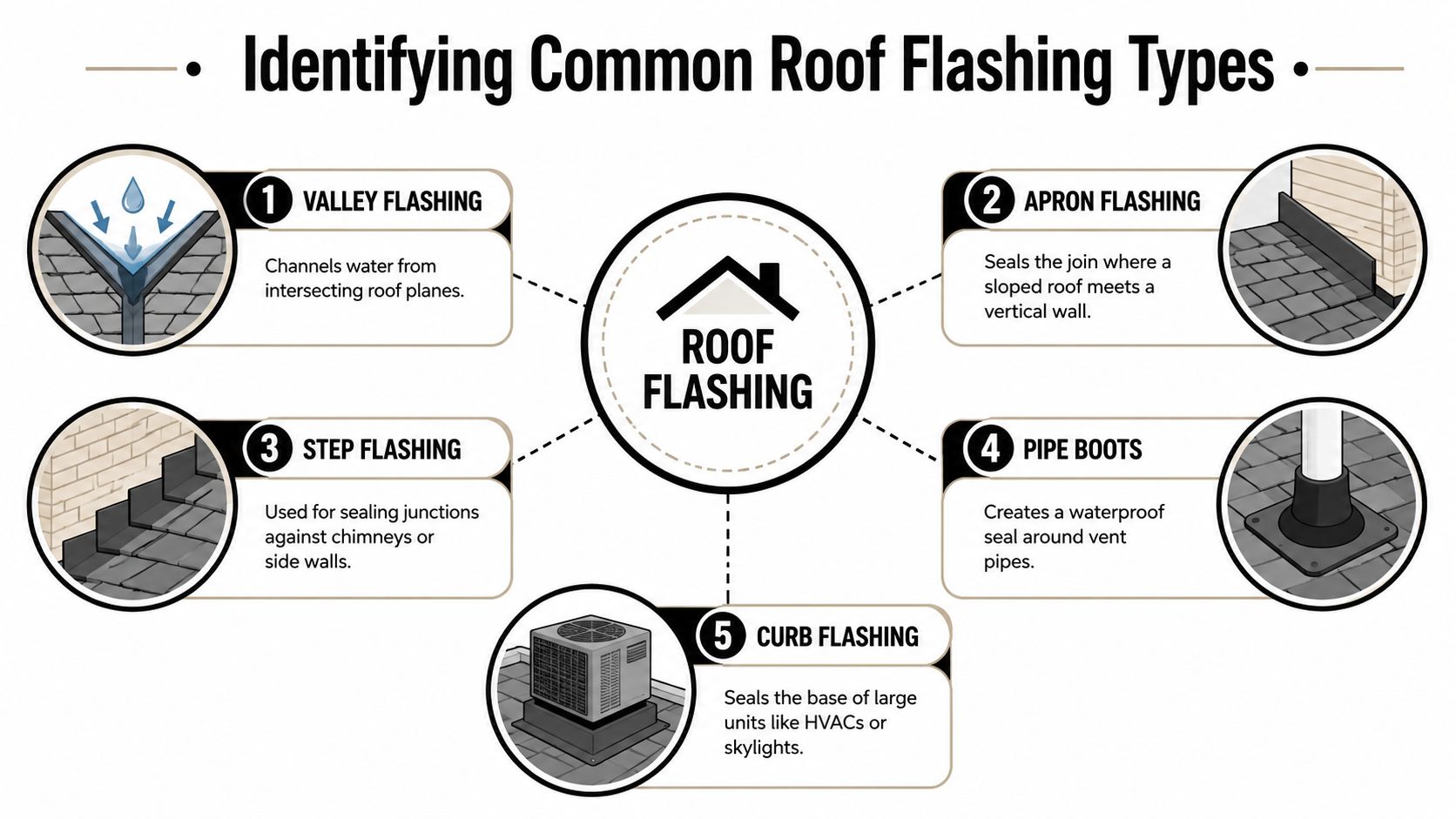
As you can see, each type is specifically engineered to protect a vulnerable point on the roof, from large curb flashings around HVAC units down to the humble but essential pipe boot.
Why Professional Installation Is Non-Negotiable
You can have the best roof flashing materials money can buy, but they’re completely useless without a flawless installation. A single mistake—one sloppy cut or a poorly placed fastener—creates a weak point, and you can be sure that water will find it. This isn't just about making things look tidy; it’s about following engineered standards designed to keep your building dry.
Think of it like this: flashing is the armour for your roof's most vulnerable joints. The goal isn't just to cover a gap; it’s to build a carefully layered defence system that actively channels water away. An experienced roofer knows that every single fold, overlap, and seal plays a critical role in standing up to whatever the weather throws at it.
The Science Behind the Standards
These installation rules aren't just arbitrary guidelines. They are non-negotiable specifications rooted in decades of building science, and they're essential for your building to be compliant. The details, like overlap dimensions and fastener spacing, exist for very specific reasons.
For example, the National Construction Code (NCC) is explicit: all flashing joints must be lapped by at least 75 mm in the direction of water flow. Fasteners must be no more than 40 mm apart. These aren't suggestions. For a commercial metal roof in NSW, these precise measurements are what stop intense, wind-driven rain from forcing its way into your building.
A professional sees these numbers not as a target, but as the absolute minimum for a watertight seal that will survive Australia’s harsh climate. Anything less is just a future leak waiting to happen.
This is exactly why hiring a general handyman or attempting a DIY flashing job is a massive gamble. They might get the basic shape right, but it's the critical details they miss—using the wrong sealant, choosing fasteners that will corrode the metal, or forgetting to allow for thermal expansion. These are the small mistakes that lead to catastrophic failures down the track.
A specialist commercial roofer, on the other hand, accounts for all these variables from the start. They’ll often custom-fabricate flashings on-site for a perfect fit and follow a strict installation sequence to ensure every component works as one cohesive system. To see what this process truly involves, take a look at our detailed guide on proper roof flashing installation.
Ultimately, getting it done by a professional is the only way to be certain your flashing will do its job and protect your asset for years to come.
Your Roof Flashing Questions, Answered
Even after getting your head around all the different roof flashing types and materials, you probably still have a few questions. We get it. As a business owner or strata manager, you need to know the practical stuff—how to maintain it, when to repair it, and what it means for your specific property.
Here are the straightforward answers to the questions we hear most often from clients across NSW.
How Often Should We Get Our Commercial Roof Flashing Inspected?
For any commercial building, regular inspections are your first line of defence. We strongly recommend a professional look-over at least twice a year, typically in spring and autumn. This gives a roofer the chance to prepare the system for the harsh summer sun and wet winter months ahead.
On top of that, it's wise to book an inspection after any significant weather event, like a severe hailstorm or gale-force winds. These checks are the best way to catch small problems—like cracked sealant, loose screws, or a minor tear—before they let water in and cause serious, expensive damage inside.
Can We Just Repair or Replace a Section of Flashing?
Absolutely. In fact, this is often the smartest and most cost-effective solution. If the main roof sheeting is still in good shape, a qualified commercial roofer can surgically remove and replace only the damaged or corroded sections of flashing.
By targeting just the failed components, you deal with the immediate leak risk without the massive cost of a full roof replacement. It’s a targeted fix that extends the life of your entire roof system, protecting your asset for a fraction of the cost.
What Are the Common Signs of Failing Roof Flashing?
Knowing what to look for can save you a fortune. When you do a visual walk-around, keep an eye out for these classic signs of trouble on the building's exterior:
- Visible Corrosion: Any sign of rust, especially along the folded seams or around fasteners, is a major red flag.
- Cracks and Gaps: Look for splits in the metal itself or sealant that has dried, cracked, and pulled away from the edge.
- Warping or Lifting: Flashing that is bent, dented, or has physically lifted away from the roof or wall is no longer doing its job.
Inside the building, the evidence is usually much more direct. Water stains on ceilings or walls are a dead giveaway. Pay close attention to areas around roof penetrations like vents and skylights, or where a wall meets the roofline—these are the hotspots for flashing failures.
Do We Really Need Custom Flashing for Our Building?
For a commercial property? Almost certainly, yes. Unlike residential homes that might get away with standard, off-the-shelf parts, commercial buildings are rarely that simple. Each angle, junction, and penetration on your roof is often unique.
This is where custom-fabricated flashing is essential. A professional roofer will measure every detail on-site and then cut and fold the flashing—usually from materials like Colorbond or Zincalume steel—to fit your roof's exact contours perfectly. This bespoke approach creates a much more reliable and durable seal than trying to force a standard product to fit, which almost always results in early failure. That precision is the hallmark of quality work and is vital for your roof's long-term health.
When it comes to protecting your commercial asset, a robust, professionally installed flashing system is non-negotiable. If you've noticed any of the warning signs or think it's time for a professional inspection, the team at Commercial Roofers is here to help. We specialise in expert repairs and replacements for all roof flashing types across Sydney. Get in touch with us today for a transparent quote and reliable service.