
You're usually not searching for a commercial roofer near me because it's a pleasant admin task. You're doing it because water has shown up where it shouldn't. It's dripping over stock in a warehouse, staining a retail ceiling, threatening switchboards, or triggering calls from tenants and facility staff who need answers now.
In Sydney, that search gets risky fast. Commercial roofing isn't just about stopping a leak. It often involves code compliance, height safety, drainage design, occupied-building staging, insurer documentation, and, on older sites, asbestos risk. A cheap patch can buy a few dry weeks and create a much larger liability later.
The right way to hire a commercial roofer is to treat the roof as a regulated business asset. You need someone who can inspect properly, define scope clearly, keep the site operational where possible, and leave you with a compliant result that stands up in front of owners, strata committees, insurers, and certifiers.
Table of Contents
- Why Your Commercial Roof Is a Critical Business Asset
- The First Cut Verifying Licences Insurance and Compliance
- Key Questions to Ask Every Potential Roofer
- Navigating Asbestos and COLORBOND Roof Replacements
- Decoding Quotes and Understanding Project Costs
- Your Hiring Checklist and Final Questions Answered
Why Your Commercial Roof Is a Critical Business Asset
A commercial roof usually gets attention only when it fails. By then, the full cost isn't limited to roofing works. It's damaged inventory, tenant complaints, interrupted loading areas, wet insulation, unsafe walkways, and pressure from everyone who wants the problem fixed yesterday.
That's why the roof should be managed like plant or structure, not like cosmetic maintenance. On a warehouse, factory, shopping strip, or strata complex, the roof controls weatherproofing, drainage, and the building's day-to-day usability. If it's neglected, small defects spread into operational problems.
For Sydney owners and managers, the mistake I see most often is hiring for speed alone. They search for a commercial roofer near me, take the fastest callback, and approve a patch without asking what failed. Was it the sheeting, a box gutter, a penetration, a drainage fall issue, old fasteners, movement at laps, or hidden substrate damage? If you don't define the failure correctly, you don't fix it. You just move it.
Practical rule: If the roof issue can affect stock, electrical services, common property, or tenants, treat it as an asset risk decision, not a handyman job.
The better approach starts with triage, then evidence, then scope. Get the leak made safe, but insist on documented inspection findings, photos, likely causes, and a recommendation that separates urgent works from longer-term correction. That gives you something defensible when you need to brief owners or committees.
For active leaks, it also helps to understand the difference between temporary containment and a proper repair. If you're dealing with immediate water ingress, this guide on commercial roof leak repair in Sydney gives useful context on what should happen first.
What matters most in the first decision
- Business continuity: Can the contractor protect occupants, stock, plant, and access paths while the issue is being investigated?
- Evidence quality: Are they documenting defect locations, likely causes, and next steps clearly enough for internal approval?
- Long-term fit: Does the proposed work match the building type, roof system, and likely remaining service life?
The First Cut Verifying Licences Insurance and Compliance
Before you compare materials, timing, or price, filter out anyone who can't satisfy the legal baseline. In Australia, roofing work is a regulated construction activity, and commercial projects are governed by the National Construction Code, with NCC 2022 adopted nationally from 1 May 2023 according to this NCC adoption reference. For a Sydney commercial building, that means the work sits inside a compliance framework. It isn't just trade preference or “the way we've always done it”.
What fully licensed and insured should mean
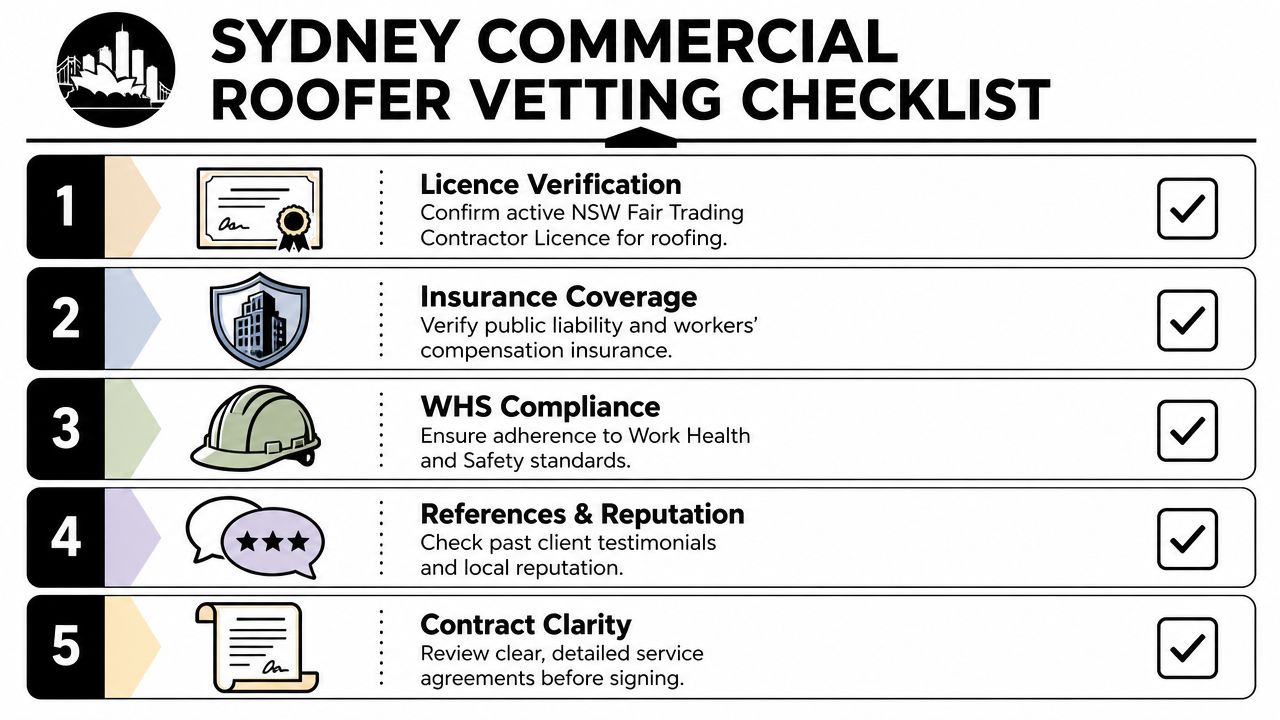
When a contractor says they're licensed and insured, don't leave it there. Ask to sight the documents. Current documents, not assurances over the phone.
For a commercial roofing contractor in NSW, the first cut should include:
- Contractor licence evidence: You want the relevant NSW licence details for the type of roofing work proposed.
- Public liability cover: Sight the certificate of currency and check that it is current for the period of works.
- Workers' compensation cover: If they have crews on your site, this matters. Don't assume it exists.
- WHS documentation: Ask whether they prepare site-specific safety documentation for the job, not just generic paperwork.
- Supervisor clarity: Confirm who is responsible on site each day.
A surprising number of problems start here. The quote may look professional, but if the entity on the quote, the licence holder, and the crew on site don't line up, you're already carrying unnecessary risk.
Why NCC compliance changes the conversation
The NCC matters because commercial roofing decisions affect more than weatherproofing. Scope, materials, drainage, wind loading, fire performance, and waterproofing details all sit inside a regulated framework. On larger or more complex sites, that can affect what products are suitable, how details are designed, and what documentation should exist before work starts.
That's the practical difference between a contractor who “does roofs” and one who handles commercial projects properly. A competent roofer will talk about specification, falls, penetrations, flashings, terminations, and compliance pathways. A weak operator will talk only about replacing sheets and getting in cheap.
A commercial roof replacement should leave an evidence trail. Inspection records, scope definition, material specification, and completion details all matter if a defect appears later.
A simple vetting sequence
Use this order and you'll cut out most of the risk early:
-
Verify the business identity
Check that the company quoting the work is the company contracting the work. -
Sight compliance documents
Don't accept “we can send that later”. Get the licence and insurance evidence before approval. -
Ask how they handle occupied sites
Warehouses, retail centres, schools, and strata buildings need different staging and access controls. -
Review their documentation standard
If their inspection notes are vague, the project documentation usually is too. -
Check whether they use in-house crews or subcontractors
Neither model is automatically wrong, but you need to know who's accountable.
A contractor can have a sharp sales process and still be the wrong fit. The first cut is about reducing exposure before you spend time reviewing technical options.
Key Questions to Ask Every Potential Roofer
Once the legal baseline is cleared, the next job is pressure-testing how the contractor thinks. Most owners ask, “How much?” too early. Better questions reveal whether the roofer can control the project.
Commercial roofing guidance identifies improper installation, neglected inspections, and poor drainage as common causes of avoidable failure, and recommends routine inspections, drainage correction where ponding occurs, and strict workflow documentation and safety protocols, as noted in this commercial roofing defects guide. That should shape your interview.
Project management questions
Ask who your single point of contact will be. If the answer is vague, expect communication gaps when access changes, weather hits, or tenants complain.
Then ask these:
-
Who runs the site day to day?
You want the supervisor role identified clearly, not just the estimator who sold the job. -
How will updates be issued?
Good answers include inspection reports, marked-up photos, progress notes, and notice of upcoming disruptions. -
How will you stage the work around operations?
Warehouses, logistics sites, and retail premises need different sequencing. If they can't speak to that, they haven't thought deeply enough about your building. -
What happens if the opened roof is worse than expected?
The right answer includes escalation steps, variation control, and make-safe planning.
Safety and defect prevention questions
Asking practical questions, not slogans, exposes poor contractors.
-
Can you provide a site-specific safety plan for this building?
A serious contractor should be able to explain access controls, exclusion zones, height safety, weather holds, and material handling. -
How do you deal with ponding or poor falls?
If they only talk about patching leaks and never mention tapered insulation, regrading, or drainage correction, they may be treating symptoms only. -
What inspection checkpoints do you use during installation?
Good teams inspect substrate condition, fixings, laps, penetrations, flashings, gutters, and final water-shedding details at defined stages. -
How do you document defects before and after works?
This matters for insurers, owners corporations, and any dispute about pre-existing conditions.
If a roofer can't explain their inspection process, they probably don't have one. On commercial work, that usually shows up later as repeat leaks.
Materials and workmanship questions
The materials discussion shouldn't start with brand preference. It should start with system suitability.
Ask:
| Question | Good answer sounds like | Red flag |
|---|---|---|
| What roof system do you recommend for this building? | Tied to building use, access, drainage, exposure, and remaining asset life | “We use the same system on everything” |
| What details are most vulnerable here? | Penetrations, box gutters, laps, terminations, movement points | Generic talk about “wear and tear” |
| What warranty information will be provided? | Clear distinction between product coverage and workmanship obligations | Vague promises without documentation |
| How will you prevent future leak points? | Specific mention of flashings, fixings, seal interfaces, drainage and QA checks | Focus only on replacing visible damaged areas |
If you're assessing providers in Sydney, one practical option is to compare how each contractor reports on inspections, staging, and system selection. For example, Commercial Roofers outlines commercial and industrial roofing scopes across repairs, replacements, inspections, gutters, asbestos removal, and metal roofing. Use that kind of detail as a benchmark when comparing any roofer, not as a substitute for your own checks.
Navigating Asbestos and COLORBOND Roof Replacements
Older Sydney commercial and industrial buildings often turn a straightforward reroof into a hazard-management project. The client thinks they need sheet replacement. The inspection suggests the roof may contain asbestos cement, the gutters are failing, and the building still needs to operate during works. That is a very different job from a modern metal re-sheet.
When the old roof may contain asbestos
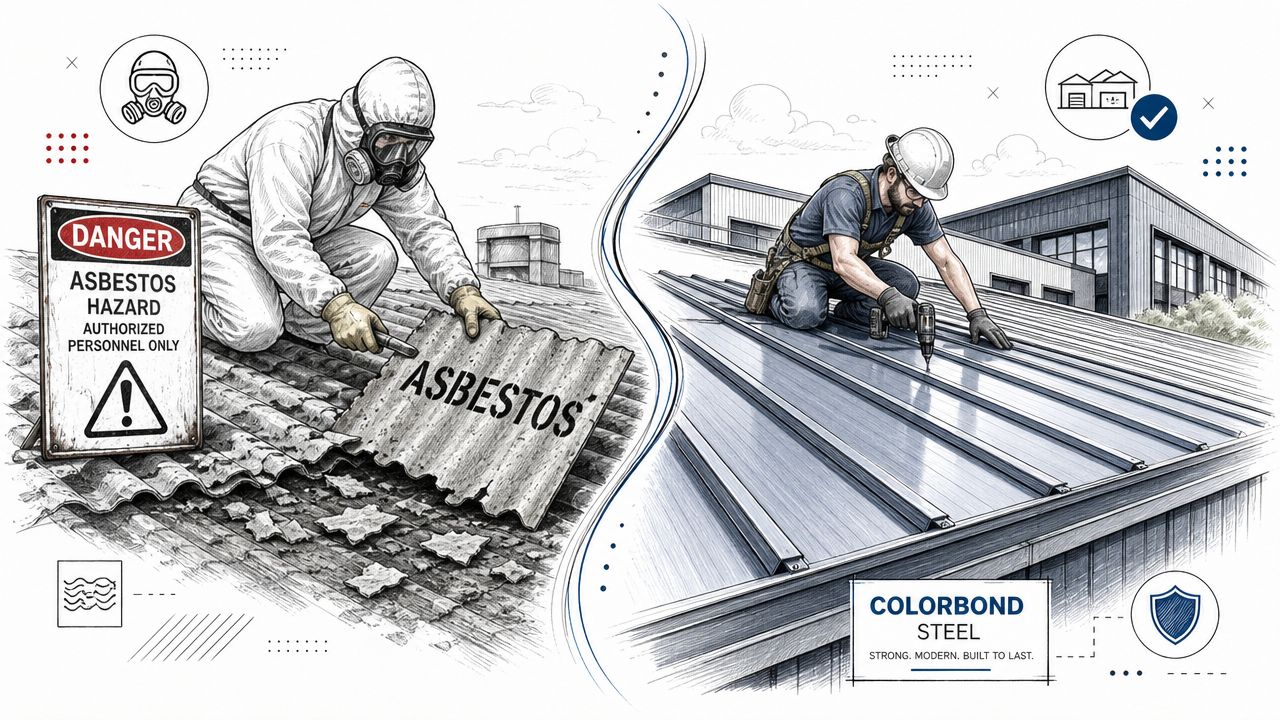
The biggest mistake on older sites is assuming age alone tells you enough. It doesn't. If the existing roof may contain asbestos, the job shifts immediately from normal roofing to controlled removal, disposal, replacement, and documentation.
Safe Work Australia reports that asbestos still causes around 4,000 deaths in Australia each year, according to this asbestos risk reference. That is why warehouses, factories, schools, and older strata assets need licensed handling and strict controls.
A compliant approach usually looks like this:
- Assessment first: The roof material is identified before anyone starts disturbing it.
- Removal planning: The contractor explains containment, access control, and disposal pathway.
- Documentation: You should expect records for removal and disposal, not verbal reassurance.
- Replacement scope: The new roof system is specified as part of the same controlled program, not treated as an afterthought.
A non-compliant approach looks very different. Crews start breaking sheets without clear assessment, waste handling is vague, neighbouring occupants are poorly informed, and the paperwork appears only after someone asks too many questions. That kind of shortcut creates liability well beyond the roof.
On older industrial stock, the first technical question often isn't “What metal profile should we use?” It's “What exactly are we removing, and how is that risk being controlled?”
What a proper metal roof replacement looks like
Once asbestos risk is dealt with, or if the building already has ageing metal roofing, the discussion shifts to replacement quality. Many Sydney owners default to COLORBOND because it suits a wide range of commercial buildings, performs well visually, and integrates cleanly with gutters, flashings, and wall cladding when detailed properly.
The trap is thinking that “new Colorbond roof” is a full specification. It isn't. A commercial reroof still requires decisions on profile selection, fixing method, laps, penetrations, insulation interface, guttering, rainwater handling, and staging around live operations.
If you're weighing material and profile options, this overview of metal roofing systems in Australia is a useful reference point.
A quality replacement should answer four things clearly:
-
What is being removed and what remains?
Existing sheets only, or insulation, flashings, gutters, and safety line interfaces too? -
How is drainage being improved?
New sheeting on a roof that still holds water is not a durable solution. -
How are penetrations and gutters being detailed?
Most repeat leaks return at transitions and drainage points. -
How will the building keep operating?
Warehouses and strata sites often need phased works, not full shutdown.
A short video can also help clients understand how replacement sequencing affects safety and site continuity:
Decoding Quotes and Understanding Project Costs
Commercial roofing quotes often look comparable until you read past the total. Two contractors may both price “roof replacement”, but one includes demolition, disposal, access equipment, flashing upgrades, drainage corrections, staging, and completion reporting. The other includes little more than new sheets and labour.
That's why the cheapest quote can become the most expensive job. In the current market, commercial building activity remains under cost pressure, with trades, materials, and scheduling delays still affecting timing, as noted in this commentary on commercial roofing timing and disruption. The better question isn't who is fastest. It's who can control disruption and define scope properly.
What a strong quote includes
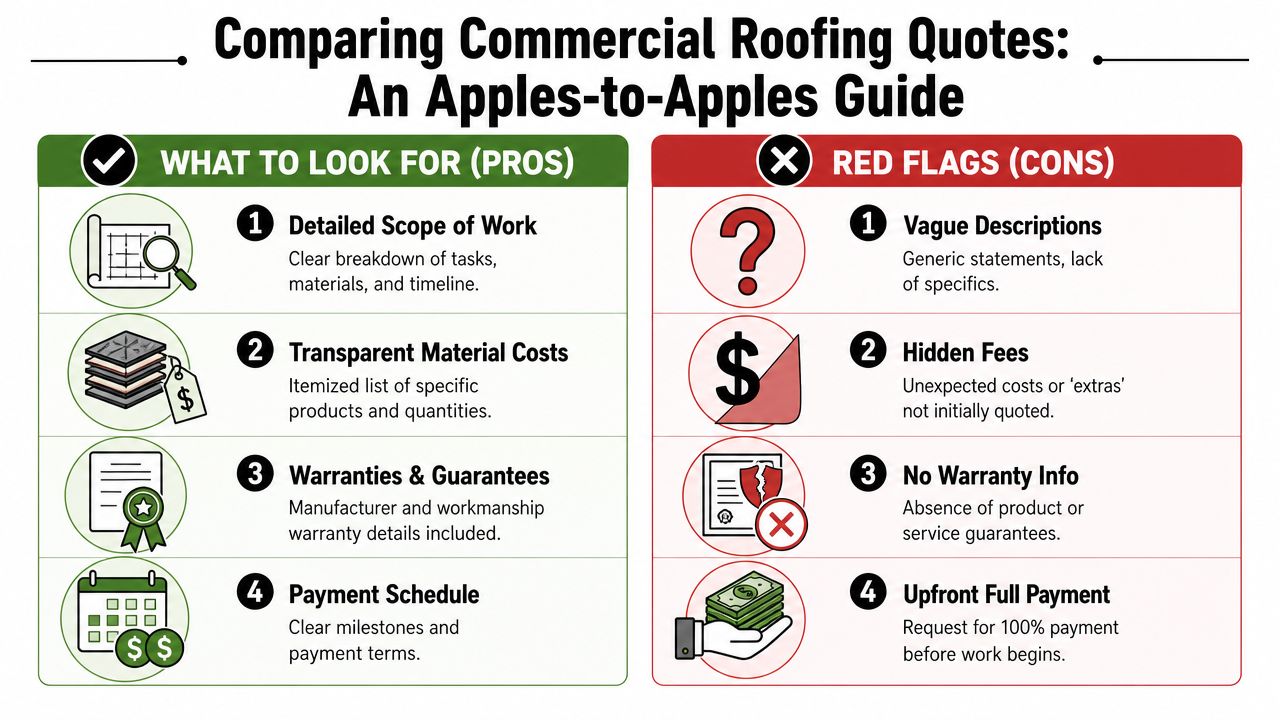
A commercial quote should let you compare apples with apples. If it doesn't, you aren't really choosing between contractors. You're choosing between different assumptions.
Review for these inclusions:
- Defined scope: Removal, repairs, replacement areas, flashings, gutters, penetrations, make-safe works, cleanup.
- Material specification: Product type, profile, finish, and any allowances that affect performance.
- Access and staging: Scaffolding, EWP access, exclusion zones, occupied-site sequencing, noisy work windows.
- Programme logic: Not just “start next week”, but how the work will progress.
- Warranty detail: What is covered by the manufacturer and what is covered by the contractor.
- Defect contingencies: How hidden conditions and variations will be handled.
If you're trying to benchmark pricing logic, this guide on commercial roof repair cost factors helps frame why scope and access often matter more than headline rate.
How to compare value not just price
A useful way to review quotes is to separate them into three buckets.
| Quote type | What it usually looks like | Why it wins or loses |
|---|---|---|
| Minimal scope quote | Brief description, low total, few exclusions explained | Wins on price, loses when defects reappear or variations stack up |
| Operationally aware quote | Clear staging, access planning, disruption controls | Strong for occupied sites and logistics facilities |
| Asset-focused quote | Detailed scope, lifecycle thinking, drainage and risk reduction included | Often higher upfront, usually easier to defend internally |
A few red flags deserve immediate scrutiny:
- Vague wording: “Repair as required” or “replace damaged areas” without marked plans.
- Large undefined allowances: Provisional sums with little explanation.
- No completion documentation: Nothing about final inspection records or handover.
- Pressure to approve quickly: Especially where the roof is not in immediate failure.
- Full payment demanded upfront: That shifts too much risk to the client.
Good quotes reduce uncertainty. Bad quotes hide it until the roof is open and your options are worse.
For owners, developers, and strata managers, the primary financial issue is total ownership cost. A better-specified roof with stronger drainage details and clearer staging usually creates fewer call-backs, fewer tenant complaints, and less unplanned disruption.
Your Hiring Checklist and Final Questions Answered
By the time you’re ready to appoint a contractor, the goal isn’t to feel comfortable. It’s to have reduced the unknowns. On a Sydney commercial roof, that means you’ve checked compliance, tested the contractor’s process, reviewed scope in detail, and matched the proposal to the building’s operational reality.
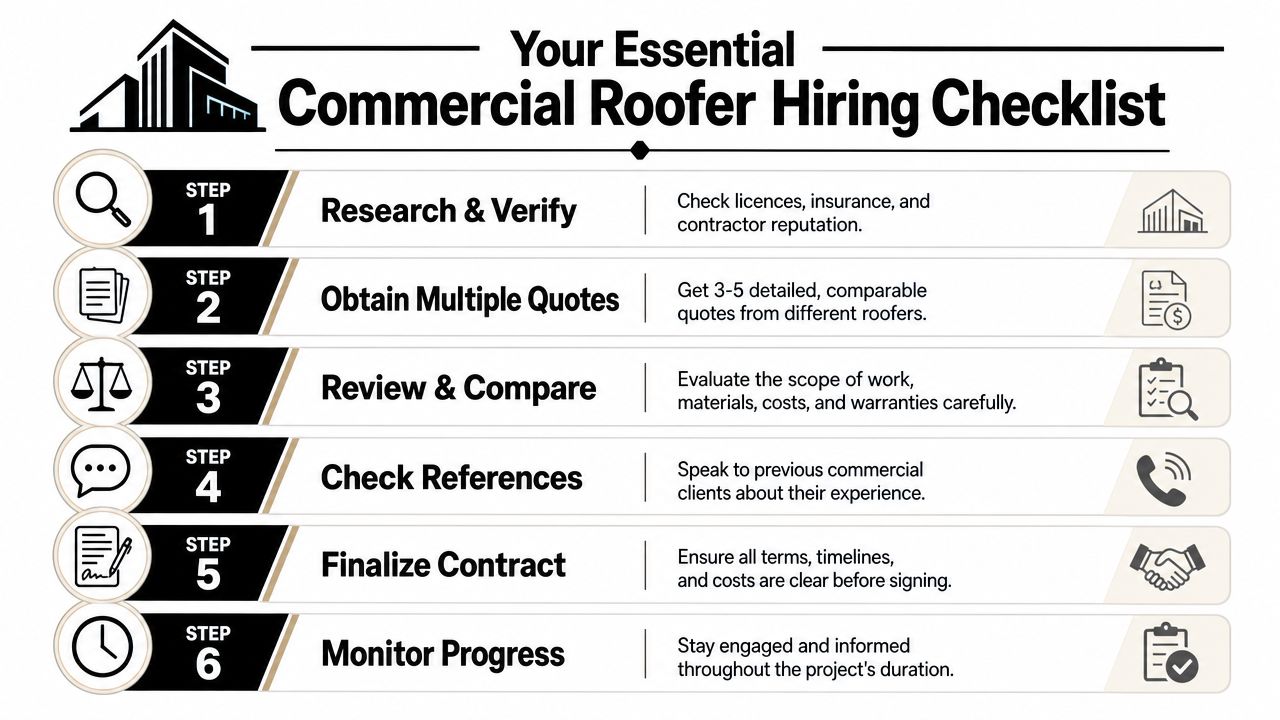
A practical hiring checklist
Use this sequence before signing anything:
-
Confirm the building problem
Is this an isolated repair, a drainage failure, an ageing roof system, or a likely replacement? -
Verify licences and insurance
Sight documents early. Don’t leave that check until after quote acceptance. -
Review inspection quality
Prefer roofers who provide photos, defect notes, and specific recommendations. -
Match the contractor to the asset
Industrial sheds, strata complexes, retail centres, and factories aren’t managed the same way. -
Compare quotes by scope and disruption control
Look at staging, access, reporting, and exclusions. Not just total price. -
Lock in contract clarity
Scope, timing, safety responsibilities, variations, and warranties should all be written clearly.
Final questions from owners and strata managers
One question is still under-asked in NSW commercial roofing: Does the contractor handle asbestos removal, compliant disposal, and replacement under Australian standards for warehouses, factories, and older strata assets? That gap matters because commercial roofing decisions often combine inspection, make-safe works, asbestos control, and replacement in one project, as highlighted in this discussion of an overlooked commercial roofing FAQ.
Here are the strategic questions I’d want answered before appointment.
Should I hire based on proximity
Only partly. “Near me” helps with response time and site familiarity, but proximity doesn’t solve compliance, staging, or technical fit. A nearby roofer with weak documentation is still the wrong roofer.
What matters more for strata buildings
Coordination. Strata roofs affect multiple stakeholders, common property, resident communication, access, and insurer reporting. The contractor needs to manage committees, occupants, and documentation, not just the roof surface.
What matters more for warehouses and factories
Operational continuity. Ask how they’ll stage works so stock movement, loading, plant access, or production can continue safely where possible. Phasing is often worth more than a lower initial quote.
Is a repair enough
Sometimes. But only if the contractor can show why the defect is localised and why adjacent areas won’t fail next. If the proposal ignores drainage, brittle old sheets, failed fixings, or repeated patch history, it probably isn’t enough.
What should I expect at handover
At minimum, you should expect a clear record of what was done, what materials were used, any unresolved limitations, and the relevant warranty information. For complex sites, that handover often matters as much as the installation itself.
The best commercial roofing appointment is the one you can still defend six months later, after rain, after tenant feedback, and after the invoice has been paid.
If you’re narrowing down options for a Sydney commercial or industrial roof, Commercial Roofers handles inspections, repairs, replacements, asbestos roof removal and metal roofing projects across NSW, with a focus on documented scope, compliant delivery, and staged works for occupied sites. Use that as your next step if you need a contractor who can assess the roof properly before you commit.