
Water is coming through the ceiling above your tenant's stock, the strata committee wants answers by tonight, and three roof leak repair contractors are offering three very different prices for what they all call the same repair. That's the moment most commercial owners get pushed into the cheapest patch, then pay again when the next storm finds the actual entry point.
A commercial leak isn't a single hole. It's a roof, gutter, flashing and drainage system failing somewhere, plus a paperwork problem for your insurer, landlord or body corporate. Vet the contractor on how they inspect, document and split the quote, not just on how fast they can get a tube of sealant onto a sheet.
Table of Contents
- How to Score Roof Leak Repair Contractors Before Quoting
- Licences, Insurances and Asbestos Checks Before Work Starts
- What Emergency Response Should Look Like in the First 72 Hours
- Inspection and Reporting That Finds the Real Water Path
- Reading a Quote Split Into Make-Safe, Diagnosis and Permanent Works
- Warranties, Insurer Evidence and Strata Approvals
- Questions to Ask Before Signing and Your Next Step
How to Score Roof Leak Repair Contractors Before Quoting
In NSW, 97% of audited buildings had at least one defect in the Deakin University and Griffith University building defects report. Roofing and rainwater-disposal failures represented 8.6% of all recorded defects in that same analysis of 212 Australian building-audit reports.
That matters because a ceiling stain rarely tells you where water got in. Within roofing and rainwater defects, roof cladding accounted for 32% and gutters for 20%, with failed membranes, inadequate falls to box gutters, missing parapet membranes and incorrectly installed flashings among the examples recorded.
Use a Weighted Scorecard, Not Price Alone
Score each contractor 1 to 5 per criterion, multiply by the weight, then compare totals. I'd weight inspection and written report at 20%, commercial and strata track record, licences and insurance, emergency response and quote clarity at 15% each, and asbestos competence and warranty and aftercare at 10% each.
| Criterion | Strong sign | Red flag |
|---|---|---|
| Commercial and strata track record | Recent warehouse, strata or retail roof jobs you can verify with references | Photos of residential work only and vague claims about all roofs |
| Licences and insurance | Current licence, public liability and workers compensation certificates provided before quoting | Refuses certificates or asks for cash payment |
| Emergency response | Named after-hours contact and a written make-safe attendance commitment | No stated response time |
| Inspection and written report | Photos, moisture readings, identified water-entry point and a stated cause | Quote issued before any inspection |
| Quote clarity | Separate make-safe, diagnosis and permanent works with unit rates | Single lump sum with no scope or exclusions |
| Asbestos competence | Reviews the asbestos register and arranges testing or licensed removal | Offers to just remove unknown sheets |
| Warranty and aftercare | Written workmanship and materials warranty with a term, exclusions and claim process | Verbal promises or a warranty that is not in the contract |
Treat any red flag on licences or emergency response as a disqualifier, regardless of total score. A contractor who can't prove cover or can't tell you who attends after hours isn't cheaper. They're transferring risk to you.
Practical rule: If a contractor will quote permanent works before they've inspected the roof and drainage, score them zero for inspection and move on.
Say a strata manager in Parramatta compares three quotes for a leaking parapet. The cheapest is a lump sum labelled "roof repairs" with no photos or cause. The mid-priced contractor provides moisture readings, identifies a split parapet membrane and blocked box gutter outlet, and separates make-safe from permanent works. On price alone the first wins. On the scorecard, the second wins because the committee can actually approve a defined scope.
Look for what good looks like in practice: in-house crews rather than unknown subcontractors, licensed and insured workmanship, and written materials and labour warranties you can read before signing. Shortlist three contractors, score them on paper, then invite only those three for site visits.
Licences, Insurances and Asbestos Checks Before Work Starts
Don't wait for rain to ask for paperwork. Request documents before any site visit, when nobody's under pressure to let a crew onto the roof just because they're already there.
Documents to Request Up Front
- Contractor licence: Current licence for the specific work type, verified on the NSW Fair Trading public register rather than accepted from a photocopy alone.
- Public liability certificate of currency: Current certificate showing the limit your building or head policy requires, with the insured name matching the contracting entity.
- Workers compensation certificate: Current cover for the people who'll attend the job, not just the director.
- WHS policy and SWMS: A WHS policy plus a site-specific safe work method statement for roof work, not a generic template with another address on it.
- Fall protection plan: How they'll access the roof, where anchor points or guardrails go, and what happens if weather turns.
- Subcontractor certificates: If any subcontractor will attend, request the same licence and insurance certificates for them before they arrive.
Check names carefully. A certificate in a different trading name, an expired policy, or a licence for general building that doesn't cover the roofing or waterproofing work proposed should stop the conversation until it's clarified in writing.
Asbestos Changes Everything
Older NSW warehouses and strata blocks often have fibre-cement sheeting that may contain asbestos. Ask for the site's asbestos register first. If there's no register, or the material is unknown, you need NATA-accredited sample results before any cutting, lifting or removal.
That includes make-safe work. A crew can't lift sheets to place a tarp properly, then claim testing was a job for later. If testing isn't complete, make-safe measures stay external and non-invasive until results arrive.
| Scenario | Licence required for removal | What to check |
|---|---|---|
| Friable asbestos, any quantity | Class A asbestos removal licence | Crumbling or powdery material; clearance certificate after removal |
| Suspected asbestos not yet tested | Testing first, licence depends on result | NATA-accredited sample results before any works start |
| Asbestos-free roof confirmed | No asbestos licence needed | Written register or testing statement kept with the job file |
Thresholds and competence requirements change, so check current SafeWork NSW rules for the material's condition and quantity rather than relying on what a contractor says worked on the last job.
Say a warehouse owner in Wetherill Park is offered cheap removal of unknown translucent and fibre-cement sheets as part of a leak repair. A licensed assessor samples the material first and finds friable material in the old backing. That single test changes the licence class, the containment, the disposal and the price. It's also the difference between a compliant job and a site shutdown.
After removal, insist on a clearance certificate and keep it with the register update. Any contractor who starts cutting before testing is complete, or who offers to "just take it away," is a red flag you should act on immediately.
What Emergency Response Should Look Like in the First 72 Hours
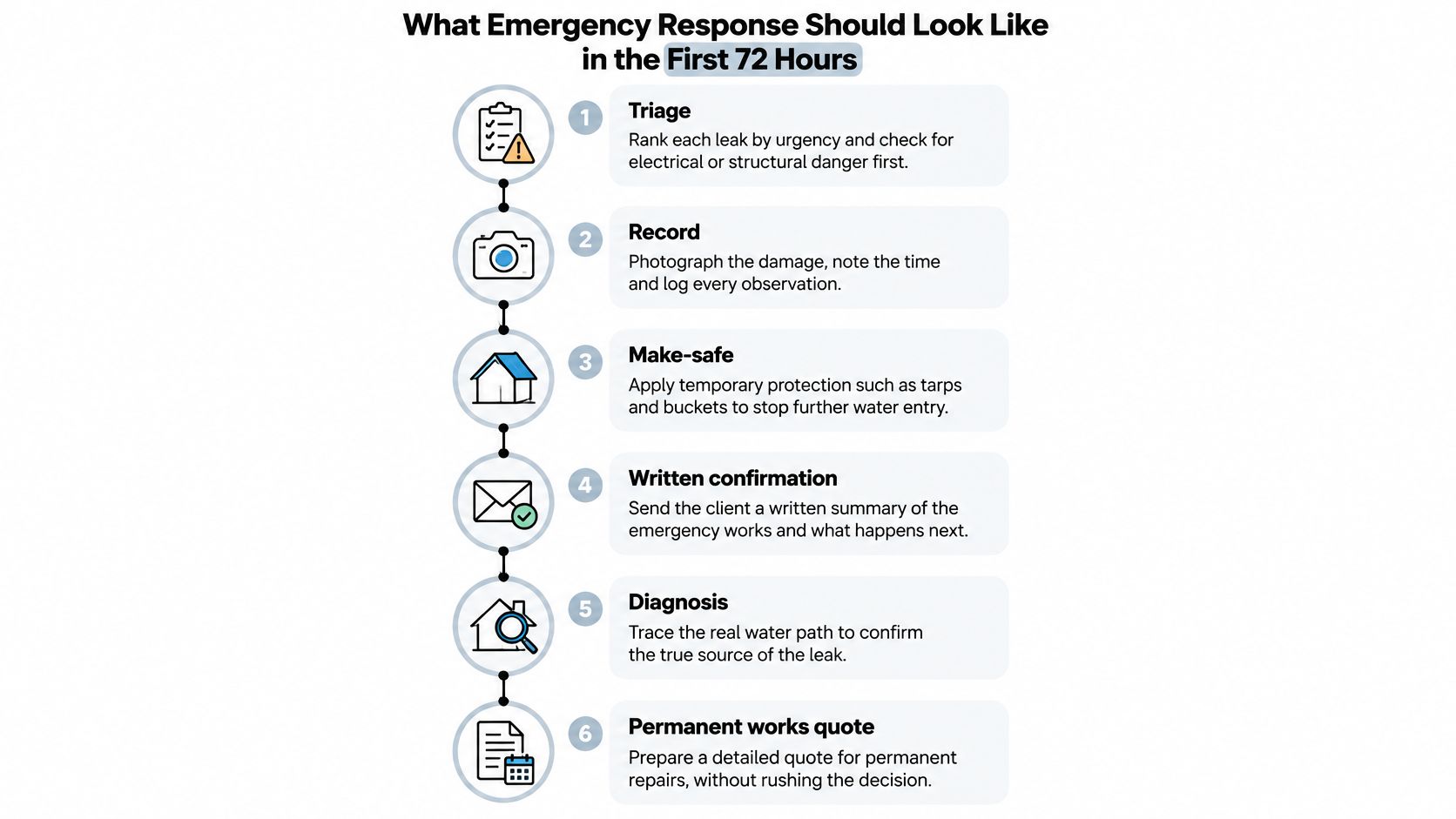
Good emergency response isn't heroic. It's sequenced: triage, record, make-safe, written confirmation, then diagnosis and a permanent quote without rushing the last two steps.
The six stages below show how that sequence should run over the first three days.
The Six Steps With Timing Targets
- Triage by phone the same business day: Where's water entering, are ceilings bulging, are switchboards, racking or stock wet, and is the site occupied right now?
- Timestamped photo and video record: Photograph every affected area before anything is moved, including stock, ceilings, floors and electrical fittings.
- Make-safe attendance the same day or within 24 hours: An electrician isolates power to the affected zone if needed, stock is lifted off the floor, buckets and tarps go down and temporary drainage is set up. No sheet is cut or lifted until the asbestos check is complete.
- Written make-safe confirmation within 24 hours: Time attended, weather at the time, areas affected and temporary measures left in place, sent to you in writing.
- Diagnostic inspection within 48 to 72 hours: Roof, gutters, flashings, penetrations and the ceiling space below, once it's safe and dry enough to inspect properly.
- Separate permanent works quote within 5 working days: Priced from the inspection findings, not guessed from the car park during the storm.
Get the operational details in writing before you need them: an after-hours number with a named person, the attendance target for active water entry, and who pays for make-safe if the insurer later disputes the cause. Guidance on structuring that first response, including what to record for the claim file, is set out in this overview of emergency roof leak repairs for commercial sites.
Make-safe is not a repair. If your invoice describes a tarp and sealant as the completed fix, you've bought temporary protection at permanent repair prices.
Say a Penrith warehouse takes water over racking at 5pm. The crew tarps the affected bay by 6pm, isolates a wet light circuit and photographs damaged cartons before staff move them. The tarp holds overnight, which looks like success. Next morning's inspection finds a cracked box gutter two bays away ponding and overflowing back under the sheeting. That's the actual cause, and no amount of sealant at the drip point would've fixed it.
Your contractor should say that plainly. Temporary work buys you time to diagnose. It shouldn't be presented, priced or invoiced as rectification.
Inspection and Reporting That Finds the Real Water Path
Not every drip is a roof leak. Condensation and inadequate roof-space ventilation can produce dripping, damp insulation, mould and ceiling staining that look identical from below.
The diagram below traces how moisture can build above a ceiling and present as a stain, even when the entry point isn't directly above it.
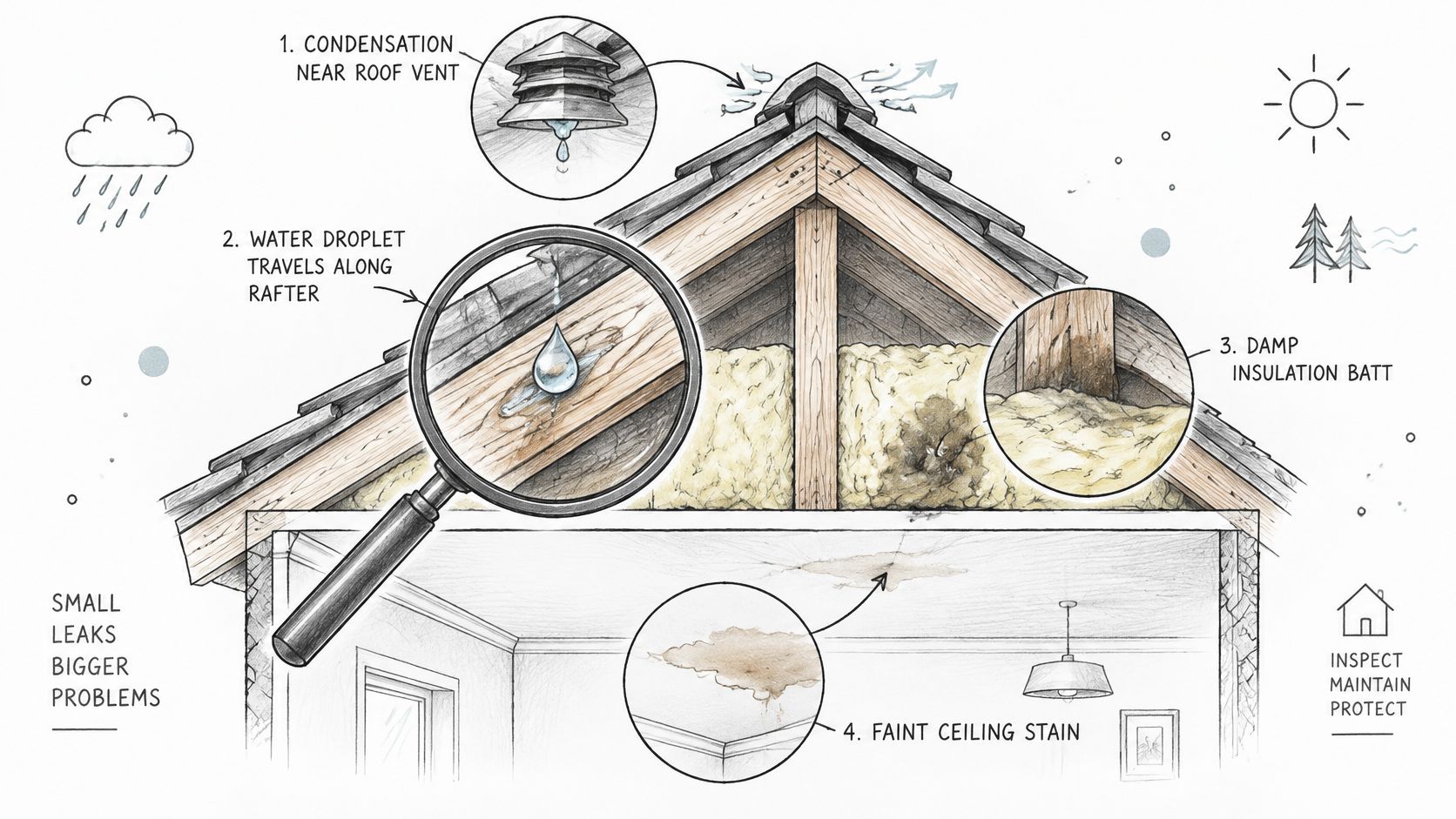
In Sydney warehouses and factories, metal roof sheets can run cold overnight while the conditioned interior stays warm and humid. Warm, humid air contacts the cold sheet, moisture forms on the underside, and staff arrive to drips on a clear morning with no rain. Sealing the sheet laps won't stop that.
The NCC 2025 commercial energy efficiency handbook specifically identifies roof-space ventilation as a control for condensation risk in relevant climate zones and updates requirements for roof and ceiling construction. Your inspection should therefore ask about vapour control, insulation condition and ventilation, not just penetrations.
What the Inspection Must Cover
- Roof covering: Membrane or metal sheet condition, laps, fixings, corrosion and previous patch repairs.
- Flashings and penetrations: Flashings at vents, flues, HVAC curbs and service penetrations, plus sealant condition.
- Parapets and box gutters: Parapet membranes and cappings, box gutter falls, ponding, joints and downpipe outlets.
- Below the roof: Ceiling and insulation condition, moisture spread and any mould or electrical exposure.
- Condensation checks: Relative humidity inside and in the roof space, insulation moisture, and whether drips appear only when HVAC runs or in early morning without rain.
Water also travels. It can enter at a penetration, run along a purlin or sarking, then drip metres away. A competent inspector traces that path with moisture readings and, where needed, controlled water testing section by section while someone watches below.
This short video shows the kind of methodical leak tracing to expect before anyone recommends permanent works.
Say a Sydney warehouse seals the same drip point three times. Each seal holds until cold nights return, then dripping resumes over the same aisle. A proper investigation logs drips at 6am after dry nights, finds saturated insulation and no rain entry during water testing, and identifies condensation as the mechanism. The fix becomes ventilation and vapour control, not a fourth tube of sealant.
What the Report Should Contain
Insist on a location plan with numbered photos, the identified water-entry mechanism, moisture readings, and records of weather, time of day and HVAC operation. It should rank the scope by priority and state whether damage looks storm-related or like deferred maintenance.
That distinction protects you with insurers and tenants. It also stops you authorising repairs blind. Before you sign, compare the report against the criteria for independent roof inspections with documented findings and record weather, time and HVAC operation yourself for the next event.
Record first: Note the time dripping starts, whether it's raining, and whether HVAC is running. Those three facts often separate a leak from condensation faster than any sealant test.
Reading a Quote Split Into Make-Safe, Diagnosis and Permanent Works
Separate the quote into three scopes. That single rule lets you approve urgent protection tonight, pay for diagnosis this week, and put permanent works to an insurer or committee without one approval blocking the others.
The commercial stakes justify the paperwork. The Insurance Council 2026 catastrophe report reported seven declared events in the 2025–26 financial year, producing more than 147,500 claims and $3.9 billion in insured losses. The same report noted commercial claims had a higher average cost than residential claims because they include damage to commercial buildings, property and business assets.
How Each Scope Should Be Priced
Make-safe is usually time and materials with a cap, or a fixed call-out fee. You should see attendance time, materials used and what was left in place. If there's no cap, ask what authorisation limit applies before the crew continues.
Diagnostic investigation is a fixed fee. The deliverable is the report, with photos, moisture readings and a stated cause. Ask whether the fee is credited against permanent works if you proceed, and get that in writing. Paying separately for diagnosis is often money well spent, because you own the findings even if you choose another contractor for the repair.
Permanent works should be itemised by unit rate. Look for membrane or sheet replacement per square metre, box gutters, flashings and sealants per lineal metre, plus separate lines for access equipment such as a raised work platform or scaffold, fall protection, waste removal and after-hours loading.
Exclusions and Variations
Ask for a written list of exclusions. Common ones include concealed structural damage, electrical repairs, ceiling replacement and asbestos removal. Exclusions aren't a problem. Hidden exclusions are.
Then check the variation clause. It should state how concealed damage is photographed, priced and approved by you before extra work proceeds. Without that clause, opening up a roof can turn into an open-ended invoice.
For example, compare an $18,000 lump sum labelled "repair roof leak" with an itemised quote showing $6,500 for make-safe, $1,200 for diagnosis and $10,300 for permanent works. The totals match, but only the second lets an insurer separate emergency mitigation from rectification, and only the second lets a strata committee see what the $10,300 buys by metre and square metre.
Don't let a temporary patch be invoiced as the final repair. It may not satisfy your insurer, and replacing materials without checking current NCC obligations for roof construction, energy performance and condensation management can create a compliance problem on top of the leak.
Warranties, Insurer Evidence and Strata Approvals
Treat a recurring leak as a possible waterproofing defect, not routine maintenance, until someone proves otherwise in writing.
A NSW Government and Strata Community Association of NSW review of multi-unit buildings exceeding four storeys found 39% of surveyed buildings had at least one serious defect. Waterproofing was the most common category, affecting 34% of the buildings.
Waterproofing failures can involve roof membranes, flashings, penetrations, parapets, gutters and drainage interfaces, and they can cause concealed deterioration well beyond the first stain. That's why the fix needs documentation, not just a dry ceiling next week.
Warranties in Plain Language
Separate the manufacturer's materials warranty from the contractor's workmanship warranty. They're different promises from different parties. For each one, check the term in years, the exclusions, the claim contact and the response time.
Exclusions often cover roof traffic damage, third-party alterations and blocked drainage from missed maintenance. Ask whether the warranty transfers if the building is sold, and whether the warranty document is part of the contract or a brochure handed over at the end. If it's not in the contract, I'd treat it as marketing.
Evidence Your Insurer Will Ask For
Keep make-safe invoices, timestamped photos and video, a damaged-stock inventory and a written causation report distinguishing storm damage from deferred maintenance. Add weather records for the event and the contractor's attendance confirmation.
Ask the contractor to respond to the insurer's assessor directly on technical questions about water entry and scope. The evidence checklist for aligning that claim file is covered in this guide to roof leak insurance documentation. Owners who assemble this file during the first week argue less about it three months later.
Strata Approvals Before Work Starts
For strata schemes, confirm whether the roof is common property, whether the cost exceeds the committee's approval threshold, what notice must go to owners, and whether certificates and contracts should name the scheme. Get the approval minuted before permanent works start, not after the invoice arrives.
Say a committee approves emergency make-safe verbally, then disputes the permanent works because the cost needed a general meeting resolution. The insurer then asks for minutes approving the works before accepting part of the claim. A ten-minute check of thresholds at quoting stage prevents that deadlock.
Questions to Ask Before Signing and Your Next Step
At the quote meeting, ask questions that show how the contractor will manage the work and its paperwork:
- Who will attend: Are the workers employed directly, and who supervises the site?
- After-hours response: What response time will you put in writing, and who is the named contact?
- Report ownership: Who prepares the report, when will it be ready, and can you keep it if you do not proceed?
- Exclusions: Which work is excluded from the written scope?
- Variations: How will concealed damage be photographed, priced and approved before extra work starts?
- Warranty: What does the workmanship warranty cover, for how long, and who handles a claim?
- Insurer and strata documents: Which invoices, photos, causation statements and certificates will you provide, and whose name will appear on them?
- Asbestos: How will testing be arranged, and what happens if results are not available before make-safe work?
Walk away if the contractor pressures you to sign that day, will not provide a written scope, or cannot provide certificates. Those gaps matter more once work has started and the deposit is paid.
Shortlist three contractors and score them against your scorecard, giving inspection and written reporting more weight than the lowest price. Request an inspection before approving permanent works. If the cause is still unclear, agree on the diagnosis as a separate paid stage so you can decide whether to proceed with repairs.
Commercial Roofers is based in Mount Druitt and has more than 20 years of experience in NSW commercial and strata work, with in-house crews. Its detailed inspections and reporting, along with transparent quotes, give you a practical benchmark for comparing contractors on documentation as well as price.
If water is reaching stock, tenant areas or switchboards, separate make-safe, diagnosis and permanent works in your approval process. That lets insurers, strata committees and owners consider the parts relevant to them without treating an urgent temporary measure as approval for the full repair. Visit Commercial Roofers to arrange a documented site inspection and discuss a quote for your Sydney commercial or strata roof.