
A ceiling stain appears after heavy rain, and the strata manager calls the roofer who's serviced the building for years. The roofer finds a likely entry point, quotes a repair and offers to return next week. But nobody has established whether the leak came from that point, whether other parts of the roof are deteriorating, or what the building's condition was before the repair.
That gap matters to owners, strata committees, warehouse operators and developers across Greater Sydney. An independent roof inspection isn't just a search for a leak. It creates a documented, impartial view of the roof that helps people make maintenance, safety, insurance and capital-works decisions. When no one can show what was inspected, what was found and why a repair was recommended, a maintenance ticket can leave important questions unanswered.
Table of Contents
- When a Leak Becomes a Governance Problem
- What an Independent Roof Inspection Really Means
- Regulatory and Safety Duties That Shape the Inspection
- Inside the Inspection Process and Its Deliverables
- How to Read the Report and Act on the Findings
- What Drives the Cost of an Independent Inspection
- Choosing an Inspector You Can Trust to Be Independent
- Next Steps Repairs, Maintenance Plans and Insurance Evidence
When a Leak Becomes a Governance Problem
A leak is visible. Its cause may not be. Water could be tracking from a failed flashing, a blocked drainage path, a damaged roof sheet or a defect elsewhere on the roof. A quick repair might stop the stain from spreading, but without an independent assessment, the owner still may not know whether the diagnosis was right or whether similar defects remain.
The problem grows when several parties need to rely on the decision. A strata committee may need to approve spending. A warehouse operator may need to protect stock and keep work areas running. A developer may need a clear condition record before handing over or changing the building. In each case, the decision isn't only “do we have a leak?” It's “what's the roof's actual condition, and what evidence supports the next action?”
Practical rule: Treat the repair and the assessment as separate decisions when the cause, extent or responsibility for damage is uncertain.
A maintenance roofer can be well trusted and still have a different role from an independent inspector. The roofer's immediate task is often to find and fix a fault. An independent inspection looks more broadly at the roof, records visible defects and gives the owner a baseline that isn't tied to a repair quote.
That baseline can help an owner compare repair proposals, prioritise urgent hazards, plan future works and retain evidence of the roof's condition. It can also clarify what remains unknown. A visual inspection, for example, may identify signs of moisture but not establish the full extent of concealed damage without further investigation.
The value is governance as much as maintenance. If a leak returns, a tenant raises a concern, or an insurer asks what was known before a storm, a dated report with mapped defects is more useful than a verbal recollection or an invoice that says “leak repaired”.
What an Independent Roof Inspection Really Means
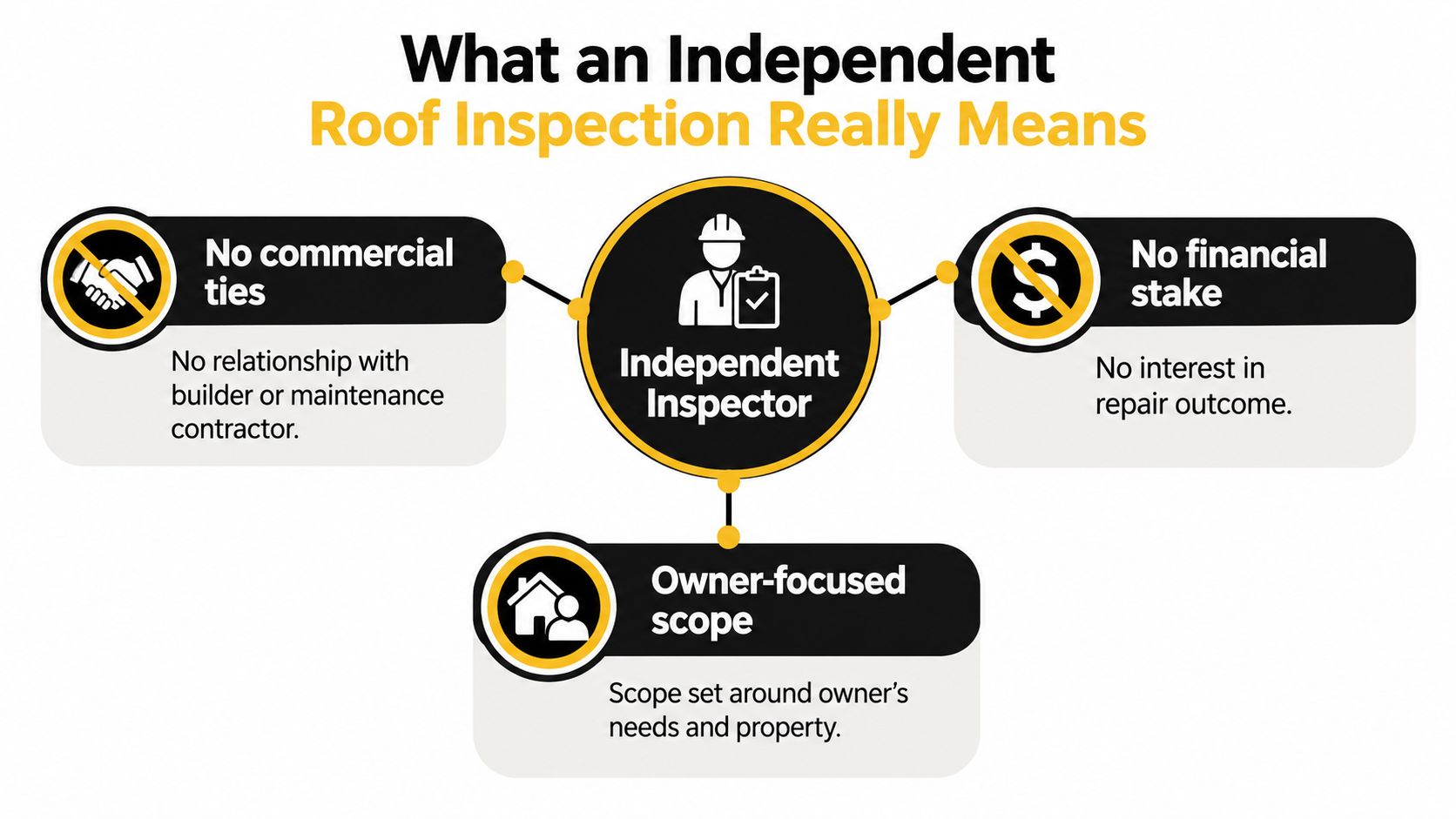
“Independent” should describe how the inspection is commissioned and conducted, not just what the report is called. In practical terms, the inspector shouldn't have commercial ties to the builder or maintenance contractor, shouldn't benefit financially from the repair outcome, and should work to a scope set around the owner's needs.
Different inspections answer different questions. A builder's handover inspection focuses on workmanship and completion against the agreed scope. A maintenance contractor's condition check may be shaped by the work that contractor can perform. An insurer's assessor considers the reported event and policy, and may focus on whether observed damage is consistent with a claim. Those inspections can each be useful, but they aren't automatically a substitute for a condition assessment commissioned to serve the property owner.
The reason an independent baseline matters is that defects can go unreported or unnoticed. Research published by the NSW Building Commission found serious defects in 53% of surveyed strata buildings, while only 36% of buildings with serious defects had been reported to the regulator. The research also identified waterproofing in 22% of newer buildings registered between 2022 and 2024. These findings describe strata buildings and don't mean that every serious defect is a roof defect, but they show why owners need reliable condition information outside the original builder or routine maintenance channel. (NSW Building Commission strata defects infographic)
Australian building-audit evidence also identifies roof and rainwater disposal as recurring defect categories. A study of 212 Australian building audit reports recorded 3,227 defects, and roof and rainwater disposal accounted for 8.58% of those defects. The study examined multi-residential audit reports, not all commercial roofs, so those figures shouldn't be treated as a failure rate for warehouses or factories. They do, however, place roof drainage and water ingress within Australia's broader building-defect record. (Australian building audit study summary)
An independent report can document visible condition, locate defects and recommend further investigation. It can't automatically establish the hidden cause of every leak, confirm concealed materials, or determine an insurer's liability. Know what the report proves, and what still needs testing.
Regulatory and Safety Duties That Shape the Inspection
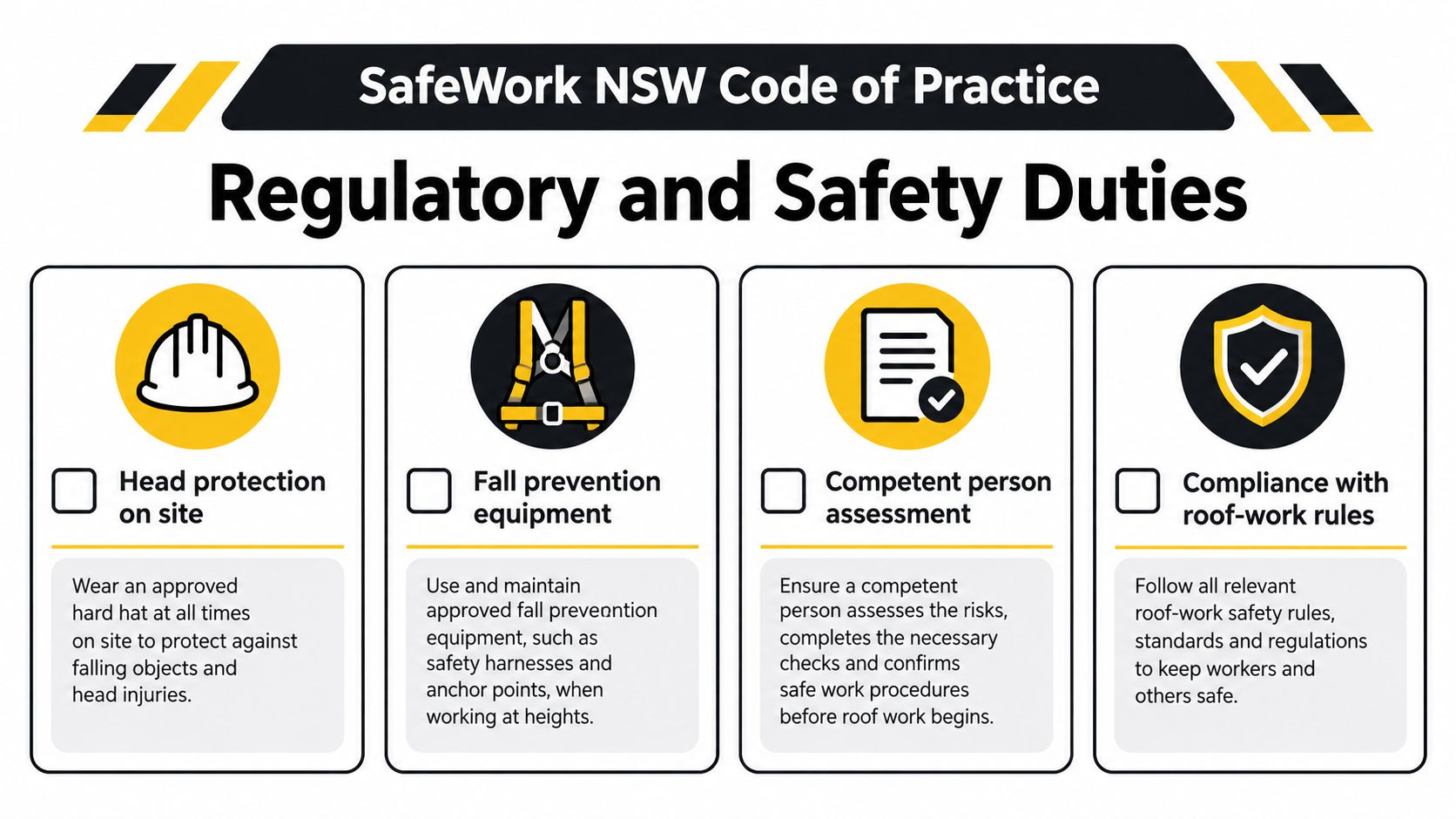
A roof inspection has to be safe before it can be useful. SafeWork NSW says an existing commercial or industrial roof must be assessed for the integrity of its safety mesh, the structural stability of the roof and supporting structure, sheet fragility, and hazards such as asbestos, skylights, electrical systems, radio-frequency equipment and chemical or biological contaminants. A competent-person assessment of these conditions is not an optional extra to a visual leak check. (SafeWork NSW code of practice for work on roofs)
If workers don't know whether sheets can carry their weight or whether safety mesh is intact, access itself can create a serious fall or breakthrough risk. A credible inspection plan therefore considers the access route and the condition of supporting members before anyone steps onto the roof. The report should record fragile zones, skylights, penetrations, edge protection and any areas that need to be isolated from access.
Asbestos needs its own clear control. Safe Work Australia identifies roofs and gutters as places where asbestos-containing materials may remain, and says only a competent person can identify asbestos in a workplace. Where exposure is possible, asbestos information must be made available to contractors and tradespeople before planned service, maintenance, refurbishment or demolition. (Safe Work Australia guide to rooftop solar installation risks)
Suspected fibre-cement roofing shouldn't be drilled, cut, pressure-cleaned, informally sampled or walked on until the material and its condition have been assessed under the relevant WHS controls. The report should mark suspected or confirmed areas on a roof plan, note visible deterioration and access restrictions, and refer to the site asbestos register. If a proposed repair may disturb the material, get specialist advice before requesting a repair scope or price.
An inspection that ignores access safety or suspected asbestos doesn't provide a sound condition record. It can expose workers to risk and leave owners without the information contractors need to plan work safely.
For a broader reference point on Australian requirements, consult this guide to roofing standards in Australia. The practical test is whether the report documents the relevant hazards and explains what should happen before maintenance proceeds.
Inside the Inspection Process and Its Deliverables
Before the site visit, the inspector should ask about the roof type, known leak locations, previous repairs, access arrangements and the reason for the inspection. Plans, maintenance records and any asbestos register can help the inspector prepare. If the building is occupied, the owner or manager should also identify tenant constraints, sensitive work areas and operational risks that may affect access.
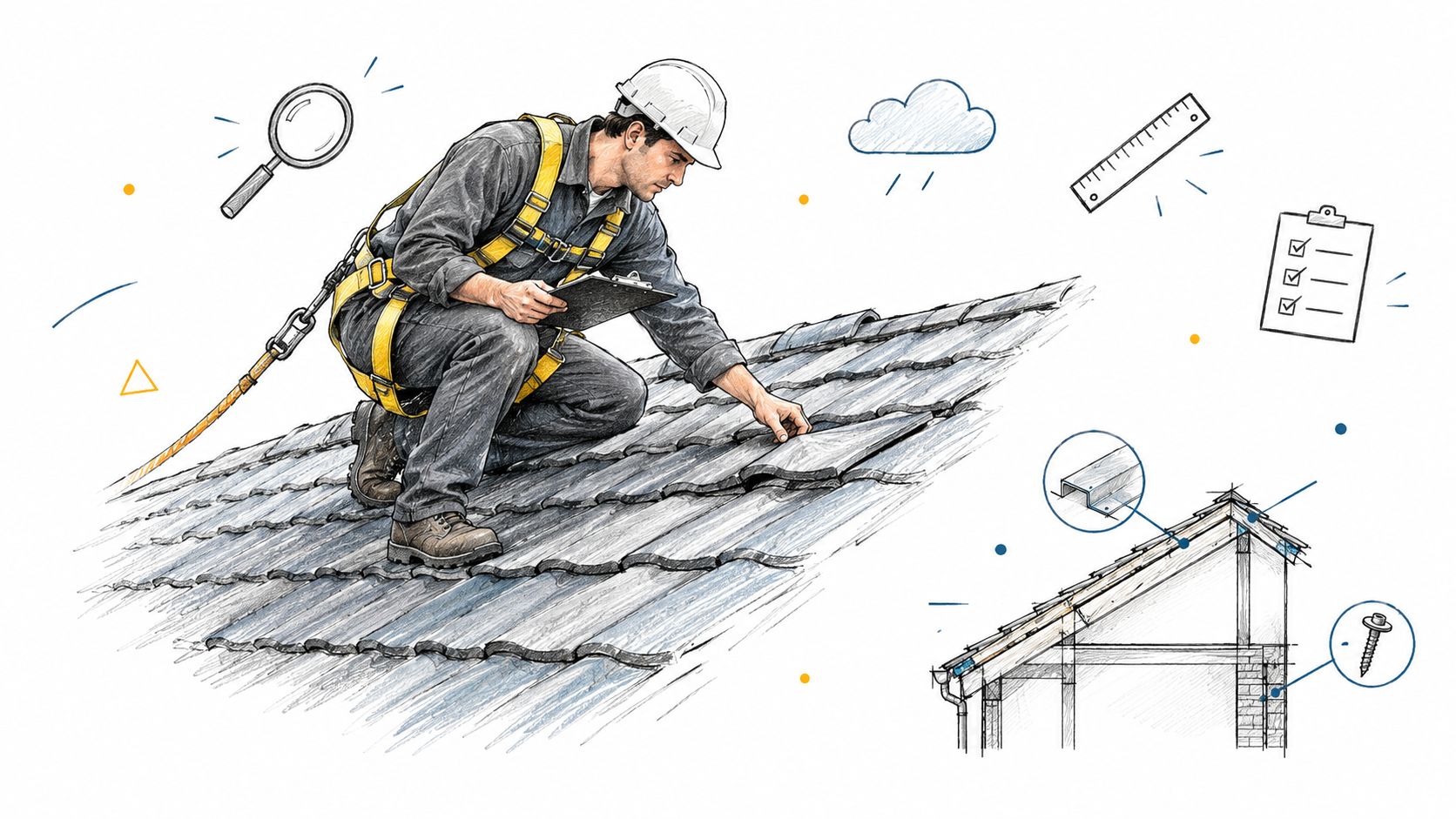
On site, the inspector confirms whether the planned access is appropriate before examining roof surfaces. Depending on the roof and safe access conditions, the assessment may cover sheets or tiles, fasteners, flashings, penetrations, gutters, box gutters, drainage paths, sealants, ponding, corrosion and prior repairs. Suspected asbestos-containing materials should be identified as a risk requiring competent assessment, not disturbed to get a closer look.
The observations should be connected to locations, not left as a list of general concerns. Photographs tied to a roof plan let the owner, contractor and insurer see where a defect sits and compare it with other findings. A report should also distinguish a confirmed visible condition from a suspected cause that needs further investigation.
A useful set of deliverables includes:
- Executive summary: The overall condition and the most important safety or water-ingress concerns.
- Defect register: Each finding's location, description, supporting photographs and severity.
- Annotated roof plan: Defects mapped to roof areas and access restrictions.
- Maintenance schedule: Actions grouped by urgency, with planned maintenance separated from immediate controls.
- Further investigation recommendations: For example, moisture mapping or specialist asbestos assessment where the visual inspection can't settle the question.
The report should flag immediate exclusion or isolation where an area may be unsafe, rather than placing that finding among routine maintenance items. It should also state the inspection's limits, including areas that couldn't be accessed or questions that require testing. These details matter when another contractor uses the report to price repairs or when an owner later needs to understand what was visible on the inspection date.
A short visual overview of inspection work can provide context for readers unfamiliar with the process.
How to Read the Report and Act on the Findings
A roof report is an action list, not a document to file and forget. Start with the overall condition rating, then check whether the defect register and roof plan explain how that rating was reached. The photographs should show each recorded issue clearly enough for the owner and contractor to locate it.
Severity labels only help if they lead to decisions. A report might group findings as immediate, short-term and planned, but the inspector should explain what each category means for safety, water ingress or asset planning. Immediate might mean isolate an unsafe area or address an active leak. Short-term can cover repairs that reduce the risk of deterioration. Planned items can be priced and included in future capital works, provided they don't create an unacceptable safety or operational risk while they wait.
| Defect | Location | Severity | Recommended Action | Timing |
|---|---|---|---|---|
| Loose flashing with signs of water entry | Roof junction above dispatch area | Immediate | Arrange safe access, repair flashing and check internal moisture | Promptly |
| Corroded fasteners | Warehouse roof, eastern bay | Short-term | Replace affected fasteners and inspect adjacent fixings | Schedule soon |
| Blocked box gutter | Loading-dock roof | Short-term | Clear the drainage path and check the outlet and adjoining lining | Schedule soon |
| Localised ponding | Low point near plant area | Planned | Investigate drainage falls and scope corrective works | Include in works planning |
This is an illustrative register, not a record of a particular site. In a real report, the inspector should identify the exact roof-plan reference, attach dated photographs and explain why the recommended timing matches the risk.
The inspector should escalate rather than just record a finding when access is unsafe, a leak threatens critical operations, suspected asbestos may be disturbed, or the roof structure appears compromised. The owner or manager can then decide who needs to respond, such as a suitably qualified roofer, an asbestos specialist or a structural engineer.
A commercial roof inspection report template can help owners understand the fields a report should contain. It isn't a substitute for a site-specific assessment, but it can help a committee or asset manager check whether the findings are clear enough to action.
What Drives the Cost of an Independent Inspection
There isn't a meaningful single price for every independent roof inspection. A quote depends on what the inspector needs to assess, how safely they can access it and how much detail the owner needs in the final report. A simple visual review from safe access points isn't the same scope as an inspection that requires complex access planning and defect mapping across several buildings.
The roof itself affects the work. Roof type and pitch influence access and the inspection method; height, fragile skylights and the condition of safety mesh can require more planning. A large roof or a portfolio of strata buildings takes longer to inspect and document than a single, straightforward structure. If tenants or active operations limit access, the inspector may need to coordinate timing and work zones with the property manager.
Suspected asbestos can also change the scope. An inspector can record suspected materials and access restrictions, but identification or sampling may need a competent specialist under the applicable controls. Owners should ask what the inspection includes and what additional specialist work, if any, is excluded.
Reporting depth matters too. A visual inspection, drone imagery and thermal methods don't answer identical questions. A drone can help document areas that are difficult or unsafe to approach, but imagery alone may not confirm the condition of a fastener, the underside of a sheet or a concealed leak path. Thermal methods can support further investigation, but the scope should make clear what the method can and can't establish.
Compare scopes, not just totals. A low quote that excludes access planning, a roof plan, dated photographs or severity grading may leave the owner paying for another assessment later.
To compare proposals, give each inspector the same information and request the same deliverables: areas to inspect, access assumptions, safety and asbestos limitations, reporting format, photographs, defect register and recommendations. That makes it easier to judge what the fee covers rather than choosing by headline price alone.
Choosing an Inspector You Can Trust to Be Independent
A credible inspector should be willing to explain how their business model supports impartial reporting. Ask directly whether they sell repairs, receive referral fees or have a commercial relationship with the builder or maintenance contractor involved. A disclosure doesn't automatically disqualify an inspector, but you should understand any potential conflict before commissioning the work.
Check qualifications against the actual scope. Roof access, work at heights and asbestos-related tasks have different requirements, and an inspector shouldn't imply that one licence or credential covers every activity. Ask which parts of the inspection they'll perform themselves and when they'll refer work to a competent specialist. Confirm professional indemnity insurance and ask for evidence of current cover.
The sample report is the clearest test of quality. Look for named defects, dated photographs, locations linked to a roof plan, severity ratings and recommendations that distinguish urgent controls from planned work. A report that says “roof in poor condition” without showing where or why gives the owner little basis for tendering or budgeting.
Before engaging, confirm the report format will meet the needs of the people who'll use it. An insurer may need evidence that separates observed damage from pre-existing deterioration. A strata committee may need clear locations and priority ratings. A builder handling warranty matters may have specific documentation requirements. Ask these parties what they'll accept rather than assuming every report format will suit every purpose.
Questions for the first call can quickly expose gaps:
- “Do you carry out or receive income from the repairs you recommend?”
- “What will the report include, and can I see a sample?”
- “How will you plan access and record fragile areas or suspected asbestos?”
- “What can't you confirm through a visual inspection?”
- “Who handles further investigation if you identify a structural or asbestos concern?”
Choose someone who answers plainly, describes limits and is comfortable recommending specialist advice where needed. Independence is a working arrangement backed by transparent reporting, not a label.
Next Steps Repairs, Maintenance Plans and Insurance Evidence
Once the report is complete, use it to define repair scopes. Give contractors the same defect locations and requested outcomes so their proposals can be compared on what they'll fix, what they'll exclude and how they'll manage access and safety. Add completed repairs to the property record, with invoices, photographs and any follow-up inspection notes.
For asset management, transfer relevant findings into the maintenance schedule and capital-works register. That makes it easier to track recurring defects, planned renewals and work that depends on further investigation. Commercial building performance and energy disclosure are also becoming more relevant to property decisions. Australia's low-energy-building trajectory discusses mandatory disclosure of NABERS ratings for commercial buildings, which gives owners another reason to record moisture, drainage and roof-envelope issues alongside visible damage.
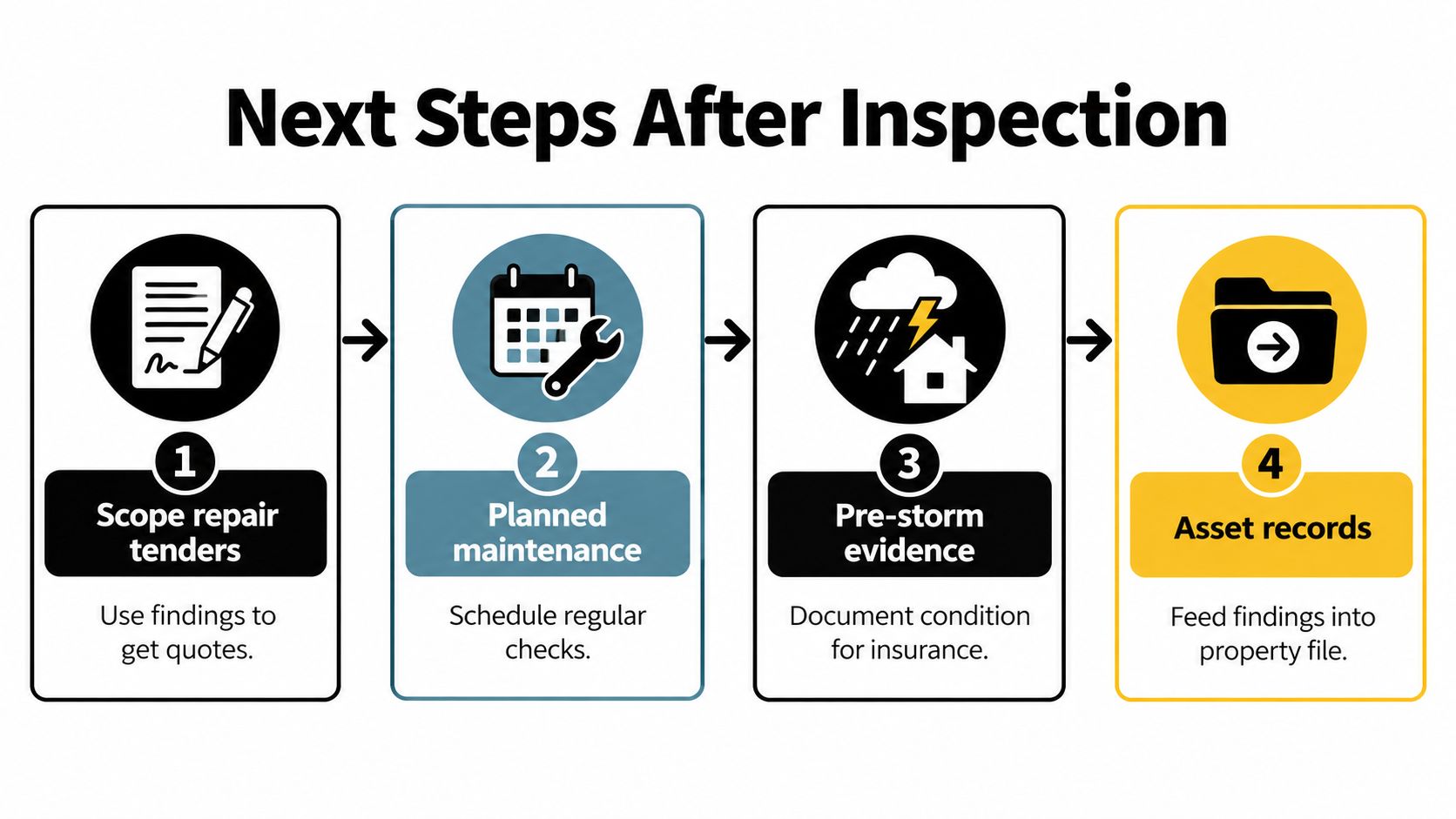
For insurance, preserve dated photographs, the defect map, maintenance history and records that distinguish existing deterioration from damage identified after an event. Australian claims data cited by Allianz indicates that winter storm incidents involving rainwater, lightning and wind generated almost A$60 million in claims in winter 2025, while 25% of surveyed Australians checked roofs or gutters before winter. That survey is residential, so it shouldn't be read as a measure of commercial roof inspections. It does reinforce the practical point: waiting for visible water inside can leave owners without a clear record of pre-event condition. (Allianz winter risk report)
How often should a commercial roof be inspected? Set a routine inspection schedule based on the roof, its condition, site risks and maintenance needs, and arrange an additional assessment when a significant change or concern warrants it.
When is an inspection urgent? Treat active leaks over critical operations, suspected structural concerns, unsafe access or possible asbestos disturbance as reasons to take prompt protective action and seek the right specialist advice.
Are drones enough? They can document visible surfaces, but they don't replace safe close assessment where that's needed to evaluate fixings, materials or concealed conditions.
What should we do about suspected asbestos? Restrict disturbance, check the asbestos register and obtain competent specialist advice before maintenance proceeds.
If you're planning an inspection or need a clear scope for commercial roof works, review the practical guidance on roofing and maintenance and align the next steps with the report's findings.
Commercial Roofers provides roof inspections and detailed reporting for commercial and industrial properties across Greater Sydney, including documented findings, photographs and recommendations. If you need an independent condition baseline or a clear scope for follow-up work, contact Commercial Roofers to discuss your site and inspection requirements.