
A Sydney warehouse owner can do everything that appears sensible. The roof is replaced, the handover file includes a manufacturer's certificate, and the contract highlights a long product warranty. Two winters later, water appears beside stored stock. The manufacturer says the product is sound and directs the owner to the installer. The installer says the flashing or drainage detail isn't covered by the product warranty. The owner is left with a wet ceiling, an urgent access problem and a dispute over which document controls.
That situation is common because a roof replacement warranty isn't one promise. It's a collection of separate protections, each with its own responsible party, start date, exclusions and evidence requirements. A warehouse, factory, strata scheme or development needs to distinguish manufacturer coverage, installer workmanship, statutory rights, insurance and the contract terms that connect them.
Table of Contents
- What a Roof Replacement Warranty Really Covers
- The Three Layers of a Commercial Roof Warranty
- Manufacturer Warranty Versus Workmanship Warranty
- How the Warranty Claim Process Actually Works
- Common Exclusions and How to Defend Your Coverage
- Sample Warranty Clauses and a Pre-Contract Checklist
- Choosing the Right Warranty for a Commercial Asset
What a Roof Replacement Warranty Really Covers
A roof warranty usually involves three core questions:
- What failed? The sheet, membrane or coating, or the way it was installed?
- Who promised to fix it? The manufacturer, roofing contractor, insurer or another party?
- What conditions apply? Maintenance, access, approved products, notice periods and permitted alterations can all affect a claim.
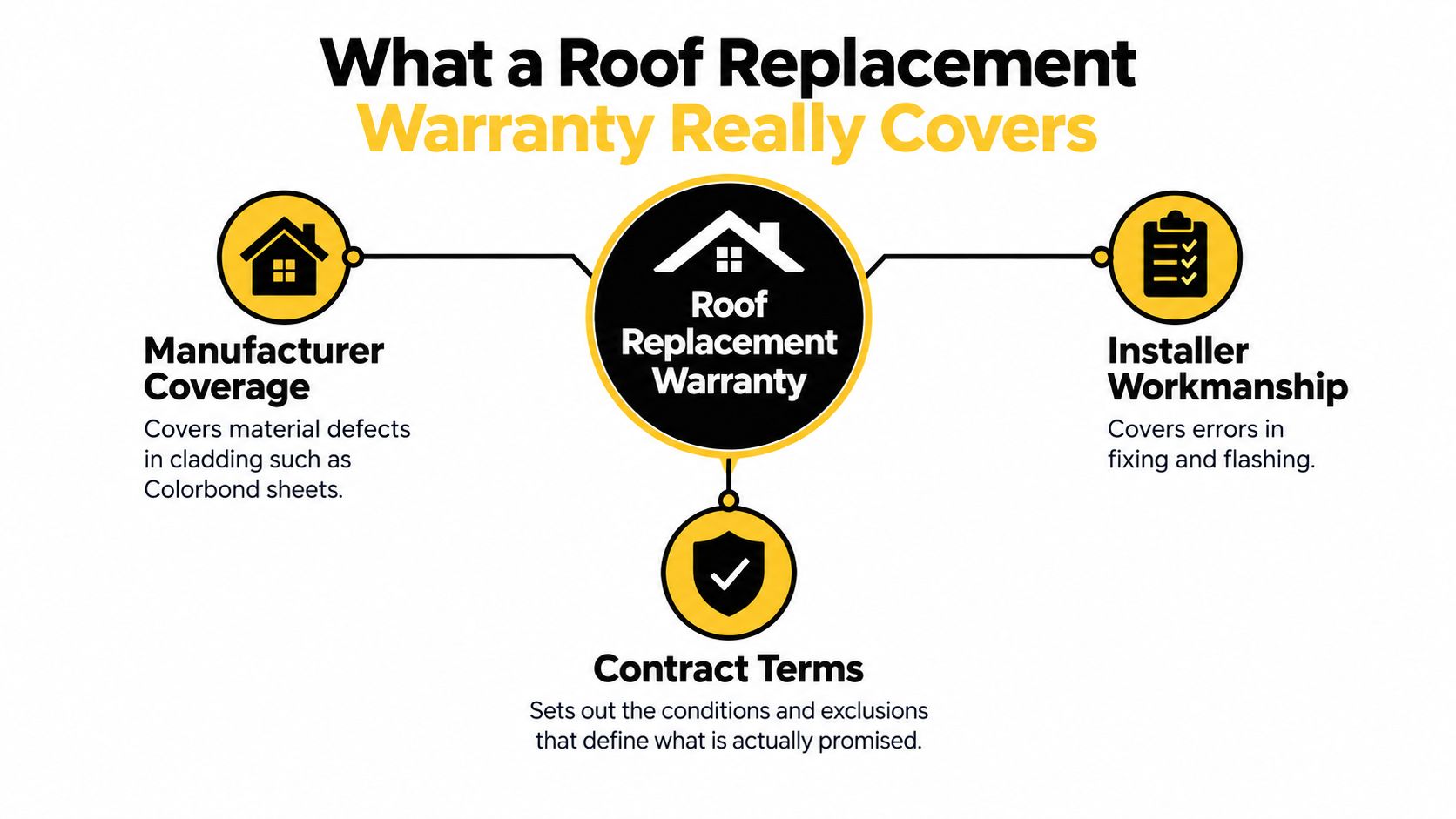
A product certificate may cover defects in steel, coating or membrane material. It usually won't automatically cover a back-pitched box gutter, poorly sealed penetration, incorrect fasteners or flashing installed without adequate fall. Those are generally questions of workmanship and contract scope.
The protection layers owners often confuse
Manufacturer coverage applies to the specified roof product or system. Depending on the product, the promise may concern material defects, coating performance or perforation. The owner must still check the exact certificate, because coverage can depend on approved installation, maintenance and the building's environment.
Workmanship coverage comes from the contractor. It should address the quality of installation, including fixing patterns, laps, flashings, penetrations, sealants, drainage details and interfaces with existing construction. A contractor's guarantee is only useful if it identifies the work covered and the response required when a defect appears.
Statutory rights sit separately from a voluntary warranty. NSW Government guidance describes residential building warranties for contracts signed on or after 1 February 2012 as six years for major defects and two years for other defects, measured from completion, with an additional six months to begin enforcement or dispute-resolution action where a defect appears during the final six months of the applicable period. Those rules apply to residential building work, not automatically to every commercial roof replacement, so a commercial owner needs negotiated terms in the contract. The NSW contract guidance is a useful benchmark, not a substitute for project-specific legal advice.
Australian Consumer Law guarantees can also operate alongside a written warranty. A voluntary warranty against defects does not erase applicable rights, and the NSW Government explains that service and acceptable-quality obligations may continue after a limited warranty ends. The NSW warranty guidance sets out the distinction.
For a deeper explanation of the documents and responsibilities, review this guide to what a roof warranty covers. Before signing, ask for every certificate, exclusion, commencement date, maintenance condition, transfer rule and claim procedure in writing.
The Three Layers of a Commercial Roof Warranty
A warranty schedule showing one figure, such as 20 years, can conceal three different responsibilities. The contract should separate the product promise, installation obligations and legal or insurance protections, then identify when each begins and who can enforce it.
Manufacturer warranty
The manufacturer's certificate follows the named roof product or system, whether that is Colorbond sheeting, architectural metal cladding, a membrane, coating, fasteners or another specified component. Before accepting it, match the certificate to the building, approved use, installation method and exact system. The wording may address material defects, coating failure or perforation, subject to its exclusions and maintenance conditions.
A product certificate does not automatically make the whole roof watertight. A defective sheet and a poorly formed flashing can send water into the same room while creating different warranty pathways. The first issue may require a manufacturer claim. The second may require the installer to rectify its work.
Installer warranty
The workmanship warranty should cover the completed installation, not merely the roof sheets. Confirm that the scope includes:
- Fixings and laps, including the specified fastener type and installation pattern.
- Flashings and penetrations, including skylights, pipes, plant supports and wall junctions.
- Drainage details, including box gutters, sumps, overflows and outlets.
- Sealants and interfaces, particularly where new work joins retained construction.
- Rectification labour, access, removal and reinstatement when the contractor accepts responsibility.
This wording matters on warehouses, factories and strata buildings, where a leak can involve several trades or areas of retained construction. A certificate naming the steel or membrane alone leaves no clear promise about defective detailing, access costs or repair labour.
Contract, statutory and insurance context
The commercial contract should state each warranty's commencement point. Define whether that means practical completion, handover or final rectification. It should also identify the claimant, response time, maintenance duties and transfer rights for a purchaser or successor owners corporation.
NSW's residential statutory baseline can help test whether commercial wording is clear, but it should not be copied into a warehouse or industrial contract without checking the applicable legal framework. Victorian guidance distinguishes consumer guarantees and implied building warranties from a manufacturer's product promise, and states that building work must use suitable materials and reasonable care and skill. Consumer Affairs Victoria's warranty guidance also explains that some domestic protections may transfer to a new owner. Commercial owners should not assume the same regime applies unchanged.
Practical rule: If the schedule does not identify the roof system, commencement date, exclusions, maintenance duties and responsible party, it is not ready for signature.
An insurance-backed warranty may protect an owner if the original contractor becomes insolvent. Check its coverage, deductible, eligibility requirements and exclusions. It supports the contractor warranty, but does not replace clear contract wording or maintenance records.
Manufacturer Warranty Versus Workmanship Warranty
The clearest way to test a roof replacement warranty is to place the two voluntary protections side by side. A manufacturer deals with the product. The roofer deals with the installation. A leak can involve one, the other or both.
| Element | Manufacturer Warranty | Workmanship Warranty |
|---|---|---|
| Primary promise | The specified roof product or system is free from covered material defects | The contractor installed the roof correctly and in accordance with the agreed scope |
| Typical issue | Defective coating, failed material or product deterioration within the stated coverage | Incorrect fixing, poor flashing, failed penetration detail, open lap or defective drainage work |
| Responsible party | Product manufacturer or approved warranty provider | Roofing contractor |
| Common exclusions | Incorrect installation, unauthorised alterations, unsuitable use, environmental exposure or neglected maintenance | Existing defects, work by other trades, owner alterations, lack of maintenance or damage outside the contractor's work |
| Evidence required | Product certificate, batch information, approved system details, installation records and photographs | Contract scope, drawings, handover records, inspection reports, photographs and notice of defect |
| Claim risk | The manufacturer may say the product was installed or maintained incorrectly | The contractor may say the failure comes from the product, another trade or an excluded event |
A 10-year material warranty doesn't automatically cover ten years of installation labour. If a Colorbond sheet performs as specified but a box gutter was back-pitched at handover, the product certificate won't solve the drainage defect. The workmanship schedule needs to allocate that responsibility directly.
The reverse can also happen. A contractor may install a product correctly, but the material can fail within its covered scope. In that case, the owner needs the manufacturer's certificate and claim process, not only a promise from the roofer.
Ask these three questions before accepting the schedule:
- Which failures belong to the manufacturer and which belong to the installer?
- Who pays for investigation, access, temporary weatherproofing, removal and reinstatement?
- What happens if both a material problem and an installation problem contribute to the same leak?
Read the product conditions alongside the contractor's scope. Guidance on how long a Colorbond roof lasts may help with material selection, but expected service life and enforceable warranty coverage are separate issues.
How the Warranty Claim Process Actually Works
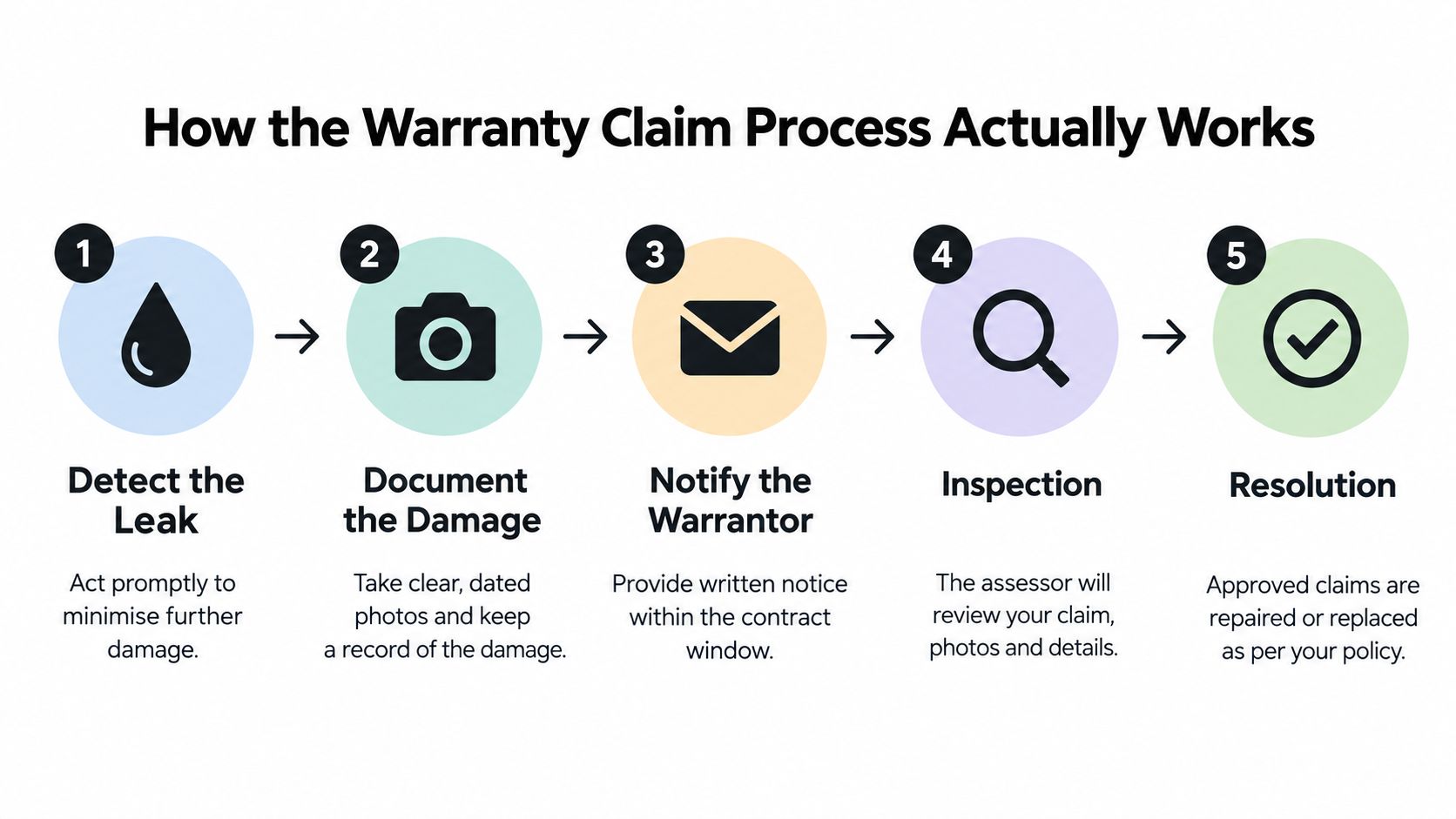
A warranty dispute becomes harder when the owner treats the first leak as an informal maintenance request. Run it as a controlled defect event, preserve the evidence and notify every relevant party without admitting the cause.
Start with safety and containment
- Make the area safe. Protect people, stock and electrical equipment. Use temporary containment only where it can be done safely, and record who authorised the work.
- Record the first signs. Note the date, weather conditions, location, affected rooms and any visible roof or ceiling damage. Take wide and close photographs with timestamps.
- Prevent avoidable damage. Move stock, isolate affected equipment and arrange temporary weatherproofing where necessary. Keep invoices and photographs because the contract may allocate those costs differently depending on the cause.
Don't cut open the roof or remove flashings before the responsible parties have had a reasonable opportunity to inspect, unless emergency safety or damage-control work requires it.
Identify the correct warranty path
Check whether the failure appears to be:
- A material defect, such as deterioration or failure in the specified sheet, membrane or coating.
- A workmanship defect, such as an open lap, failed flashing, incorrect fastener or defective penetration.
- An external event, such as storm impact, fire, damage by another trade or chemical exposure.
- A maintenance issue, such as blocked gutters, neglected sealants or unapproved rooftop access.
Notify the contractor and manufacturer where the cause isn't yet clear. Send the contract, warranty certificates, photographs, roof plan, completion records and maintenance history. A written notice should identify the location, observed symptoms, date first noticed and action requested.
Manage inspection and resolution
The claim schedule should contain a response time, inspection process and rectification period. During inspection, ask the assessor to record the suspected entry point, contributing conditions, affected components and proposed repair. A vague statement that the roof “needs attention” isn't enough for a commercial asset.
Coordinate the building insurer where storm, fire or consequential internal damage is involved. The roof repair and damage to stock, plant, ceilings or finishes may follow different claim paths. Asbestos work needs the same discipline. Where removal or disturbance is required, use the appropriate licensed professionals, isolate the work area and ensure the repair sequence doesn't compromise the warranty record.
Keep a claim register with every email, call, photograph, report, invoice and site attendance. Use a detailed commercial roof inspection report template to give the facility manager or strata committee a consistent record.
A successful claim is easier to prove when the owner can show what failed, when it failed, who was notified and what maintenance occurred beforehand.
Common Exclusions and How to Defend Your Coverage
Most warranty arguments don't begin with the headline term. They begin with a condition hidden in the exclusions or maintenance section.
A contractor may accept that water entered the building but argue that a blocked box gutter caused the overflow. A manufacturer may accept that a sheet deteriorated but say an unauthorised penetration or chemical exposure contributed to the failure. The owner's evidence needs to address both the defect and the alleged exclusion.

Turn each exclusion into a control
Neglected maintenance. Arrange documented inspections, clean gutters and box gutters, check sealants and fasteners, and photograph conditions after service. NSW Government guidance recommends keeping the roof maintained and checking warranties and service arrangements before work proceeds. Its guidance on keeping new work trouble-free provides a practical basis for formalising those duties in a commercial maintenance plan.
Unauthorised penetrations. Require written approval before solar, HVAC, signage, cable routes or plant supports are fixed to the roof. Record the installer, location, fixing method, sealant and flashing detail. A third-party trade can create a leak and leave the original roofer defending work it didn't perform.
Roof traffic. Mark approved access routes and protect fragile sheets, skylights and flashings. Keep visitor and contractor records so a later claim doesn't depend on recollection.
Chemical exposure. Identify exhausts, processing fumes, wash-down chemicals and stored substances during design. Require the contractor and manufacturer to confirm suitability where the environment is aggressive.
Storm or impact damage. Photograph the roof promptly after severe weather and notify the building insurer where appropriate. Separate storm damage from pre-existing defects and retain any temporary repair records.
Consequential damage. The roof warranty may address the defective roof work without automatically covering stock, equipment, internal finishes or business interruption. Ask the contract to state who pays for inspection, access equipment, temporary weatherproofing, labour, removal and reinstatement.
For strata schemes, the owners corporation should retain the warranty, service reports, approvals and photographs in a central asset file. The practical requirement is continuity. A committee change or building manager change shouldn't erase the evidence needed to support a legitimate claim.
Sample Warranty Clauses and a Pre-Contract Checklist
A commercial owner doesn't need ornate legal wording to improve a warranty schedule. The document needs clear responsibility, measurable procedures and enough detail for a new facility manager to use it later.
Three plain-English clause examples
Duration and commencement
The Contractor warrants that the roof replacement work, including fixings, flashings, penetrations, drainage interfaces and sealants within the agreed scope, will be free from defects caused by workmanship for the period stated in Schedule A. The workmanship warranty starts on practical completion of the roof replacement, subject to completion of the agreed defect rectification. The Manufacturer Warranty is separate and starts on the date stated in the manufacturer's certificate.
Maintenance and exclusions
The Owner must carry out the maintenance tasks listed in Schedule B and keep dated service records, photographs and invoices. An exclusion applies only to the extent that the Owner's failure, unauthorised alteration or third-party work caused or contributed to the claimed defect. Routine maintenance does not transfer responsibility for defective workmanship or defective materials to the Owner.
Claim and response procedure
The Owner may notify a claim by email using the contact details in Schedule C. The Contractor must acknowledge the notice, arrange an inspection within the agreed response period and provide a written finding and rectification proposal. Emergency temporary works may be undertaken to prevent further damage, with responsibility for reasonable costs determined after the cause is assessed.
Have a solicitor review the final wording, especially for complex developments, strata assets, asbestos removal and insurance-backed products.
Handover checklist
Before signing or reaching practical completion, confirm:
- Scope: Roof areas, substrates, flashings, gutters, penetrations, access systems and exclusions are identified.
- Product system: Product names, profiles, coatings, membranes, fasteners and installation instructions are recorded.
- Responsible parties: Manufacturer, contractor, insurer and any specialist subcontractor are named.
- Commencement: Each warranty has a clear start date and completion trigger.
- Evidence: Drawings, photographs, moisture records, batch details, compliance documents and inspection reports are included.
- Maintenance: Cleaning, inspection, traffic, sealant, fastener and third-party trade requirements are written down.
- Transfer: The schedule states whether coverage transfers on sale or to a new owners corporation.
- Insurance: Roof failure, storm events, consequential damage and temporary works are allocated between warranty and insurance.
- Asbestos: Licensed removal, disposal records, safe access and interfaces with the replacement work are addressed where relevant.
- Consumer rights: The document doesn't purport to remove rights that cannot lawfully be excluded.
A warranty certificate without the handover evidence is a weak file. The records show what was installed, how it was installed and what the owner did afterwards.
Choosing the Right Warranty for a Commercial Asset
Three principles usually produce a stronger result than chasing the longest headline term.
First, treat the roof replacement warranty as a risk schedule, not a single number. Separate product defects, workmanship, statutory rights, insurance and consequential damage. Second, write maintenance and access conditions around the actual building. A factory with rooftop plant needs different controls from a lightly accessed warehouse. Third, plan for contractor insolvency or refusal by examining insurance-backed options and transfer provisions before work starts.
The decision depends on the asset:
- Strata scheme: Prioritise transferability, common-property records, committee approval controls and a clear process for owners corporation claims.
- Warehouse: Prioritise weather tightness, drainage, stock protection, temporary works and fast inspection response.
- Industrial facility: Prioritise chemical exposure, rooftop plant, third-party access, penetrations and coordination with insurers.
- Developer or builder: Prioritise document control, compliance records, defects procedures and handover obligations.
Ask the contractor to show where each answer appears in the contract. If it's only discussed in a sales meeting, it isn't yet a dependable warranty protection.
Commercial Roofers offers Sydney commercial and industrial roof inspections, roof replacement, asbestos roof removal and replacement, gutter and box gutter work, and documented material and workmanship warranty records. To discuss a roof replacement scope with clear warranty responsibilities, visit Commercial Roofers .