
Commercial roof replacement in Sydney can start around $25,000 for a small job and run to $1M+ for a large industrial facility, depending on roof size, material, access, and remediation scope. If you're pricing a standard commercial replacement, broad Australian market guides also place many projects in the $15,000 to $60,000 range before larger industrial scale, premium systems, or hidden site issues push the budget higher.
If you're reading quotes for a warehouse, retail strip, strata block, or factory right now, you're probably seeing numbers that vary far more than expected. One contractor gives you a fast ballpark. Another asks about asbestos, crane access, box gutters, and structural steel. That gap isn't just sales style. It usually reflects whether the quote has dealt with the actual risks on site.
A commercial roof isn't a cosmetic upgrade. It's weather protection, compliance, tenant protection, operational continuity, and a capital works decision. The only useful way to look at prices for a new roof is through that lens.
Table of Contents
- Understanding Commercial New Roof Prices in Sydney
- What Really Drives the Price of a New Commercial Roof
- Uncovering the Hidden Costs in Roof Replacement
- Commercial Roof Replacement Costs in Sydney by Project Size
- How to Budget and Procure Your New Roof Project
- Beyond the Upfront Price The ROI of a Quality Roof
- New Roof Price Questions from Strata Managers and Developers
Understanding Commercial New Roof Prices in Sydney
If you manage a building, the quote rarely lands at a convenient time. It's usually after leaks have started affecting stock, a tenant has complained, or an inspection report has turned a maintenance item into an urgent project. At that point, a rough figure isn't enough. You need a budget that reflects what the roof requires.
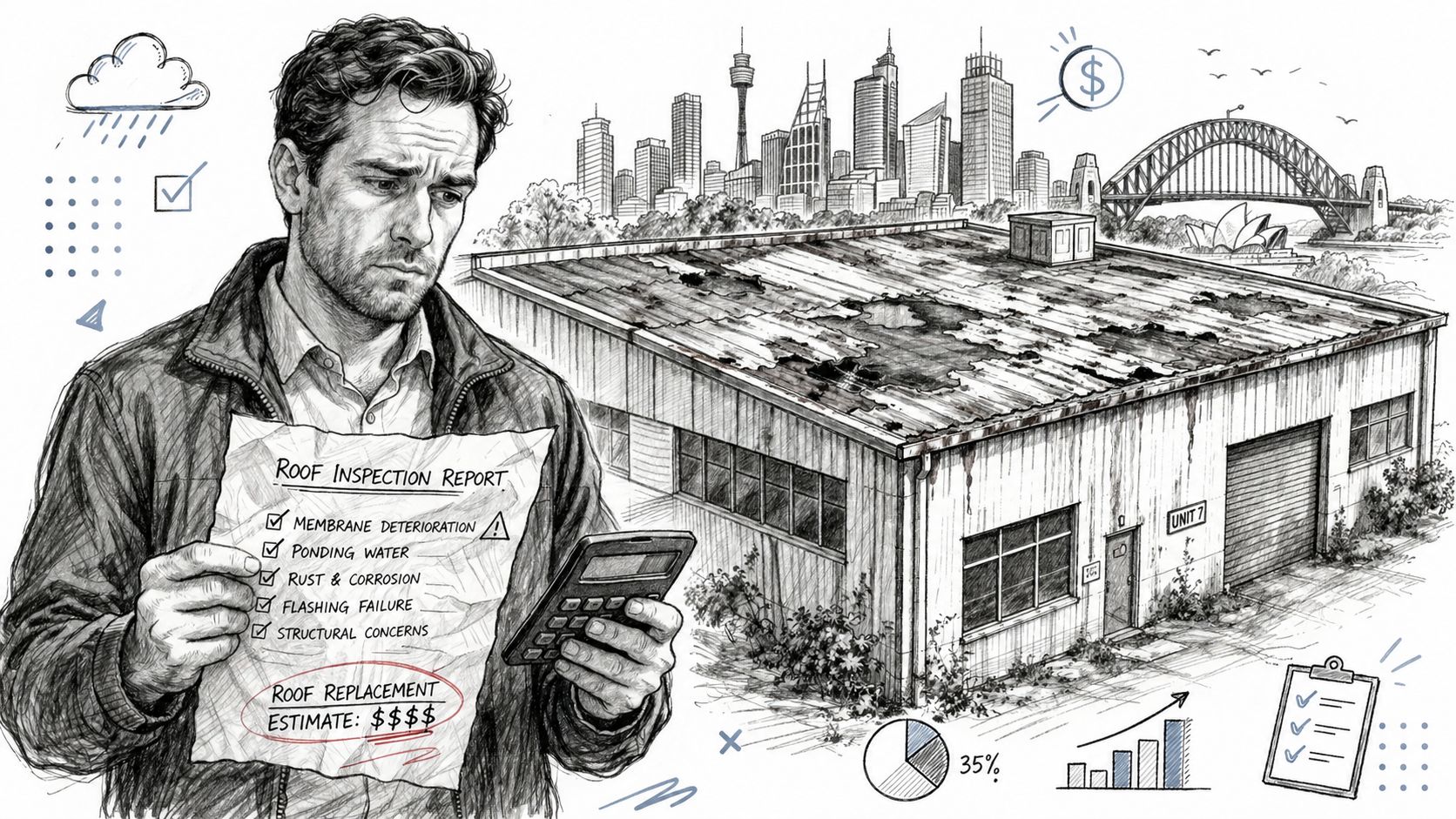
Sydney commercial roofing prices swing because commercial roofs aren't one product. A small retail unit with easy access and straightforward sheeting is one type of project. A live warehouse with height constraints, fragile sheets, drainage issues, and staged works is another.
What matters most is whether the pricing accounts for the full scope. That means not just sheets and labour, but also safe access, compliant removal, flashing details, gutters, penetrations, drainage points, and the condition of the structure underneath.
Practical rule: If a quote looks much lower than the rest, check what it excludes before you treat it as a saving.
For facility managers and developers, the primary job is to separate a usable budget from a hopeful estimate. That starts with asking a few direct questions:
- What roof system is being priced: Metal sheet replacement, membrane system, roof-over, or full strip and replace.
- What site assumptions are built in: Crane, scaffolding, edge protection, traffic control, and after-hours work.
- What happens if defects are uncovered: Rusted purlins, wet insulation, rotten timber, or non-compliant prior repairs.
- What compliance work is included: Waste handling, safety systems, and documentation for the completed project.
A commercial roof quote should read like a scope document, not a single lump sum. If it doesn't, the number is less reliable than it looks.
What Really Drives the Price of a New Commercial Roof
A sound commercial roofing quote usually comes down to three cost groups. Materials set the base. Labour adjusts for complexity. Access and safety can move the price sharply, especially on larger Sydney sites or occupied premises.
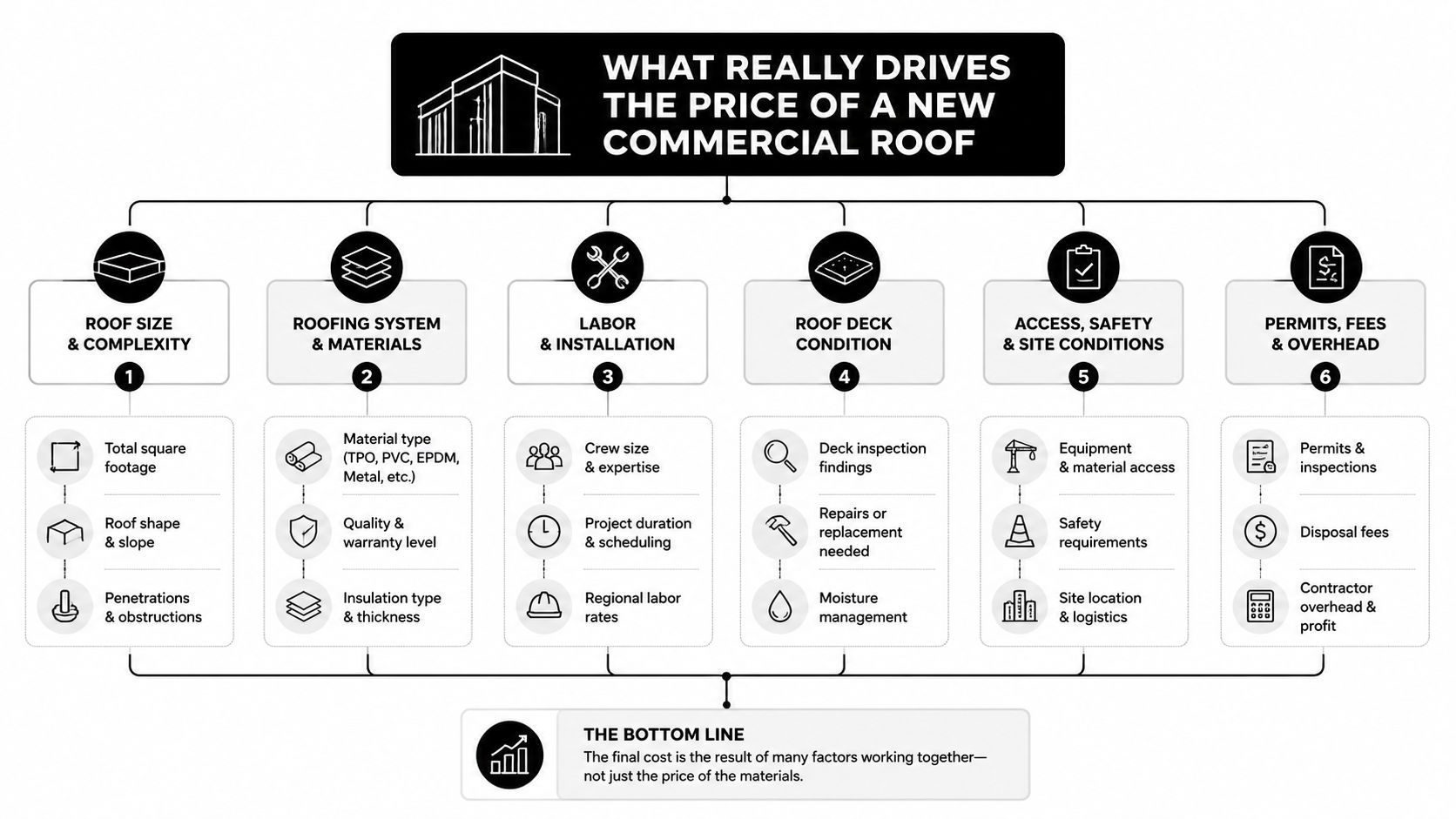
Materials set the baseline
Material choice isn't just about upfront rate. It changes service life, maintenance profile, detailing requirements, and suitability for the building's use.
Australian guides place long-run metal roofing from about $56 per square metre, metal roof tiles at $50 to $70 per square metre, and copper from around $190 per square metre plus GST, with copper offering a lifespan of up to 200 years according to Refresh Renovations' roof cost guide. On commercial work, you'll also see regular discussion around Colorbond steel, Zincalume, and membrane systems such as TPO, with the final choice driven by exposure, detailing, and the building's performance goals.
For many industrial buildings, metal sheet systems remain the practical default because they suit large spans, can be detailed around penetrations, and are familiar to maintenance teams. Premium architectural metals have their place, but they need a client who values longevity, appearance, and specialised detailing enough to support the higher initial spend.
If you're weighing common steel options, this comparison of Zincalume vs Colorbond for commercial roofing is useful because the finish, environment, and expected maintenance burden matter more than many buyers expect.
Labour follows complexity
Two roofs with the same area can need very different labour inputs. That's because labour isn't just installation time. It's set-up, strip-off, cut-in work around services, weatherproof staging, flashing fabrication, and quality control.
Simple roof planes with clear access price more cleanly. Costs rise when the roof has:
- Multiple penetrations: Plant platforms, ducts, skylights, pipes, and cabling all slow production.
- Complex geometry: Valleys, parapets, level changes, and awkward junctions create more detail work.
- Live-site constraints: Noise limits, tenant coordination, and staged areas reduce installation efficiency.
- Specialised systems: Some profiles and membranes need crews with narrower installation experience.
A cheap labour allowance often means the contractor has assumed a cleaner roof than the one you actually have.
Access and safety change the budget fast
Commercial roofing in Sydney often lives or dies on access planning. If the crew can't move material safely and legally, the job won't stay on budget.
That can include scaffolding, cranes, aerial work platforms, perimeter protection, exclusion zones, and controlled loading areas. On a straightforward low-rise building, access may be manageable. On a dense urban site, school, medical facility, or occupied strata complex, access can become a major line item.
The mistake buyers make is treating access as overhead. It isn't. Access is part of production and risk control. When a quote includes proper safety planning, it may look dearer at first glance, but it's often the more realistic number.
Uncovering the Hidden Costs in Roof Replacement
Most budget blowouts don't come from the visible roof surface. They come from what sits under it, around it, or inside the compliance process. Consequently, many low initial estimates fall apart.
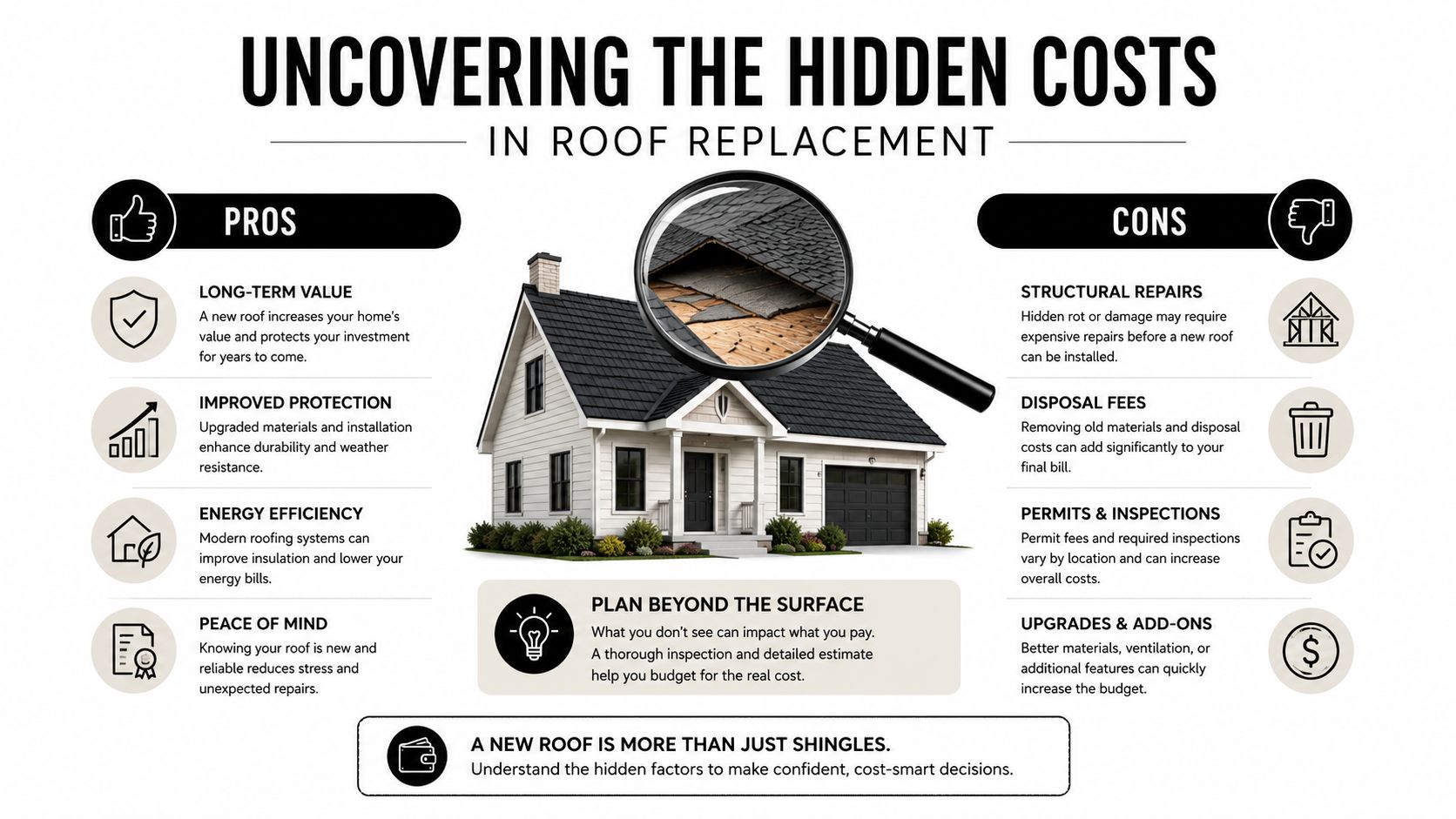
A widely cited NSW pricing gap is that hidden structural repairs or asbestos disposal can inflate roofing costs by 30 to 50 per cent, and asbestos roof removal alone adds $15,000 for a 100 sqm home, pushing total costs from $22k to $37k+, as outlined in Hipages' roofing cost guide. That example is residential, but the lesson applies directly to commercial budgeting. Once hazardous material handling or concealed defects enter the job, the original figure can stop being relevant.
Asbestos changes everything
On older commercial and industrial buildings, asbestos cement roofing and associated components are still a serious pricing variable. Removal isn't just demolition. It can involve licensed handling, controlled packaging, compliant transport, disposal, site controls, and clearance processes.
That affects programme as well as price. A contractor who prices asbestos casually is usually underpricing the work or leaving key tasks out of scope.
To see the issue in practical terms, this short clip gives a useful site-level view of roof replacement realities:
Structural repairs are often discovered after strip-off
Commercial roofs often hide corroded purlins, timber decay, failed fastener zones, and wet sections around gutters or penetrations. These defects aren't always visible during a ground inspection or even from the roof surface.
That's why responsible quotes often separate base scope from latent conditions. It isn't evasive. It's honest procurement. If the contractor promises a fixed figure without discussing substrate condition, ask how they intend to handle discoveries once the roof is open.
Common hidden structural items include:
- Purlin repair or replacement: Corrosion near laps, gutters, and fixing points.
- Timber replacement: Older structures can hold rot longer than expected under chronic leaks.
- Insulation replacement: Wet or degraded insulation often has to come out during full replacement.
- Drainage metalwork: Box gutters, sumps, and downpipe junctions are frequent failure points.
Compliance upgrades aren't optional
This is the part many owners resent paying for until they need it. A roof replacement can trigger related work that isn't visible in a glossy proposal but is necessary for legal, safe delivery.
On commercial projects, the lowest quote is often the one that assumes the fewest obligations.
Expect scrutiny around insulation performance, roof drainage, penetrations, edge protection, and safe access. If you're planning around a single all-in number, make room for the possibility that the actual cost sits in the compliance detail, not just the sheeting.
Commercial Roof Replacement Costs in Sydney by Project Size
For budgeting, size is still the fastest way to frame a commercial roof project. It won't tell you everything, but it does help anchor early discussions with owners, strata committees, and finance teams.
A practical cost table
For large-scale industrial roof replacements in Australia, small commercial roofs of 200 to 500 m² range from $25k to $110k+, medium facilities of 500 to 1,500 m² from $60k to $350k+, and large facilities of 1,500 m²+ from $250k to $1M+, based on commercial roof replacement cost ranges published for Australian industrial projects.
| Project Type | Typical Size (m²) | Estimated Total Cost Range |
|---|---|---|
| Small commercial unit or retail | 200 to 500 | $25k to $110k+ |
| Medium industrial warehouse | 500 to 1,500 | $60k to $350k+ |
| Large distribution centre or strata complex | 1,500+ | $250k to $1M+ |
These are broad market ranges. They aren't a substitute for site inspection, but they're useful for first-pass capital planning.
If you want a closer look at how one common system is usually priced, this breakdown of Colorbond roof installation cost on commercial projects helps show why profile choice and detailing matter.
Why two similar-sized roofs can price very differently
A 500 m² roof with open access, simple geometry, and standard sheeting won't behave like a 500 m² roof above tenants with plant penetrations, drainage problems, and restricted loading. Size matters, but scope quality matters more.
Use the table as a screening tool, then test each quote against three commercial realities:
How complex is the roof form
A clean run of sheet is faster than a roof broken by services, parapets, and internal gutters.How difficult is the site
CBD access, school hours, resident interface, or crane dependency can reshape labour planning.How much remediation sits behind the visible roof
Once substrate, drainage, or hazardous materials are involved, the project behaves less like a simple replacement and more like partial reconstruction.
A sensible Sydney budget usually combines a base replacement number with a contingency approach for latent defects and access complications. That makes board approvals easier because the logic is visible from the start.
How to Budget and Procure Your New Roof Project
The best roof procurement process isn't the one that gets the lowest first number. It's the one that gives you a quote you can rely on when the works start.
Commercial roof replacements in Australia often sit in a broad $15,000 to $60,000 range, with materials alone accounting for $15,000 to $30,000 depending on area and quality, according to Holy Mess Repairs' Australian roof replacement overview. For Sydney buyers, that reinforces one key point. A meaningful quote has to show what material standard is being allowed for, not just a total.
Build a quote request that gets useful pricing
If your request for tender is vague, your responses will be vague too. Ask each contractor to price the same scope assumptions wherever possible.
Include the basics:
- Existing roof information: Age, known leaks, prior patching, and any asbestos history.
- Building use: Occupied warehouse, retail, medical, strata, or live industrial operation.
- Site constraints: Trading hours, loading access, neighbours, noise restrictions, and traffic controls.
- Required inclusions: Removal, disposal, flashings, gutters, downpipes, penetrations, access systems, and clean-up.
A good starting point is reviewing what goes into a proper installation scope for roof works before you send the enquiry out.
Compare quotes line by line
Don't compare three lump sums and call that due diligence. Compare the assumptions underneath them.
Create a side-by-side matrix and check:
- What material has been nominated: Generic "metal roof" isn't enough.
- What preparatory works are included: Strip-off, substrate inspection, replacement of damaged sections.
- How access is handled: Scaffolds, crane lifts, edge protection, site isolations.
- What exclusions appear at the end: Many budget problems are hiding there.
Tender advice: If one contractor hasn't clearly listed exclusions, ask for them in writing before you accept the quote.
Check warranties permits and delivery risk
Roofing warranties only help if you know who stands behind what. Separate the manufacturer's material warranty from the installer's workmanship warranty, and make sure both are documented.
Also check licences, insurance, safe work procedures, and who will perform the job. In-house crews and subcontract crews can both work, but you need clarity on supervision, accountability, and quality control. In NSW, make sure permit and certification responsibilities are clear before the first sheet comes off.
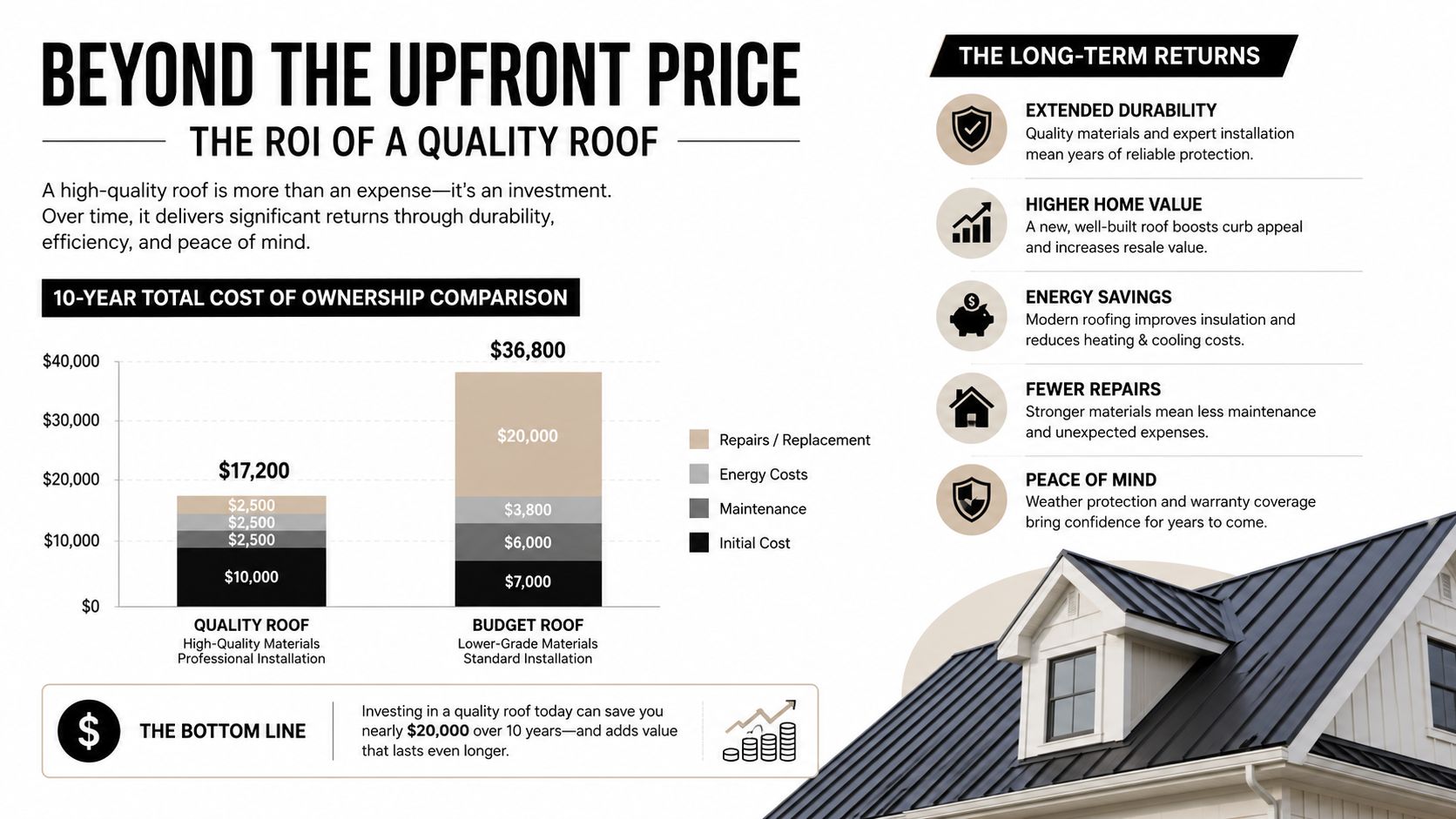
Beyond the Upfront Price The ROI of a Quality Roof
A quality commercial roof pays back differently than many building upgrades. It doesn't always show its value in one obvious line item. It shows up in fewer shutdowns, fewer call-outs, better weather performance, and a cleaner compliance position.
Cheap pricing often shifts cost forward
The lowest upfront price can still become the most expensive decision if it leaves drainage defects, uses a poor-fit system, or skips critical remediation. On commercial sites, owners often pay for that later through repeat leak repairs, tenant complaints, stock risk, interior damage, and disruption to operations.
A better way to assess prices for a new roof is to compare lifecycle burden, not just installation cost. Ask which option is more likely to stay dry, remain compliant, and reduce reactive maintenance.
What long-term value actually looks like
A useful internal comparison is simple:
| Option | Upfront view | Likely long-term pattern |
|---|---|---|
| Budget replacement | Lower initial approval barrier | More pressure on maintenance, patching, and defect management |
| Fully detailed compliant replacement | Higher capital spend at the start | Better asset protection and more predictable ownership costs |
This isn't about buying the most expensive roof available. It's about paying for the right scope once. In practice, owners get the best return when the project matches the building's use, exposure, traffic level, and expected hold period.
A roof that stops emergency spending is often the one that looked expensive during tender.
New Roof Price Questions from Strata Managers and Developers
How do strata managers reduce disruption during replacement
Stage the works carefully and insist on a tenant communication plan before the project starts. Access routes, noisy work windows, parking impacts, and weather contingencies should be documented early. On residential strata, the best-run jobs are the ones where residents know exactly what will happen and when.
Should warehouse owners care about roof specification beyond leaks
Yes. The roof affects operations, maintenance planning, and insurer confidence in the asset. A replacement that improves detailing, drainage, and durability is usually easier to manage than one that only solves the immediate leak point.
Can developers rely on a square metre rate alone
Not for procurement. Early feasibility can start there, but final budgets need project-specific review of design, access, structural condition, and compliance obligations. A roof that looks simple on drawings can become expensive once staging, safety, and drainage details are priced properly.
What's the biggest mistake when comparing prices for a new roof
Treating all quotes as if they cover the same work. They often don't. One may include compliant removal, detailed flashings, gutter replacement, and access protection. Another may price only the visible roof surface and leave the rest as exclusions.
When is the cheapest quote acceptable
Only when it's also the clearest, the most complete, and the most appropriate for the building. Low price on its own isn't a buying signal. In commercial roofing, it's often a cue to read the exclusions more carefully.
If you're planning a replacement and need a clear commercial scope rather than a vague ballpark, Commercial Roofers can inspect the site, explain the key cost drivers, and provide a transparent proposal for Sydney and NSW commercial properties.